- The paper presents a novel target-adaptive text-tabular framework for predicting AI decisions based on limited interaction data.
- It leverages an observer-augmented approach by incorporating LLM hidden states alongside structured game-state and dialogue features.
- Experimental results show improved predictive performance, with notable gains in AUC for response prediction and reduced proposal error.
Predicting Unfamiliar AI Agent Decisions: Target-Adaptive Text-Tabular Modeling
The paper "Predicting Decisions of AI Agents from Limited Interaction through Text-Tabular Modeling" (2605.12411) addresses the challenge of forecasting decisions made by unfamiliar AI agents, particularly in language-mediated bargaining and negotiation contexts. The impetus arises from real-world scenarios where agents transact via natural language, yet the underlying LLM, prompt engineering, and procedural logic governing counterpart agents are opaque. The task is to predict the agent’s next decision having only a limited set (K) of prior observed games, with each decision potentially carrying monetary stakes. Unlike much prior work leveraging population-level behavioral statistics, the focus here is individualized prediction—requiring adaptation from limited exemplars, not access to the agent’s internals.
Controlled Game Setting and Dataset Design
Recognizing the inadequacy of public marketplace logs for systematic analysis, the authors instantiate the prediction task within GLEE, a language-based economic game simulation platform. Two game families—bargaining and negotiation—are utilized, both exhibiting multi-turn, free-text dialogue and payoffs informed by private valuations and structured incentives.
Training is performed on a 13-agent round-robin tournament (GLEE) featuring frontier LLMs of varying architectures and providers, offering labeled exemplars for source-population regularities. Evaluation is conducted on a novel 91-agent university hackathon dataset, where agents share an underlying LLM but diverge in prompting strategies and scaffolding (control logic, rule-based fallbacks). This cross-population design tests the transferability of prediction models across axes of agent variation.
Modeling Approach: Text-Tabular Representation and LLM-as-Observer
Each decision point is encoded as a multimodal tabular row comprising three modalities:
- Structured game-state features: Encapsulate strategic configuration, current and previous offers, round index, and public parameters.
- Dialogue representation: Leverages sentence encoders to capture the semantics of free-text negotiation.
- LLM-as-Observer hidden state: Deploys a small, frozen LLM to read the decision-time state and dialogue. Rather than utilizing its output, the internal hidden state is extracted and supplied to the predictor, functioning as a decision-oriented encoding.
Unlike the direct LLM-as-Predictor baseline—which prompts a large API-based model with the current game and K adaptation exemplars—the tabular model can aggregate population-level evidence with target-specific adaptation, harnessing reusable LLM representations rather than committing to direct answers.

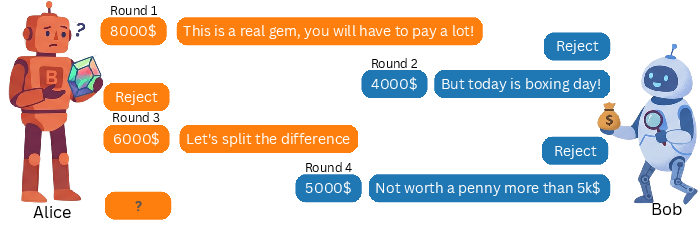
Figure 1: Three approaches for predicting decisions: (A) LLM-as-Predictor with in-context prompt, (B) text-tabular feature row, and (C) Observer-augmented row combining hidden LLM state.
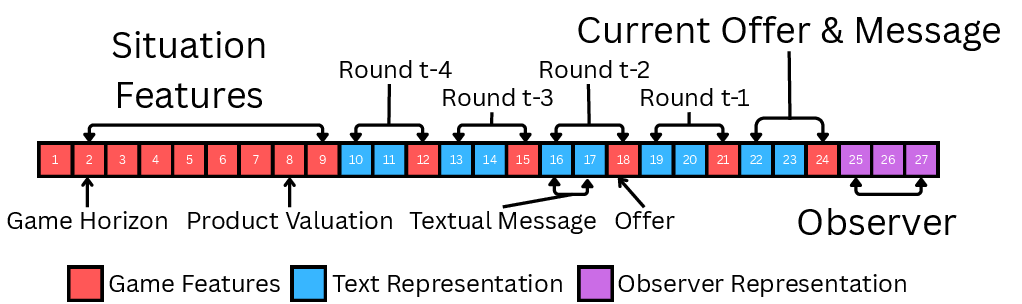
Figure 2: Multimodal tabular row at a decision point, concatenating structured features, dialogue embedding, and Observer LLM hidden state.
Experimental Protocol and Baseline Comparisons
Cross-population transfer is executed by training on frontier LLM agents and testing on scaffolded hackathon agents, with adaptation exemplars K∈{0,2,4,8,16}. Two tasks are evaluated:
- Response prediction (binary classification): Will the agent accept the current offer?
- Proposal prediction (regression): What offer will the agent make next?
Performance is measured via AUC (response) and R2 (proposal), using TabPFN with game+text features as a baseline.
Numerical Results and Ablation Analyses
Results indicate that observer-augmented models considerably outperform both direct LLM prompting and the game+text features baseline:
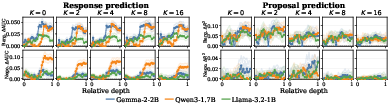
Feature ablation confirms a clear hierarchy: game-state features are indispensable, Observer hidden states are critical for nuanced prediction, and generic sentence embeddings become largely redundant upon integration of Observer representations. Critically, the hidden-state representation is consistently superior to direct output logits, regardless of provider (Google, Alibaba, Meta).
Theoretical and Practical Implications
The findings imply that the forecasting of unfamiliar agent decisions is better framed as target-adaptive text-tabular prediction than direct few-shot prompting. Tabular modeling enables simultaneous leveraging of population-level behavioral priors and target adaptation, while frozen LLM representations expose latent, decision-relevant signals unavailable via direct output. This architectural separation—representation via LLM, adaptation via supervised learning—aligns with transfer learning and probing literature, with robustness across agent types and tasks.
Practically, the approach enhances interpretability and calibration in settings where agents may be engineered, adversarial, or strategically heterogeneous, offering a viable framework for deployment-like scenarios in commercial negotiation, mechanism design, and automated contract management.
Future Directions
Future developments may entail:
Conclusion
The paper demonstrates that decision prediction for unfamiliar, language-based agents is markedly improved by a target-adaptive text-tabular modeling framework augmented with hidden LLM representations. Observer-derived encodings capture strategic signals that direct outputs and game history cannot, yielding stronger predictive performance and robustness in cross-population transfer. The approach constitutes a principled method for extrapolative modeling of agent decisions, with substantive implications for multi-agent AI, economic negotiation, and adaptive commerce systems.