- The paper introduces FAMeX, a graph-theoretic XAI algorithm that integrates feature relevance via mutual information with feature redundancy via Pearson correlations.
- It demonstrates superior performance by achieving higher classification accuracy on SVM, RF, DT, and NB compared to benchmarks like PFI and SHAP.
- Its GUI tool enables real-time feature importance exploration, offering actionable insights for feature selection in high-dimensional datasets.
Feature Association Map-based Explainability: A Graph-Theoretic XAI Paradigm
Motivation and Background
The opacity inherent in complex AI models such as ensemble methods and deep networks impedes their adoption in high-stakes domains that require transparency and accountability. Traditional XAI approaches, like Permutation Feature Importance (PFI) and SHapley Additive exPlanations (SHAP), offer feature relevance quantification but often overlook the joint modeling of relevance and redundancy among features. This paper introduces FAMeX, a graph-theoretic explainability algorithm that systematically quantifies feature importance by explicitly incorporating both relevance and redundancy, operationalizing these via the Feature Association Map (FAM).
Conceptual Framework
FAMeX leverages two information-theoretic constructs: feature relevance (measured via Mutual Information (MI) with the target, capturing dependency) and feature redundancy (represented as pairwise Pearson correlations, encoding linear associations). Feature nodes within the FAM are graded based on redundancy:
- Grade 1 (low redundancy): correlation < 0.67 with all others.
- Grade 2 (moderate redundancy): correlation > 0.67 but < 0.9 with one or two features.
- Grade 3 (high redundancy): correlation > 0.9 with ≥1 feature or >0.67 with ≥3 features.
A feature's similarity score is inversely proportional to its grade relative to the average similarity. These scores are used to construct the FAM, where vertices represent features, and edges encode similarity.
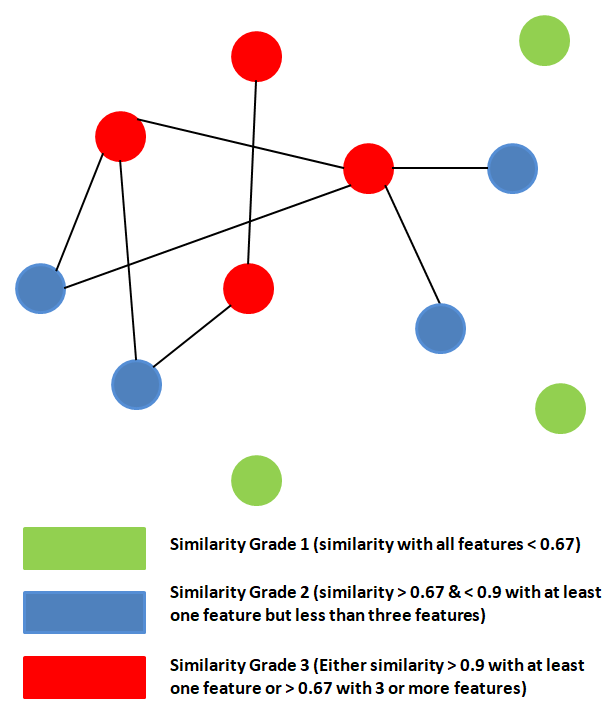
Figure 1: FAMeX Feature Graph illustrating the association structure and grading of feature redundancy within the dataset.
The importance score for each feature integrates normalized relevance and normalized similarity (Equation 11), ensuring that high relevance with low redundancy results in maximal importance.
Methodology and Algorithmic Implementation
The FAMeX algorithm operates in quadratic time complexity with respect to the number of features (O(n2)), primarily due to the calculation of the feature association matrix. The operational steps are:
- Construct pairwise correlation matrix and apply graded thresholds to determine feature similarity grades.
- Build the FAM, assign colors/grades to feature nodes based on redundancy level.
- Compute similarity and relevance scores for each feature as defined.
- Calculate feature importance as Feature Importance=Similarity ScoreRelevance Score.
- Rank features and extract subsets (top, bottom) for downstream evaluation.
These steps are integrated, and the algorithm is implemented in Python, with a public GUI-based tool for practical deployment.
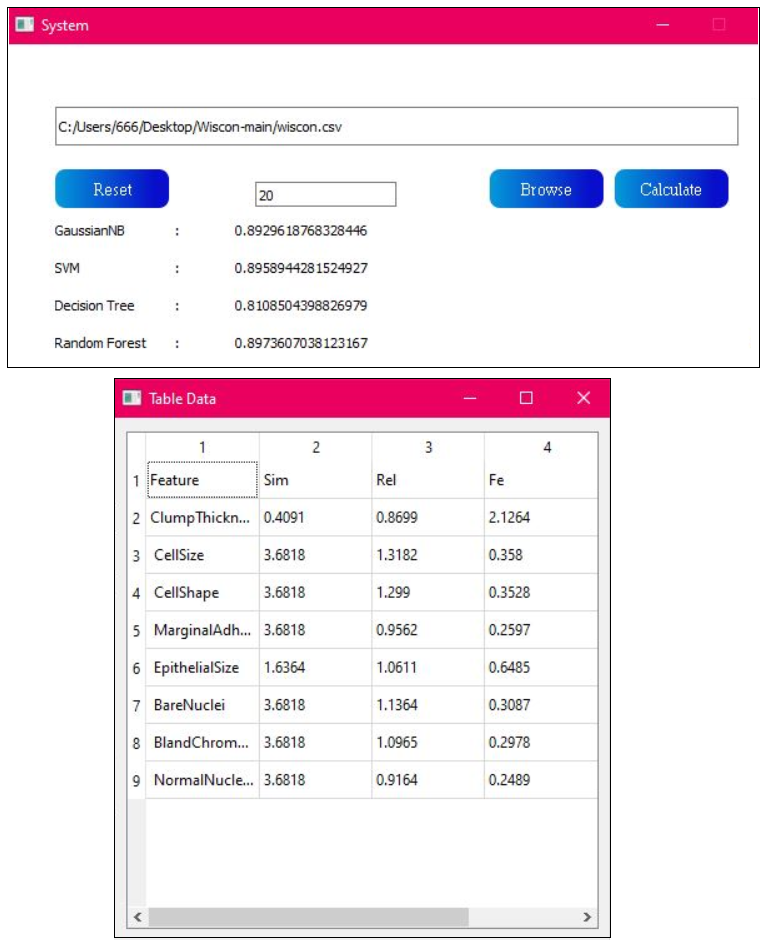
Figure 2: FAMeX Feature Detector Tool enables interactive exploration of feature scores and classification accuracies.
Experimental Results and Comparative Analysis
FAMeX was evaluated across eight UCI datasets, spanning diverse domains, using four classifiers: SVM, Random Forest (RF), Decision Tree (DT), and Naive Bayes (NB). The evaluation metric is the classification accuracy achieved by subsets of features ranked highest or lowest by each XAI technique. Notably, the paper provides extensive comparative accuracy metrics.
- On SVM, FAMeX top 30% features yield average accuracy of 77.03%, PFI 72.35%, SHAP 73.53%.
- On RF, FAMeX achieves 80.16%, PFI 71.47%, SHAP 71.82%.
- On NB, FAMeX reaches 76.88%, PFI 65.10%, SHAP 71.3%.
- On DT, FAMeX attains 78.03%, PFI 75.11%, SHAP 70.41%.
Across all classifiers, FAMeX consistently produces higher accuracy using top features and demonstrates significantly larger accuracy gaps between top and bottom ranked features, establishing its reliability for feature subset selection.
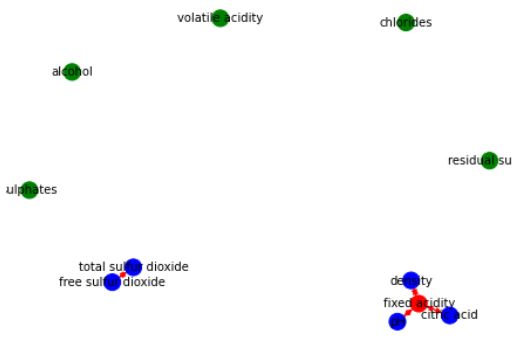
Figure 3: Association Map for WineQuality dataset, showcasing feature grading according to redundancy and information contribution.
Such results suggest FAMeX's capacity to produce physically meaningful feature rankings that align strongly with classifier performance. An additional observation is that for competing algorithms (PFI, SHAP), in several instances, feature rankings distributions lead to lower accuracy using top features compared to the bottom, indicating inconsistent feature selection logic.
Practical and Theoretical Implications
By merging feature relevance and redundancy in a unified, visual graph framework, FAMeX addresses critical gaps in XAI. This dual modeling enables robust identification of influential features for prediction, aids in data-driven feature selection, and delivers actionable explanations to practitioners. The methodology is particularly suited to domains with high dimensionality and multicollinearity, where conventional importance metrics falter.
The tool’s GUI facilitates real-time exploration and deployment in operational settings, further democratizing access to advanced XAI methodologies. Its modularity and generality permit extension to more sophisticated models and greater dimensionality, including latent-feature spaces.
Future Directions
Potential research avenues include:
- Application of FAMeX on larger, more complex datasets, e.g., biomedical imaging, genomics, text classification.
- Comparative analysis with recent neural XAI methods (e.g., integrated gradients, layer-wise relevance propagation).
- Extending graph-theoretic modeling to include non-linear, higher-order association metrics.
- Adapting FAMeX for unsupervised and semi-supervised learning paradigms.
- Integration within automated machine learning (AutoML) pipelines for interpretability.
Conclusion
FAMeX presents a novel, graph-theoretic XAI algorithm that demonstrably outperforms benchmark importance techniques (PFI, SHAP) in empirical classification tasks by robustly modeling both feature relevance and redundancy. Its consistent alignment of feature scores with classifier accuracy underscores its utility for actionable model interpretation and feature selection (2605.12350). The approach is extensible and its practical implementation advances the state-of-the-art in interpretable AI for both academic and industrial contexts.