- The paper introduces MASEM, which employs entropy maximization to uniformly sample constrained manifolds, even when disconnected.
- It combines penalty-based Gauss–Newton initialization, feasibility-preserving local mixing, and k-NN density estimation to achieve global mass allocation.
- Empirical and theoretical results show exponential KL divergence contraction and significant performance gains over conventional sampling methods in robotics and high-dimensional settings.
Manifold Sampling via Entropy Maximization (MASEM): A Technical Overview
Motivation and Problem Setting
Sampling uniformly from implicitly defined, constrained manifolds is a crucial requirement in diverse domains such as Bayesian inference, robotic motion planning, and molecular design. While classical constrained MCMC approaches guarantee feasibility and local mixing, they fundamentally rely on local transition kernels. This locality assumption precludes correct probability mass allocation across disconnected components, which is common in real-world problems due to the nonconvexity and complex structure of constraints. Addressing this limitation, the paper introduces Manifold Sampling via Entropy Maximization (MASEM) (2605.12338), a scalable, modular framework for uniform sampling on arbitrary constrained manifolds, regardless of the connectivity of the feasible set.
Methodology
MASEM targets the maximization of the empirical entropy of samples over the feasible manifold, thereby promoting uniform mass allocation even across disconnected components—without requiring explicit knowledge of their number, topology, or volumes.
The key steps of the MASEM algorithm are:
- Initialization: Randomly sample points in the ambient space, followed by projection onto the constraint manifold via penalty-based Gauss–Newton minimization, ensuring initial component coverage with high probability as N→∞.
- Local Mixing: Apply a feasibility-preserving local kernel (e.g., NHR, OLLA) for intra-component mixing, assuming rapid within-component equilibration.
- Entropy-based Resampling:
- Estimate local sample density using k-nearest neighbor (k-NN) statistics adapted to the intrinsic manifold dimension.
- Assign each sample an importance weight inversely proportional to its local estimated density (i.e., proportional to its k-NN radius raised to a temperature parameter τ).
- Resample according to these weights, redistributing samples toward underrepresented components, maximizing entropy.
This resampling is modular: it can be inserted into any feasible local sampler with minimal adjustments, yielding uniform coverage over disconnected components.
Theoretical Results
The analysis proceeds in the mean-field limit, reducing the stochastic particle system to a deterministic dynamical system on the simplex of component weights. The crucial theoretical result is the exponential contraction of KL divergence to the target uniform distribution under successive entropy-based resampling operations.
Given τ the temperature parameter and p the manifold's intrinsic dimension, after t iterations, the expected KL divergence satisfies
DKL(pαt∥uΣ)≤C0(1−τ/p)2t,
where C0 depends logarithmically on the number of samples and the initial misallocation of mass.
This establishes that MASEM contracts the KL divergence towards the uniform measure at a geometric rate. The probability of failing to populate a component decays exponentially in the number of chains per component, as rigorously quantified and supported by empirical studies (see Figure 1).
Empirical Evaluation
Synthetic Benchmarks
MASEM is benchmarked against contemporary local samplers—NHR, OLLA—and global methods, including SCMC and explicit clustering. The evaluation involves low-dimensional synthetic manifolds (e.g., multi-disk, sine curve, Swiss roll) both in connected and disconnected settings.
Standard local samplers systematically fail to allocate mass proportionally across disconnected components, often underrepresenting larger-volume regions and failing to assign mass to isolated modes.
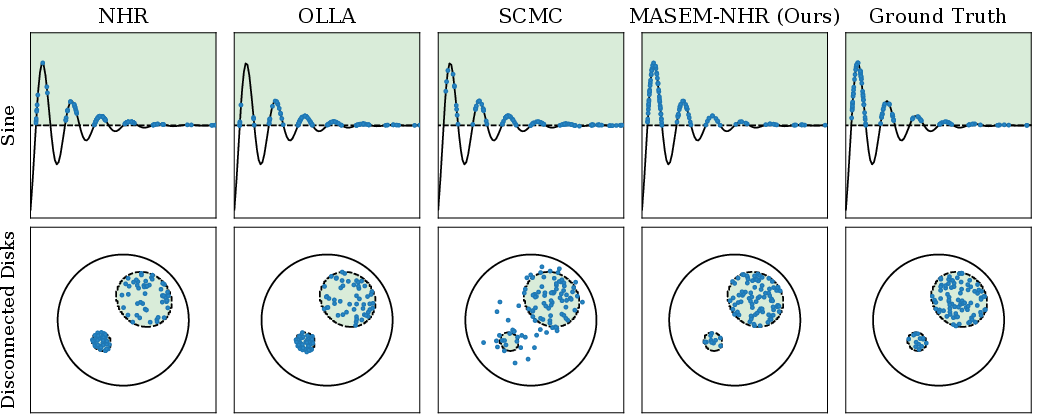
Figure 2: Empirical sample distributions for classical and MASEM-augmented samplers on synthetic benchmarks; base methods fail to assign correct mass, while MASEM achieves uniformity across all components.
Quantitative metrics—Sinkhorn distance, pairwise KL divergence, and constraint violation—demonstrate that MASEM-augmented samplers outperform all baselines by up to an order of magnitude on disconnected settings. Notably, MASEM does not degrade performance in the connected (trivial) case.
High-dimensional Scaling
MASEM's robustness is assessed via stress tests involving scaling both the ambient and intrinsic manifold dimensions, as well as the number of constraints and disconnected components. Sampling error remains stable with increasing ambient dimension if the manifold dimension is held constant, suggesting that the intrinsic dimensionality is the dominant factor.

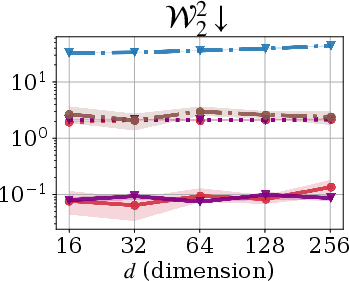
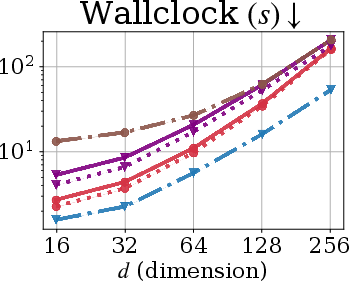
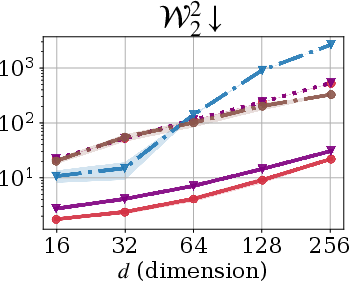
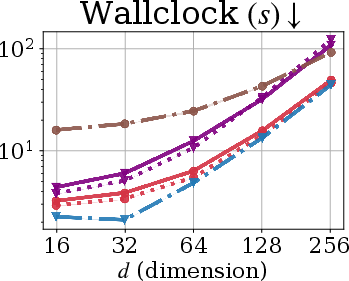
Figure 3: Scaling performance as ambient and manifold dimensions increase with fixed constraint count; MASEM maintains lower Sinkhorn distances compared to alternatives.
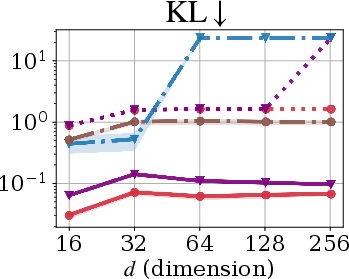
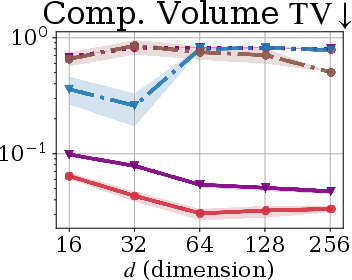
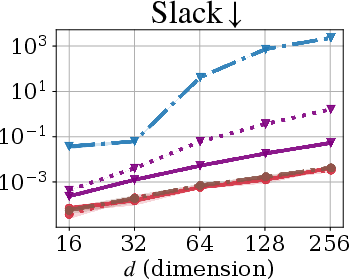
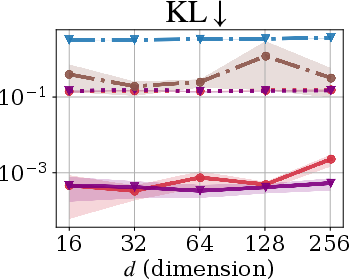
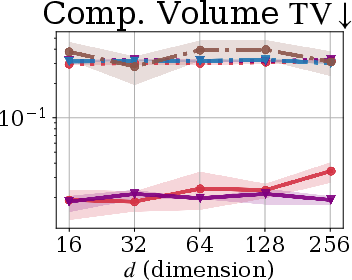
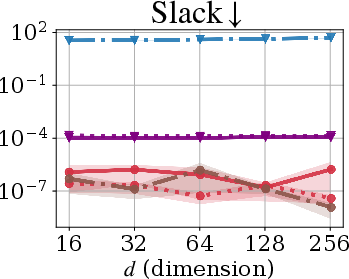
Figure 4: Benchmarking against alternative/global samplers as manifold and ambient dimension scale; MASEM maintains order-of-magnitude improvements.
Robotics Applications
Practical relevance is validated through motion planning and grasp optimization tasks. In high-constraint scenarios (trajectory parameterization with hundreds of constraints, grasping with nonconvex contact constraints), MASEM dramatically improves the entropy and coverage of feasible trajectories and grasps.
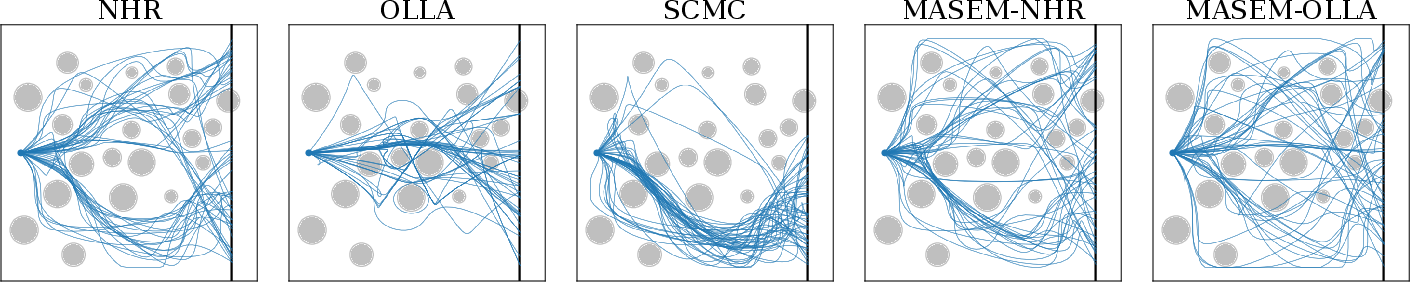
Figure 5: Comparison of sampled motion planning trajectories with random obstacles, highlighting MASEM’s superior component coverage and entropy.
MASEM also enables coverage of narrow passages and rare events in trajectory generation tasks, supporting applications requiring diverse solution sets for robust robot policy initialization and behavior cloning.
Convergence Metrics
Comprehensive convergence diagnostics on all tasks confirm the theoretical exponential decay in divergence and indicate that high sample quality is maintained throughout the optimization.
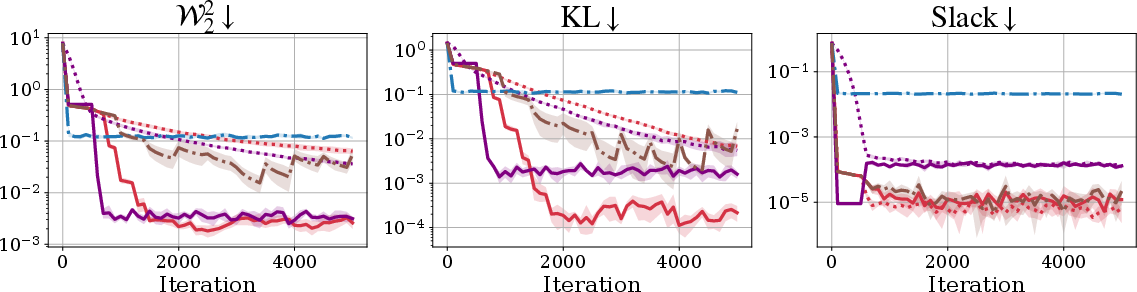
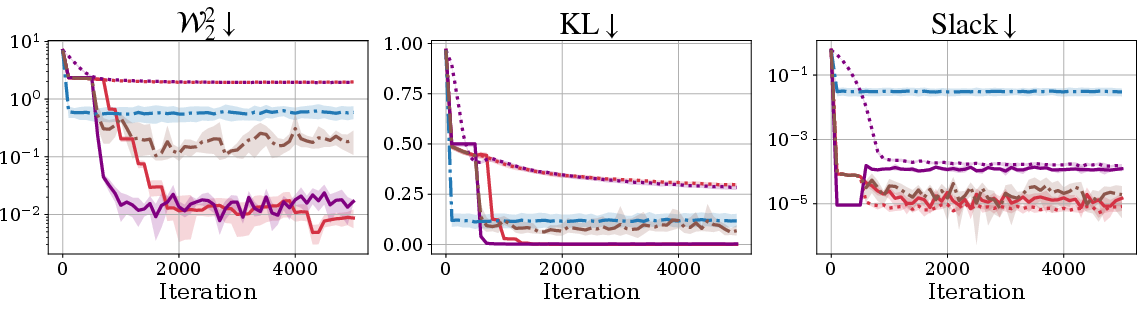
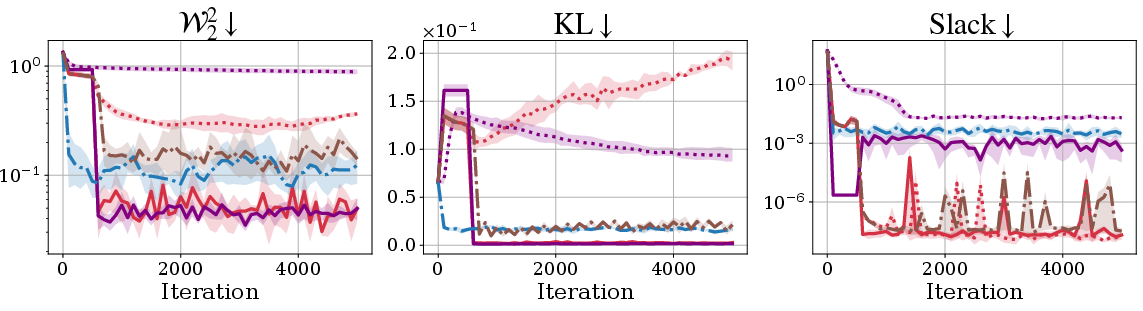
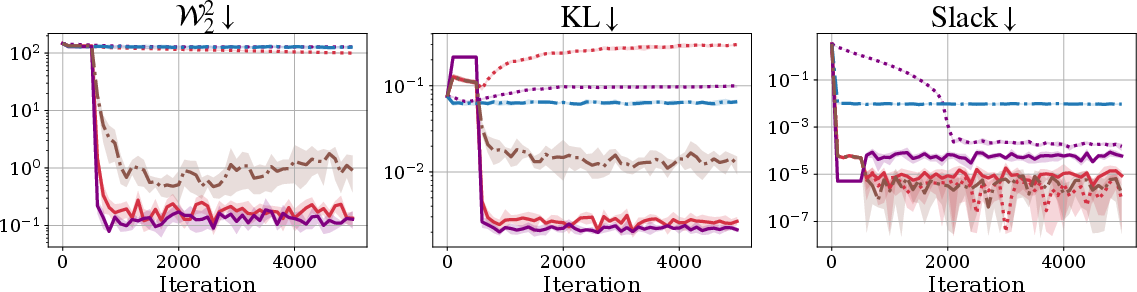
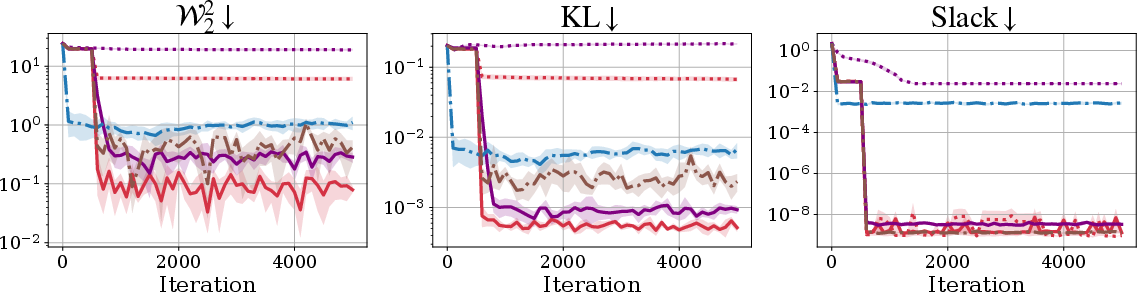
Figure 6: Convergence curves for Sinkhorn distance, pairwise distance KL divergence, and mean constraint violation, demonstrating rapid mass redistribution and feasibility.
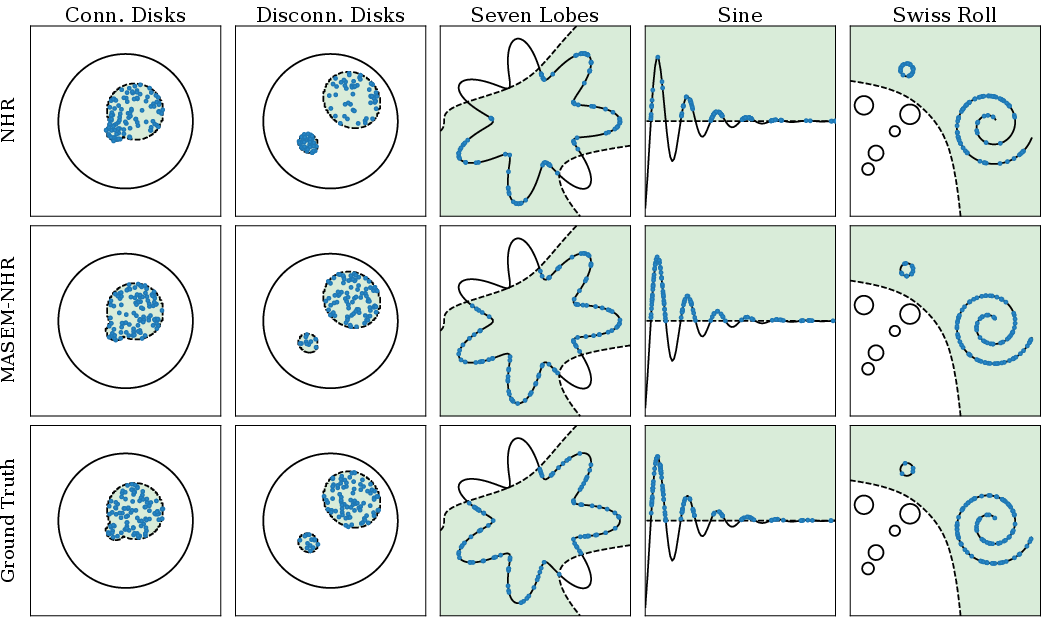
Figure 7: Qualitative sample distributions for NHR and MASEM-NHR on various manifolds with disconnected/curved structure; MASEM ensures proper coverage.
Component Loss Analysis
Robustness to component loss is analyzed, showing that even with a moderate number of chains per component (k0), the probability of failing to represent any mode is negligible for practical entropy scaling parameters k1.
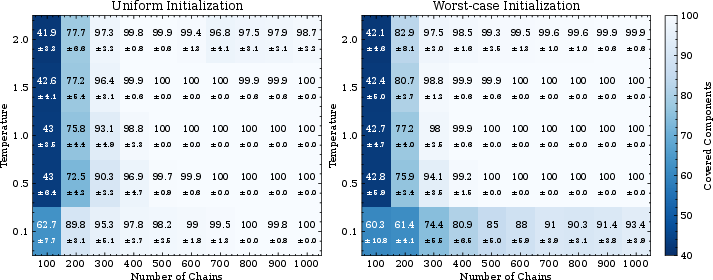
Figure 1: Component coverage as a function of k2 and number of chains, highlighting negligible component loss above four chains per component.
Practical Implications and Limitations
Practical implications include:
- MASEM significantly increases sample diversity, supporting initialization and exploration strategies in high-dimensional, constrained optimization and RL tasks requiring unbiased coverage.
- The modular resampling step generalizes to any feasible local sampler, enhancing their utility in multi-component and multimodal settings.
- The lightweight design incurs minimal runtime overhead (k3 per resampling) and is robust to hyperparameter choices, as demonstrated empirically.
Limitations noted in the analysis:
- The approach in its present form targets uniform distributions; extension to non-uniform targets is possible but outside the current scope.
- The optimal choice of the temperature parameter k4 requires knowledge of the intrinsic manifold dimension, which is not always directly available.
- Theoretical results are predicated on the large-particle (mean-field) regime and near-perfect within-component mixing.
Theoretical and Methodological Implications
MASEM establishes a new paradigm for constrained sampling by leveraging entropy maximization and k5-NN-based density estimation within an SMC-inspired framework. The interplay between density estimation on manifolds and particle-based resampling is central, enabling the resolution of the local-to-global allocation problem that impedes all previous local approaches. The theoretical framework—based on geometric contraction of KL divergence under resampling—provides a blueprint for future generalizations, including non-uniform targets and adaptive resampling schedules.
Future Directions
Key avenues include:
- Extension to non-uniform target measures for posterior inference and importance sampling.
- Adaptive or automated selection of manifold dimension and temperature hyperparameters.
- Integration with learned local kernels and application-specific transformations (e.g., in robotic manipulation, chemical design).
- Investigation of theoretical guarantees under imperfect mixing and finite-k6 settings.
Conclusion
MASEM provides a theoretically grounded, empirically robust solution to uniform sampling on implicitly defined, disconnected manifolds. By augmenting local feasible kernels with entropy-driven resampling, it rapidly and reliably achieves global mass allocation, laying the groundwork for more general constrained sampling strategies and facilitating complex applications in robotics and machine learning.