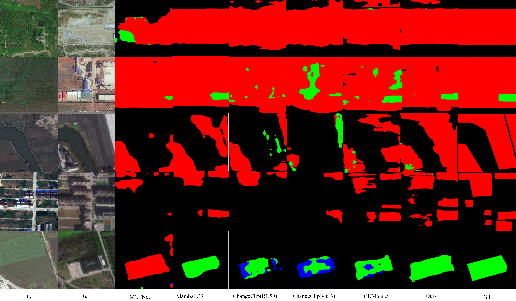
- The paper's main contribution is the integration of a lightweight, change-aware model with a frozen vision-language module for precise farmland semantic change detection.
- It introduces the HZNU-FCD benchmark with 4,588 annotated bitemporal patch pairs, enabling detailed 'from-to' transition analysis.
- Extensive experiments demonstrate state-of-the-art performance with robust pseudo-change suppression and efficient inference.
Large-Small Model Collaboration for Farmland Semantic Change Detection: Technical Analysis
Introduction
The accurate monitoring of farmland conversion is imperative for food security and ecological management. Traditional binary change detection (BCD) approaches fail to capture detailed semantic transitions required for land law enforcement—such as distinguishing farmland-to-building or farmland-to-water conversions—and suffer from pseudo-change interference caused by phenological factors. "Large-Small Model Collaboration for Farmland Semantic Change Detection" (2605.12282) directly addresses these limitations by introducing both a novel, fine-grained benchmark (HZNU-FCD) and a collaborative detection architecture fusing a lightweight difference-aware Mamba model with a frozen large vision-LLM for robust, efficient, fine-grained semantic change detection (SCD).
HZNU-FCD: Fine-Grained Farmland SCD Benchmark
The HZNU-FCD dataset fills a critical gap by providing 4,588 bitemporal patch pairs (256×256px) from both UAV and satellite sources, annotated with pixel-level "from-to" labels across five farmland-to-non-farmland category transitions (road, building, bareland, vegetation, water), in addition to "no change". Annotations were produced via a dedicated, multi-stage workflow to address challenges such as strong phenology-induced visual pseudo-changes and subtle semantic ambiguities at parcel boundaries.
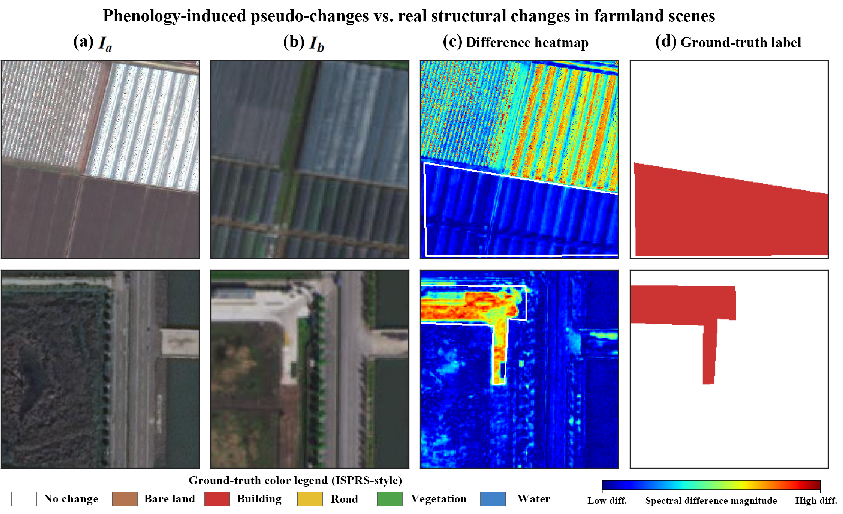
Figure 1: Phenology-induced pseudo-changes visualized in HZNU-FCD—top row shows strong spectral shifts in unchanged farmland due to seasonal variation, while bottom row illustrates genuine conversion with precise boundary.
HZNU-FCD's dual-source design enhances cross-sensor generalization while its strict "from-to" annotation protocol enables clear benchmarking for category-specific SCD performance.
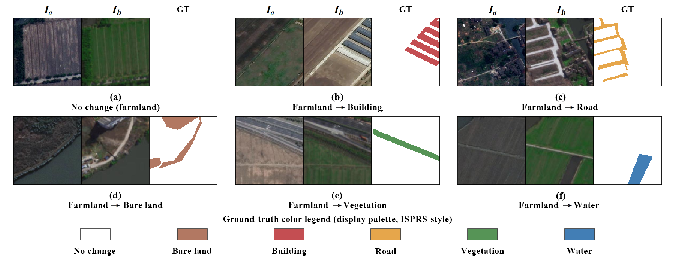
Figure 2: Representative bitemporal image pairs and ground-truth “from-to” semantic labels for all six HZNU-FCD categories.
Large-Small Collaborative Framework: Overview
The proposed detection framework innovatively marries a task-driven, small visual model (Fine-grained Difference-aware Mamba, FD-Mamba) with a CLIP-based Cross-modal Logical Arbitration (CMLA) semantic module. The small model excels at extracting compact, boundary-preserving, and change-aware features, while the large, frozen vision-LLM provides category-level semantic verification via prompt conditioning, suppressing pseudo-changes unresolved by visual signals alone. The architecture is unified through a hard-region co-training regime, where CMLA is supervised only on ambiguous (low-confidence) pixels, concentrating semantic arbitration capacity where it is most needed.
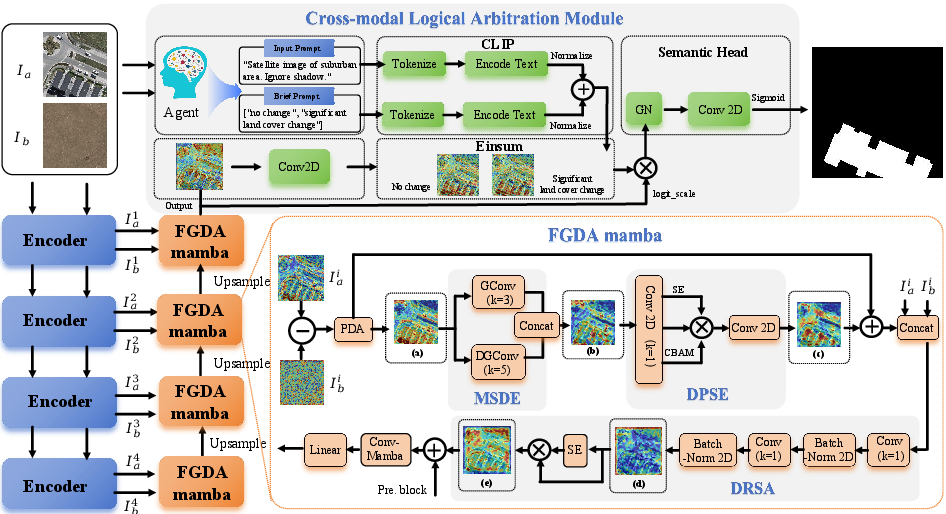
Figure 3: Schematic of the large-small collaborative network: FD-Mamba performs bitemporal feature refinements, while CMLA injects CLIP-derived priors; semantic gates modulate predictions, boosting robustness to pseudo-changes.
FD-Mamba: Visual Change Representation Backbone
FD-Mamba is architected as a fully Mamba-based encoder–decoder pipeline specialized for dense, fine-grained change detection:
- SRCM-Mamba Encoder: Encodes hierarchical spatial and contextual features from bitemporal images, preserving elongated parcel boundaries.
- FGDA-Mamba Decoder: Incrementally refines difference features through sequential modules—Physical Difference Anchor (PDA), Multi-scale Spatial Difference Excavation (MSDE), Dual-Path Difference Purification and Saliency Enhancement (DPSE), Dimensionality Reduction and Redundancy Suppression Aggregation (DRSA), and a Conv-Mamba unit for global context modeling.
- Effectiveness: Ablation demonstrates that DPSE delivers the largest performance gain, confirming the central role of spatial–channel recalibration in suppressing phenology-driven false activations.
CLIP-based CMLA: Semantic Arbitration Pathway
CMLA introduces frozen CLIP text encodings as priors for all relevant semantic categories via "Brief Prompts" (e.g., "farmland change to building") and adapts them to batch context using "Input Prompts" that enumerate scene and nuisance descriptors. Pixel-wise vision–language matching between FD-Mamba features (projected into CLIP space) and these prototypes yields semantic logits, further transformed into a gating mechanism that modulates visual predictions. Hard-region supervision directs CMLA’s auxiliary loss exclusively to low-confidence, ambiguous pixels—optimizing semantic consistency where direct visual discrimination is inadequate.
The proposed method achieves state-of-the-art performance across SCD and BCD tasks with orders-of-magnitude fewer parameters compared to multimodal baselines:
Ablations reveal that CMLA’s semantic gating effectively reduces shadow/illumination-induced false positives and enhances fine-grained class differentiation, especially between spectrally similar "from-to" transitions (e.g., bareland vs. road).
Theoretical and Practical Implications
This research establishes several important implications for the AI and remote sensing communities:
- Dataset Standardization: HZNU-FCD sets a new standard for high-fidelity, cross-source SCD annotation, directly supporting legal and policy applications in land management.
- Model Architecture: Demonstrates that a collaborative paradigm—where a small, efficient model handles localization and boundary recovery, while a frozen, large vision-LLM supplies semantic arbitration via prompts—can exceed the capabilities of monolithic visual or multimodal models.
- Pseudo-change Suppression: Explicit semantic gating using language priors substantially improves robustness to non-structural visual fluctuations, a persistent challenge in cropland monitoring.
From a broader AI perspective, this study generalizes the concept of large-small model collaboration beyond generic image or language tasks, affirming its unique benefits for dense prediction domains where semantic context cannot be reliably recovered from local or even global visual cues alone.
Future Directions
Potential future advances inspired by this work include:
- Extension of the HZNU-FCD protocol to new regions, agronomic scenarios, or open-vocabulary SCD;
- End-to-end finetuning of the vision-language pathway for task-specific adaptation while maintaining parameter efficiency;
- Integration with foundation model-based, cross-modal reasoning engines for real-time, explainable land management diagnostics.
Conclusion
"Large-Small Model Collaboration for Farmland Semantic Change Detection" (2605.12282) presents a rigorously validated framework and benchmark for fine-grained, robust farmland change detection. The collaborative fusion of a lightweight FD-Mamba model and a frozen CLIP-based semantic module yields superior performance, efficient inference, and unmatched resilience to phenology-induced pseudo-changes. This work establishes new methodological and practical baselines for pixel-level, semantically aware change detection in challenging real-world applications.