- The paper introduces a cross-entropy method (CEM) that drastically reduces the number of inferences needed to achieve five-nines reliability in LLM evaluations.
- It reveals that LLM failures concentrate in specific input regions, enabling targeted sampling that offers statistically robust error estimates.
- The approach differentiates models with similar aggregate accuracy, providing actionable insights for improving reliability in safety-critical applications.
Measuring Five-Nines Reliability in LLMs: Sample-Efficient Evaluation on Saturated Benchmarks
Motivation and Problem Statement
As performance on high-profile NLP benchmarks approaches saturation, existing evaluation pipelines provide limited insight into the true reliability of LLMs—particularly in the regime of extremely rare failures. For real-world, safety-critical deployments, quantifying reliability with "five-nines" (99.999%) confidence is imperative, as even a minuscule increase in failure probability can result in catastrophic numbers of total failures at scale. However, precise estimation of such rare events via standard Monte Carlo (MC) evaluation becomes computationally infeasible, given the prohibitive number of inferences required for tight confidence intervals. This work addresses the fundamental gap: enabling sample-efficient and statistically robust estimation of LLM error rates at extreme reliability levels, even in benchmarks where aggregate accuracies appear indistinguishable across models.
Systematic Structure of LLM Failures
The primary insight underlying this work is that LLM failures are not randomly or uniformly distributed in the input space. Instead, errors systematically concentrate on specific regions defined by input parameterizations. Empirical analysis shows that for parameterized tasks (e.g., GSM8K variants), a small subset of parameter values is responsible for the vast majority of failures across multiple models and majority-vote settings. For example, in one case, a single parameter value ("fraction of blue ball = 2/7") accounts for 82% of failures for a model on a given template.



Figure 1: Distribution of failures across parameter values for model–template pairs, indicating systematic concentration relative to chance expectations.
This structure becomes even more pronounced as majority-vote ensemble size (K) increases, filtering out random sampling error and revealing stable failure modes. Quantitative metrics such as total variation distance between failure histograms and uniform distributions confirm the heavy-tailed, concentrated nature of error distributions.
Sample-Efficient Rare-Failure Estimation via CEM
Building upon the empirical finding of systematic failure concentration, the authors propose to address rare-failure estimation using the Cross-Entropy Method (CEM) to learn a proposal distribution Q that preferentially samples from failure-prone subspaces. This turns the reliability estimation problem into a rare-event simulation scenario: rather than exhaustive uniform input sampling (which is inefficient for rare events), CEM iteratively adapts Q to assign higher probability mass to failure-inducing parameter configurations.
This procedure is coupled with importance sampling: after learning Q via CEM, empirical error rate estimation is performed using importance-weighted estimators, yielding unbiased estimates of the true failure rate under the canonical data distribution P.
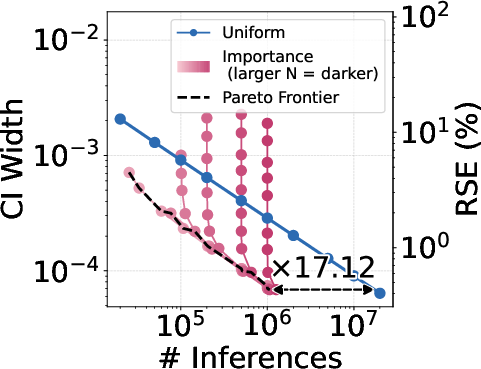
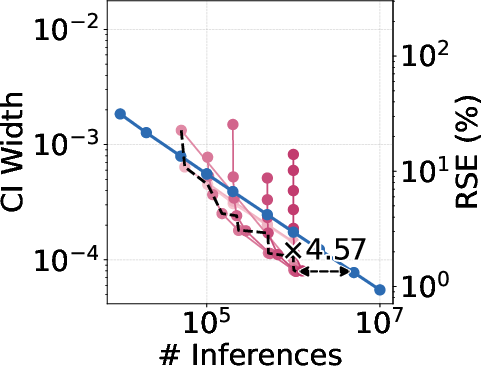
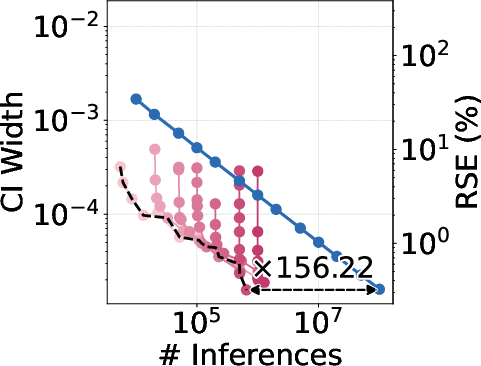
Figure 2: Pareto-frontier of inference cost vs. confidence interval (CI) width for CEM (pink) versus uniform (blue): CEM achieves much tighter intervals with dramatically fewer inferences.
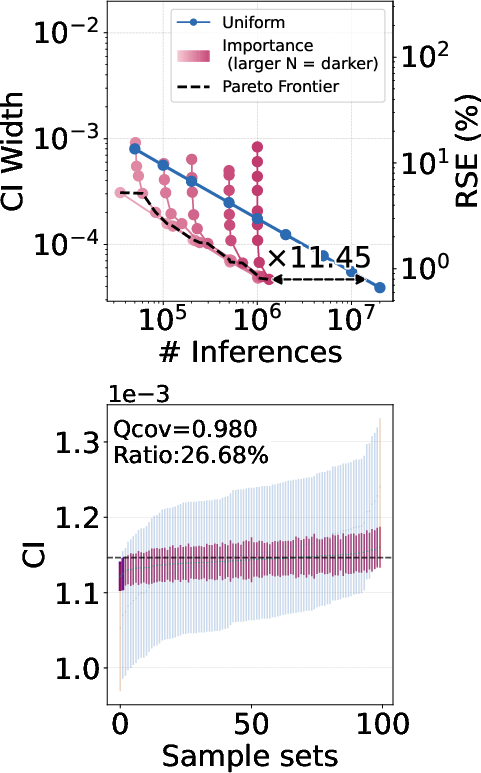
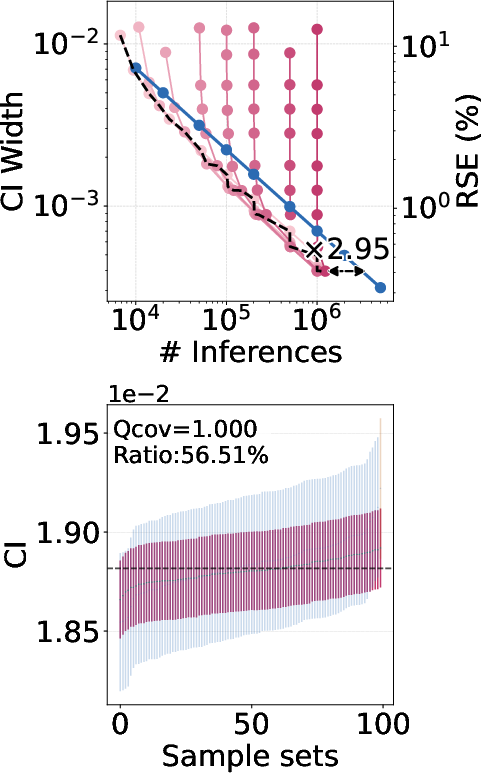
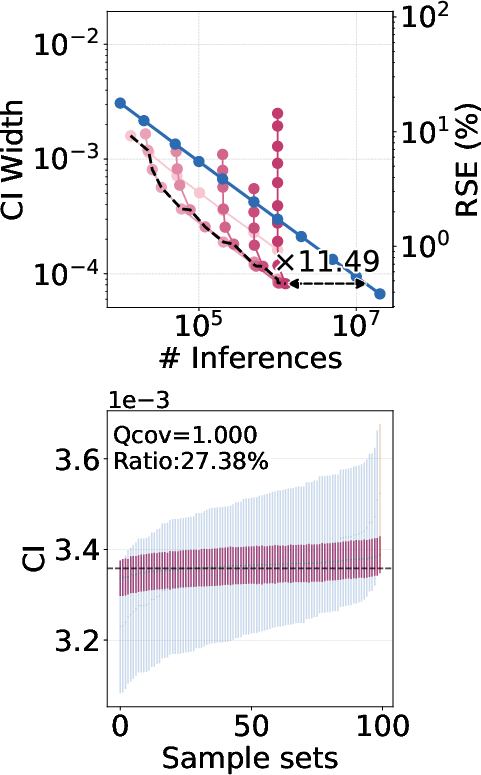
Figure 3: Confidence interval width versus number of inferences, demonstrating consistent efficiency gains via importance sampling with CEM-learned Q, across models and templates.
Algorithmically, Q is parameterized as a fully factorized categorical over the structured parameter template variables, updated with smoothing and defensive sampling to ensure support and stability.
Empirical Results: Inference Efficiency and Reliability Discrimination
Across extensive experiments on parameterized GSM8K templates and three LLMs (Qwen2.5-Math-7B-Instruct, gpt-oss-20b-low, and Gemini 2.5 Flash Lite), this approach yields order-of-magnitude reductions in required inferences to reach fixed confidence bounds (e.g., up to 156.22× fewer inferences for Gemini 2.5 Flash Lite on Template 6, K=16). Sampling efficiency gains are strongly correlated with the concentration of failure patterns and the rarity of failures—both of which increase as models saturate existing benchmarks.
Model-level comparisons show that even among models achieving >99.9% raw accuracy, precise rare-failure estimation reveals substantial differences. For instance, on Template 0 with K=16, gpt-oss-20b-low exhibits a failure rate of Q0, while Qwen2.5-Math-7B-Instruct is at Q1, demonstrating that saturated benchmarks retain discriminatory power in the rare-error regime.
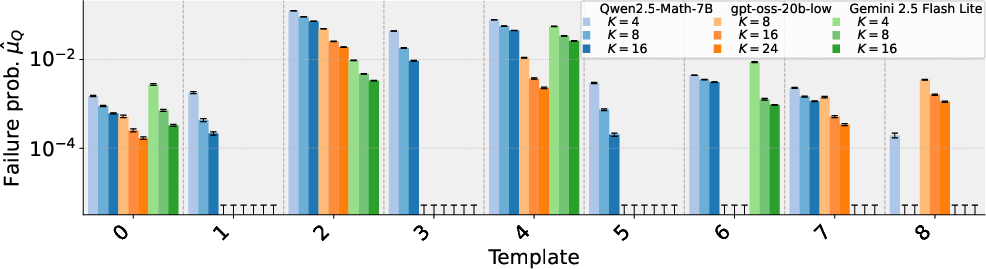
Figure 4: Estimated failure probability Q2 with tight CI bars, illustrating differentiation between models within the ultra-high-accuracy regime.
Additionally, majority voting increases both error concentration and sample efficiency, with TV distance and CEM efficiency gains escalating as Q3 grows.
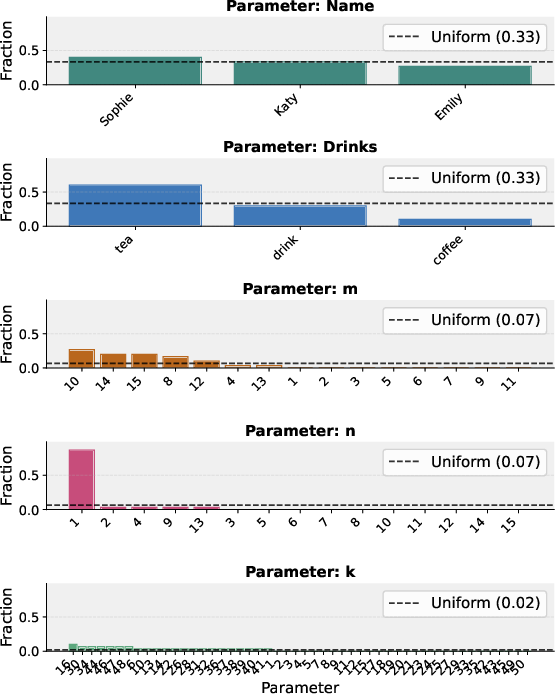
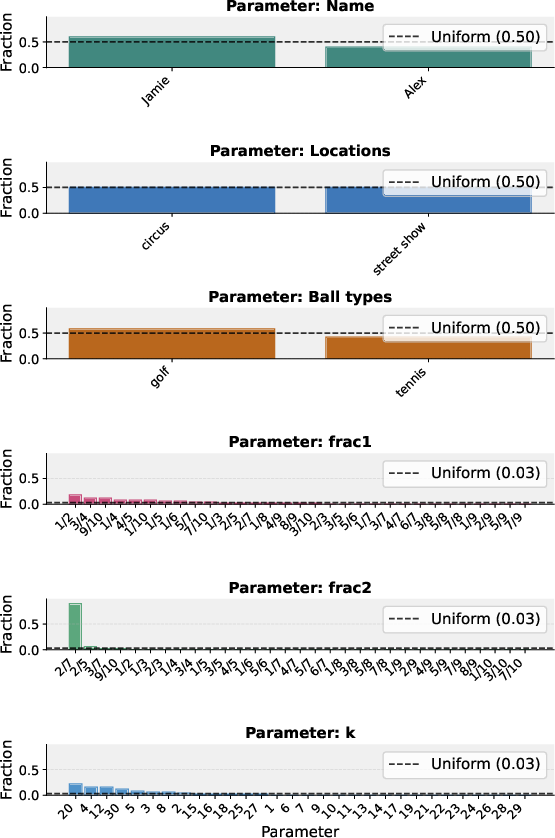
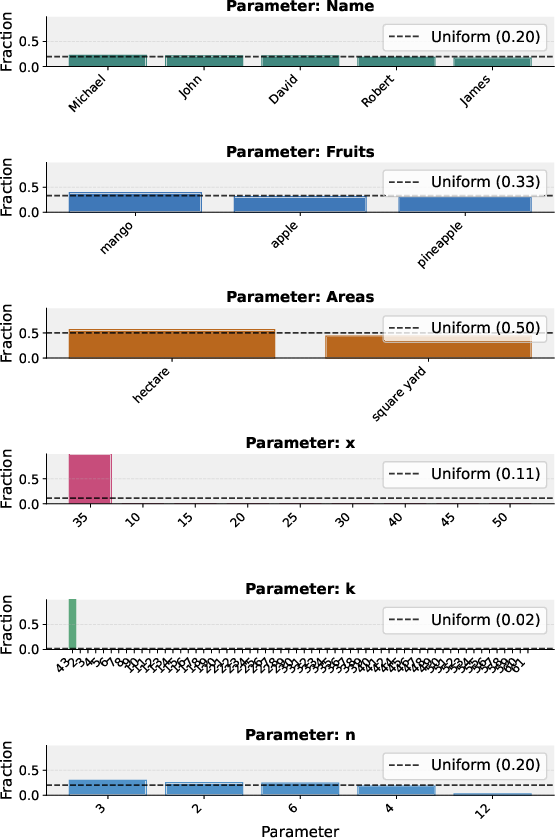
Figure 5: Parameter-wise failure histograms across all variables, highlighting sharp error localization.
Qualitative Error Analysis
Repeated failure induction by specific parameter instantiations is validated by model generations: certain parameter values reliably trigger systematic reasoning flaws or calculation errors, even across multiple independent stochastic runs and under various models. This provides a concrete technical handle for practitioners to identify and potentially "surgically" correct LLM failure cases. Typical observed error modes include recurring arithmetic slips, spurious heuristics (e.g., unjustified unit conversion), and persistent pattern misinterpretations.
Practical and Theoretical Implications
Practically, the demonstrated approach transforms large-scale reliability estimation from a computationally intractable Monte Carlo exercise into a plausible workflow for real-world, mission-critical LLM deployment. It enables rigorous, statistically sound quantification of reliability at five-nines levels on highly-saturated benchmarks. The learned failure-prone distribution also acts as a diagnostic tool: practitioners can extract and prioritize training or evaluation cases most likely to reveal or fix systematic vulnerabilities.
Theoretically, this work underscores the importance of concentration of measure in the LLM error landscape and the corresponding necessity of adaptive, variance-reducing evaluation procedures. It demonstrates that even minor aggregate improvements in rare-event error rates are both measurable and meaningful.
The limitations are clear: for models or tasks where errors are diffusely distributed or for small Q4, CEM may offer limited gains. Extension to larger frontier models and broader task domains (e.g., safety or code generation benchmarks) is a critical next step.
Future Developments and Community Impact
This research advocates for elevating reliability—beyond aggregate accuracy—as a first-class metric in benchmarking and model selection. It anticipates that future AI development, particularly for high-stakes applications (healthcare, legal, safety), will require reliability guarantees validated at this extremely rare event scale.
Furthermore, the failure-prone input identification enabled by this technique could serve as the basis for targeted adversarial training, fine-grained diagnostics, and overall robustification of LLMs at the "last mile" of benchmark performance.
Conclusion
This work provides a scalable, statistically principled solution for rare-failure estimation in LLMs on saturated benchmarks, leveraging systematic structure in the error space via CEM-accelerated importance sampling. As LLMs approach saturating performance on conventional evaluations, such fine-grained reliability measurement is essential for responsible, real-world deployment, fostering the development of models that are not only capable but predictably reliable in the ultra-rare error regime.

