- The paper introduces Clifford ergotropy, defining the maximal extractable work under Clifford restrictions and establishing an ergotropy gap with non-Clifford resources.
- It derives analytical upper bounds using Pauli basis expansions and ties energy extraction limits to magic quantifiers like the stabilizer Rényi entropy.
- It demonstrates that high-magic states severely limit work extraction, embodying a version of the second law for closed quantum systems under Clifford operations.
Motivation and Definitions
The paper probes the intersection of quantum thermodynamics and the theory of quantum magic by introducing "Clifford ergotropy," defined as the maximal extractable energy from a quantum state by restricting the operations to the Clifford group. This extends the classical notion of ergotropy, which quantifies extractable work under all unitaries, to a resource-theoretic scenario where available operations are limited to Clifford transformations. The central motivation stems from the computational constraints imposed by the Gottesman-Knill theorem, whereby stabilizer states and Clifford operations can be efficiently simulated classically, but non-Clifford (magic) resources are essential for universal quantum computation.
Clifford ergotropy, ECl(ρ^), is contrasted with unrestricted ergotropy, E(ρ^), leading to the definition of the ergotropy gap, ΔE=E(ρ^)−ECl(ρ^). This gap operationally measures the work enabled by non-Clifford resources.
Analytical Upper Bounds and Magic Constraints
The core formalism is built on an expansion of states and Hamiltonians in the Pauli basis, allowing an explicit characterization of the Clifford orbit via signed permutations of Pauli operators. The minimization inherent in Clifford ergotropy becomes a combinatorial optimization over non-arbitrary but structured permutations, prompting the derivation of tractable upper bounds.
The main upper bound is
ECl(ρ^)≤E(ρ^)+r⋅h
where r is the vector of ordered absolute Pauli coefficients of ρ^, and h are the ordered absolute coefficients from the Hamiltonian expansion. This bound is further relaxed via Hölder's inequality, yielding
ECl(ρ^)≤E(ρ^)+r1∥H∥1
with r1 the largest absolute Pauli coefficient and ∥H∥1 the Hamiltonian's E(ρ^)0-norm.
Crucially, these bounds connect to the infinite-order filtered stabilizer Rényi entropy (SRE), E(ρ^)1, a robust measure of magic, via E(ρ^)2:
E(ρ^)3
This makes explicit the observation that high magic—quantified through E(ρ^)4—suppresses Clifford ergotropy, operationalizing the role of nonstabilizer content in limiting energetically accessible transformations under Clifford restriction.
Single-Qubit and Two-Qubit Analysis
The Clifford ergotropy precisely saturates the above bounds in the single-qubit case, where explicit expressions relate the extractable work to the stabilizer fidelity and min-relative entropy of magic:
E(ρ^)5
Significantly, the ergotropy gap is a direct witness of magic for pure states, vanishing exactly for stabilizer states.
In the two-qubit scenario, especially for the transverse-field Ising Hamiltonian,
E(ρ^)6
Clifford ergotropy exhibits nontrivial transitions in the control landscape—a phenomenon absent in unrestricted ergotropy. These transitions manifest as sharp changes (cusps) in extractable work as system parameters vary, reflecting the discrete nature of the Clifford optimization and the finite cardinality of the Clifford group.
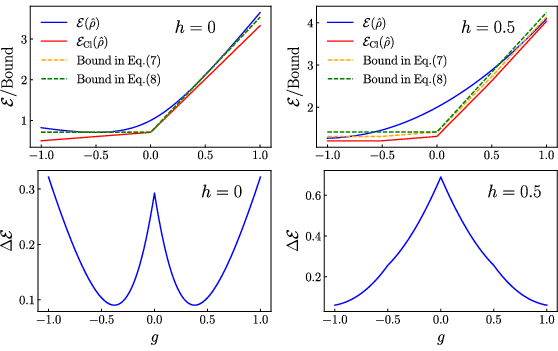
Figure 1: Comparison of ergotropy, Clifford ergotropy, and analytical bounds versus transverse field E(ρ^)7, highlighting control landscape transitions for different longitudinal fields.
Many-Body Behavior and Quantum Second Law
For many-qubit product states and typical pure states sampled from the Haar measure, the bounds yield compelling implications:
- Product States: The maximal Pauli coefficient in the product determines the upper bound; for a product of E(ρ^)8 states (E(ρ^)9), the Clifford ergotropy becomes a fixed fraction smaller than unrestricted ergotropy, providing a nontrivial quantitative lower bound on the gap.
- Typical States: For typical high-magic pure states, the infinite-order filtered SRE scales extensively with the number of qubits: ΔE=E(ρ^)−ECl(ρ^)0. Accordingly, the largest Pauli coefficient ΔE=E(ρ^)−ECl(ρ^)1, rendering Clifford ergotropy exponentially small, even as unrestricted ergotropy remains extensive. This result constitutes a version of the second law of thermodynamics for Clifford-restricted closed quantum systems: typical high-magic states permit negligible energy extraction through Clifford operations.
The paper further proves that even at finite energy densities (microcanonical shell), typical states retain exponentially small Clifford ergotropy, by measure concentration arguments on the correspondence of Pauli coefficients between typical pure states and the microcanonical ensemble. This second law is thus robust and tied fundamentally to magic, not operational timescales.
Practical and Theoretical Implications
The formalism establishes a rigorous obstruction to work extraction via Clifford operations in high-magic states, operationalizing the thermodynamic consequences of restricted quantum control. This is directly relevant to quantum batteries where control gates are limited, and more broadly, to scenarios in quantum computation where only stabilizer operations are feasible. The derived bounds are also applicable for maximizing or minimizing general observable averages under Clifford restriction, not just energy.
The discrete transition phenomena in the two-qubit case suggest rich, potentially critical behavior in the control landscape for larger, intermediate systems, which may have implications for optimal quantum protocols and resource allocation in Clifford-restricted frameworks.
On a theoretical front, the demonstrated linkage between magic monotones and energy accessibility in closed dynamics compares and contrasts sharply with known results for entanglement and locally-restricted unitaries, opening avenues for cross-resource theory analysis.
Future Directions
Several open problems emerge from the analysis:
- Construction of tighter bounds or efficient algorithms for Clifford ergotropy in complex systems.
- Generalization to non-unitary, measurement-based control protocols (including Clifford measurements).
- Extension to other resource theories (e.g., coherence, contextuality), exploring whether analogous energy bounds apply.
- Investigation of control landscape transitions in multi-qubit and many-body regimes, and their effect on quantum thermodynamic processes.
Conclusion
The notion of Clifford ergotropy establishes an explicit quantitative bridge between quantum magic and thermodynamic work extraction in closed systems. The presented universal bounds and analytical results demonstrate that high-magic states severely restrict energetic manipulation via Clifford operations, substantiating a form of the second law of thermodynamics in the quantum regime. This work provides a solid framework for future studies on quantum resource utilization, thermodynamic bounds, and control landscapes under algorithmic and operational constraints.