- The paper introduces KiTE-Extend, a planner-agnostic framework that precomputes translation-invariant edge bundles to guide efficient expansion in sampling-based kinodynamic planners.
- It demonstrates significant improvements in computational time and solution quality, achieving near-perfect success rates and up to 60% shorter path times in various planning paradigms.
- The method integrates with centralized, prioritized, and CBS planners while preserving theoretical guarantees such as probabilistic completeness and asymptotic optimality.
Efficient Multi-Robot Motion Planning via Translation-Invariant Edge Bundles
Background and Motivation
Multi-robot motion planning (MRMP) involves computing collision-free, kinodynamically feasible trajectories for teams of robots operating in cluttered environments. The complexity is magnified by the coupled nature of inter-agent constraints and the requirement to respect system dynamics. Established MRMP paradigms include centralized planning, prioritized planning, and conflict-based search (CBS), each exhibiting distinct tradeoffs in scalability, completeness, and solution quality.
Conventional sampling-based planning (SBP) techniques guarantee feasibility via forward simulation. However, in interaction-rich settings, node expansion is computationally intensive due to the high frequency of fruitless propagation attempts. Prior approaches to improve expansion efficiency involve learned steering, motion-primitive-based lattices, and offline trajectory optimization, but these methods either restrict the search space, incur heavy online optimization costs, or lose theoretical completeness.
This work introduces the Kinodynamic Translation-Invariant Edge Bundles (KiTE-Extend) framework—a planner-agnostic mechanism leveraging offline library construction to guide expansion in sampling-based kinodynamic planners. KiTE-Extend exploits translation invariance in system dynamics to enable efficient retrieval and reuse of precomputed motion segments, targeting the bottleneck in MRMP associated with repeated low-level feasibility checks.
Methodology
KiTE-Extend operates as a modular action selection scheme, agnostic to the underlying SBP planner and applicable across centralized, prioritized, and CBS paradigms. The core approach hinges on precomputing a large library (edge bundle) of short, dynamically feasible trajectory segments, indexed by the translation-invariant components of the robot state.
During online planning, KiTE-Extend intercepts node expansion steps. For a given tree node, it retrieves candidate edges from the offline bundle whose initial states are close (in translation-invariant space) to the current node. Candidates are ranked heuristically—typically by progress toward a sampled target state—and attempted in order. Each candidate is re-propagated under current constraints and accepted if valid. If no candidate succeeds, the planner falls back to random control sampling, preserving completeness.
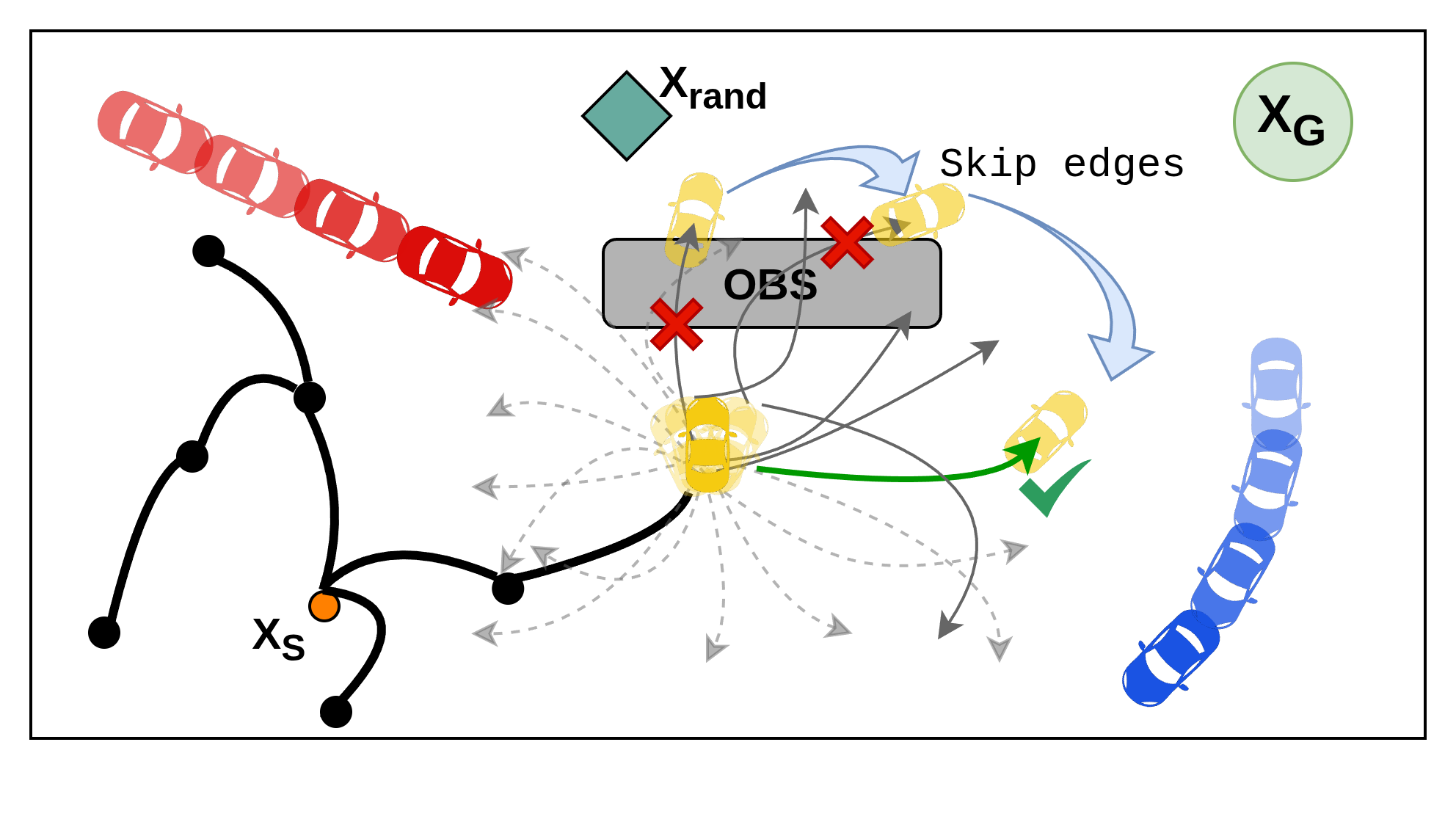
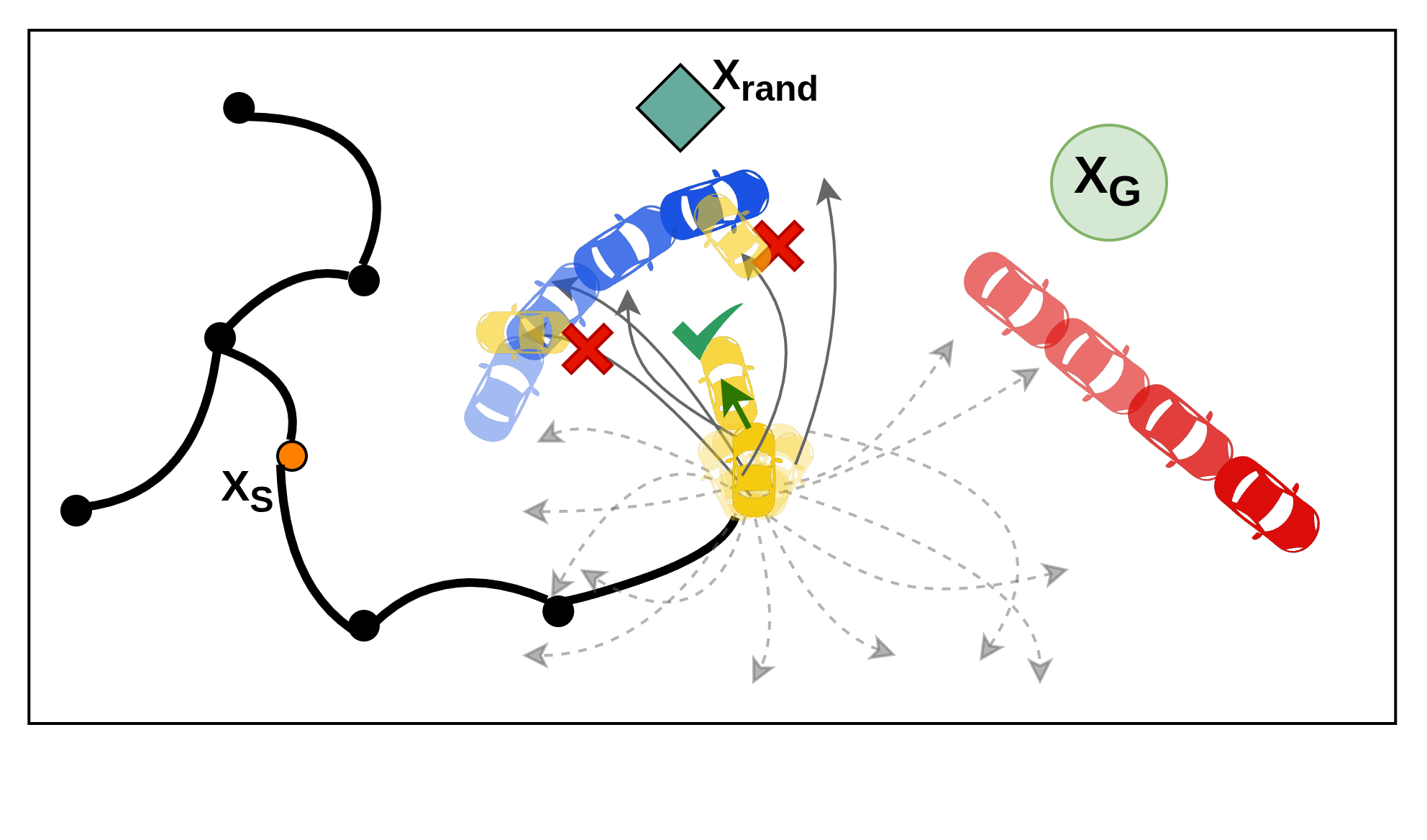
Figure 1: Ranked edge-bundle expansion in KiTE-Extend. Candidate segments are ranked by endpoint proximity to the sampled state; only collision-free segments under current constraints are propagated.
The ranking mechanism is critical: it biases expansion toward promising rollouts, thus reducing wasted computation. The design of stride-based traversal and ϵ-greedy random fallback ensures that exploration is not unduly restricted, retaining the base planner’s theoretical guarantees (probabilistic completeness and asymptotic optimality).
KiTE-Extend seamlessly integrates with SBP instantiations of joint-state planning (centralized), prioritized planning (with higher-priority agents as dynamic obstacles), and CBS-style planners (handling constraints induced by detected conflicts). For CBS, KiTE-Extend also enables efficient partial tree reuse during replanning, minimizing redundant computation.
Experimental Evaluation
Extensive evaluation is performed on three kinodynamic systems—Unicycle (UC), Second-Order Car (SOC), and Double Integrator (DI)—across diverse environments (swap, narrow corridor, small and large cluttered 2D and 3D settings). Baselines include standard SBP planners (cRRT, pRRT, KCBS) and discontinuity-bounded conflict-based search (dbCBS), both with and without KiTE-Extend augmentation.
Key metrics:
- Success Rate (SR): proportion of trials yielding feasible solutions.
- Computation Time (CT): total online planning time.
- Path Time (PT): aggregate execution duration of robot trajectories.
KiTE-Extend exhibits strong improvements:
- Scalability: In centralized planning (cRRT), KiTE-Extend converts otherwise intractable cases for teams of 10+ robots into consistently feasible solutions, e.g., maintaining near-perfect SR where baseline cRRT fails.
- Efficiency: Across prioritized and CBS planning, KiTE-Extend reduces CT by mean factors up to 4.2×, maintaining or improving SR.
- Solution Quality: Shorter PT (by up to 60% in cRRT, 20–30% in pRRT/KCBS), with coordinated waiting behaviors naturally emerging from feasible edge candidates.
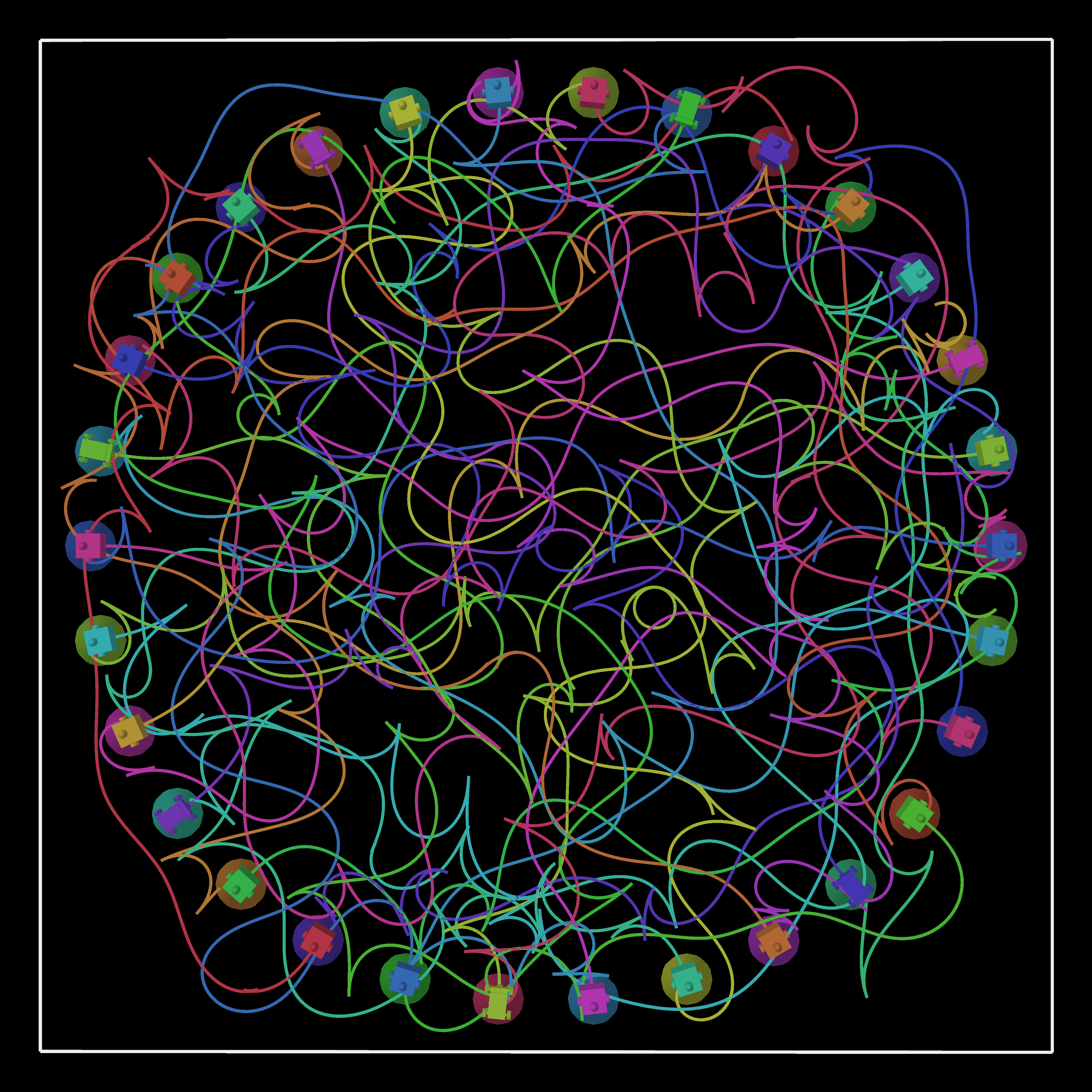
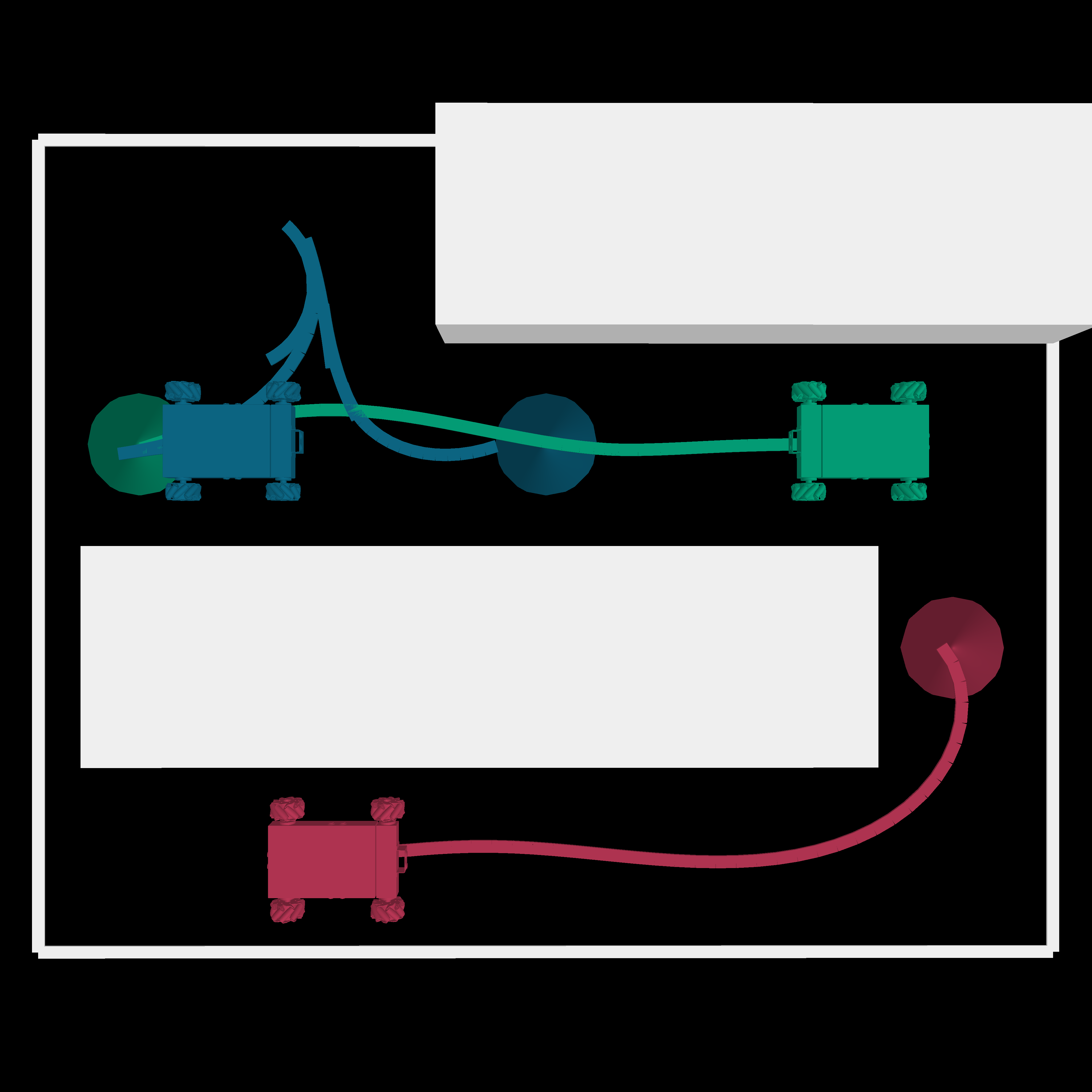
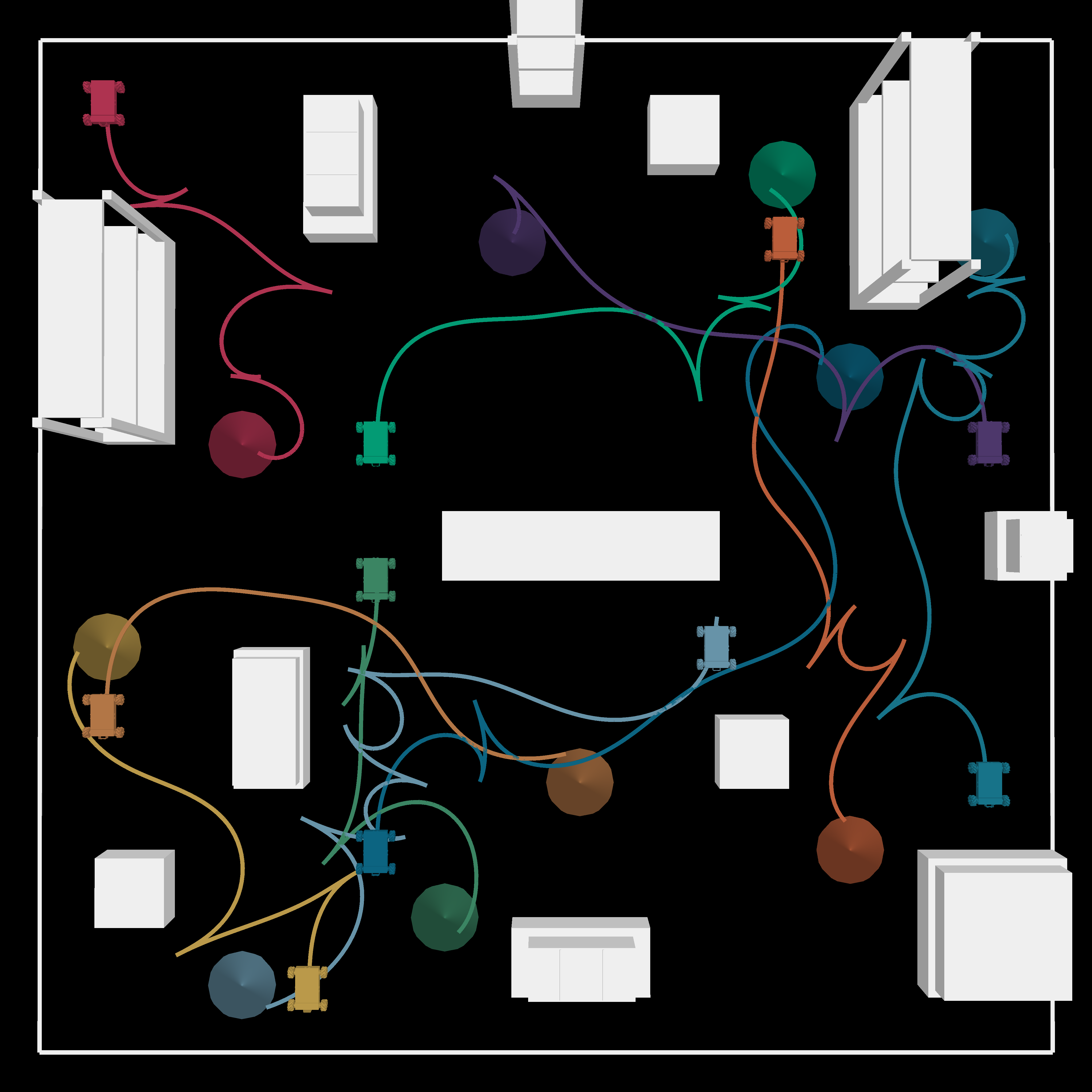
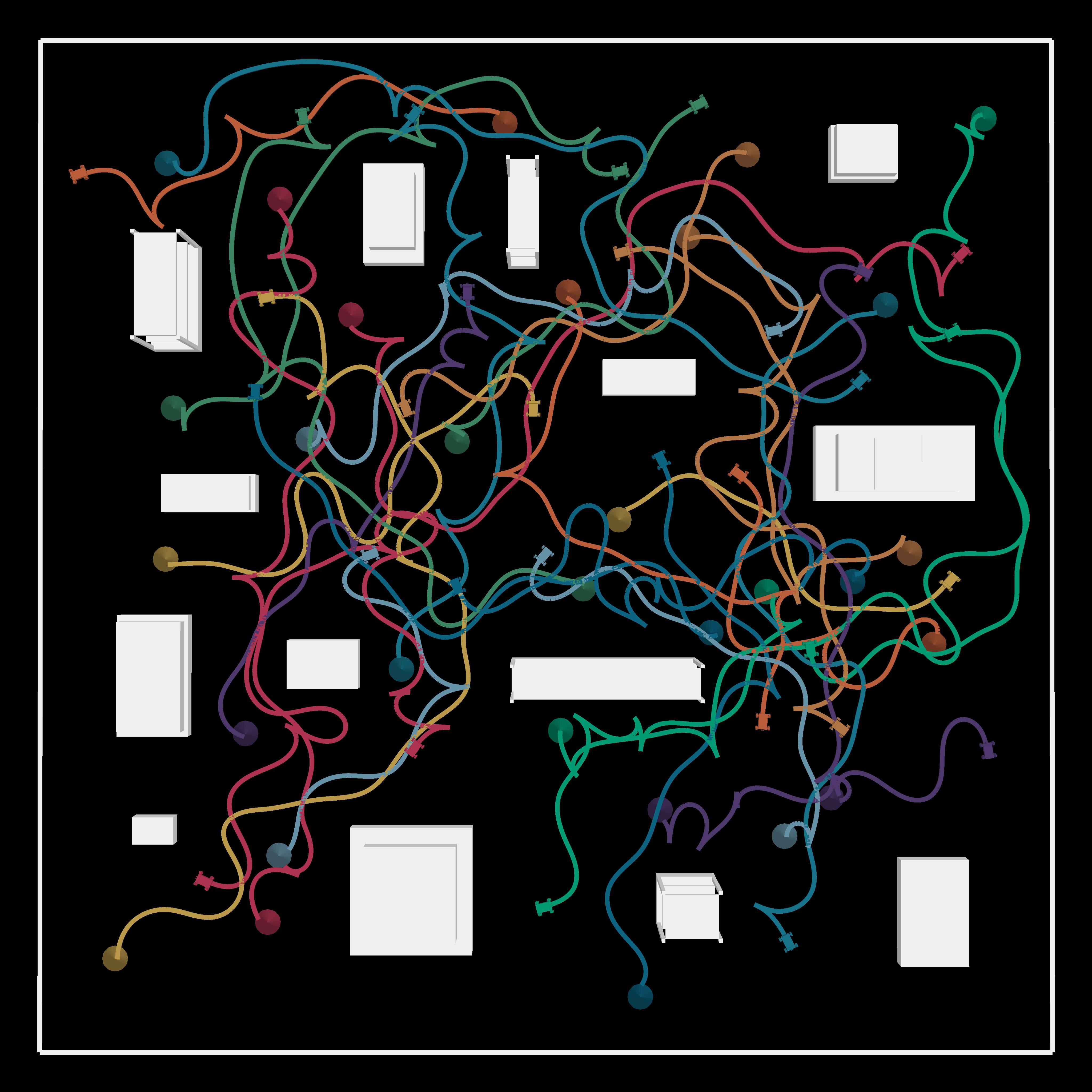
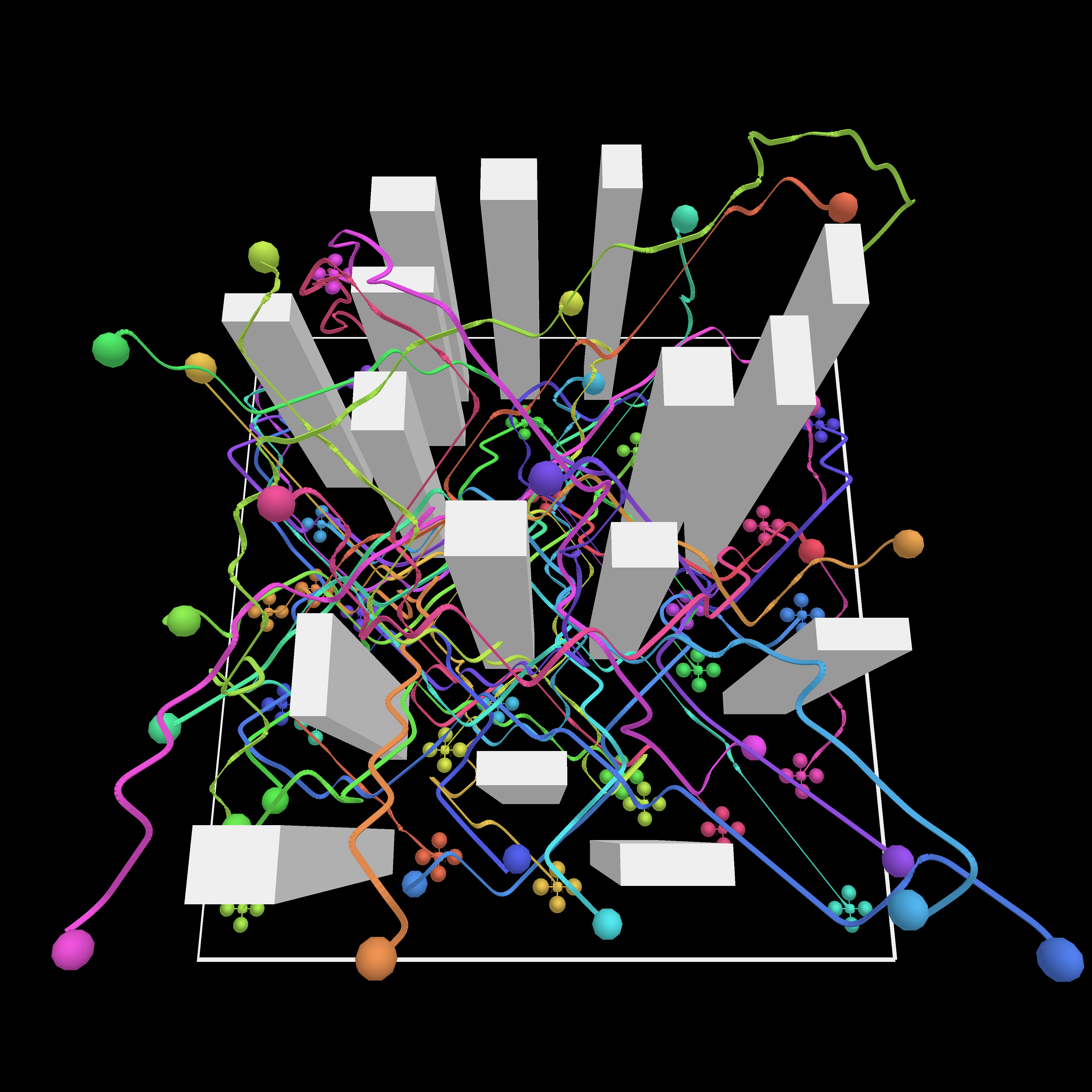
Figure 2: Swap scenario (20×20)—KiTE-Extend solutions for coupled multi-agent motion, demonstrating coordinated avoidance.
The method also outperforms dbCBS in scalability, especially as agent count and environment size rise. dbCBS sometimes yields lower path durations in small teams, but at substantially higher computational cost and frequent failures in larger settings.
Ablation studies indicate that increasing edge-bundle size monotonically improves PT, with CT showing non-monotone tradeoffs reflecting retrieval overhead versus propagation reductions. The skip factor in candidate ranking traversal has planner-dependent effects on CT while PT remains invariant.
Implications
KiTE-Extend establishes the practical value of translation-invariant offline computation in accelerating kinodynamic SBP expansion. By reframing expansion as retrieval and ranking, it preserves theoretical guarantees while mitigating the computational cost endemic to constraint-driven node expansion in MRMP.
Practically, KiTE-Extend enables planners to handle larger teams of robots, more dynamically complex systems, and denser spatiotemporal constraints with minimal modification. Its compatibility with various high-level coordination mechanisms means that further improvements in coordination strategies are orthogonal and can be layered for additional gains.
Theoretically, the approach highlights low-level expansion efficiency as a critical bottleneck—suggesting that advances in motion primitive generation, symmetry exploitation, and retrieval algorithms will directly drive MRMP scalability.
Limitations and Future Directions
KiTE-Extend’s offline bundle size must scale with the dimensionality of translation-invariant state space. For robots with limited symmetry or in high-dimensional workspaces, maintaining adequate coverage becomes expensive. Future work should explore structured bundle generation, alternative symmetries (rotational, reflectional), and adaptive retrieval to mitigate this cost.
Integration with emerging learning-based motion planning and diffusion model-based planners [shaoul2025multi] is an avenue for hybrid approaches. Application to real-world robotic fleets (e.g., drones, warehouse AGVs) and incorporation of uncertainty, partial observability, or soft constraints would further extend the utility of KiTE-Extend.
Conclusion
KiTE-Extend delivers a planner-agnostic, translation-invariant offline-guided action selection scheme for kinodynamic SBP, yielding superior scalability, efficiency, and solution quality in MRMP across standard paradigms. The results demonstrate that judicious offline reuse—combined with online ranking and fallback—can significantly mitigate exploration bottlenecks in dense multi-robot motion planning without compromising theoretical guarantees (2605.09801).

