- The paper presents vector-accelerated primitives that reduce collision validation times by up to 1100X compared to conventional methods.
- It employs SIMD parallelism with innovative batch 'rake' strategies to efficiently execute robot-robot and robot-obstacle collision checks.
- The integration into various multi-robot planning algorithms yields millisecond-scale solution times and enhanced scalability for complex, heterogeneous robot teams.
Vector-Accelerated Primitives for Multi-Robot Sampling-Based Motion Planning
This paper addresses the computational bottlenecks in Multi-Robot Motion Planning (MRMP), particularly focusing on the cost of motion validation within sampling-based planning algorithms. Extending the Vector-Accelerated Motion Planning (VAMP) framework, previously designed for single-robot systems, to the multi-robot context, the authors introduce two vector-accelerated primitive operations: MotionValidation (MV) for rapid boolean validity checks and FindFirstConflict (FFC) for precise conflict identification across synchronized robot motions. These primitives leverage fine-grained SIMD parallelism applied to forward kinematics and collision checking operations, optimizing early termination and overall throughput.
Empirical results highlight dramatic reductions in validation time—over 1100X compared to conventional approaches—and significant acceleration in end-to-end planning, with multi-robot solutions produced in milliseconds and planning speedups of up to 850X across varied robot team compositions.
Algorithmic Foundations and Primitives
Sampling-Based Motion Planning
Sampling-based algorithms such as RRT, PRM, and their multi-robot adaptations face scalability limitations from combinatorial explosion in composite configuration spaces and exponential growth in robot-robot collision checks. These checks dominate runtime as robot numbers increase, primarily due to O(N2) scaling in inter-robot collision processing.
Vector-Accelerated Primitive Design
Two principal primitives are constructed:
- MotionValidation (MV): Provides a boolean validity check for composite motions by parallelizing both robot-obstacle and robot-robot collision checks. Early termination is optimized by employing temporal "rake" batch strategies, distributing timesteps across the motion to maximize likelihood of early collision detection.
- FindFirstConflict (FFC): Identifies the first timestep at which a robot-robot collision occurs. Batch packing utilizes linear scans to minimize redundant computation, only checking up to the discovered conflict.
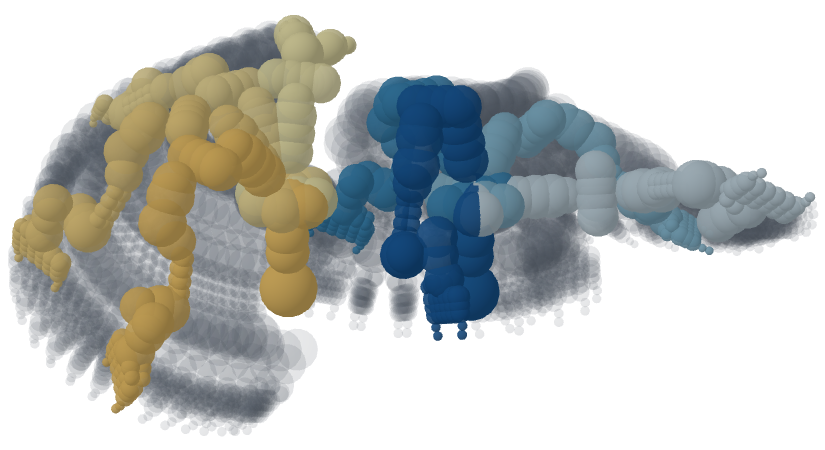
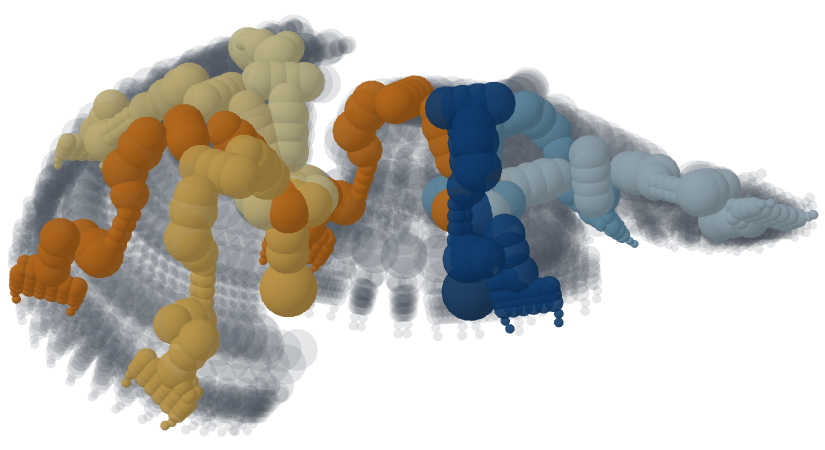
Figure 1: The rake technique in MV checks for robot-robot collisions in parallel across distributed timesteps, enabling rapid early termination.
Both primitives exploit a sphere-based robot abstraction, which enables efficient batch kinematic and collision computations via specialized vectorized kernels. The choice of rake versus linear batch packing is critical: rake enhances early witness detection for boolean queries, whereas linear is necessary for accurate conflict timing.
Integration in MRMP Algorithms
The primitives are incorporated into a representative suite of sampling-based multi-robot motion planners encompassing coupled, decoupled, and hybrid approaches:
- Composite RRT-C: Direct coupled search in composite space, utilizing MV.
- PP-ST-RRT: Decoupled prioritized planning, with MV used to check new robot paths against higher priority trajectories.
- ST-CBS: CBS-based conflict-driven search, employing FFC to guide constraint tree branching.
- MR-dRRT and ARC: Hybrid frameworks, selectively invoking MV/FFC depending on path composition and current search context.
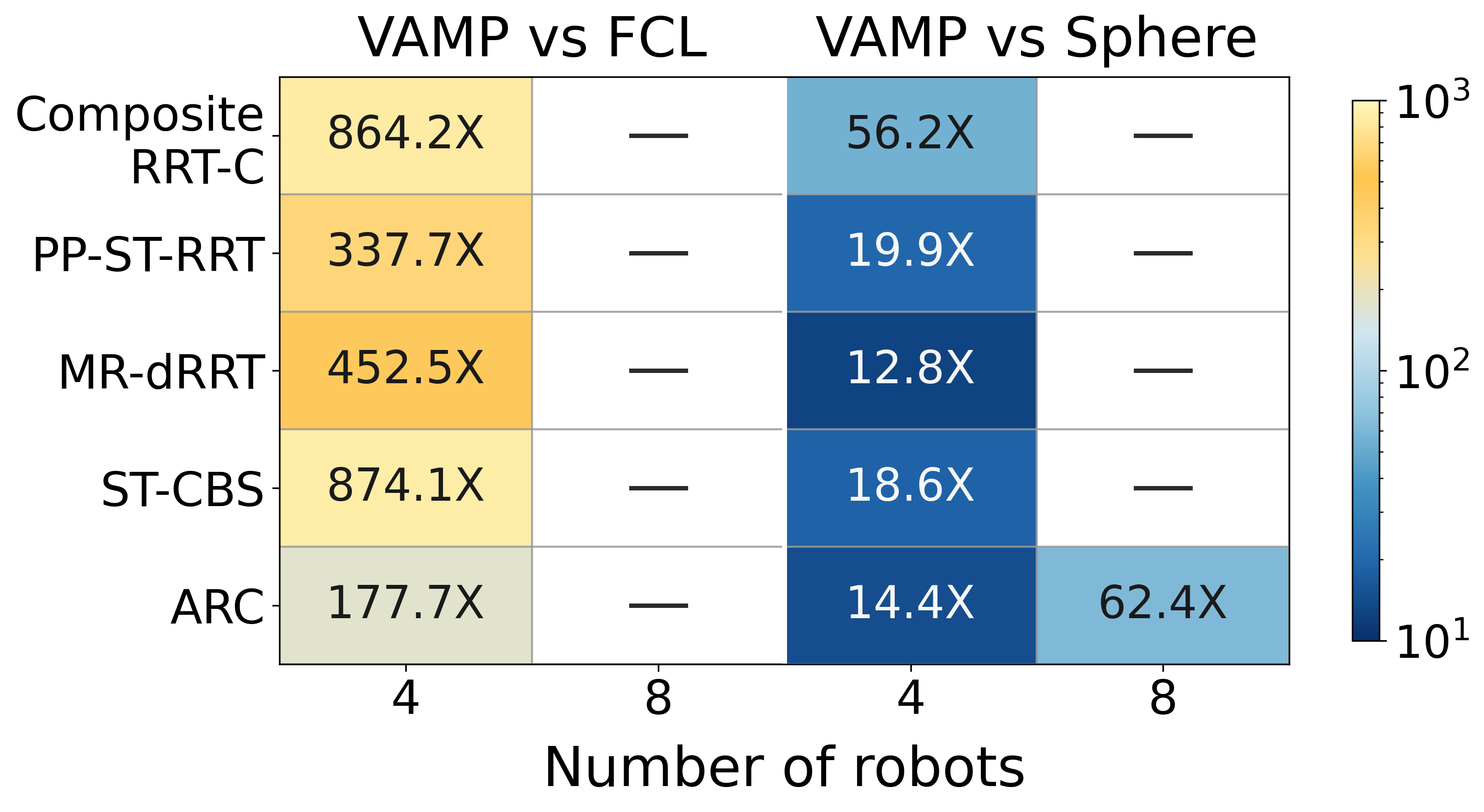
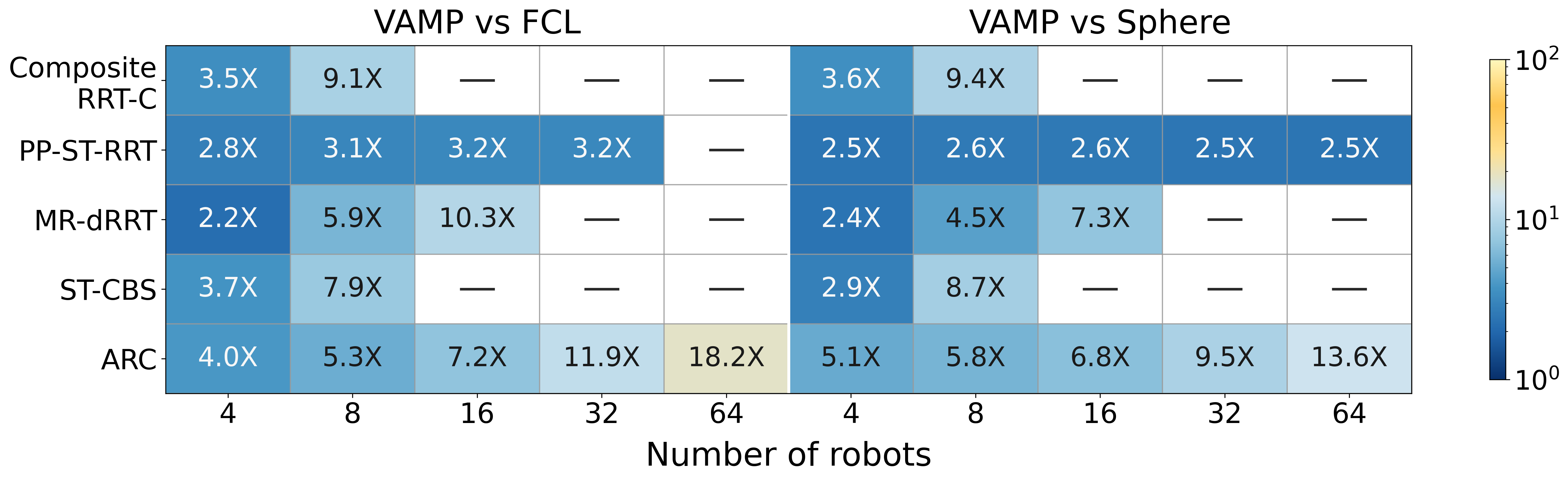
Figure 2: Speedup plots showing substantial runtime improvements for manipulator coordination tasks.
Empirical Evaluation
Validation Timing
A detailed timing study isolates the effect of batch packing and validation strategy. The hierarchical rake strategy achieves up to 1109X speedup and reduces validation effort to 0.2% for large manipulator teams, demonstrating the necessity of distinct primitives and intelligent batching.
Rigorous benchmarks across manipulator, rigid body, and heterogeneous team scenarios reveal strong improvements. The most substantial speedups are observed in highly coupled planners and coordinated manipulator teams, where collision validation dominates runtime. For rigid body teams, gains scale with robot count due to quadratic validation burden.
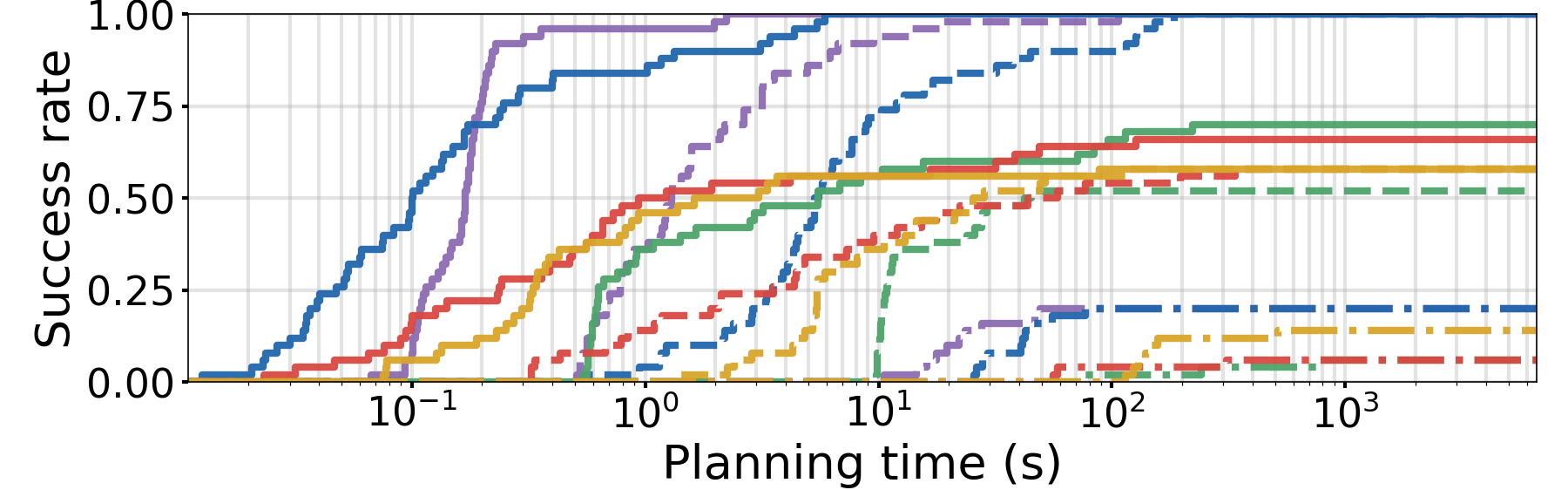
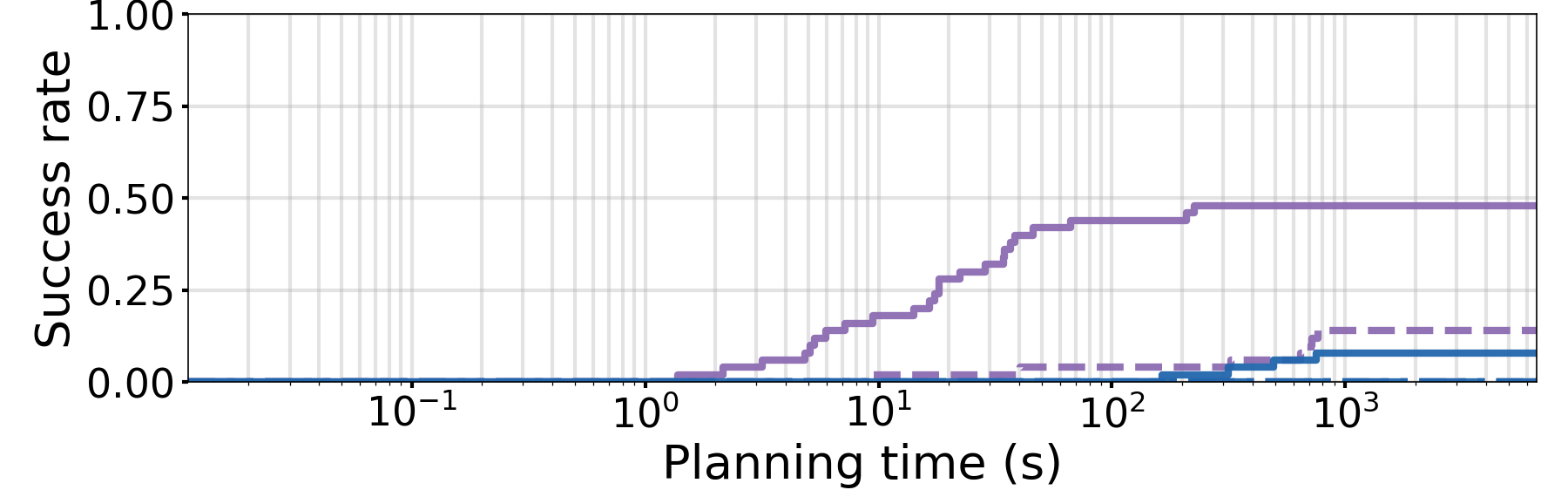
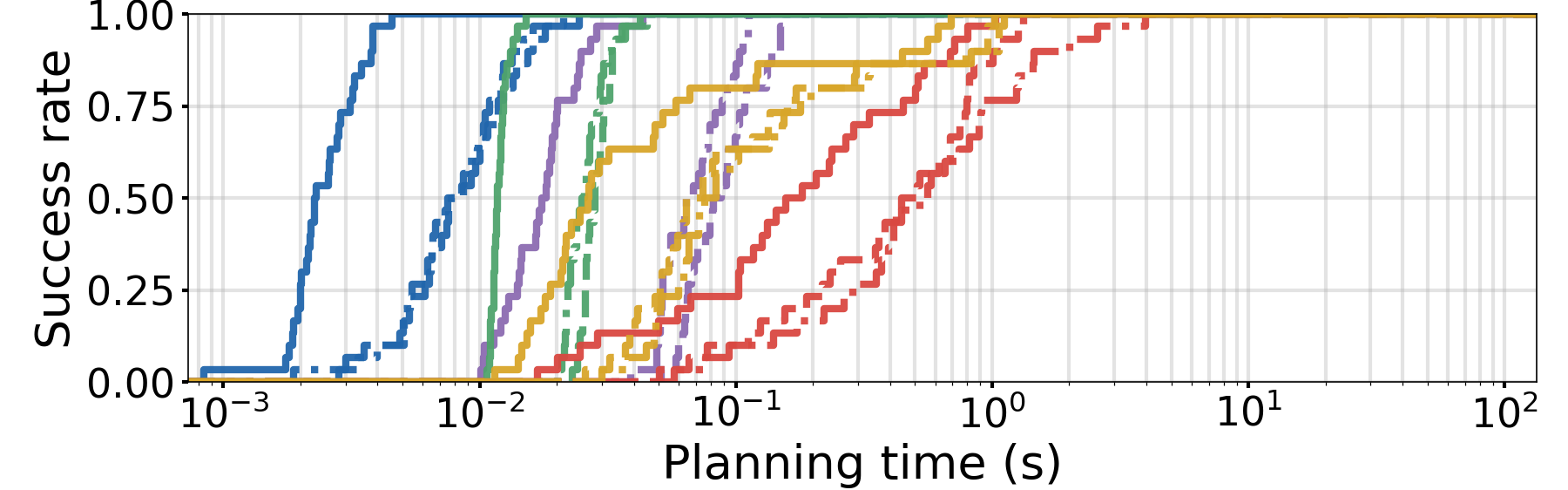
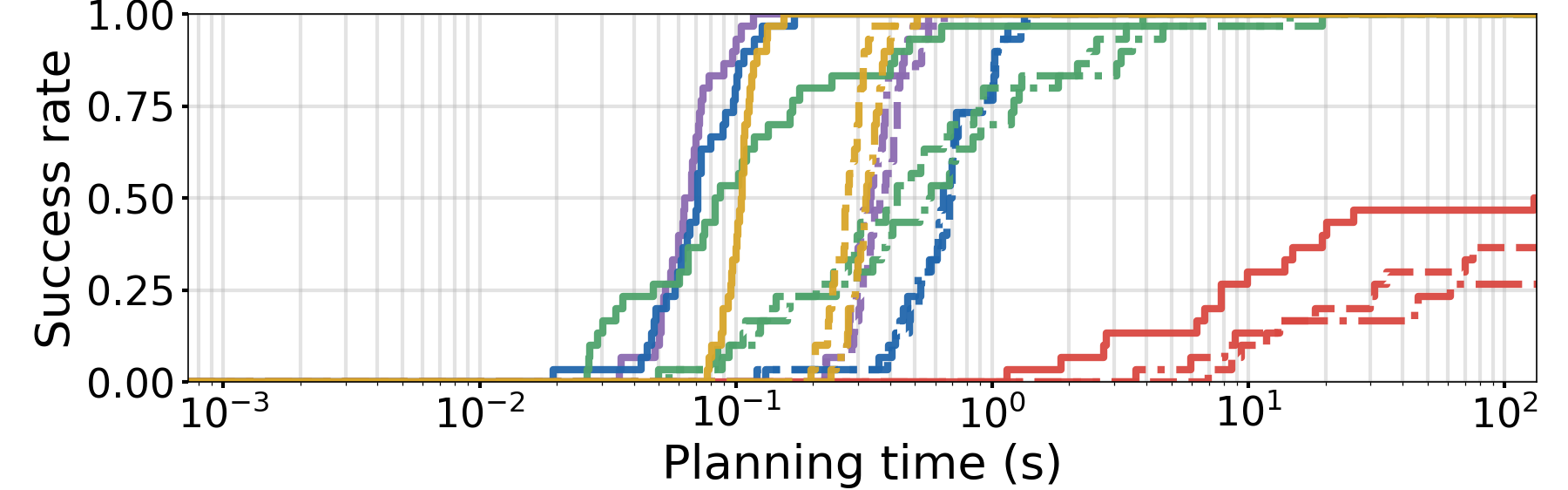
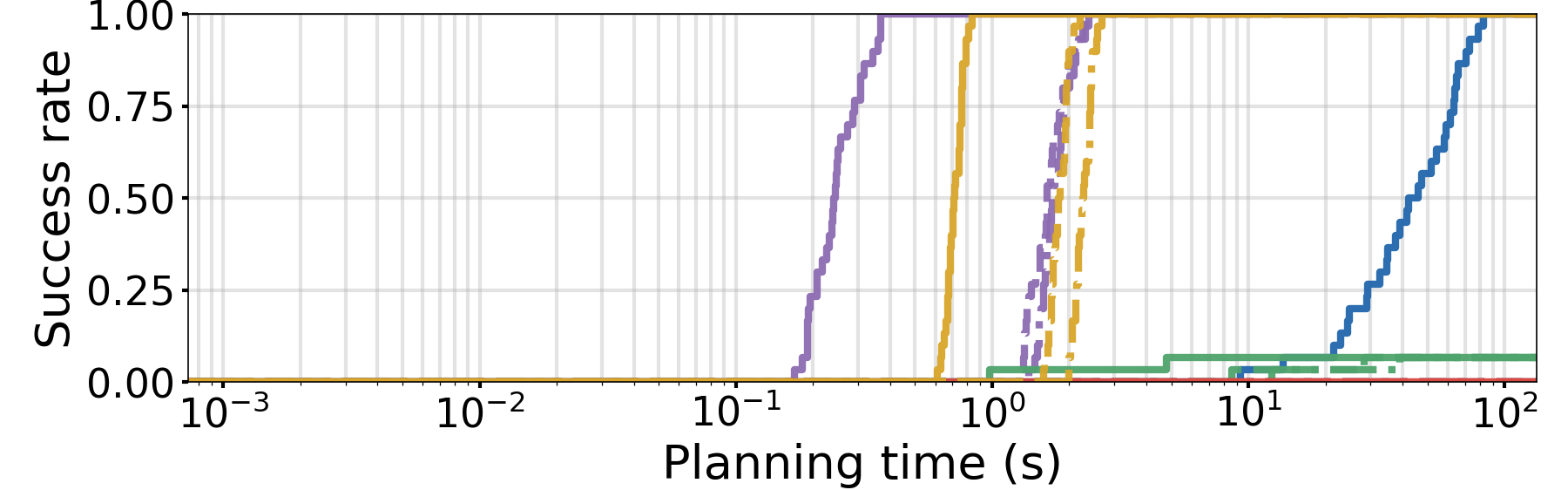
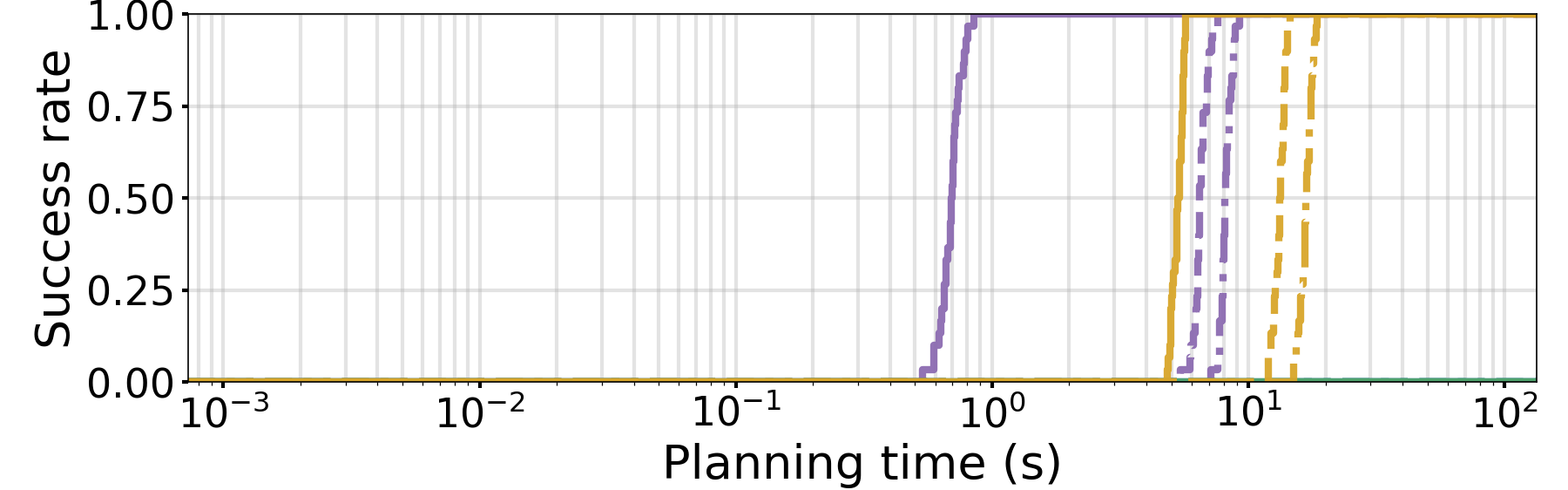
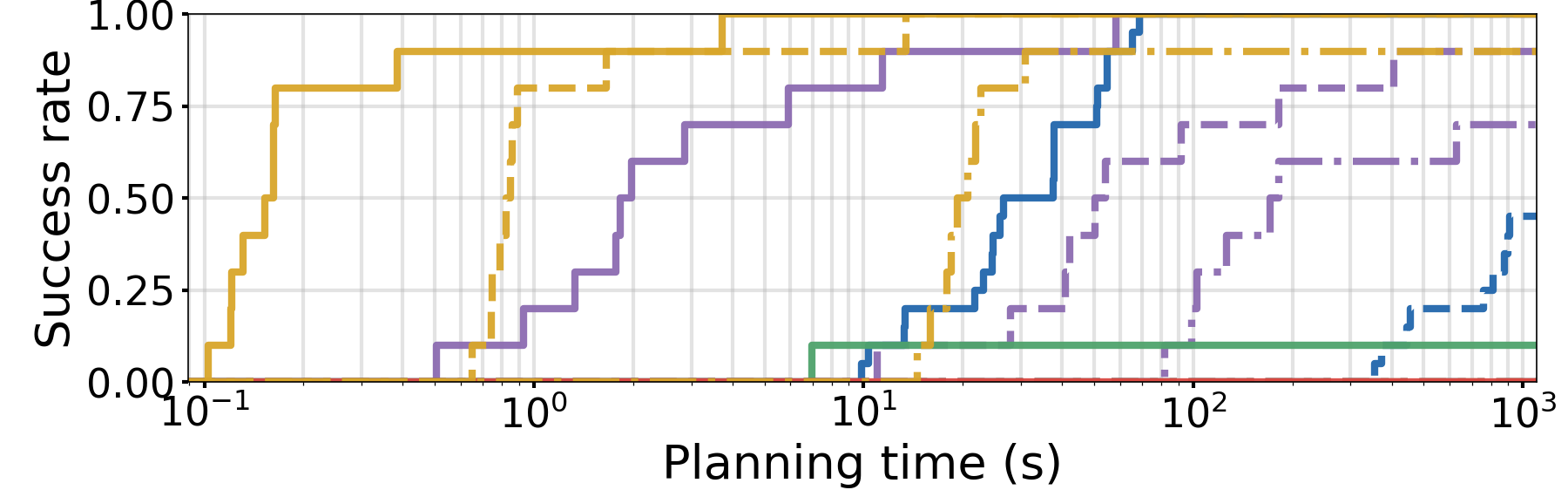
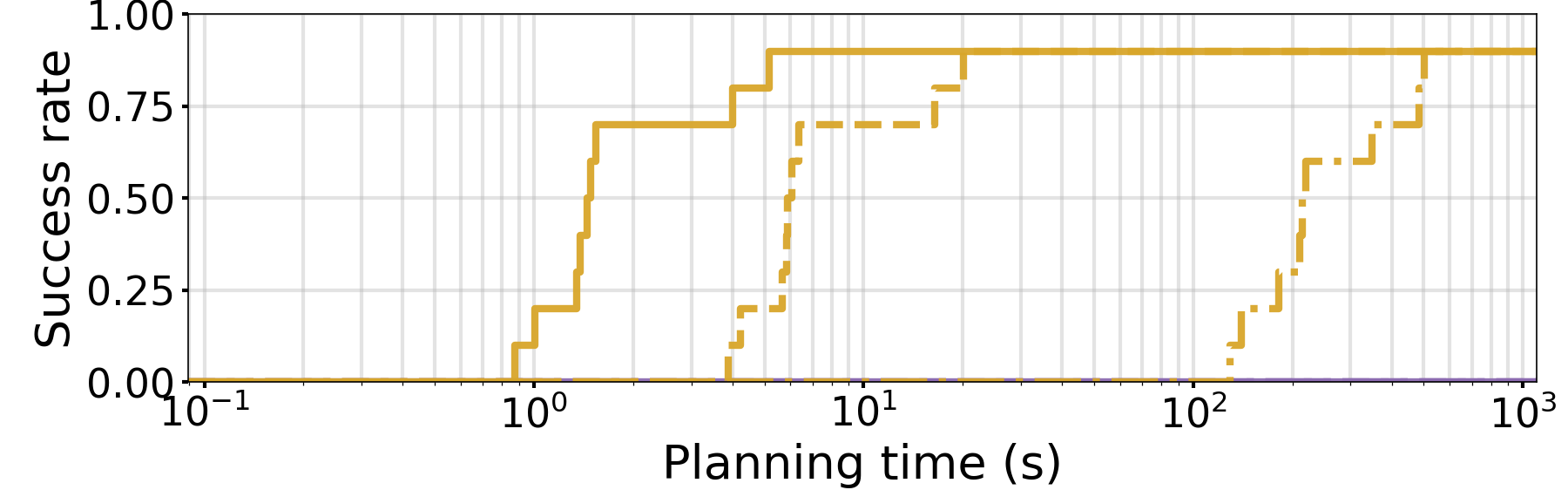

Figure 3: Cumulative distribution of planning times for teams of 4 Panda manipulators, emphasizing millisecond-scale solution times with vector-accelerated primitives.
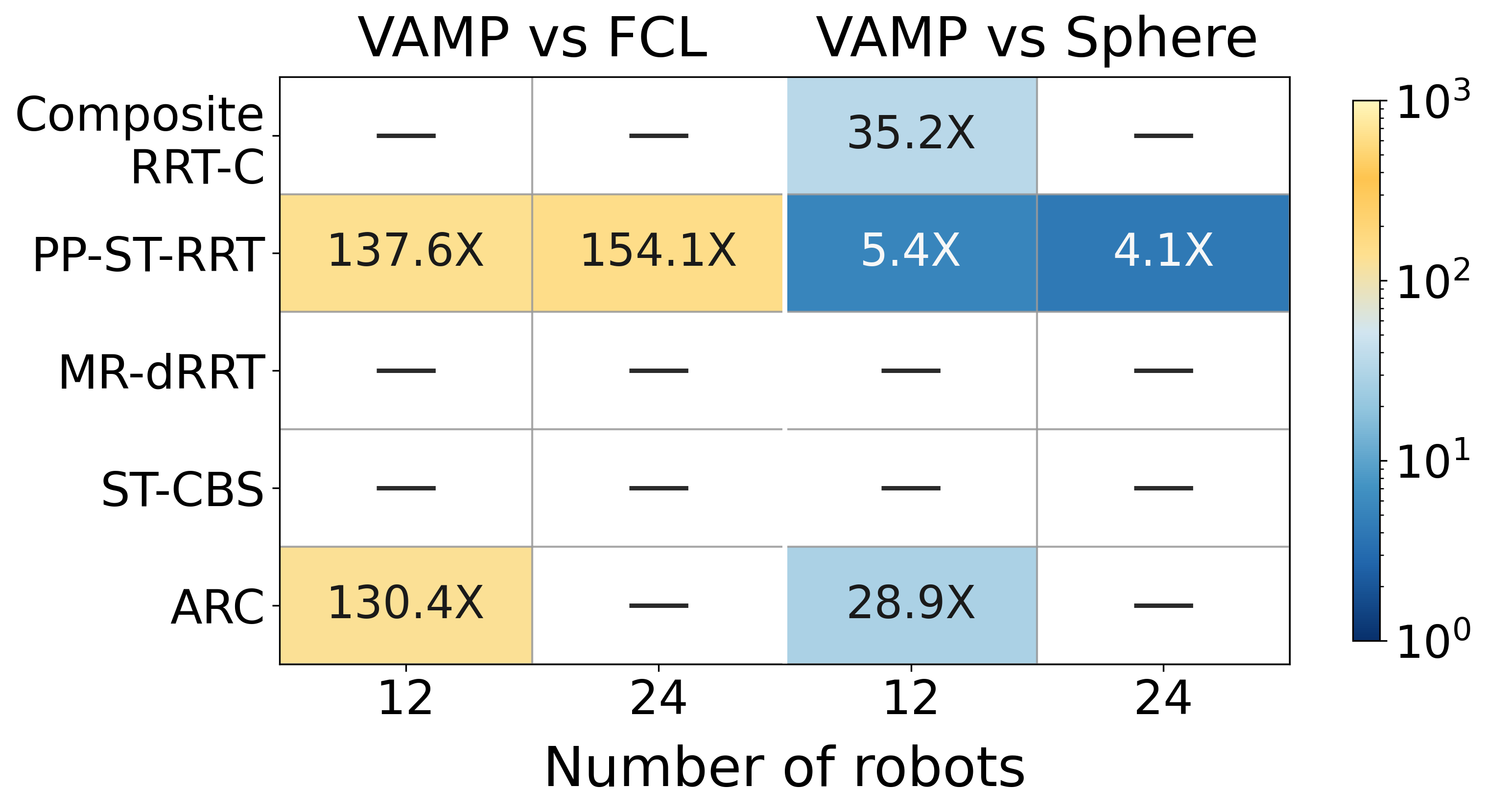
Figure 4: Speedup plots for heterogeneous teams, highlighting performance gains in prioritized planning for mixed robot types.
Success rates also improve, particularly in scenarios with dense interactions and frequent conflicts. The reduced validation cost enables algorithms like ARC or PP-ST-RRT to scale to larger problem sizes and previously intractable heterogeneous compositions.
Practical and Theoretical Implications
The deployment of vector-accelerated primitives in MRMP redefines the limits of efficient planning, shifting the primary bottleneck from validation to search in large-scale multi-robot systems. The distinct separation of MV and FFC primitives is essential for correct and optimal application across algorithmic families, and strategies such as rake batch packing should be standard in high-performance MRMP libraries.
From a practical perspective, this enables real-time coordination in manufacturing, logistics, and assembly domains with dozens to hundreds of robots, where planning latency previously prevented dynamic reconfiguration or adaptation. On the theoretical side, these results underscore the importance of algorithm-hardware co-design, advocating for parallelizable geometric abstractions and computation models.
Future research directions include further optimization of batch formation, exploration of hardware-accelerated collision checking (e.g., GPU-based), and integration of vector-accelerated primitives with learning-based planners to enable rapid feedback-driven replanning.
Conclusion
The adaptation of vector-accelerated motion validation and conflict detection primitives to multi-robot sampling-based planning delivers transformative improvements in runtime, scalability, and applicability. By carefully distinguishing validation queries and optimizing parallel computation strategies, the planning algorithms achieve millisecond-scale solution times for complex multi-robot tasks, enabling reliable operation in highly coordinated, heterogeneous environments. These findings support increased adoption of parallelized geometric representations and batch processing in both academic and industrial MRMP systems, setting new standards for efficiency and responsiveness.

