- The paper's main contribution is its novel boundary integral formulation leveraging a geometric-optics parametrix to accurately model wave scattering with moving obstacles.
- The methodology eliminates volumetric discretization by using boundary-only representations, enabling efficient simulation of Doppler effects and refraction in heterogeneous media.
- Numerical results demonstrate stability for high-speed (up to Mach 0.9) moving obstacles and accurate reproduction of complex wavefront dynamics.
Overview
"A boundary integral method for wave scattering in a heterogeneous medium with a moving obstacle" (2605.09500) advances time-domain numerical methods for modeling linear wave propagation subjected to refractive, focusing, and Doppler effects induced by medium heterogeneities and boundary motion. The approach is distinguished by its avoidance of volumetric discretization; the entire computational strategy is formulated using boundary-only representations, making it especially suitable for problems where the exterior domain is large or unbounded and the complexity is localized at the interface.
Geometric Optics Parametrix and Causal Geometry
The method is built upon a geometric-optics parametrix representation, which marries high-frequency asymptotics of the wave equation to a boundary integral formulation. The key mathematical ingredients are:
- Travel-time Function: Encodes the causal propagation geometry in heterogeneous, possibly time-varying media. It is calculated via ray tracing or a chord approximation, depending on the complexity and sound speed profile.
- Amplitude Transport Equation: Governs the prefactor of the parametrix Green's function and is typically modeled using a two-point sound-speed-dependent approximation for computational tractability.
The geometric-optics framework captures the distortion of light cones arising from spatially and temporally dependent sound speed and moving boundaries, rectifying the cone geometry in travel-time coordinates to facilitate layer potential computations. The distinction between the true and source-frozen cones is critical; divergence between the two as time advances encodes the nontrivial refraction structure governing wavefront evolution.
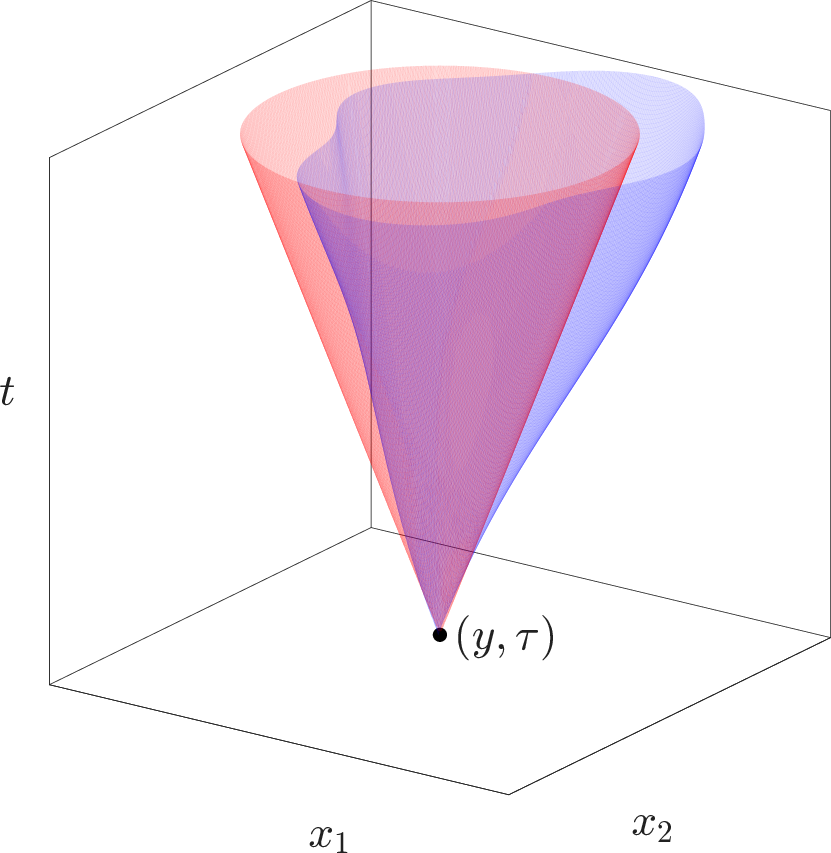
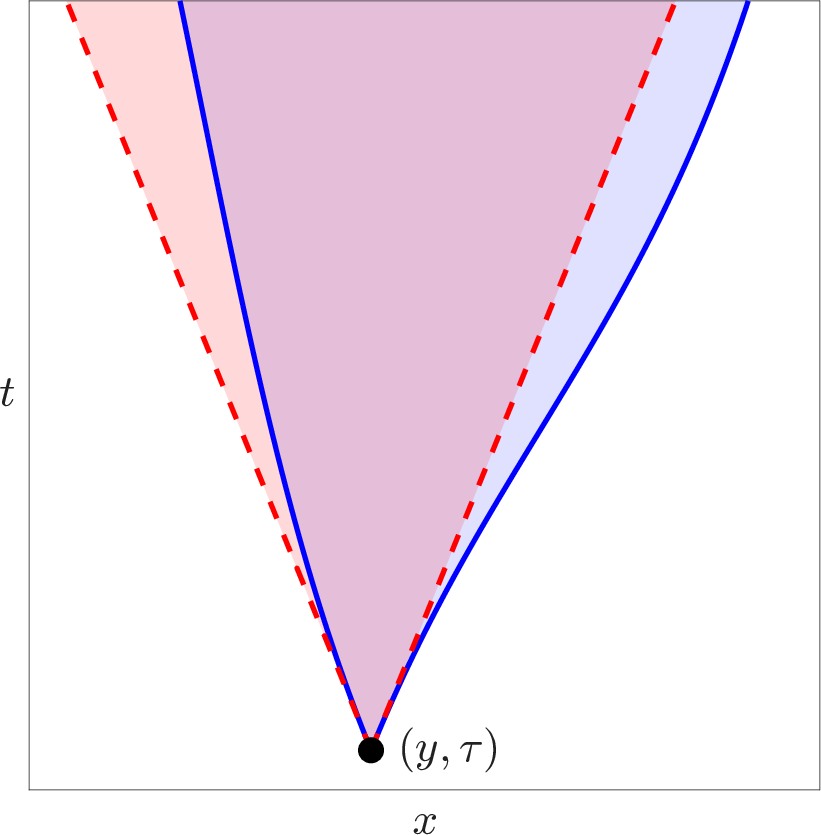
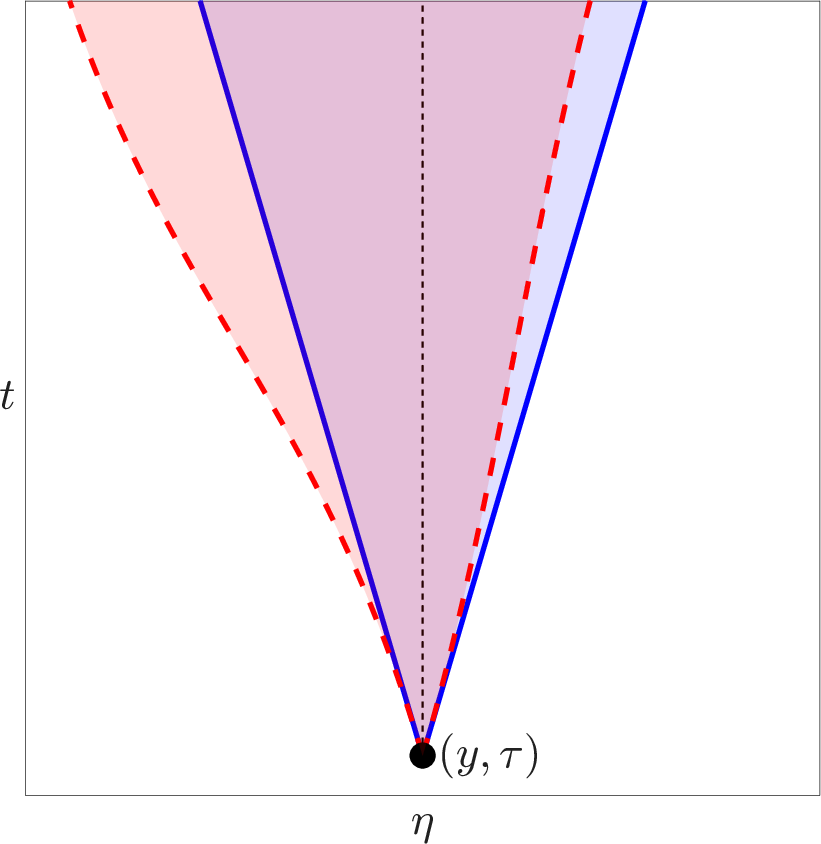
Figure 1: True and source-frozen cones compared, illustrating the divergence induced by spatial refraction in heterogeneous media.
The boundary integral method defines both single-layer (SL) and double-layer (DL) potentials with explicit parametrix kernels constructed from the travel-time and amplitude fields. Unlike classical formulations where the jump coefficients are strictly ±21 due to static boundaries, the moving boundary leads to a jump condition with a space-time-dependent coefficient:
λ(α,t)=1+C2−Vν2Vν2
where Vν is the normal boundary velocity and C is the local sound speed at the boundary. This coefficient captures Doppler effects directly at the level of the boundary integral operator.
Numerical Scheme: Marching-on-Time with Slab-Frozen Causality
The numerical implementation leverages a time-marching collocation scheme, discretizing the boundary in both space and time. Temporal integration of nonlocal retarded interactions is handled via a slab-frozen approximation, wherein all geometric quantities and kernels are evaluated using frozen time endpoints, permitting analytic evaluation of temporal weights. Spatial integration uses piecewise linear basis functions and Gaussian quadrature, prioritizing simplicity and flexibility over spectral accuracy, which can be attained in future work using more advanced quadrature techniques.
Numerical Results
The paper provides strong numerical evidence for the stability and accuracy of the method across multiple scenarios:
- Doppler Effects: The method robustly resolves Doppler shifts for obstacles moving at Mach numbers up to $0.9$—a regime challenging for classical collocation schemes due to spurious oscillations—by employing stabilization techniques such as temporal averaging (Rynne's method) and spatial smoothing.
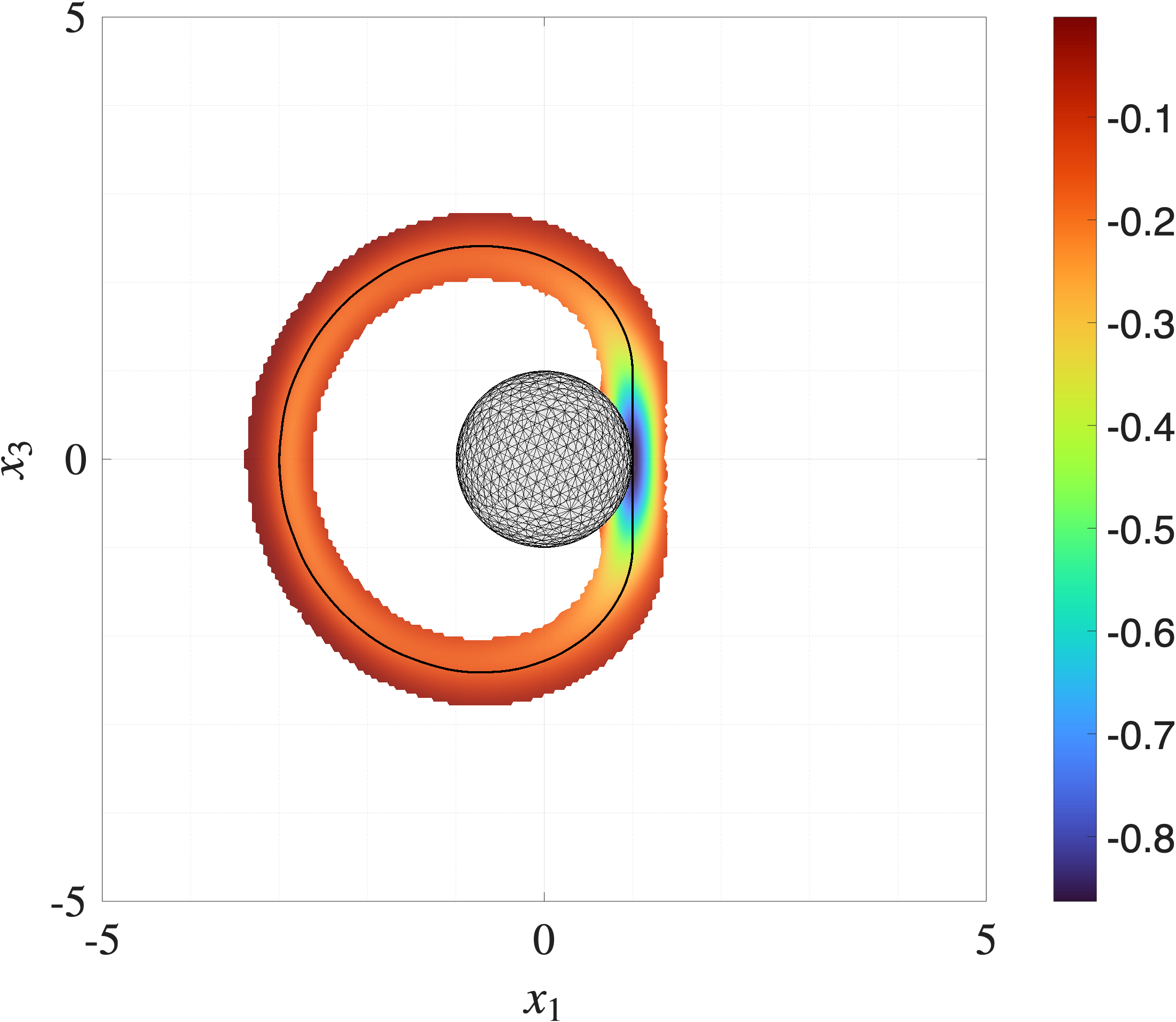
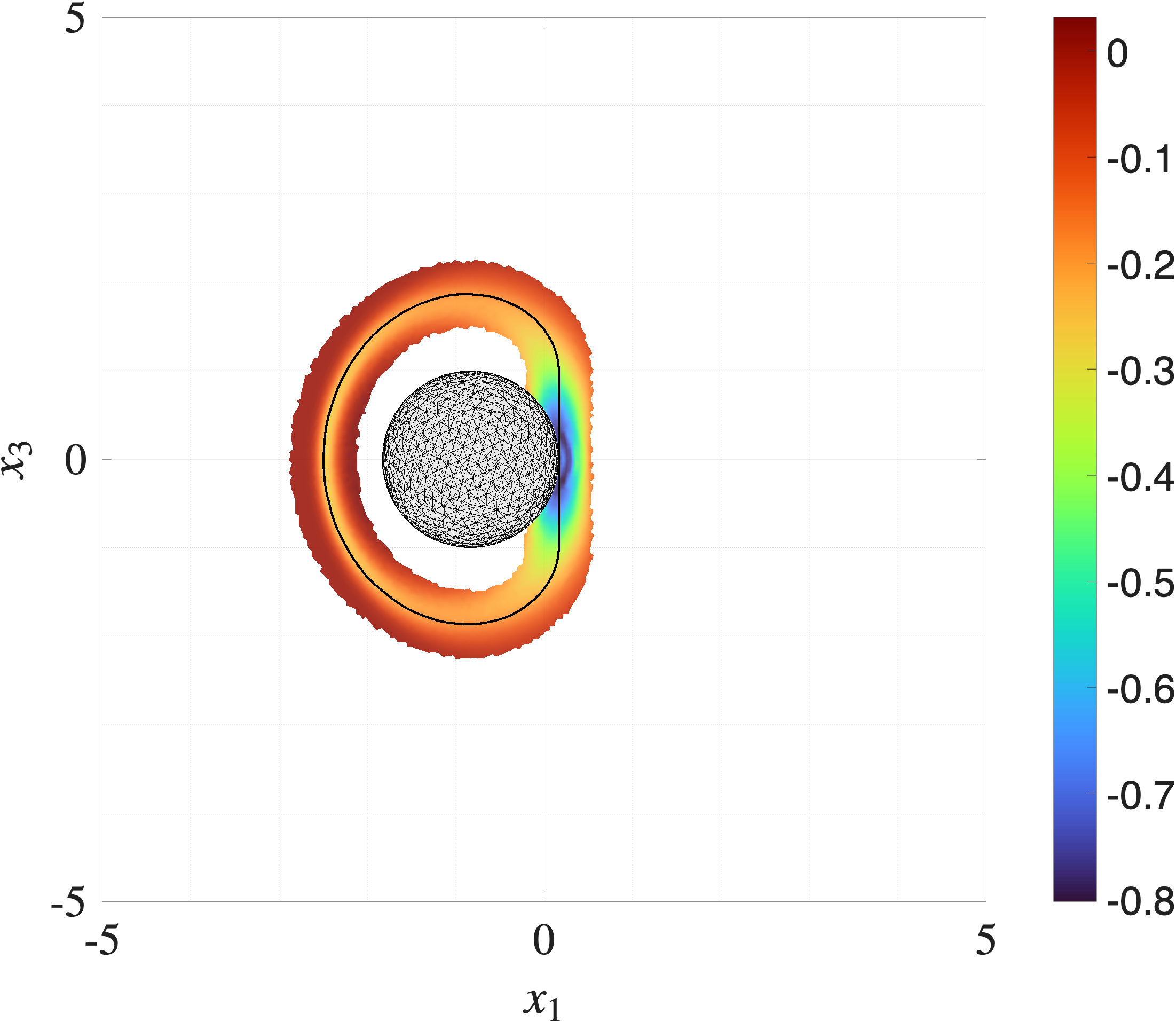
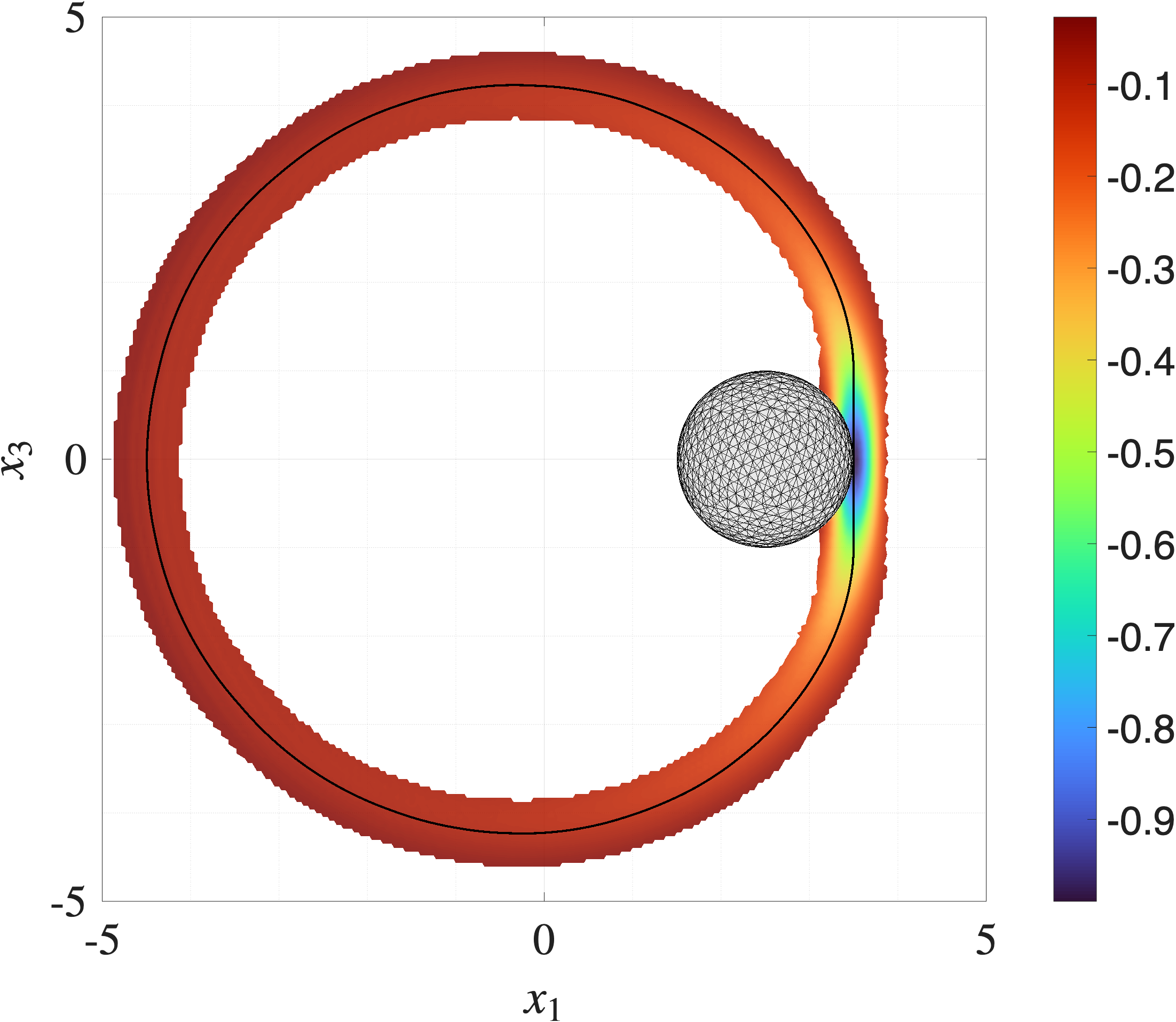
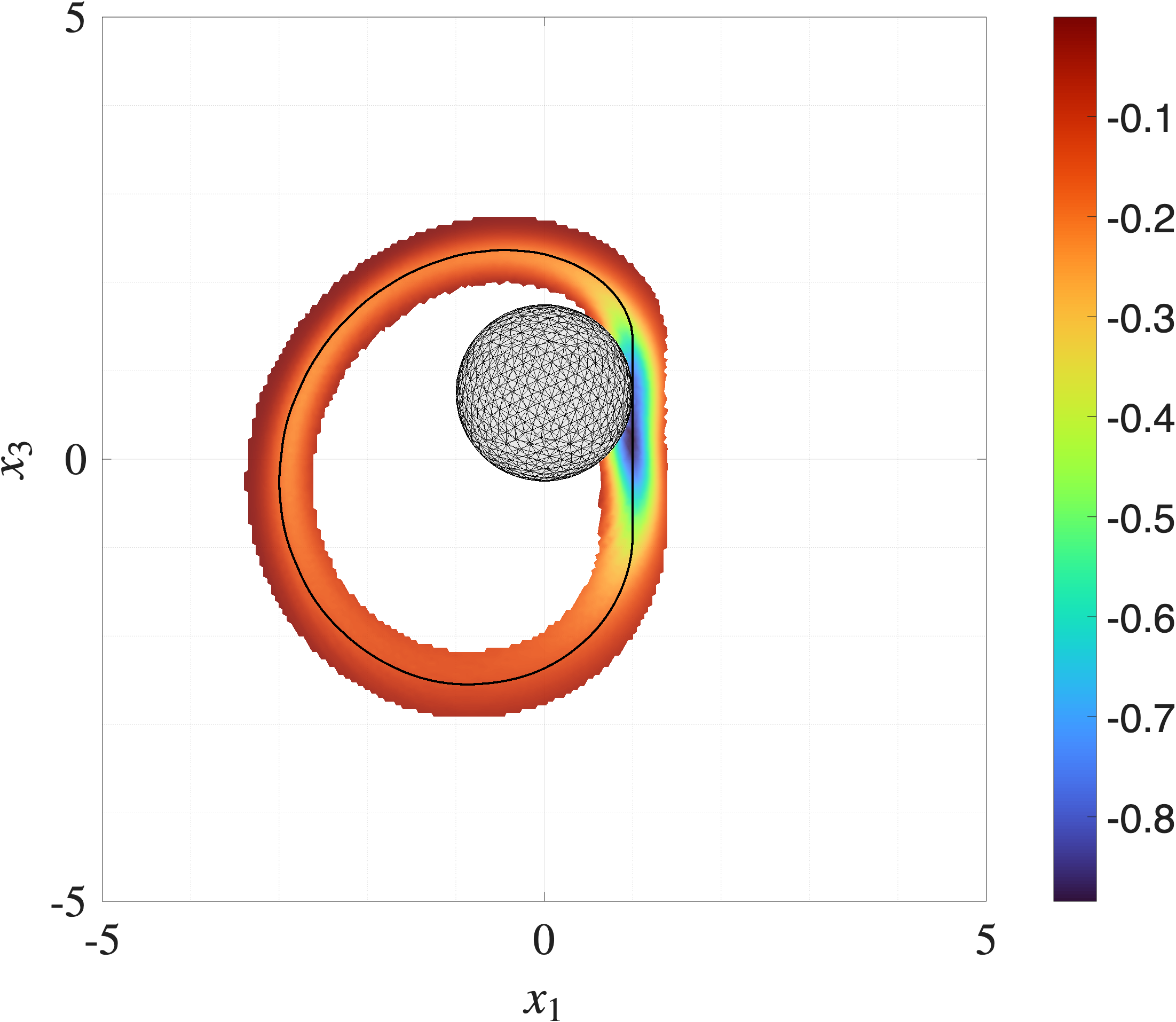
Figure 2: Doppler scattering by a rigidly moving sphere at t=2.5, capturing the motion-induced asymmetry in reflected wavefronts.
- Wavefront Refraction: In spatially heterogeneous media, the method reproduces bypassing rays and asymmetric scattered fields when encountering slow inclusions, e.g., a gas bubble in water. The Newton ray correction for travel-time computation is shown to be critical for capturing genuine ray geometry in the slow-inclusion regime.
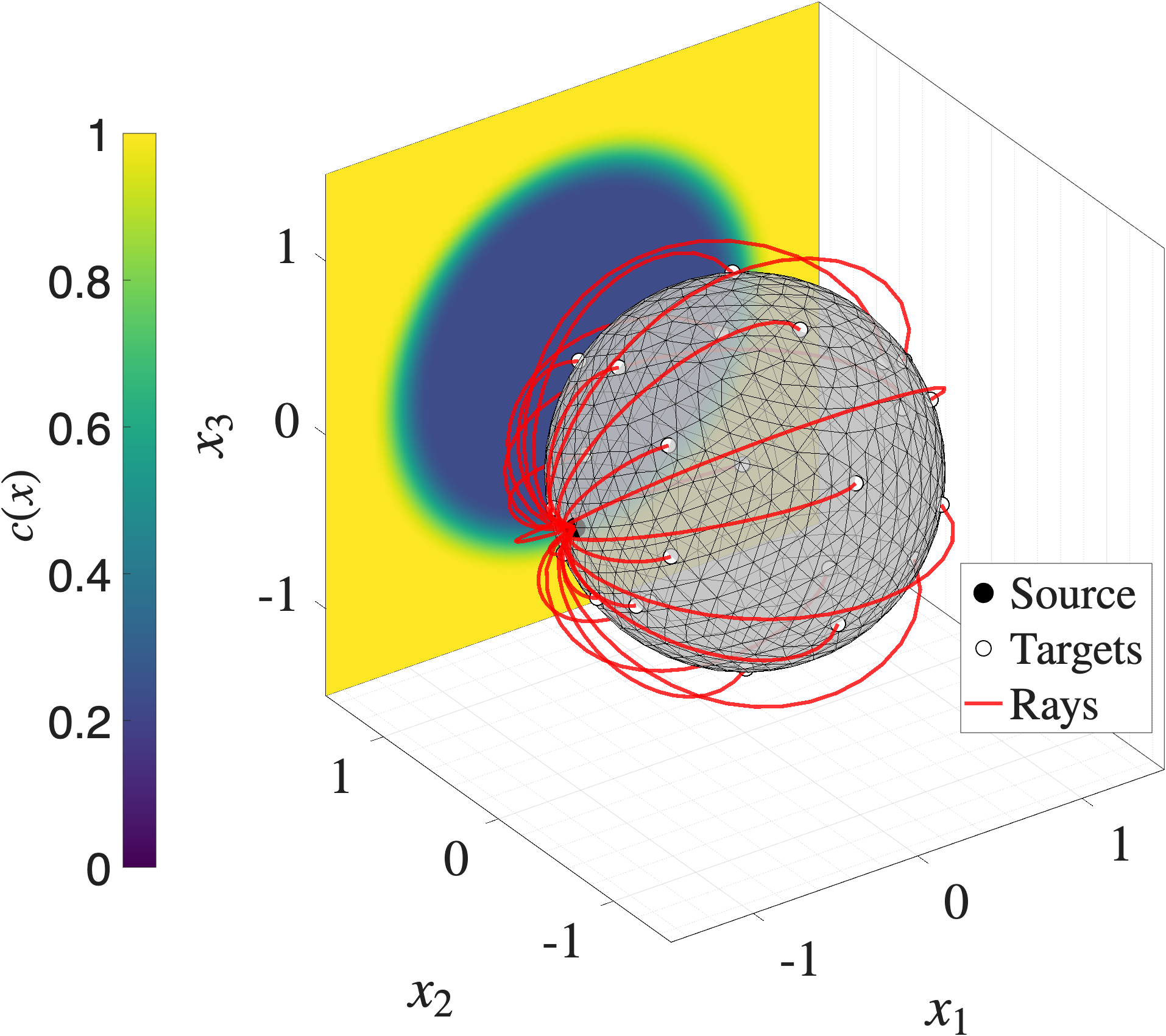
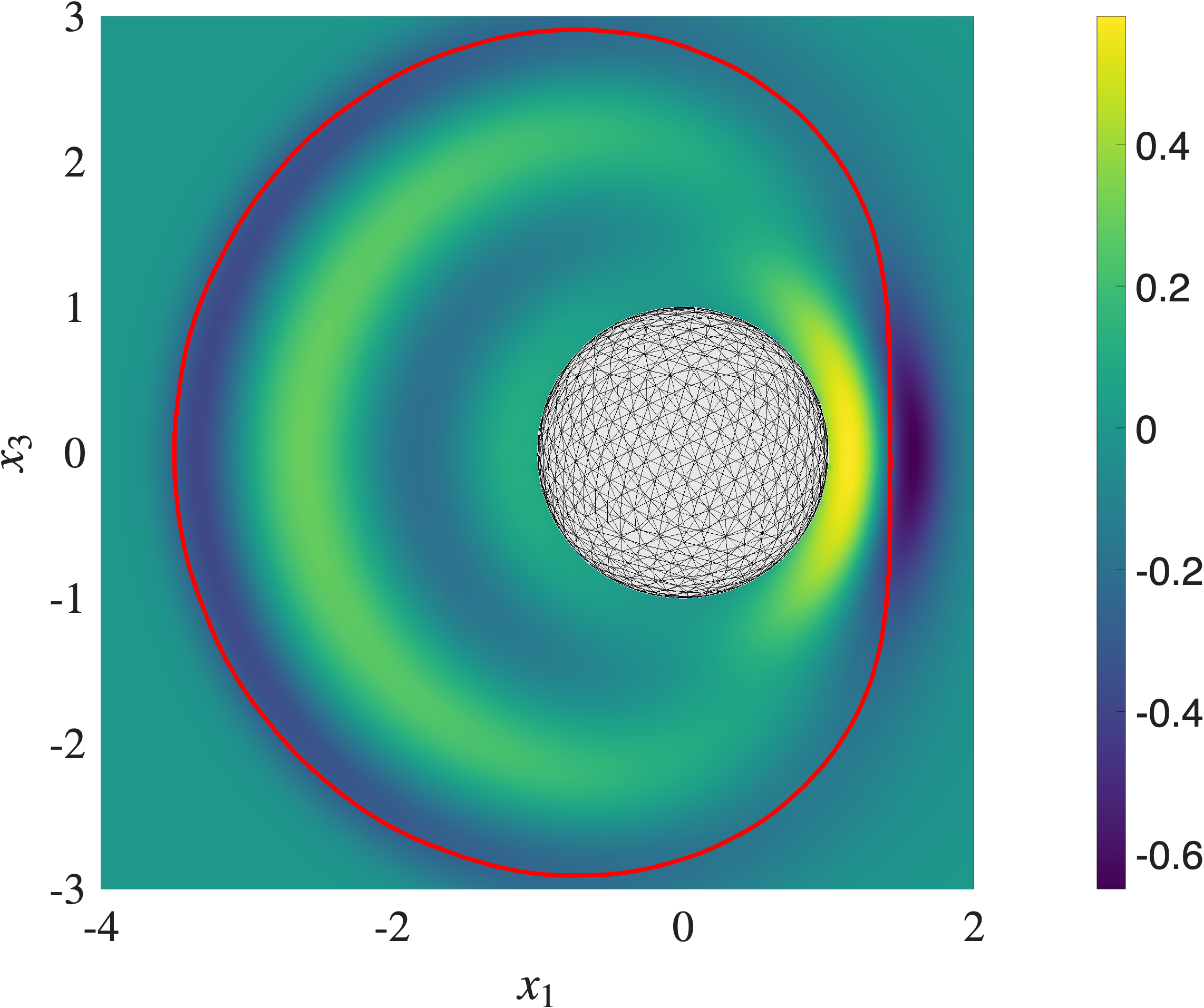
Figure 3: Sound-speed field with representative rays demonstrating refraction around a slow spherical inclusion (gas bubble).
- Spatio-Temporal Heterogeneities: In problems with spatial and temporal variations (e.g., a rising hot fireball in an atmospheric context), the method correctly predicts arrival time shifts and spreading of scattered signals, consistent with physical intuition for localized refractive inclusions.
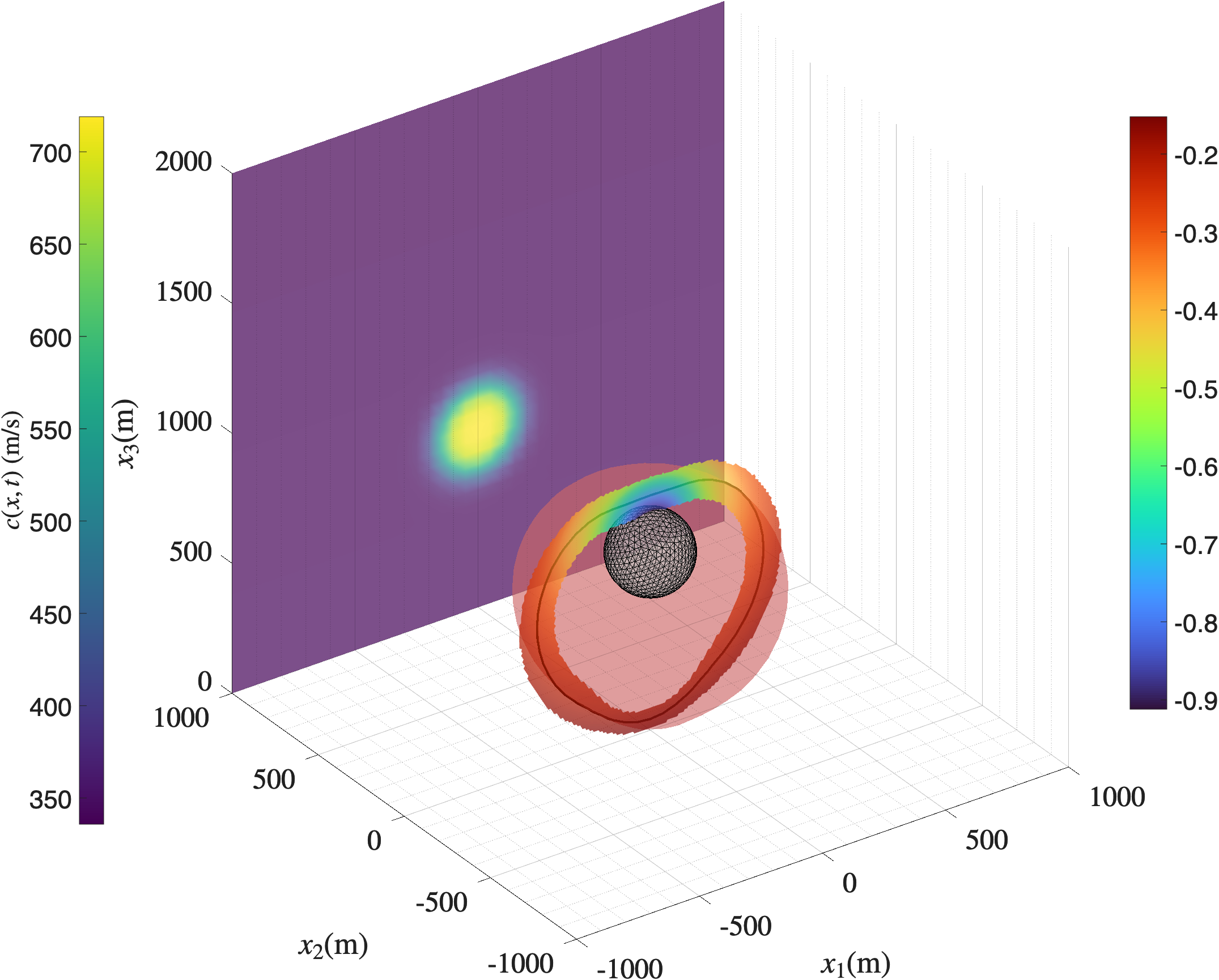
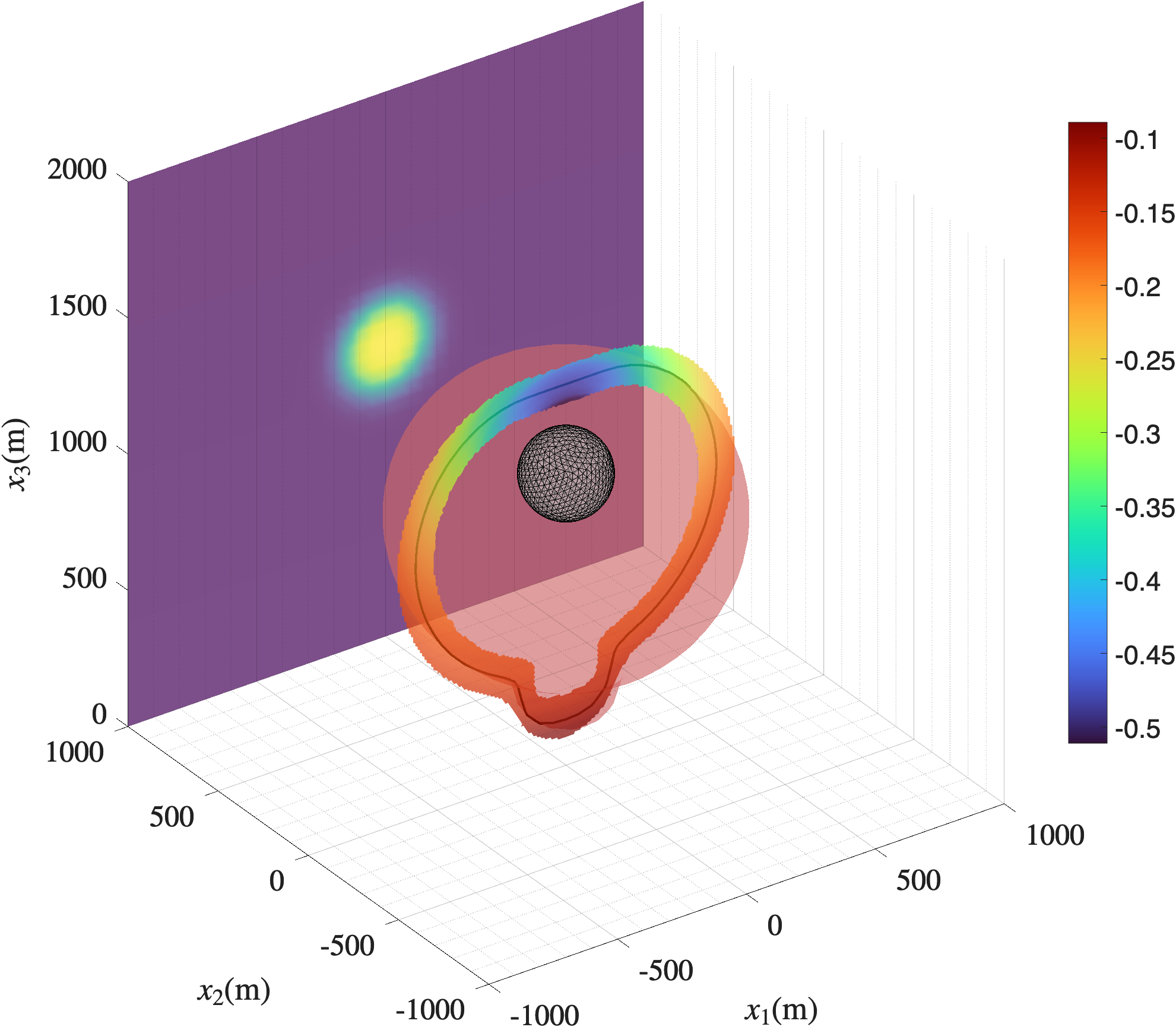
Figure 4: tphys snapshot of the reflected wavefront and scattered potential, showing refractive defocusing induced by a rising hot fireball.
Notably, strong agreement is demonstrated between the boundary integral and finite element solutions in benchmark exterior-problem cases with time-dependent sound speed, validating the boundary-only approach against volumetric discretizations.
Practical and Theoretical Implications
This boundary integral method can be immediately applied to wave scattering, acoustic signal propagation, and aeroacoustic simulations with moving boundaries and refractive media. The avoidance of volumetric discretization confers substantial computational savings and geometric flexibility, particularly for situations featuring complex boundary motion with subsonic velocities.
On the theoretical side, the explicit jump relation for the DL operator with moving boundaries provides a concise characterization of Doppler effects within a boundary-only framework. The geometric-optics parametrix forms a bridge to high-frequency asymptotics and can be further extended to capture caustics and multi-path phenomena, potentially by incorporating more sophisticated ray tracing and amplitude models.
Future Directions
Key avenues for future research include:
- High-order quadrature strategies for improved spatial accuracy;
- Stable Galerkin discretizations for large-scale computations;
- Parallelization and acceleration techniques (e.g., fast multipole and convolution quadrature);
- Extension to coupled interior-exterior transmission problems with variable coefficients;
- Integration as a fine-scale solver within hybrid Eulerian-Lagrangian frameworks for multi-scale simulations (e.g., turbulence, compressible flows).
Further exploitation of geometric-optics machinery—for caustics, amplitude transport beyond leading order, and robust travel-time computation—will enhance the method's fidelity and applicability to broader classes of wave propagation problems across physics and engineering.
Conclusion
This work establishes a boundary-only integral method for linear wave scattering accommodating heterogeneous media and moving obstacles. By leveraging a geometric-optics parametrix and efficient causal geometry representations, the method achieves boundary-only discretization without sacrificing physical accuracy, resolving complex wave phenomena including Doppler shifts, refractive defocusing, and bypass ray geometry. Stable performance is demonstrated numerically with strong qualitative agreement to volumetric reference solutions. The approach opens pathways to efficient, scalable simulation of wave dynamics in challenging environments, with potential for both theoretical refinement and practical deployment in high-fidelity acoustic and electromagnetic scattering applications.