- The paper introduces a unified certificate-based framework that quantitatively verifies observational properties in partially observed stochastic systems.
- It reduces verification to automata-guided reachability analysis, leveraging barrier certificates synthesized by neural networks for scalable performance.
- Empirical evaluations on stochastic linear systems demonstrate high probabilistic guarantees, achieving bounds with p ≥ 0.9699 on dense validation grids.
Certificate-Based Unified Verification for Observational Properties in Stochastic Systems
Overview and Motivation
This paper addresses rigorous verification of observational properties in partially observed stochastic dynamical systems with continuous state spaces. Observational properties, central in estimation and information-flow security, formalize the inferences an external observer can make from system outputs, encapsulating classical notions such as (approximate) detectability, opacity, and diagnosability. Historically, these notions have been studied with highly tailored, property-specific techniques and typically over deterministic or discrete-event dynamics.
The core innovation of this work is the synthesis of a unified certificate-based framework. This approach enables the quantitative verification (with probabilistic guarantees) of a rich class of hyperproperties—expressed as probabilistic finite-trace HyperLTL formulas—without requiring discretization or abstraction of the continuous state space. The framework leverages stochastic barrier certificates synthesized via neural architectures for automated, scalable verification.
The paper generalizes the structure of partially observable discrete-time stochastic systems (POSS) as Markov processes on Borel spaces, with state evolution
xt+1=f(xt,wt)
where wt denotes stochastic noise, and output spaces represent the partial observability. Observational indistinguishability is parameterized via an ϵ-approximate output equivalence, capturing the measurement precision. Fundamental estimators—initial-state and current-state estimates—are defined as set-valued functions over all trajectories indistinguishable with ϵ accuracy.
Within this complex setting, the authors systematically formalize several significant properties:
- Approximate (ϵ,p,λ)-Detectability: The state estimator’s error diameter must be below λ with probability at least p,
- Approximate (ϵ,p)-Opacity: For secret states XS, the observer cannot infer membership in XS with probability at least wt0.
Crucially, unlike prior work, the paper’s definitions are made metric-aware and explicitly parameterized by observation precision.
Unified HyperLTL-Based Property Specification
The inherent relational (hyperproperty) nature of observational properties—requiring reasoning over pairs (real and hypothetical) of trajectories—motivates their encoding as finite-trace HyperLTL formulas with quantification over trace variables:
wt1
where temporal formulas wt2 can refer to atomic relations between two traces (e.g., indistinguishability predicates). For example:
- Approximate Detectability:
wt3
wt4
This uniform specification enables handling a broad suite of properties within a single verification pipeline.
Reduction to Automata-Guided Reachability
The HyperLTL formulas are compiled to deterministic finite automata (DFA) over predicates parameterized by the state-pair dynamics. The system verification problem is reduced to a reachability analysis on an augmented verification structure:
- State space: Product of two system states and the DFA state.
- Dynamics: One trajectory (the real system) evolves stochastically; the other is adversarially selected (reflecting existential or universal quantification, depending on the property).
- The overall task becomes evaluating, for all initial states, whether the probability (under adversarial or supportive selection of hypothetical traces) of reaching a DFA-accepting state meets or exceeds a target wt5.
This connection allows deploying scalable value-function-based reasoning instead of full-blown state-space exploration, which is infeasible in the continuous setting.
Barrier Certificate Framework
The technical centerpiece is the extension of stochastic barrier certificates—originally used for safety, reach-avoid, or non-probabilistic reachability—to this adversarial-stochastic product space. Two variants are developed:
- Universal-TRBC (wt6-TRBC): Provides lower bounds for properties requiring adversarial trace quantification (e.g., detectability).
- Existential-TRBC (wt7-TRBC): Provides lower bounds for properties with existential quantification (e.g., opacity).
Synthesis conditions are formulated such that recursively, at each time step, the certificate bounds future reachability with worst/best-case (as appropriate) adversarial selection, avoiding discretization.
Guarantee: Given suitable certificates satisfying these properties, the satisfaction probability bound for the observational property can be certified for all initial states.
Neural Synthesis and Case Study
For practical certificate synthesis in complex, nonlinear, or high-dimensional systems, the framework employs deep neural networks to approximate the certificate function wt8. The learning objective encodes the barrier certificate constraints as differentiable loss terms, balancing terminal and recursive constraints and regularization to avoid degenerate solutions. Training leverages Monte Carlo estimation for integrals and min/max (adversarial) terms.
As an empirical demonstration, a scalar stochastic linear system is evaluated for wt9-approximate detectability (with ϵ0) over a horizon ϵ1. The neural certificate was trained over ϵ2 trajectory pairs, converging to a nontrivial (nontrivially positive ϵ3, tight ϵ4) bound with no post-training violations over a dense validation grid.
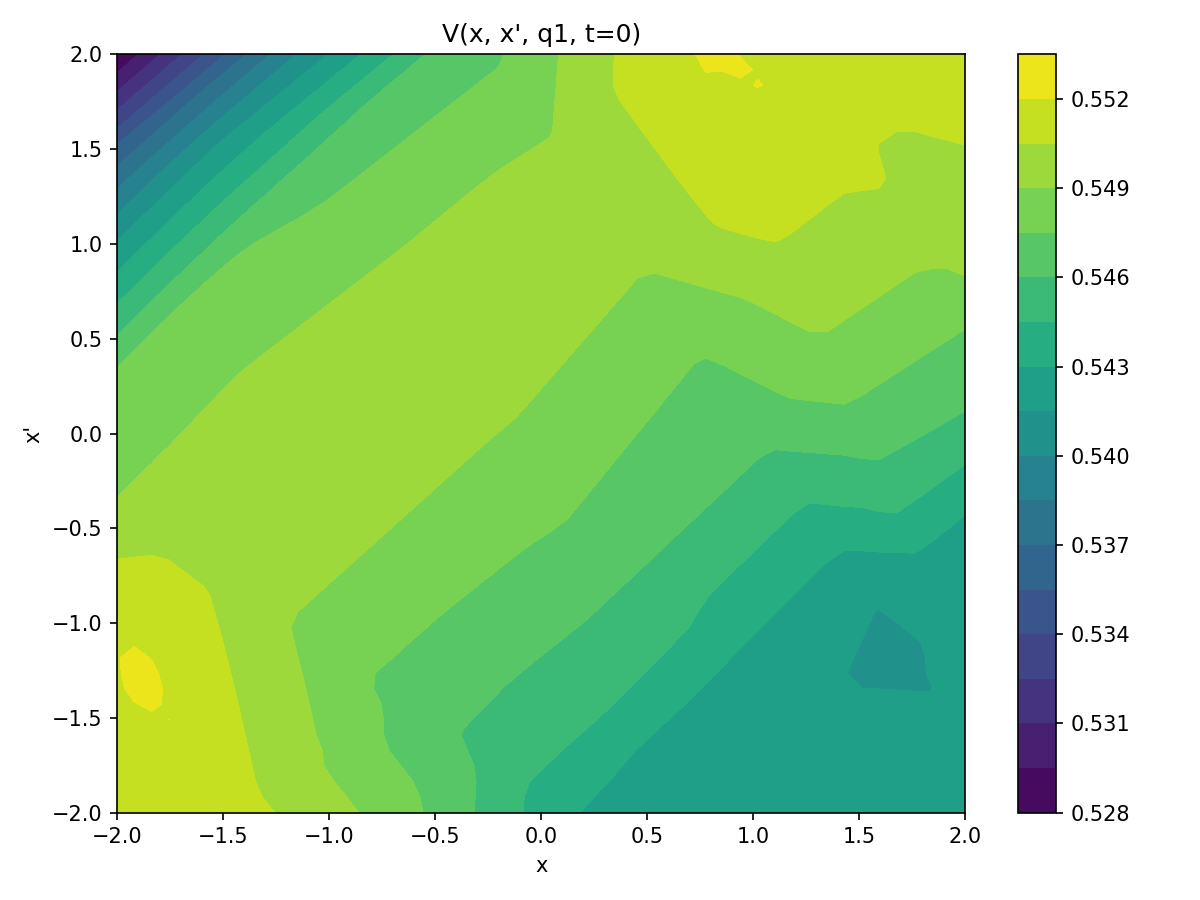
Figure 1: The value of the certificate ϵ5 at time instant ϵ6 exhibits positive lower bounds uniformly across initial product state pairs.
Discussion and Implications
- Theoretical Implications: This method subsumes case-by-case techniques into a principled, automata-guided verification procedure for a wide array of properties. By operating directly in the continuous (or hybrid) domain and leveraging the expressiveness of HyperLTL, it avoids ad-hoc reductions and compositional reasoning residues.
- Practical Implications: The neural certificate synthesis paradigm, in combination with the automata-based reduction, enables scaling to large, complex, or nonlinear systems, where symbolic algebraic methods collapse. The method provides not only verification but also quantitative lower bounds on property satisfaction probabilities.
- Contradictory/Strong Claims: The paper asserts that without discretization, verification of probabilistic hyperproperties over continuous-state stochastic systems is feasible using this framework, a claim supported by nontrivial empirical results.
- Limitations and Future Work: While the framework is general, completeness is not established—certificate existence is only sufficient, not necessary. Synthesis may be hindered by training difficulties or poor expressivity for specific architectures. Future research directions include extending to controller synthesis under partial observability and further scaling or formalizing soundness-completeness tradeoffs for neural certificates.
Conclusion
This paper establishes a unified, automata-barrier-certificate-based framework for the probabilistic verification of generalized observational hyperproperties in continuous-state stochastic systems. The approach enables rigorous, probabilistic, and numerically sound guarantees over a broad class of properties, confirmed via neural certificate synthesis in challenging settings. The pipeline fuses developments in hyperproperty specification (HyperLTL), automata-theoretic reduction, and data-driven barrier certificate methodologies, promising broad applicability in safety, security, and information-flow reasoning for CPS and stochastic control domains.
Reference: "Certificates Synthesis for A Class of Observational Properties in Stochastic Systems: A Unified Approach" (2604.04067).