- The paper introduces a neural dual warm-start framework that reliably predicts feasible duals, ensuring optimality in LAP solvers.
- It employs a row-centric architecture with compact feature vectors and a sparse k-NN refinement, reducing augmenting path work by ~68%.
- Empirical results demonstrate speedups up to 4x on large instances and robust zero-shot generalization to urban transportation and tracking tasks.
Learning-Augmented Scalable Linear Assignment Problem Optimization via Neural Dual Warm-Starts
Motivation and Limitations of Current Approaches
The Linear Assignment Problem (LAP) is a central primitive in combinatorial optimization with applications in multi-object tracking, resource scheduling, and logistics. Classical algorithms such as the Hungarian and Jonker-Volgenant (LAPJV) guarantee optimality but scale poorly due to their O(N3) complexity. Recent neural approximations using GNNs attempt to directly predict assignments, but these approaches cannot guarantee exactness, struggle on hard constraints, and exhaust memory for large N since their architectures scale at least quadratically with N. There now exists increasing demand for assignment solvers that are both fast, exactly optimal, and practical at scale.
Neural Dual Warm-Starting: Framework and System Design
The authors introduce a learning-augmented dual warm-starting framework, which leverages neural networks as a systems accelerator rather than as a solver replacement. Namely, their model, RowDualNet, is trained to predict row-based continuous dual variables. These predictions are guaranteed to be feasible via a dual construction (the Min-Trick: vj=mini(Cij−ui)), ensuring that primal-dual constraints are satisfied for the LAP, and all solutions remain optimal post-resolution by the exact solver. This mechanism is illustrated in the overall pipeline.
A critical aspect is the row-centric architecture. Instead of exposing the network to the full N×N cost matrix, they generate a compact feature vector for each row, capturing statistical properties, ambiguity, competition, and positional encodings. The RowDualNet is row-independent, with a sparse refinement module to communicate instance-specific structure using a k-NN interrogation over columns per row, which efficiently captures instance-salient global competition without incurring quadratic memory growth.
A fallback mechanism is embedded, testing the quality of the neural seed by evaluating the average degree of the induced equality subgraph; if predicted duals are of low quality, the method reverts to traditional initialization, preserving worst-case O(N3) guarantees.
Theoretical Guarantees: Exactness and Complexity
By construction, any predicted (u^,v^) duals are feasible; passing these duals to LAPJV preserves exact optimality due to the algorithm's correctness and complementary slackness. Unlike prior work, no post-hoc projection or repair is needed thanks to the Min-Trick.
The pipeline's computational complexity remains O(N3), with the neural preprocessing (feature extraction, network inference, column dual construction, and quality checking) introducing just O(N2logN) overhead, which becomes negligible for large N0.
Experimental Evaluation
The empirical evaluation is comprehensive, targeting both synthetic (uniform, block-structured) and real-world (OpenStreetMap urban transportation, multi-object tracking) datasets. All experiments include end-to-end wall-clock timing, including all CPU-GPU communication and neural overhead, and verify a strict zero optimality gap across all runs.
Synthetic Datasets
The warm-start method demonstrates consistent end-to-end speedup factors N1 on large dense instances (N2) and up to nearly N3 against highly tuned C++ baselines on structured data. Notably, runtime variance, a major concern for real-world engineering, is severely reduced compared to traditional heuristics—coefficient of variation drops from ~45% to ~30%.
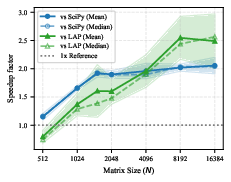
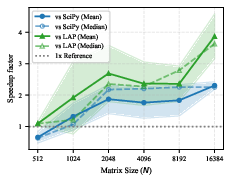
Figure 1: End-to-end speedup factors by matrix size N4 on dense models; performance and stability gains become pronounced for N5.
Generalization to Urban Transportation Networks
Remarkably, the same model trained solely on synthetic data generalizes robustly to cost matrices derived from real road networks (OpenStreetMap). Here, it maintains a speedup of N6–N7 over both SciPy and LAP, demonstrating effective zero-shot generalization and encoding of universal assignment structure priors.
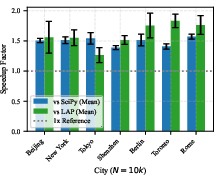
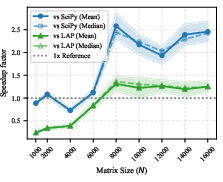
Figure 2: Speedups on OSM-derived transportation networks across seven metropolises, showcasing robust transfer without fine-tuning.
Multi-Object Tracking
On substantially structured cost matrices extracted from large-scale multi-person tracking datasets, the method sustains a N8 speedup relative to the fastest state-of-the-art LAP solvers for N9.
Mechanism Dissection and Ablation
Extensive solver work analysis shows that the principal acceleration source is the increased coverage of the greedy matching step. Neural dual warm-start allows the solver to instantaneously resolve N0 of assignments (as opposed to N1 for cold-start heuristics), resulting in a N2 reduction in expensive augmenting path work.
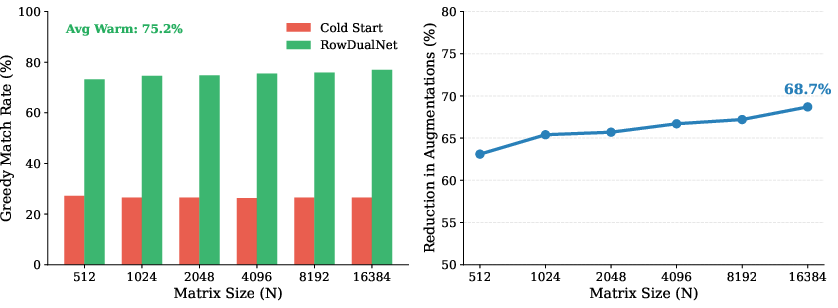
Figure 3: Neural warm-starts allow immediate greedy matching of 76% of assignments, reducing augmenting path computation by 68% compared to cold starts.
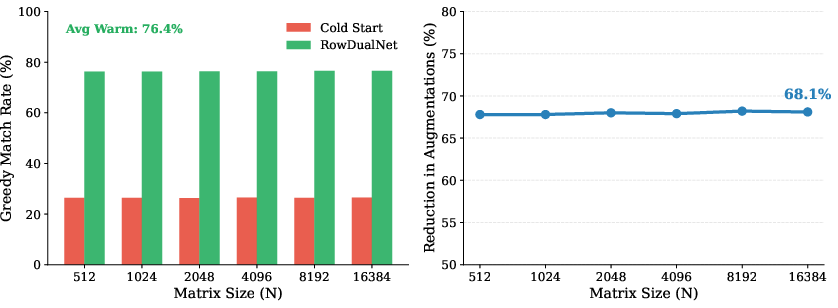
Figure 4: Consistent results are observed in dense models: cold-starts match only 27%, neural dual seeds match 76.4% upfront.
Ablation results demonstrate that both simple statistical heuristics and shallow (linear) models fail to provide speedup on large N3; only the full deep RowDualNet sustains robust and growing acceleration at industrial scales.
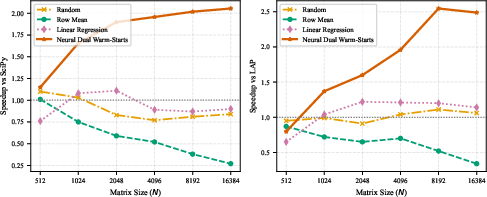
Figure 5: Linear regression and heuristic initializations offer no scalable benefit; deep RowDualNet maintains acceleration to the largest addressed instances.
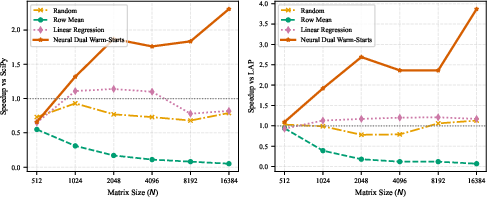
Figure 6: In structured models, only deep neural feature extraction can disentangle group-level structure and provide sustainable speedups.
Comparison with Prior Learning-Augmented Methods
Relative to prior learned duals approaches that use static median/mean-based prediction [dinitz2021faster], the proposed architecture is substantially more expressive and scalable. The median dual baseline cannot adapt to instance-level noise or group structure, rapidly degrading for problem sizes beyond those handled in previous studies.
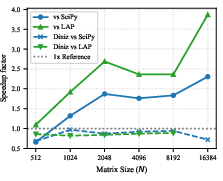
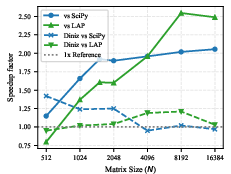
Figure 7: Dinitz et al. (2021)’s static learned median baseline fails to scale or match instance noise, providing no gain for large instances; neural seeds maintain robust speedup.
Robustness and Safety
A critical practical contribution is establishing that the fallback safety mechanism ensures no asymptotic penalty. On adversarial out-of-distribution shifts (e.g., geometric distance matrices), the fallback triggers reliably, and the neural overhead becomes negligible for large N4.
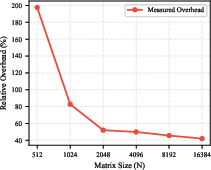
Figure 8: The neural overhead for failed warm-start seeds vanishes for large N5, ensuring safety at scale.
Implications and Future Directions
Practically, these results validate that large-scale, exact combinatorial solvers can be accelerated by neural instance-specific guidance with mathematically guaranteed safety—enabling deployment in latency-constrained, large-instance industrial and scientific applications such as city-scale logistics optimization and large-scale tracking. The framework holds promise for other combinatorial primitives (e.g., min-cost flow) and motivates future research into partially-supervised or unsupervised dual estimation for combinatorial problems lacking global optimal dual training signals.
Theoretically, the results reinforce the view that neural networks can effectively learn competitive structure metrics that guide dual ascent/k-augmentation dynamics, providing a foundation for more general “learning-augmented” primal-dual optimization frameworks. Furthermore, the observed runtime stabilization is critical in safety-critical decision systems.
Conclusion
This work presents a scalable, exactly optimal, and robust learning-augmented architecture for the linear assignment problem. It achieves strong, stable, and generalizing acceleration of standard cubic-time solvers for unprecedented problem sizes. By combining deep non-linear feature extraction, dual LP construction, and conservative safety engineering, it delivers practical advances toward real-time combinatorial optimization that do not sacrifice correctness or tractability.