- The paper introduces a unified rough path framework that formulates signature and Schwinger-Dyson kernel equations as two-parameter rough differential equations.
- It develops novel controlled rough path theory on rectangular and simplicial domains, establishing well-posedness, stability, and implementable numerical schemes.
- The work provides rigorous convergence analysis and highlights practical implications in machine learning and quantum field theory through explicit complexity bounds.
Signature Kernel and Schwinger-Dyson Kernel Equations as Two-Parameter Rough Differential Equations
Introduction and Motivation
This work introduces a comprehensive rough path-theoretic framework for two-parameter rough differential equations (RDEs) on both rectangular and simplicial domains. The motivation is rooted in the analysis of two canonical objects: the signature kernel equation and the Schwinger-Dyson (SD) kernel equation. Both arise in contexts where the driving signals are of low regularity and classical integration fails. The signature kernel underpins various methods in sequential data analysis and nonparametric statistics, while the SD kernel emerges in the study of limits of random unitary developments and in quantum field theory settings.
Theoretical Foundations: Two-Parameter Controlled Rough Paths
The pivotal technical advancement is the development of controlled rough path theory in two parameters. Introducing spaces of jointly controlled rough paths, the authors extend robust notions of rough integration to rectangular and, crucially, simplicial (triangular) domains. This construction evolves the theory beyond the p-variation regime previously handled for rectangles in Cass and Pei [cass2023fubini] and two-parameter controlled paths in Gerasimovičs and Hairer [gerasimovivcs2019hormander]. The definition of joint control is based on regularity and compatibility of pathwise expansions in both directions and their higher-order remainders with respect to the controlling rough signals.
For geometric rough paths X,Y on V,W, a two-parameter controlled path Z is defined via increment expansions separately in each parameter, together with higher-order cross-remainders that satisfy refined joint variation bounds. The main outcome is a Banach algebraic structure on the space of such controlled maps, supporting nonlinear transformations and integrations.
Two-Parameter Rough Integration over Rectangles and Simplices
A central technical result is the construction of a two-parameter rough integral: ∫[a,b]×[c,d]Zs,ud(Xs,Yu)
that generalizes the joint Young and rough integrals. The rough Fubini theorem is verified, establishing the equivalence of iterated and joint two-parameter rough integration for controlled integrands.
The framework is extended to integration over simplices, which is essential for analyzing the SD kernel equation written on domains Δ[s,t]. The simplex integral is constructed via symmetrization, resulting in an integral over the square [a,b]2 that returns the desired domain upon restriction.
Well-Posedness, Stability, and Nonlinear Equations
The authors advance a fixed-point formulation for two-parameter RDEs, encompassing both the signature and SD kernel equations:
- Rectangular case (signature kernel):
Zt,v=z+∫[a,t]×[c,v]g(Z)s,ud(Xs,Yu)
- Triangular case (SD kernel):
Zs,t=z+∫Δ[s,t]g(Zs,⋅,Z)u,rd(Xu,Xr)
A major technical achievement is showing that local (and by extension global) well-posedness holds for these classes of nonlinear two-parameter rough equations. Smooth transformation of controlled paths is rigorously established, allowing nonlinearities in the equations. Quantitative stability results are demonstrated: solutions depend continuously on the driving rough signals and the initial data, in particular, with explicit regularity-dependent estimates.
Signature Kernel as a Rough Differential Equation
It is established that the signature kernel equation,
K(t,v)=1+∫at∫cvK(s,u)⟨dXs,dYu⟩,
is a canonical instance of the general two-parameter RDE. Uniqueness and continuous dependence on the underlying rough paths are proved. In the smooth-rough path regime (where X,Y0 are smooth), the equation recovers a PDE formulation, previously derived through other means [lemercier2024log].
Schwinger-Dyson Kernel Equation in the Rough Regime
The paper rigorously extends the SD kernel equation
X,Y1
from bounded variation to arbitrary geometric rough paths. Existence and uniqueness in the class of two-parameter controlled rough paths are established. The equation is shown to uniquely characterize the free-probability scaling limit of certain random unitary evolutions.
In the smooth regime, the system reduces to a well-structured, closed integro-differential system involving the trace and higher-order components, with the structure induced by non-crossing partition combinatorics. This analytic re-expression is key for qualitative and numerical analysis.
Numerical Approximation and Complexity
A direct outcome of the theory is an implementable numerical scheme for the rough SD equation. Iterative algebraic expansion using non-crossing matchings is the core of the algorithm. Detailed runtime and memory complexity analysis is carried out: for a grid of size X,Y2 and tensor algebra of rank X,Y3, the asymptotic runtime is shown to scale as X,Y4.
Empirical studies (Figure 1) demonstrate that the observed runtime matches the theoretical complexity and highlight the polynomial dependence on the structural parameters.
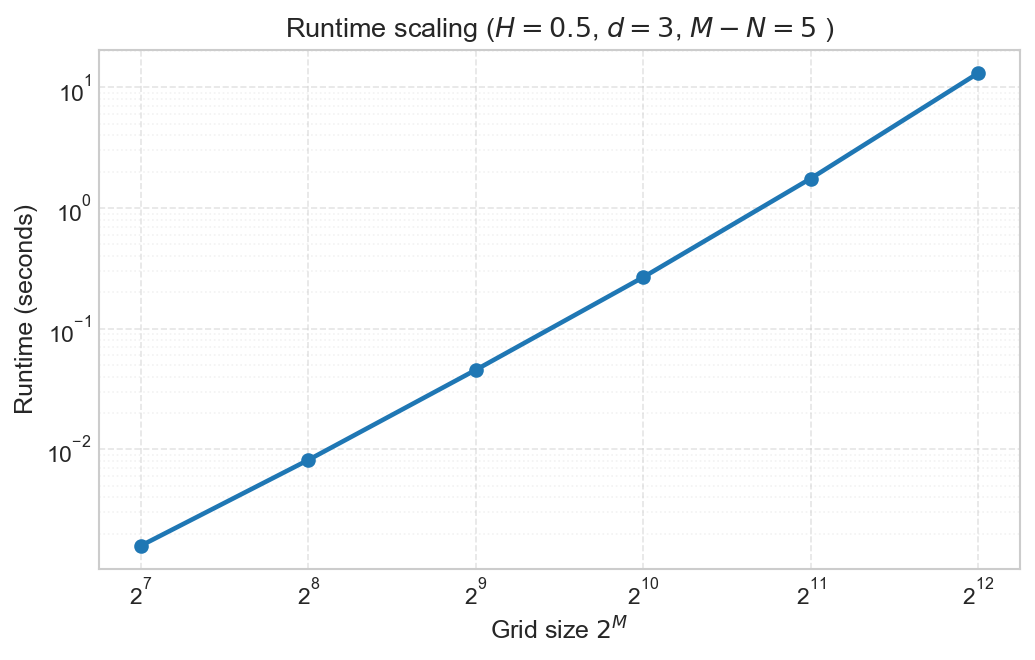
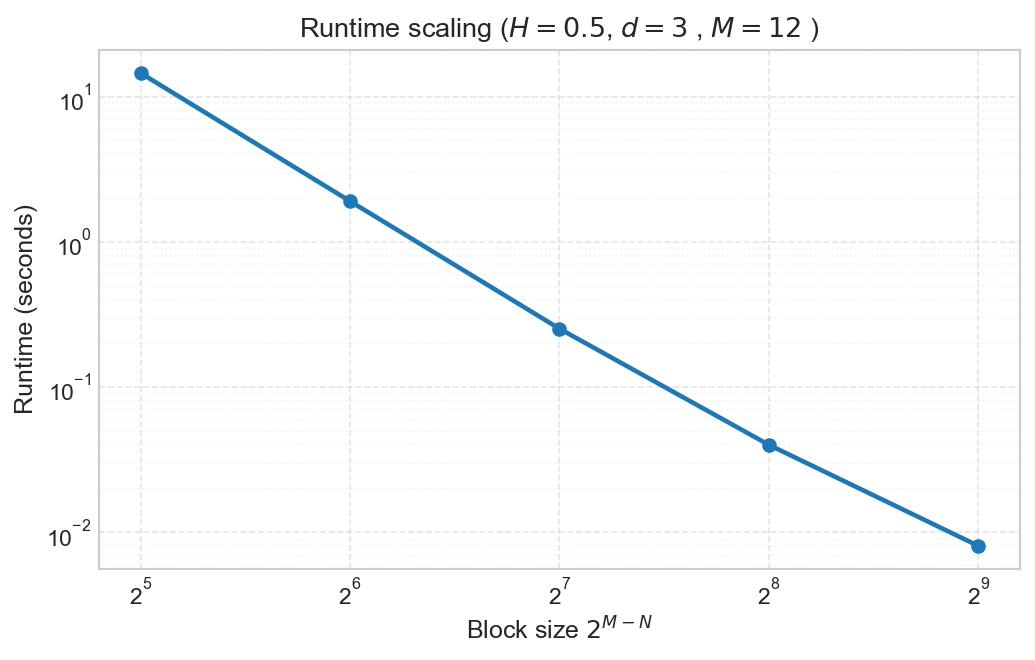
Figure 1: Runtime as a function of the grid size X,Y5, illustrating the superlinear scaling of the proposed SD kernel solver.
The stability and accuracy of the schemes are compared across regimes of regularity, showing that discrepancies between successive approximation orders become more pronounced as the path regularity deteriorates.
Implications and Future Directions
This work constitutes a foundational advance in the analytic and numeric theory of two-parameter rough differential equations, unifying approaches to signature and SD kernels under a coherent and extendable framework. It enables robust and tractable analysis of stochastic kernels on path space, with direct implications for machine learning (notably kernel-based methods for sequential data), universal scaling limits in random matrix theory, and stochastic models in mathematical physics.
Future research avenues include:
- Extension to higher-parameter rough integration and rough PDEs.
- Optimization of numerical schemes, perhaps exploiting sparsity or low-rank structure in the tensor algebra.
- Applications to learning generative models on path space, including adversarial and score-based paradigms.
- Investigation of regularity and support properties of SD kernels for drivers with jumps or inhomogeneous roughness.
Conclusion
This paper establishes the robust analytic and computational machinery necessary for handling nonlinear, two-parameter rough differential equations on path spaces. The resolution of existence, uniqueness, stability, and numerics for the signature and Schwinger-Dyson kernels positions the work as a reference for high-dimensional, low-regularity stochastic analysis. Its framework is poised to significantly impact both theoretical and applied developments in stochastic analysis, machine learning, and mathematical physics.

