- The paper introduces FedGMI, a framework that leverages VAEs for modeling client data as convex mixtures of inherent distributions and estimating mixture coefficients.
- It decouples the federated learning objective into learning generative VAEs, specialized classifiers, and accurate mixture inference, ensuring both personalization and shared structure.
- The framework demonstrates robust convergence with bounded partition error and superior performance on benchmarks like MNIST, CIFAR-10, and EMNIST.
FedGMI: Generative Model-Driven Federated Learning for Probabilistic Mixture Inference
Introduction
This work addresses the federated learning (FL) challenge of modeling client heterogeneity, particularly for the case where local data distributions are convex mixtures of latent, shared distributions. Standard approaches to FL, namely Clustered Federated Learning (CFL) and Personalized Federated Learning (PFL), have well-known trade-offs: CFL leverages shared structure but ignores client-specific properties, and PFL offers personalization but underutilizes shared information. FedGMI proposes a structured, generative approach to this mixture scenario by estimating the inherent distributions with Variational Autoencoders (VAEs) and inferring the precise mixture proportions for each client. The resulting framework enables more expressive client representation, structured personalization, and theoretically robust learning.
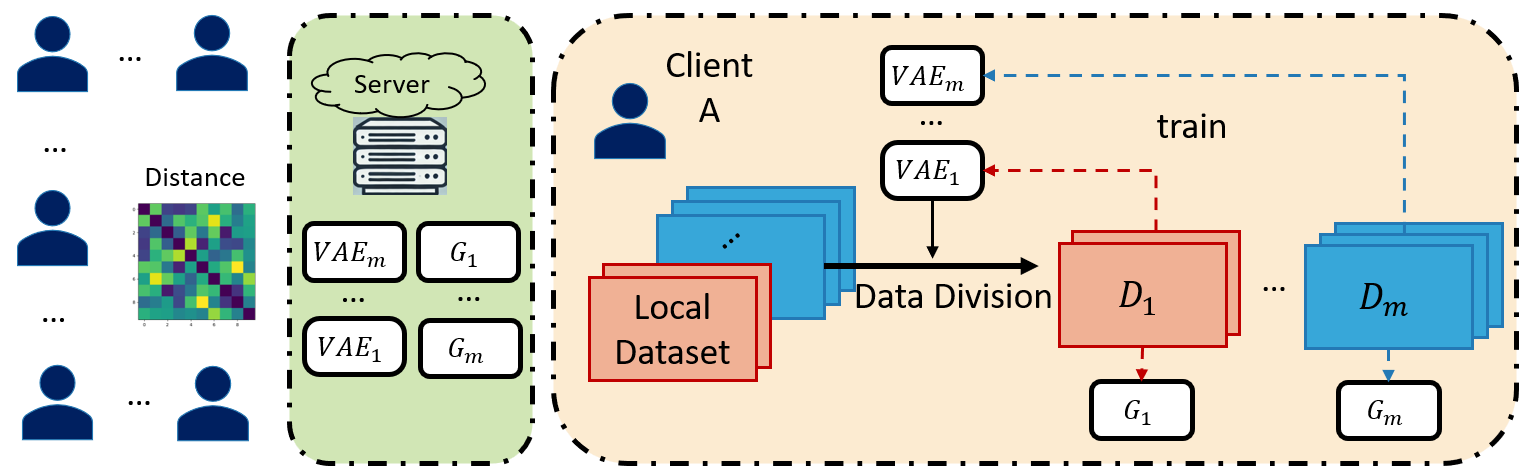
Figure 1: High-level architecture of FedGMI. Local datasets are modeled as mixtures of inherent distributions; data division is performed, VAEs/classifiers are updated, and server synchronization involves aggregation of both VAEs and classifiers.
Core Methodology
FedGMI is formulated for an FL setting with N clients, each sampling their data locally from a distribution pi, which is itself a convex mixture of M unknown, shared "inherent" distributions {qj}j=0M−1:
pi=j=0∑M−1αijqj;αij≥0,j∑αij=1.
The framework decouples the problem into three interlinked tasks:
- Learning the Inherent Distributions: Each qj is modeled by a VAE, acting as both a generative model and density estimator.
- Distribution-Expert Classifiers: For each inherent distribution, a specialized classifier Gqj is learned.
- Mixture Proportion Inference: For each client, the mixture coefficients {αij} are estimated via samplewise assignment using an affinity score closely tied to the VAE log-likelihood.
To assign a sample (x,y) to an inherent distribution, a normalized affinity score l(x,y;qj), proportional to the posterior pi0, is computed using VAE-based likelihoods and current mixture estimates. Efficient data partitioning is then achieved via a MAP principle, and classifier/vae training is performed on these partitions.
A key architectural feature is stable VAE initialization—instead of random parameters, VAEs are initialized to maximize pairwise KL-divergence, ensuring sufficient separation and stable data partitioning. This initialization step is theoretically shown to be necessary for convergence and bounded partition error.
Theoretical Results
A rigorous convergence analysis is provided for the FedGMI framework. Under mild smoothness, convexity, and stable-initialization assumptions, the probability of assignment error for any sample—assigning it to the wrong inherent distribution—is tightly bounded as a function of key system parameters (e.g., number of distributions pi1, data variance, separation parameter pi2 between optima of pi3). The analysis extends via a two-phase argument: first, showing convergence of the data division (partitioning) mechanism, then bounding the global FL objective heterogeneity after partition stabilization.
A critical insight is that as pi4 increases, the optimal locations for the inherent distributions in parameter space approach each other, decreasing pi5 and thus increasing partitioning error. This limitation motivates keeping pi6 small in practical setups and motivates future work on adaptive pi7 selection.
Empirical Results
Experiments extensively validate FedGMI on synthetic and real-world data, using standard FL benchmarks (MNIST, CIFAR-10, EMNIST) under carefully controlled mixture distributions.
Mixture Proportion Estimation:
For pi8 inherent distributions with linear variation of mixture coefficients across clients, FedGMI robustly reconstructs the ground-truth mixture proportions, whereas baselines (IFCA, FedSoft) either binarize client assignment or produce noisy stepwise estimates.
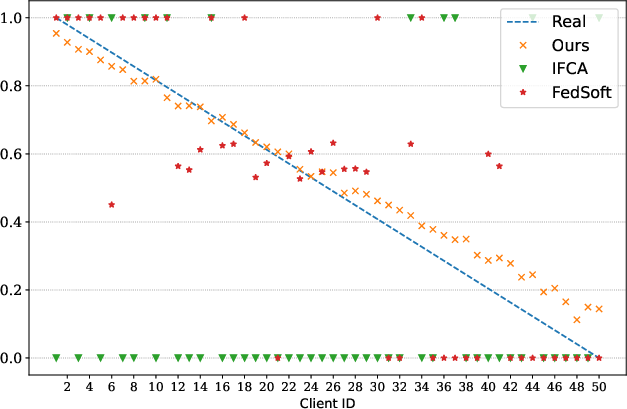
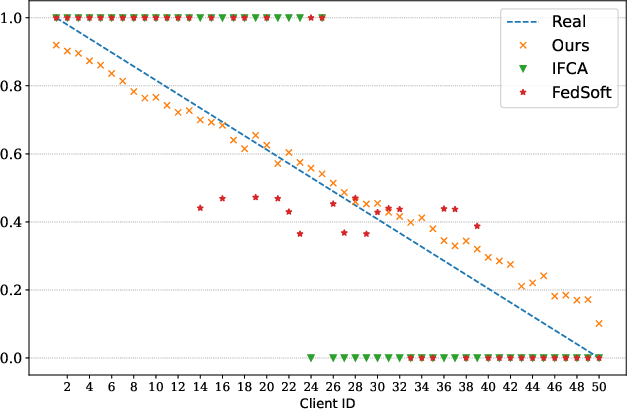
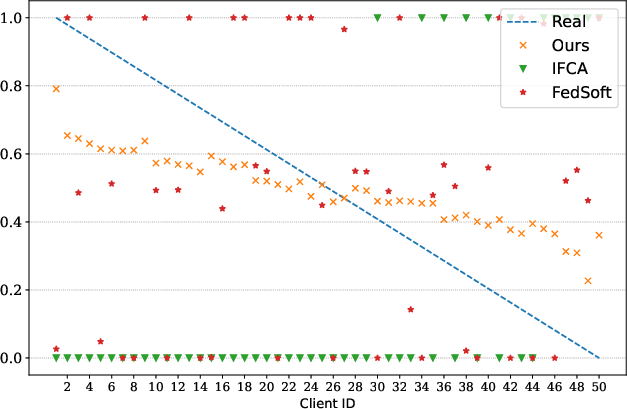
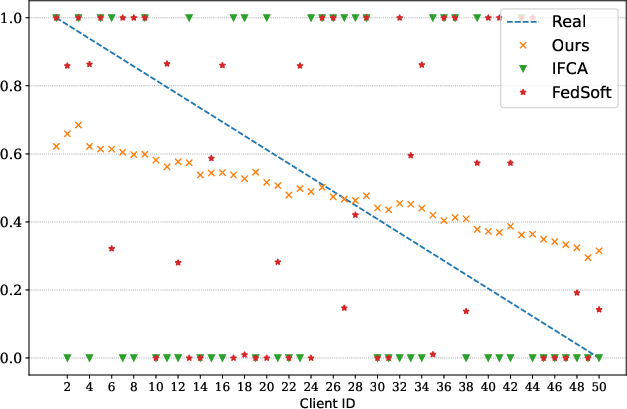
Figure 3: Estimated and ground-truth proportions of pi9 for M0. FedGMI closely tracks true values, especially for simpler data (MNIST) and in both high and low communication regimes.
Specialist Classifier Accuracy:
FedGMI yields classifiers that are highly specialized to their assigned inherent distributions, maintaining very high accuracy on target distributions and large performance gaps on non-target data. This effect is prominent on both MNIST and more complex datasets like CIFAR-10, outperforming alternatives especially in challenging (low-communication, high-heterogeneity) settings.
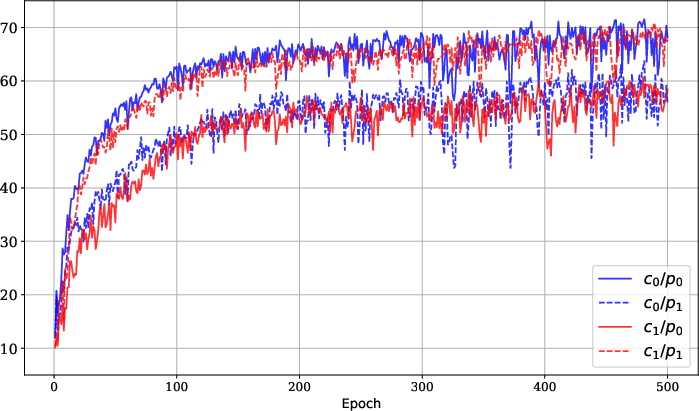
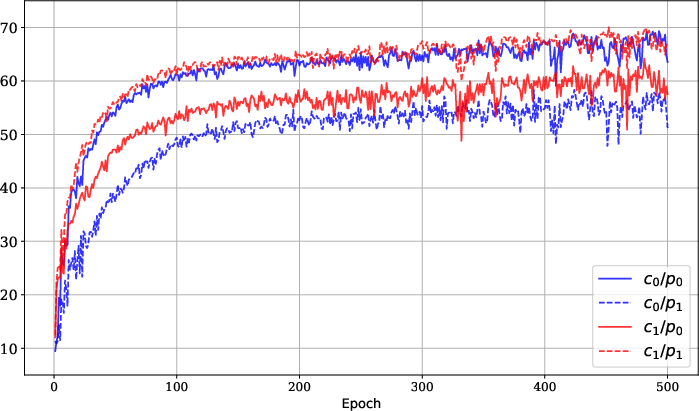
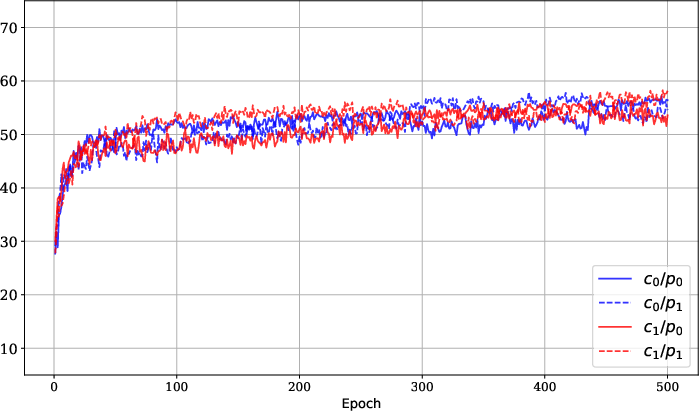
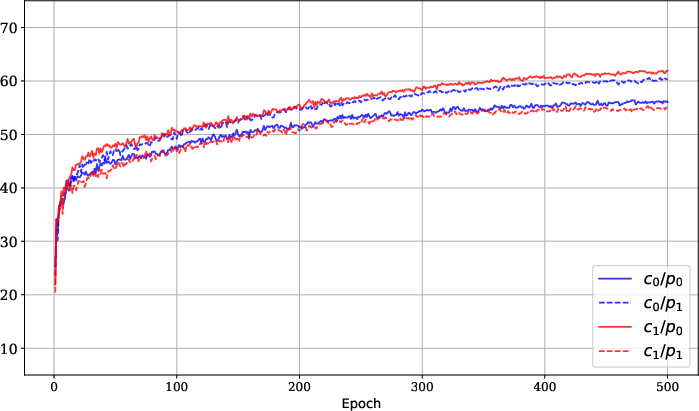
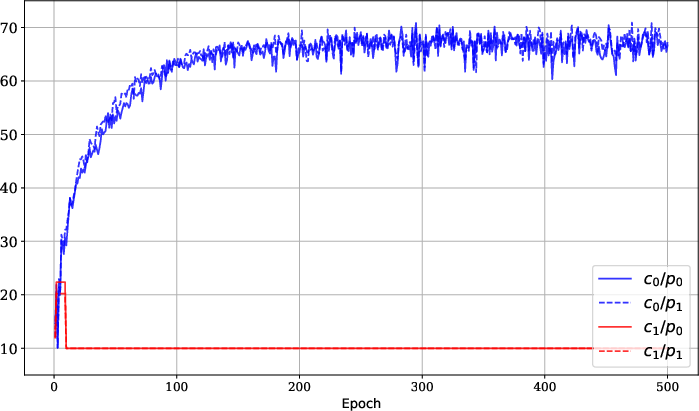
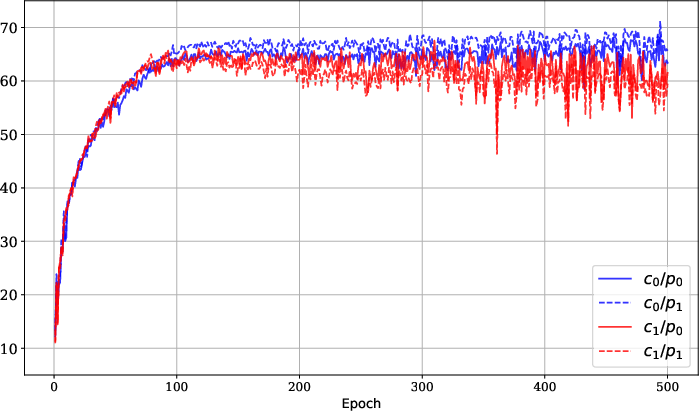
Figure 5: Classification accuracy trajectories (CIFAR-10, M=2). Each line shows performance of a cluster-specialist classifier; a pronounced and sustained accuracy gap appears for cluster-specialized models in FedGMI.
Generative Visualization:
VAE samples generated from each estimated inherent distribution are qualitatively consistent with the true underlying data generative structure (e.g., original vs. rotated images).


Figure 2: Samples synthesized by the two VAEs learned for MNIST (M1): One generates canonical digits, one generates M2-rotated digits, mirroring the dataset construction.
Mixture Estimation under Natural Heterogeneity:
On EMNIST, where inherent distributions correspond to uppercase/lowercase letter morphology rather than synthetic transformations, FedGMI still accurately infers mixture proportions per client and yields specialist classifiers with high and differentiated accuracy.
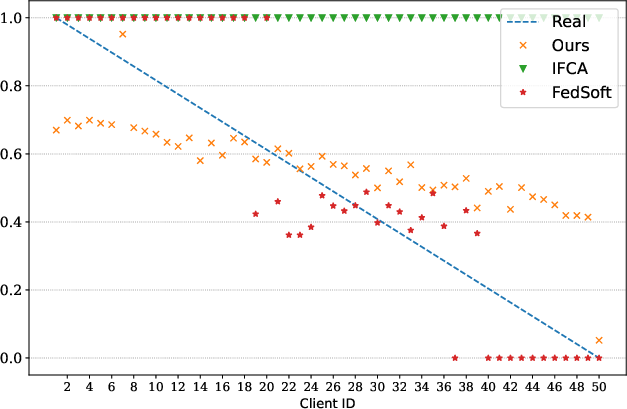
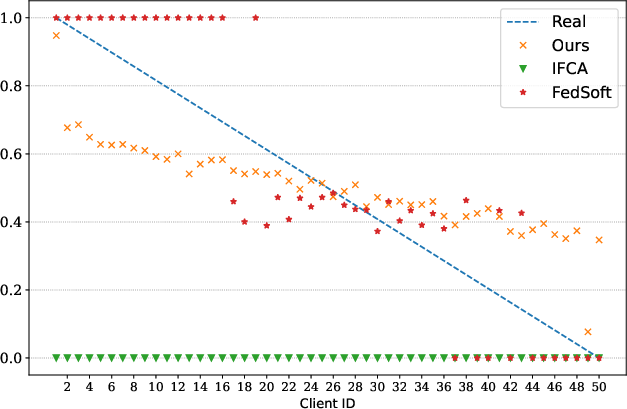
Figure 4: Estimated proportion of uppercase letters per client for EMNIST. FedGMI tracks the ground-truth trend more reliably than alternatives.
Implications and Future Directions
FedGMI introduces a highly structured, generative foundation for probabilistic mixture modeling in federated learning, supporting:
- Accurate client-level heterogeneity modeling and interpretability via mixture decomposition.
- Improved personalized inference and cluster-specific modeling without loss of collaborative efficiency.
- Robustness under communication constraints, benefiting practical deployment to edge devices.
The explicit use of generative models opens further research paths, such as leveraging more powerful generative models (e.g., diffusion models) for richer density estimation, integrating dynamic/adaptive selection of M3, and exploring regularization schemes for higher stability and lower sample complexity.
Conclusion
FedGMI presents a generative, mixture-aware FL framework that moves beyond hard clustering or naive personalization by capturing the shared and client-specific structure jointly. Theoretical guarantees, along with strong empirical performance under both synthetic and real heterogeneity, position FedGMI as an advanced platform for mixture inference and structured personalization in federated systems. Future work should extend to adaptive mixture complexity and to evaluating generative model advances in the federated context.
Reference: "FedGMI: Generative Model-Driven Federated Learning for Probabilistic Mixture Inference" (2605.08760)

