- The paper presents the Core-Halo method that decouples write ownership and read-only context, eliminating bias in decentralized fixed-point computations.
- It mathematically proves that overlapping halo sets exactly preserve fixed points even in systems with cross-boundary dependencies.
- Empirical results across RL, graph algorithms, and control systems validate up to m× iteration speedup and stable convergence with Core-Halo.
Core-Halo Decomposition: Decentralizing Large-Scale Fixed-Point Problems
Overview and Motivation
This paper addresses the decentralized solution of large-scale fixed-point equations of the form x⋆=Fˉ(x⋆), which arise in dynamic programming, RL (e.g., Bellman or SARSA equations), graph computations like PageRank, decentralized control, and implicit deep models. A pervasive challenge in these settings is that while decentralization is computationally attractive, naive disjoint partitioning of variables (i.e., strict decomposition) can yield irreducible bias: if local block updates depend on variables outside the owned block, then strict locality fundamentally alters the fixed-point operator.
To mitigate this, the paper proposes the Core-Halo decomposition. The approach separates write ownership (core) from read-only evaluation context (halo), allowing agents to incorporate cross-boundary information into updates while maintaining disjoint write sets. Core-Halo ensures that the decentralized implementation remains faithful to the intended fixed-point solution under an explicit locality condition. Theoretical analysis demonstrates that strict local decomposition can incur significant and irreducible structural bias, and the Core-Halo framework directly addresses this by matching the operator’s blockwise dependency structure.
Theoretical Framework
Strict Local Decomposition and Its Limitations
Strict decomposition partitions the global variable into blocks owned by individual agents, who are restricted to updating their own block using only locally stored variables. While computationally efficient, it is exact only if the fixed-point operator exhibits block closure: all dependencies in updating block Di must fall wholly within Di. The paper formalizes this obstruction through a bias lower bound, Δi(u), which quantifies the minimum error any strict local rule must incur:
If the update of [Fˉ(x)]Di depends on coordinates outside Di, then any strict local estimator suffers at least Δi(u)/2 bias (see Proposition 2).
This challenge is made explicit for Bellman equations: if state partition Ci is not dynamically closed (i.e., there is a non-negligible probability of transitioning outside Ci), then strict decomposition will not correctly capture the Bellman backup. This leads to systematic structural bias that cannot be mitigated by more samples or additional consensus.
Core-Halo Decomposition
The Core-Halo framework decouples update ownership (core) and read-only context (halo). Each agent i owns a unique disjoint set of coordinates Di0 (the core), but is permitted read-only access to a superset Di1, the halo, which contains all variables needed to faithfully evaluate Di2.
The central theoretical result demonstrates that as long as each halo Di3 covers all arguments of Di4, the averaged lifted Core-Halo operator exactly preserves the original fixed points:
Di5
Thus, under this construction, the decentralized algorithm is equivalent to the original centralized problem in terms of fixed points.
Application to Bellman Operators
For the Bellman equation, strict decomposition is only correct if each state partition is dynamically closed. In contrast, Core-Halo requires only that the one-step successor set of a core falls within the halo. Hence, the Bellman backup for each agent can utilize cross-boundary information from its halo, preserving the fidelity of the global operator without requiring duplicative ownership or writes.
Empirical Validation
The experimental section investigates three main questions:
- Does strict decomposition incur irreducible structural bias?
- Can Core-Halo exactly recover the global fixed-point solution?
- Is the Core-Halo advantage robust across diverse decentralized SA problems?
Decentralization Speedup in Decomposable Problems
In the ideal setting where the mean operator decomposes exactly into a block-sum (e.g., gridworld partitioned into dynamically closed regions), decentralization yields an Di6 variance reduction and Di7 iteration speedup with no bias. This is validated numerically by comparing Decentralized Stochastic Approximation (DSA) and single-agent SA in wall-separated gridworlds.
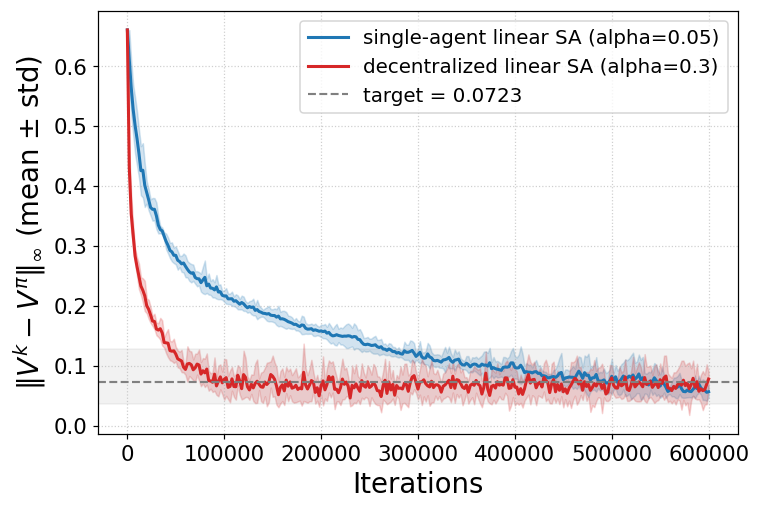
Figure 1: Left—Tabular: DSA achieves a 5.54× iteration speedup over SA on wall-separated grids; Right—Per-iteration consensus error for both methods.
Structural Bias in General Fixed-Point Problems
When applied to global problems with cross-boundary dependencies (e.g., MiniGrid navigation, synthetic PageRank, smart-grid SARSA, DQN traffic), strict decomposition exhibits irreducible bias. As the number of partitions (and hence artificial block boundaries) increases, strict decomposition performance degrades substantially. Core-Halo exhibits stable performance, matching or nearly matching centralized baselines by incorporating essential boundary context.
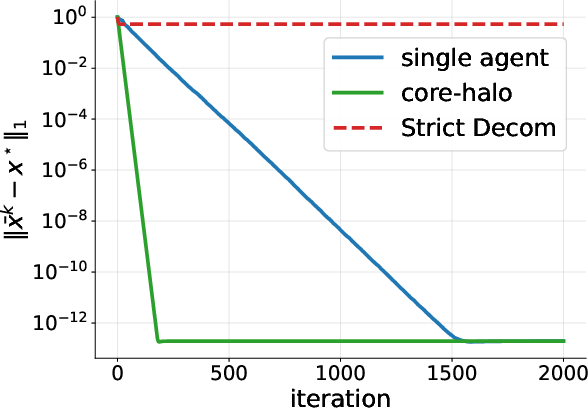
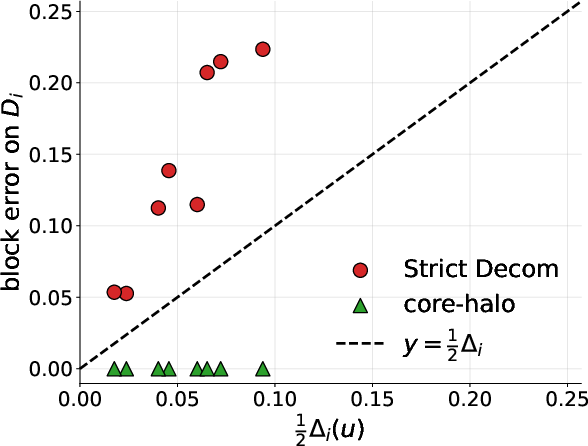
Figure 2: Core-Halo and single-agent methods converge to the true PageRank fixed point; strict decomposition remains at a nonzero error plateau, indicating bias.
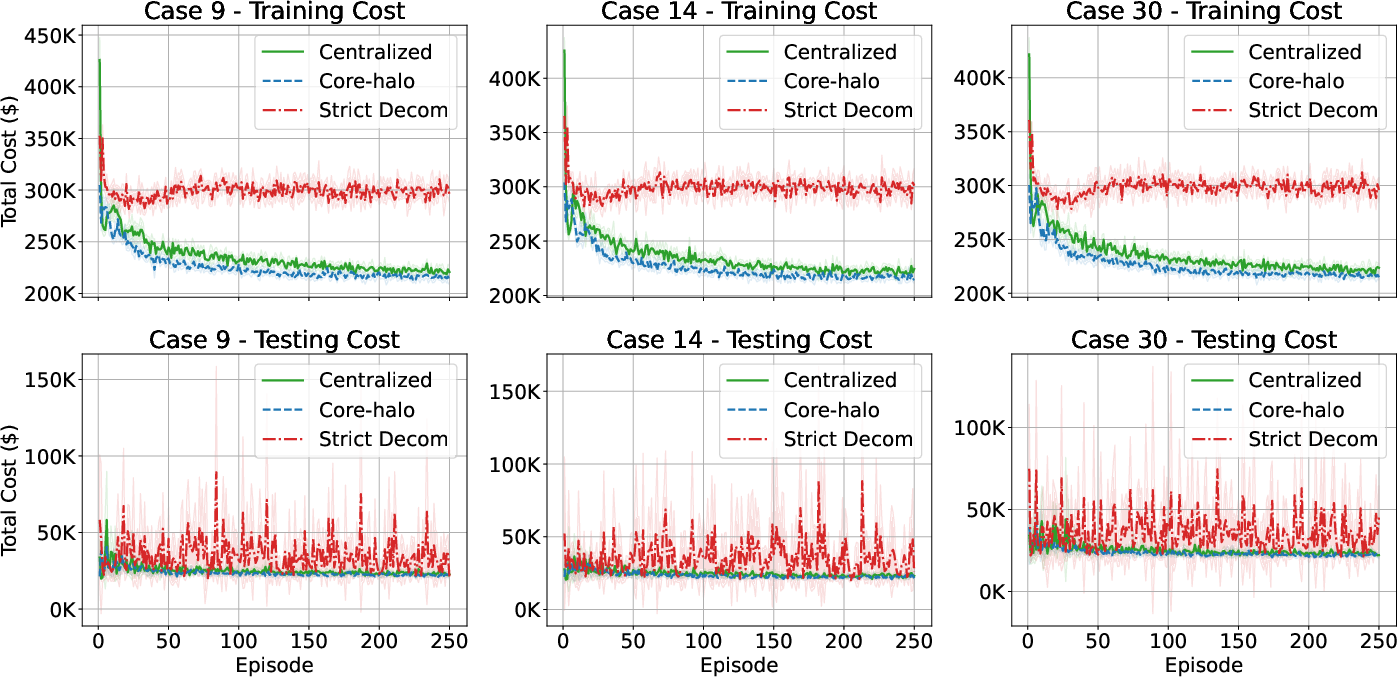
Figure 3: Core-Halo SARSA nearly matches centralized cost trajectories across IEEE grid benchmarks, while strict decomposition suffers persistent performance gaps.
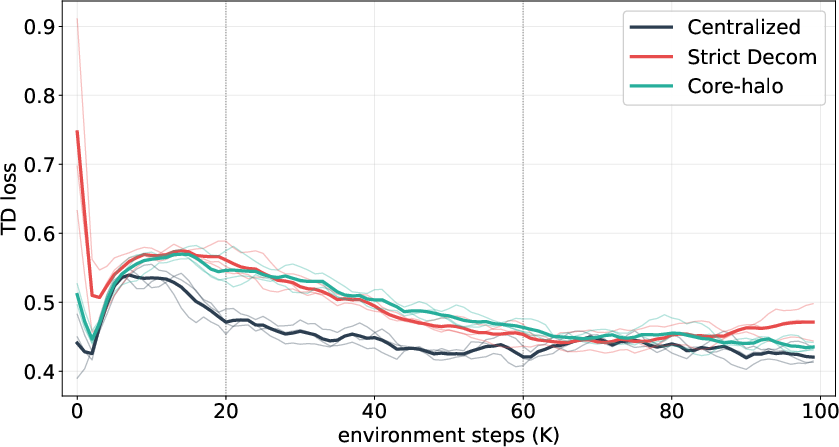
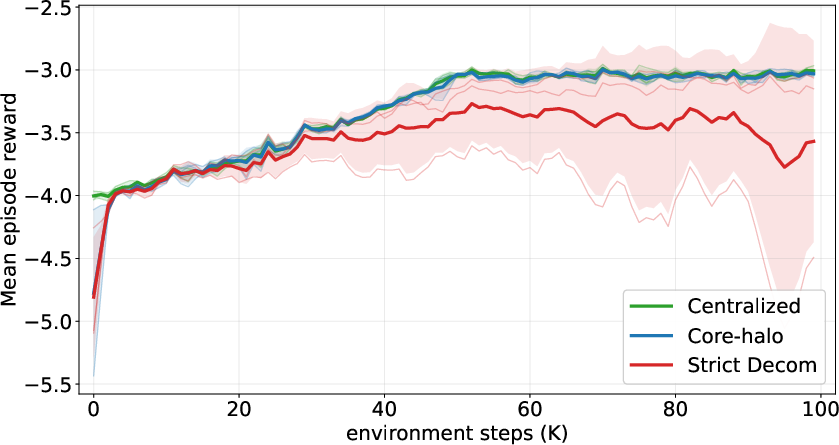
Figure 4: DQN traffic control—Core-Halo yields more stable TD loss and better rewards compared to strict decomposition across multi-intersection environments.
Gridworld Analysis
A rigorous lower bound is established on the error introduced by strict decomposition in a deterministic gridworld: the error grows with the number of partitions and is caused by missing continuation values across artificial boundaries. Empirically, this manifests in degraded returns in MiniGrid and other tasks as block count increases.
On sampled SBM graphs, strict decomposition fails to capture true PageRank due to omitted cross-core nodes. The Core-Halo operator preserves the correct fixed point and converges rapidly, matching centralized power iteration.
Decentralized SARSA in Smart Grids
Realistic power grids (IEEE 9/14/30-bus) highlight the need for neighborhood context (e.g., overload penalties). Core-Halo SARSA leverages neighbor battery states in the halo, matching optimal costs and constraint satisfaction, while strict decomposition (local battery only) incurs higher penalties and unrecoverable constraint violations.
Multi-Intersection DQN Traffic Control
In multi-agent DQN for traffic-light scheduling, strict decomposition leads to unstable learning and higher waiting times, particularly in environments with more pronounced cross-group dependencies. Core-Halo, using one-hop neighbor observations, substantially improves stability and performance without requiring full centralization.
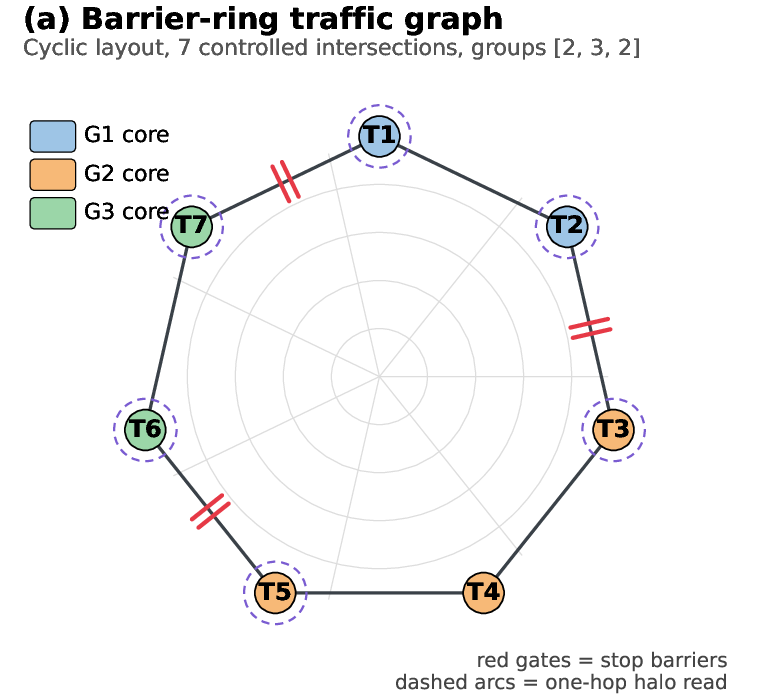
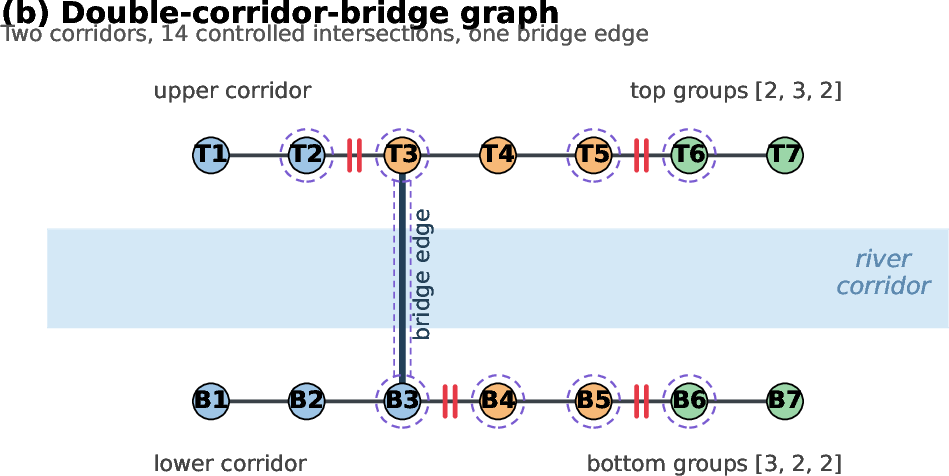
Figure 5: Barrier-ring traffic control topology with 7 controlled intersections, showing core (ownership) partitions and dashed halo connections for read-only context.
Broader Implications and Future Directions
The Core-Halo framework offers a general, low-communication principle for decentralized fixed-point computation, applicable to RL, networked control, distributed optimization, and implicit modeling. By precisely aligning agent halo sets with true operator dependencies, the approach guarantees structural correctness without sacrificing the benefits of parallelism.
For practitioners, this suggests prioritizing explicit analysis of dependency structure in fixed-point algorithms, rather than defaulting to strict locality. Theoretical extension to DSA convergence with overlapping halos—especially in function approximation regimes—and exploration of adaptive, dynamic halo selection are highlighted as future research directions. Moreover, communication-privacy tradeoffs and approximate halo correctness under neural parameterization merit further study.
Conclusion
Decentralization of large-scale fixed-point problems must address not only computational efficiency but also structural faithfulness to the original operator. Strict decomposition, with its rigid locality assumptions, can introduce irreducible bias when dependency structure is misaligned. The Core-Halo decomposition provides a principled and practical remedy: it preserves disjoint ownership yet allows overlapping read-only evaluation context, ensuring correct fixed-point recovery under a natural locality condition. Extensive empirical results across RL, control, and graph settings validate the superiority and generality of this approach. The framework is broadly applicable wherever local updates require cross-boundary information, and opens new questions on theory and practice for decentralized learning with explicit structure.

