- The paper demonstrates that non-Hermitian skin effects emerge in skyrmion-string lattices even with local damping, overturning previous claims requiring nonlocal damping.
- It employs linear spin-wave theory and nondegenerate perturbation techniques to derive spectral winding numbers that dictate magnon boundary localization.
- Simulations confirm asymmetric spin-wave propagation and mode-selective dissipation, highlighting potential applications in magnonic circuit engineering.
Point-Gap Topology of Damped Magnon Excitations in Skyrmion Strings
Introduction and Context
This work delivers a comprehensive theoretical analysis of non-Hermitian topology in magnon systems with finite lifetimes, incorporating both local and nonlocal Gilbert damping via the Landau-Lifshitz-Gilbert (LLG) formalism. The authors systematically study the emergence of non-Hermitian skin effect (NHSE) via analytical evaluation of spectral winding numbers for magnonic band structures and elucidate their dynamical and physical implications in skyrmion-string-lattice backgrounds. By extending the formalism beyond conventional field-polarized states, the paper clarifies the mechanisms whereby NHSE arises and reveals conditions under which nonlocal damping is and is not essential for nontrivial skin modes, providing both analytical and simulation-backed arguments.
Non-Hermitian BdG Framework for Damped Magnons
A central technical step is the application of linear spin-wave theory to the generalized LLG equation, including nonlocal damping kernels:
- The generalized LLG equation includes a position-dependent, possibly nonlocal, symmetric damping matrix αr,r′.
- Linearization around a stationary, typically noncollinear, spin configuration produces a non-Hermitian Bogoliubov-de Gennes (BdG) Hamiltonian, Hτ(α).
- Damping enters as a Hermitian positive-semidefinite matrix, which via the structure of the BdG system, still preserves anomalous particle-hole symmetry (but breaks pseudo-Hermiticity in general).
The spectral properties under both local and nonlocal damping are thus encoded in the complex band structure of the non-Hermitian BdG Hamiltonian, with finite-lifetime modes and, in certain parameter regimes, topological skin effects.
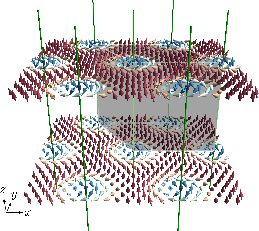
Figure 1: Spin configuration of the stationary skyrmion-string-lattice state at B/b=0.7 with spatially modulated magnetic moments; this forms the background for magnon propagation and non-Hermitian topology analyses.
Analytical Evaluation of Spectral Winding Numbers
Using nondegenerate perturbation theory, the paper derives an analytical form for the dressed magnon energies in the presence of small damping,
En,k(α)≃En,k(0)(1−iαeff,nk),
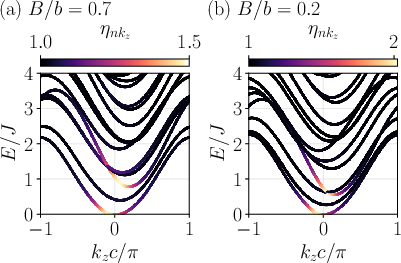
where the effective damping, αeff,nk, factorizes into a momentum-dependent damping strength αk and a state-dependent ellipticity ηnk, with ηnk quantifying the particle-hole content and thus the nontrivial mixing arising in noncollinear backgrounds.
The main results include:
Numerical Demonstration in Skyrmion-String Lattices
The theoretical results are corroborated with simulations of magnon spectra and excitation dynamics in a classical Heisenberg-DM model on a triangular lattice that stabilizes a skyrmion-string-lattice ground state:
- Magnon complex spectra under various damping scenarios: The CCW (counterclockwise) mode in the skyrmion-string-lattice case exhibits a nontrivial spectral loop (winding Hτ(α)2) even when nonlocal damping is absent, in stark contrast to many collinear systems.
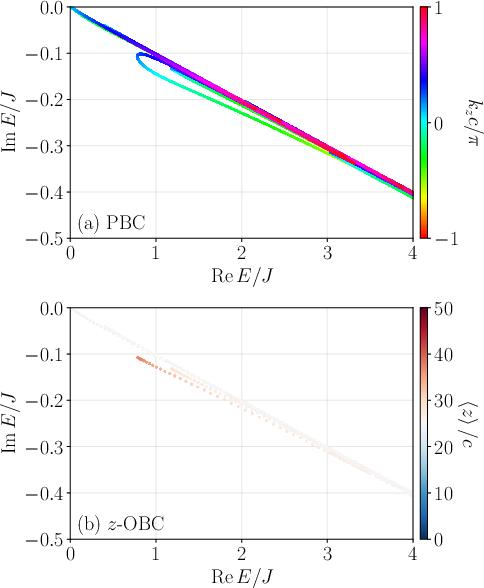
Figure 3: In the presence of only local damping, the CCW magnon band forms a loop in the complex-energy plane (PBC), manifesting as skin localization (OBC) under NHSE prediction.
- Noncollinear, multiband situations: In low field (Hτ(α)3), modes with negative winding numbers emerge, giving rise to skin modes localized at opposite boundaries. This is a direct result of the momentum sign at the band minima, a phenomenon absent in single-band or strictly collinear systems.
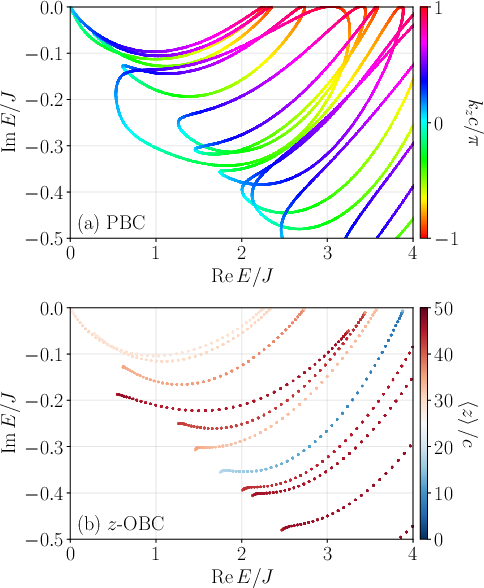
Figure 4: Magnon complex spectra at lower field with local and nonlocal damping; different bands exhibit windings of opposite sign, leading to band-dependent skin localization.
Dynamical Consequences: Asymmetric Spin-Wave Propagation
The implications for spin-wave propagation and mode-selective dissipation are explicitly demonstrated via time-domain simulations of LLG dynamics perturbed by local, circularly polarized magnetic field pulses:
- Modes with positive winding preferentially propagate in one direction (e.g., upward), while negative-winding modes propagate oppositely. This asymmetry in lifetime and propagation is a direct consequence of the point-gap topology of the underlying non-Hermitian magnon spectra.
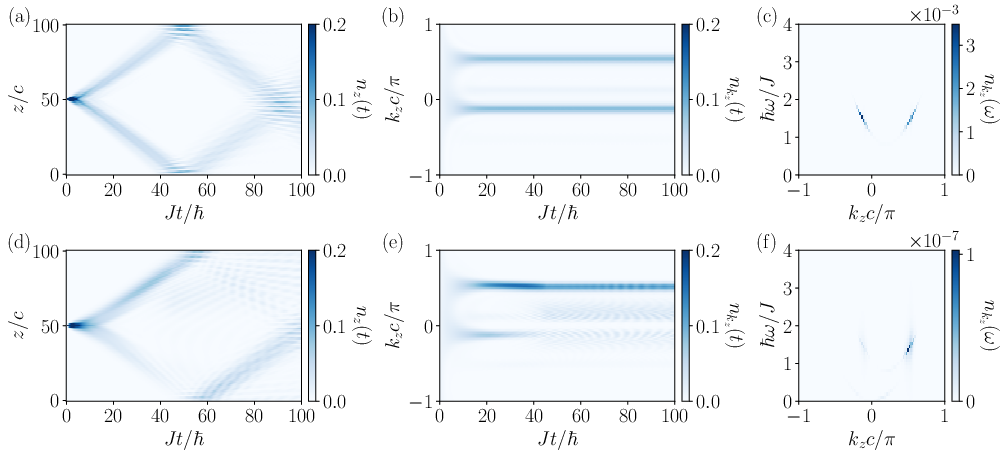
Figure 5: Spin-wave propagation after left-circularly polarized pulse (Hτ(α)4); in the presence of local damping, the upward mode persists—the hallmark of NHSE.
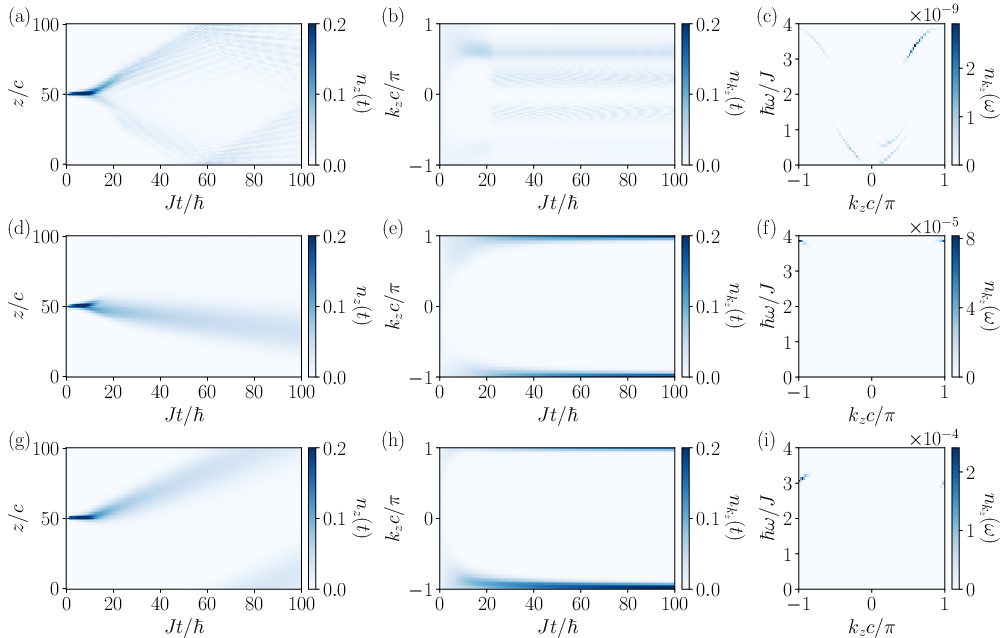
Figure 6: At lower field and in the presence of nonlocal damping, propagation direction depends on which band (and thus which winding number) is excited, demonstrating band-resolved NHSE with asymmetric mode selection.
Implications and Outlook
This work solidifies the link between non-Hermitian topology and magnon dynamics in realistic, damped magnetic materials, especially in complex, noncollinear backgrounds like skyrmion crystals. The findings have several key ramifications:
- Redefining prerequisites for NHSE in magnetic systems: The demonstration that local damping plus intrinsic band structure properties of noncollinear states suffice to produce NHSE revises earlier understanding from field-polarized ferromagnets.
- Mode-selective, unidirectional magnonics: The band- and direction-selectivity of long-lived magnon propagation conveys potential for engineered damping-based magnonic circuits, leveraging NHSE in synthetic or real materials—especially given the relative tunability of damping via material engineering or external drives.
- Analytical tractability with multiband generalizations: The spectral winding approach offers a framework for predicting (and tuning for) NHSE in arbitrary magnetic unit cells, beyond simple ferromagnets.
Future theoretical directions include extension of the winding number formalism to degenerate or strongly hybridized magnon bands, exploration of dynamical instabilities in genuinely non-Hermitian topological phases, and investigations into experimental access—particularly with time-resolved optical or THz-magnetic driving to modulate local or nonlocal damping in situ.
Conclusion
The theoretical and computational results establish the conditions for the emergence of non-Hermitian topology—the NHSE—in damped magnon systems embedded in skyrmion-string-lattice backgrounds. The central conclusion is that NHSE is not contingent upon nonlocal damping alone; rather, the nontrivial particle-hole mixing endemic to noncollinear magnetism enables point-gap topology and resultant long-lived, boundary-localized magnon modes. This advances the understanding of topological transport and dissipation in complex magnetic textures and supplies tools poised for experimental investigation and magnonic device engineering.