- The paper demonstrates that quantum corrections, parametrized by ξ, measurably alter orbital dynamics and gravitational-wave signatures in black hole spacetimes.
- Periodic orbits classified using the zoom–whirl taxonomy provide a clear mapping to gravitational-wave features, facilitating template design for EMRI detections.
- Numerical analyses reveal that increasing ξ reduces the ISCO radius and amplifies waveform strain, offering new avenues for testing quantum gravity effects.
Gravitational Wave Signatures from Periodic Orbits of Regular Black Holes in Asymptotically Safe Gravity
Introduction
This paper presents a rigorous study of bound and periodic time-like geodesics, and their resulting gravitational-wave (GW) signals, in the spacetime of a regular black hole arising in asymptotically safe gravity (ASG). The focus is on the recently formulated Bonanno et al. black hole metric, characterized by a quantum-correction scaling parameter ξ, which modifies the near-horizon geometry while preserving asymptotic flatness. The analysis is motivated by observational opportunities in the strong-field regime provided by extreme mass-ratio inspirals (EMRIs) targeted by future GW observatories such as LISA, Taiji, and TianQin.
Regular Black Holes in Asymptotically Safe Gravity
The underlying model is based on an effective action with a scale-dependent gravitational coupling, introducing quantum corrections that regulate the curvature singularity present in classical black holes. The exterior static, spherically symmetric metric contains a logarithmic correction term proportional to ξ, where ξ is constrained observationally and causes controlled deviations from Schwarzschild geometry in the strong-field regime.
The behavior of event and Cauchy horizons as a function of ξ is systematically analyzed, showing that the quantum correction modifies both horizon positions, with a degenerate horizon at a critical value of ξ.
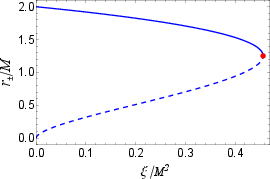
Figure 1: The event horizon (solid curve) and Cauchy horizon (dashed curve) of the RBHASG as a function of ξ for M=1.
The effective potential for massive particles is derived, and the conditions for marginally bound orbits (MBOs) and innermost stable circular orbits (ISCOs) are obtained numerically. Results indicate that both the radii and angular momenta of MBOs and ISCOs decrease as ξ increases, yielding more compact stable orbital structures around the quantum-modified black hole.
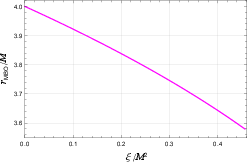
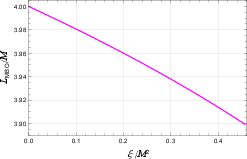
Figure 2: The radii and angular momenta of MBOs decrease with increasing quantum parameter ξ in the RBHASG metric.
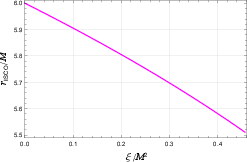
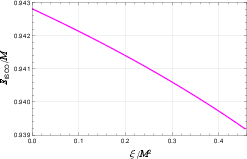
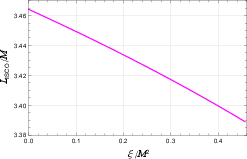
Figure 3: The ISCO radius, energy, and angular momentum as functions of ξ, demonstrating reduced ISCO size and energy with larger quantum corrections.
The allowed energy-angular momentum parameter space for bound orbits broadens with increasing ξ0.
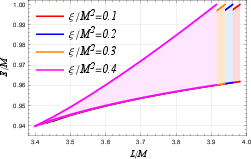
Figure 4: The ξ1 parameter regions for bound orbits around RBHASG, enlarged as the quantum parameter ξ2 increases.
Classification and Structure of Periodic Orbits
Bound orbits are classified using the zoom–whirl taxonomy—the triplet ξ3 denoting the number of zooms, whirls, and vertices per radial period. Periodic orbits correspond to rational ratios of the azimuthal (ξ4) and radial (ξ5) frequencies, with frequency ratio ξ6. The dependence of ξ7 on energy and angular momentum is expressed and numerically evaluated: ξ8 increases monotonically with energy and decreases with increasing angular momentum, showing reduced precession for higher ξ9 values.
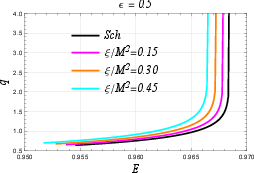
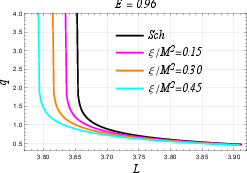
Figure 5: The rational frequency ratio ξ0 versus energy and angular momentum for different ξ1, showing sensitivity to quantum corrections.
Representative orbit morphologies for different ξ2 values are constructed, illustrating the increasing topological complexity and number of whirls as ξ3 or ξ4 increases.
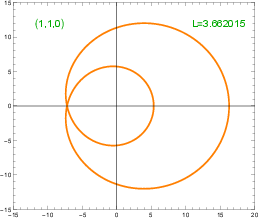
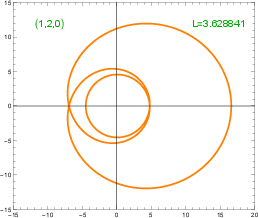
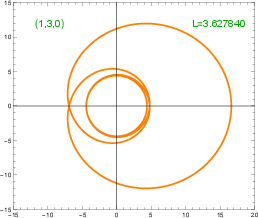
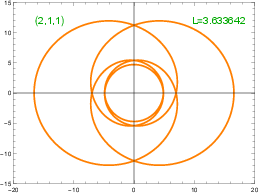
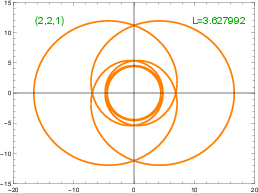
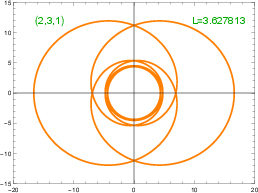
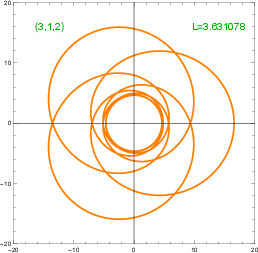
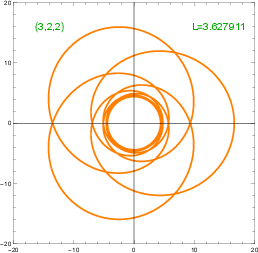
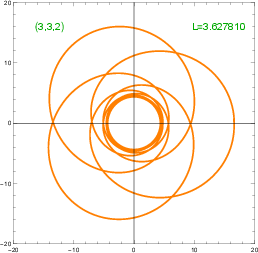
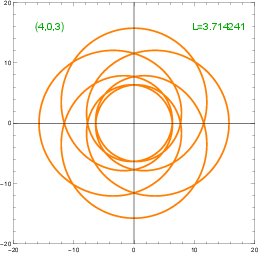
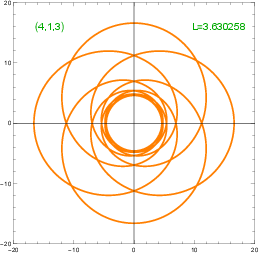
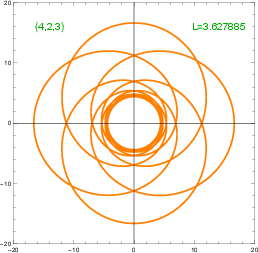
Figure 6: Example periodic orbits classified by ξ5, demonstrating the intricate structures generated by zoom-whirl dynamics in the RBHASG background.
The computation of GW signals is carried out in the adiabatic approximation, neglecting radiation reaction and using the numerical kludge approach to synthesize geodesic-based waveforms in the quadrupole limit. Two polarization states (ξ6) are extracted for representative orbits, capturing the characteristic zoom–whirl modulation: low-amplitude, smooth segments during zoom phases punctuated by sharp, high-frequency bursts during whirls near periapsis.
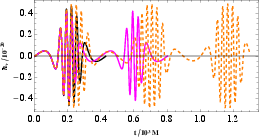
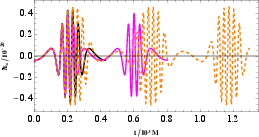
Figure 7: ξ7 and ξ8 polarizations for selected periodic orbits, vividly reflecting the zoom–whirl morphology and the imprint of strong-field dynamics.
An explicit mapping between orbital trajectory segments and GW waveform features is illustrated.
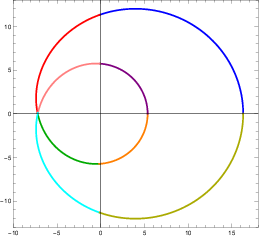
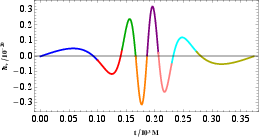
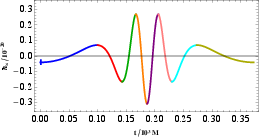
Figure 8: Visualization of how distinct orbital segments correspond to features in the GW polarizations for a ξ9 periodic orbit.
The influence of quantum corrections on orbital and GW properties is pronounced: the amplitude of the GW signal increases, and a cumulative phase shift emerges as ξ0 is raised. These effects are distinct from the Schwarzschild scenario, despite ξ1 entering as a small parameter.
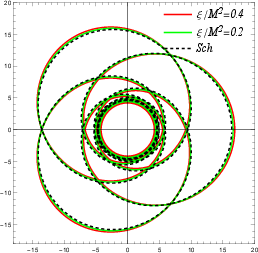
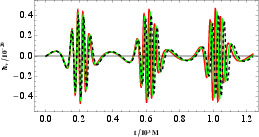
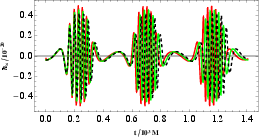
Figure 9: Modulation of the ξ2 periodic orbit and its associated GW signal by quantum parameter ξ3; increased ξ4 yields greater amplitude and clear phase shifts.
GW Spectrum and Detector Implications
The spectral decomposition of the waveforms is performed via discrete Fourier transform, yielding the frequency-domain polarizations and the characteristic strain ξ5. The dominant harmonics peak in the millihertz range—precisely the target sensitivity window for LISA, Taiji, and TianQin. The strain amplitude and peak frequency both increase as ξ6 is increased.
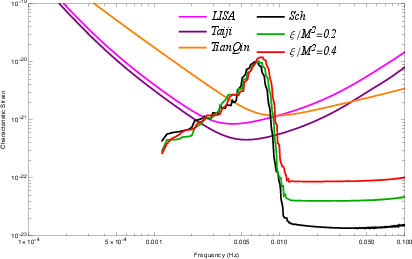
Figure 10: Characteristic strain ξ7 for the ξ8 orbit at varying ξ9, superimposed with LISA, Taiji, and TianQin sensitivity curves; the GW signal is well within detection thresholds for all considered values of ξ0.
Orbit topology (as set by ξ1) strongly impacts waveform shape and spectral features.
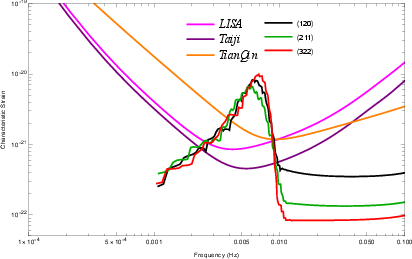
Figure 11: Strain spectra for different periodic orbit classes, demonstrating that zoom–whirl structure imprints observable differences relevant for source classification and parameter inference.
Implications and Outlook
The main theoretical implication is that even perturbatively small quantum modifications to black hole metrics (through the parameter ξ2 in ASG) produce measurable effects in the strong-field orbital dynamics and encoded GW signatures. Quantitative results show that the amplitude and phase of EMRI waveforms carry information about quantum corrections in the gravitational potential, with strain spectra exceeding detection thresholds for next-generation space-based GW observatories.
This establishes EMRIs as promising probes for constraining or revealing new quantum-gravity corrections distinct from those in classical GR. The paper also identifies that the zoom–whirl classification naturally organizes the expected GW signals, offering a taxonomy for template construction and parameter estimation.
Future developments include incorporating radiation reaction and gravitational self-force to compute fully generic inspiral waveforms, extension to rotating regular black holes, analysis of inclined and non-equatorial orbits, and detailed Bayesian inference studies on prospects for constraining ξ3 using high-SNR EMRI detections.
Conclusion
This work thoroughly characterizes the influence of quantum corrections from ASG on the orbital dynamics and gravitational wave emission of regular black holes, exploiting the periodic orbit structure and producing GW observables well suited for detection by LISA, Taiji, and TianQin. The clear monotonic enhancement of GW strain and systematic phase shifts with increasing ξ4 are critical findings with direct implications for quantum-gravity phenomenology. The presented framework provides groundwork for future comparative and template-based analyses for strong-field quantum modifications via precision GW astronomy.