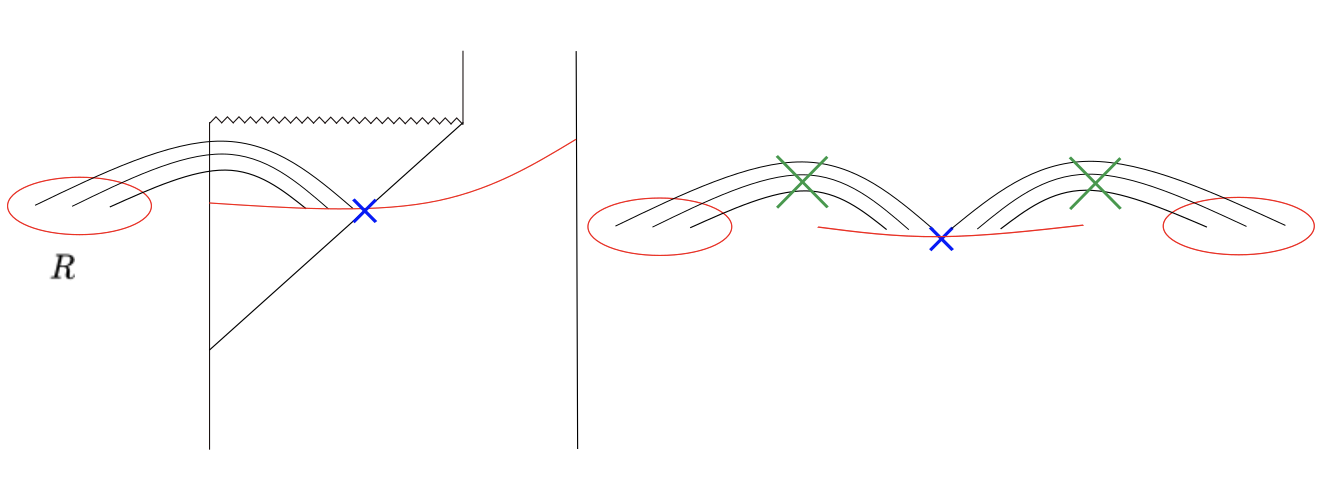
- The paper introduces a diagnostic for spacetime emergence by identifying evanescent QES as indicators of holographic error correction breakdown.
- It employs tensor network models, specifically slice-normal networks, to formalize the interplay between generalized entropy and emergent geometry.
- The study demonstrates that excising regions beyond low-entropy QES restores a reliable emergent bulk description in diverse geometrical settings.
Semiclassical Diagnostics of Spacetime Emergence: The Role of Evanescent Quantum Extremal Surfaces
Introduction
The holographic principle postulates that gravitational effective field theory (EFT) in a bulk region can emerge from the dynamics of a lower-dimensional non-gravitational theory. However, recent advances in AdS/CFT and quantum information theory demonstrate that the emergence of semiclassical spacetime is subject to nontrivial limitations. This paper addresses these limitations by introducing a geometric and tensor-network-based diagnostic: the presence of evanescent quantum extremal surfaces (QES) signals a failure of spacetime emergence according to strict quantum error correction criteria.
The authors analyze the interplay between the generalized entropy formula, the area term, and bulk quantum entanglement. They employ tensor network models—specifically, slice-normal networks inspired by Python’s lunch geometry—to formalize the information-theoretic properties underlying the bulk-boundary map. Their diagnostic sheds light on both failure and partial restoration of spacetime emergence in situations such as closed cosmologies, fully evaporated black holes, and more.
Criteria for Emergence and Evanescent QES
In the conventional holographic context, the bulk-to-boundary map V should approximately preserve inner products between subexponentially complex states up to errors of order e−N2, with N2 the number of fundamental degrees of freedom. However, particular smooth semiclassical geometries (e.g., closed universes entangled with AdS regions or fully evaporated black holes) violate this criterion (2605.06780).
The core proposal of the paper is that such violations can be diagnosed by the existence of evanescent QES, defined as follows: a QES X is evanescent if, for all code subspace states ψ,
ψinfSgen[X]≤O(log(1/G)),
where Sgen is the generalized entropy and G is Newton's constant. Crucially, the bound depends only on the area term, not the full generalized entropy. This operational distinction reflects the fact that degrees of freedom associated with the area term are inaccessible from EFT, whereas the bulk entanglement entropy is not.
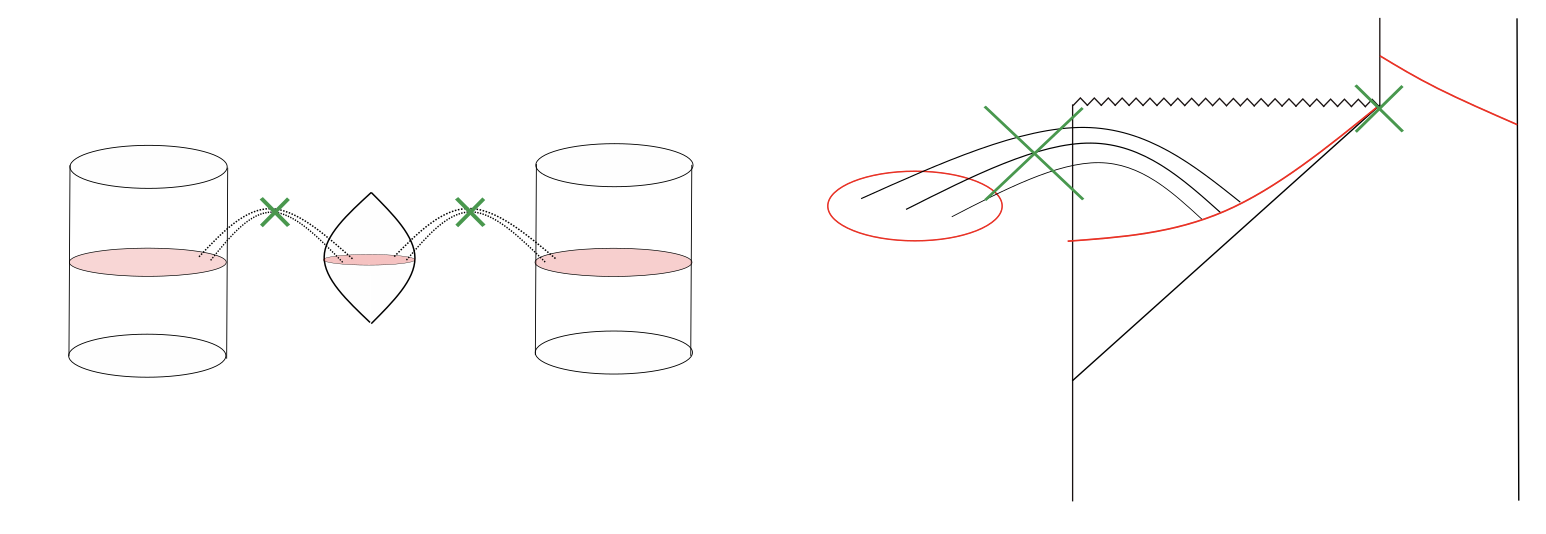
Figure 1: The evanescent QES (green cross) homologous to the fundamental description for AS2 cosmology (left) and the fully evaporated black hole (right).
The presence of an evanescent QES homologous to the fundamental boundary implies that the semiclassical spacetime region beyond this surface does not emerge in the boundary description: subexponentially complex overlaps of code subspace states become easily distinguishable (e.g., using swap tests) within the bulk EFT, violating the fundamental holographic error correction structure.
Slice-Normal Tensor Networks and χ-Entropies
To formalize the diagnostic, the authors introduce slice-normal tensor networks, where non-isometric tensor contractions (postselections) correspond to QES of minimal area. The contracted legs—the e−N20-states—encode the "area" contribution to the generalized entropy. The key result is that for reliable emergence, all e−N21-entropies must satisfy
e−N22
with e−N23 the entropy carried by each e−N24-state.
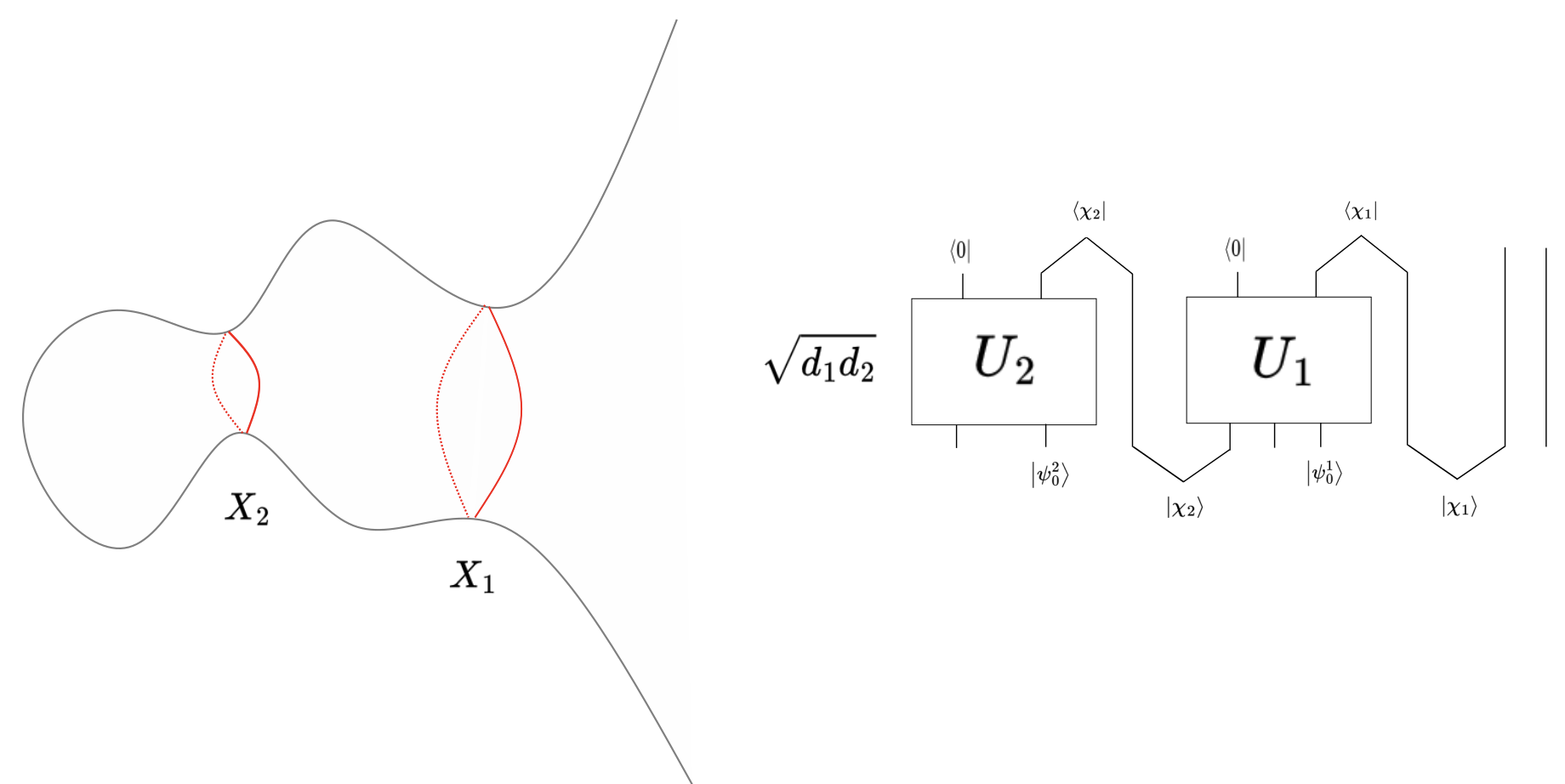
Figure 2: A slice geometry and corresponding slice-normal tensor network. Surfaces e−N25 and e−N26 of locally minimal area yield random unitaries joined by e−N27-states.
If any e−N28-state fails this entropy bound, the network signalizes a breakdown in the emergent description: no code subspace states are reliably mapped to the boundary. The failure is both robust and code-independent (state-independent).
Excision Protocol and Spacetime Diagnostics
Whenever an evanescent QES is present, one can excise the non-emergent region by modifying the code subspace to exclude degrees of freedom lying beyond the offending e−N29-state in the tensor network. This restabilizes the code's error-correcting properties and restricts the emergent region to the domain of dependence of the non-excised spacetime—a geometric protocol with direct operational meaning.
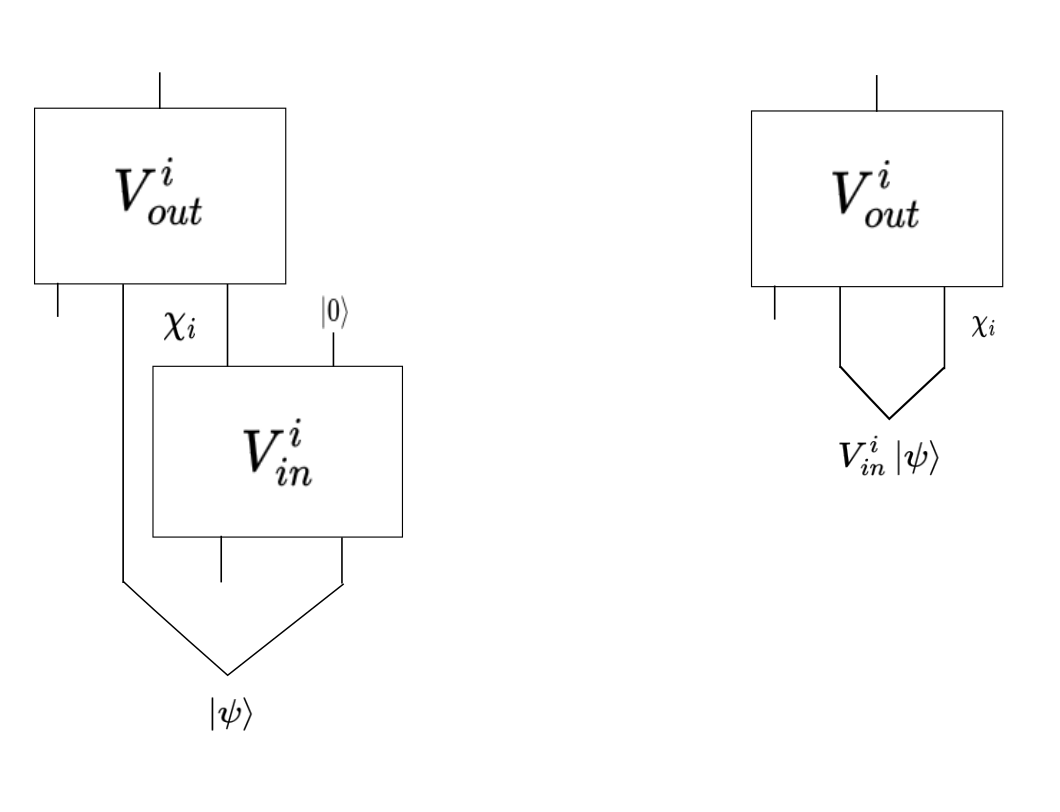
Figure 3: Excision protocol in tensor networks—degrees beyond the small N20-entropy surface (left) are excised, yielding an emergent bulk region (right).
A covariant version identifies the outermost evanescent QES homologous to the full fundamental description and restricts the emergent spacetime to its outer wedge.
Case Studies and Heuristic Consequences
The framework is explicitly illustrated in several geometrical regimes:
Bulk Interpretation: Classical vs. Quantum Connectivity
A significant claim is that the area and bulk entanglement contributions to generalized entropy are operationally distinct with respect to emergent geometry. Large bulk entropy does not counteract the non-emergence induced by a vanishing area term—the emergent region must be classically connected, not merely quantum-entangled [EngLiu23]. This separates and clarifies the physical status of "ER=EPR": quantum connectivity (entanglement) does not suffice for emergent geometry if not supported by adequate classical connectivity (area).
Observer Rules and Ob-Evanescent QES
The addition of an "observer" in the bulk can, in some cases, extend the emergent region by changing the effective homology constraint—i.e., by modifying the boundary data to which the QES are homologous. The diagnostic generalizes accordingly: with a bulk observer of entropy N23, one considers Ob-evanescent QES for which the area term is bounded above by N24.
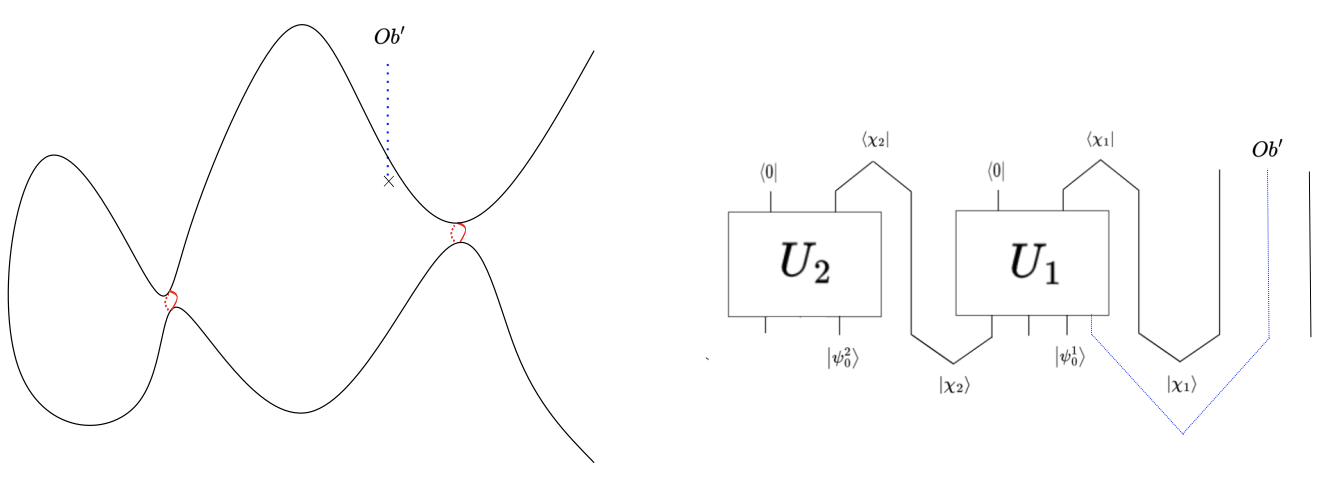
Figure 5: Observer-modified slice-normal tensor network with new QES homologous to the observer clone and asymptotic boundary; non-emergent regions remains present if left QES is evanescent.
However, even observer rules may leave portions of spacetime non-emergent (e.g., nested QES or multiple observers), demonstrating that observer complementarity does not universally restore the bulk.
Large N25 Limit, Volatile Spacetimes, and the Algebraic Approach
The authors connect their results to the algebraic and large N26 approaches to holography, showing that the presence of evanescent QES is associated with the breakdown of code isometry at large N27—i.e., the nonexistence of a boundary state whose correlation functions converge to the bulk EFT correlators in the N28 limit [Ges25].
In quantum volatile spacetimes (e.g., with divergently large interior volume at increasing N29), the operational meaning and complexity-class of the non-emergence criteria are more subtle. Diagnosing emergence requires considering polynomially complex operators, a technical distinction from previous analyses focused on operators with X0 complexity.
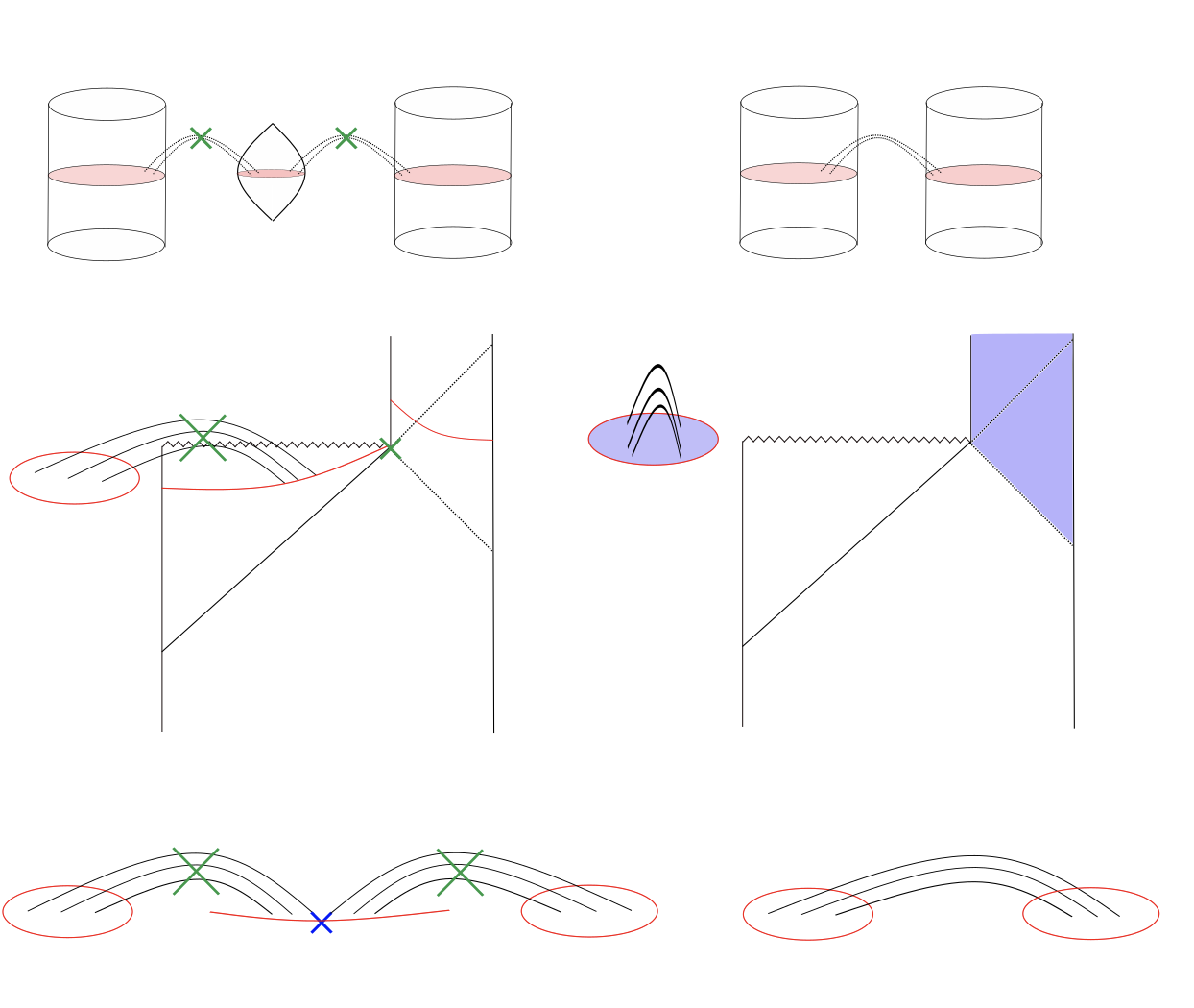
Figure 6: Schematic depiction of excision: ASX1 cosmology, evaporated black hole, and canonical-purified Hawking wedge before (left) and after (right) covariant excision; emergent regions are shaded.
Implications, Open Problems, and Future Developments
The proposed diagnostic provides a concrete, operational criterion for the emergence (and excision) of spacetime geometry from quantum error correction and tensor network principles. Extension of this paradigm to de Sitter space, wormhole physics, and more general classes of holographic spacetimes is a natural avenue for further research [Zha26, Har26].
Connections to recent developments leveraging non-local "magic" for area term calculation in quantum codes [CaoChe26], as well as dynamic tensor network constructions for modeling evaporating black holes, suggest the robustness of the diagnostic beyond static settings.
Key open questions include: the precise role of complexity-theoretic class of operations in the boundary, characterization of emergent regions in the presence of multiple observers or nested QES, and the CFT signature of evanescent QES for fixed X2.
Conclusion
This work firmly establishes the area-term-dominated evanescent QES as a semiclassical diagnostic for (non-)emergence of spacetime, rooted in quantum error correction structure of the holographic map. The diagnostic links geometric, information-theoretic, and algebraic frameworks, demonstrating operational non-equivalence between classical and purely quantum connectivity. The approach offers powerful tools for analyzing the frontiers—and limitations—of holographic bulk reconstruction, quantum gravity, and black hole information.
References: