- The paper introduces a novel robot-centric extension to standard V2X protocols to support dynamic multi-robot and VRU-inclusive urban traffic mediation.
- It implements decentralized leader-follower mechanisms and a finite-state coordination model to achieve low-latency, scalable interactions between heterogeneous robots.
- Empirical evaluations, including SUMO/Artery simulations and a real-world proof of concept, demonstrate significant improvements in safety metrics and reduced communication channel load.
Decentralized Multi-Robot Coordination in V2X Urban Traffic: Framework, Implementation, and Evaluation
Introduction
The paper "Multi-Robot Coordination in V2X Environments" (2605.06662) addresses the integration of social robots as active agents in connected urban mobility ecosystems by proposing a robot-centric extension to V2X cooperative communication standards. The core motivation is robust multi-robot operation for real-time traffic mediation in environments where standard vehicular V2X protocols fail to capture the dynamic roles, coordination, and intent specific to robots or to accommodate non-V2X-equipped Vulnerable Road Users (VRUs).
Analysis of Existing V2X Standards and Motivation
Standard ETSI ITS facility-layer messages—CAM, VAM, CPM, and MCM—are limited in their capacity to support robotic mediation:
- CAM lacks semantics for robot intent, operational role, or stateful task execution.
- VAM only covers V2X-enabled VRUs, excluding the majority of real pedestrians.
- CPM is inefficient for clustered VRU representation in dynamic mediation.
- MCM is tailored to vehicle driving; it does not support heterogeneous multi-robot maneuver coordination.
Hence, the paper identifies requirements R1–R7, emphasizing decentralized awareness, non-infrastructure-dependent coordination, role assignment, real-time maneuver execution, support for non-V2X VRUs, and backward compatibility plus security/alignment with ETSI ITS-G5.
Robot-Centric Facility-Layer Service Design
The proposal is a dual-message framework—Robot Awareness Message (RAM) and Robot Maneuver Coordination Message (RMCM), forming RAS and RMCS, respectively. These messages allow robots to act as full ITS stations, interoperable with conventional vehicular systems but additionally supporting:
- Explicit role signaling: Robots report category, job/task role, execution status, and control mode within dedicated RAM containers.
- Decentralized leader-follower mechanisms: RAM coordination containers support lightweight, event-driven leader election and group management.
- Integrated VRU clustering: RAM aggregates externally-perceived VRUs (including non-V2X pedestrians), with configurable scope and bounds, reducing channel contention.
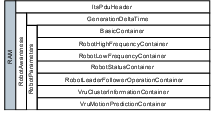
Figure 1: Structure of the RAM framework, illustrating extensible containers for robot attributes, context, role, and VRU inclusion.
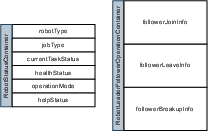
Figure 2: Robot status and coordination containers, enabling both individual robot state-reporting and explicit group formation within the RAM structure.
RMCM complements RAM by enabling fine-grained, event-driven task and maneuver coordination post-group formation via distinct leader/follower containers:
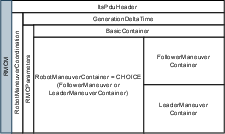
Figure 3: RMCM structure with explicit bidirectional separation of task instructions and feedback between leader and follower roles.
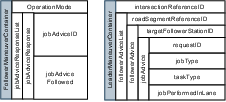
Figure 4: Visualization of role-specific maneuver containers supporting scalable multi-follower orchestration and context-aware command dissemination.
Finite-State Coordination and Real-World Multi-Robot Proof of Concept
A decentralized FSM is implemented, orchestrating the five-stage coordination between a humanoid and a quadrupedal robot assisting a pedestrian crossing:
- Idle: Self-advertising via RAM.
- HelpRequested: Detection triggers help request, encoded in RAM.
- RoleEstablished: Role negotiation/confirmation occurs via RAM.
- ManeuverExecuting: RMCM realizes task decomposition with strict timing and reliability primitives.
- Termination: Explicit disassociation via RAM.
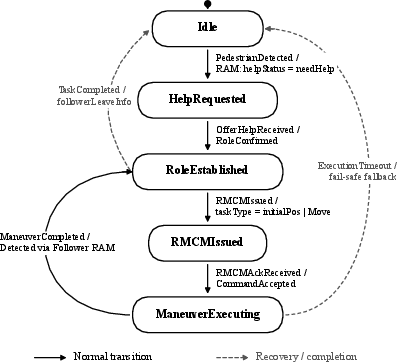
Figure 5: FSM schema governing the event-driven, robust, and fail-safe decentralized multi-robot coordination protocol built atop RAM and RMCM.
Robustness is validated by bounded negotiation/execution times—e.g., mean Tneg<0.13 s and stable execution times across trials, supporting deterministic, low-latency behavior. Reliability is ensured by periodic RAM and mandatory RMCM acknowledgments, integrating with ITS-G5 safety principles.
A staged demonstration, with detailed state transitions and behavioral guarantees, further confirms the scalability of the FSM as team size increases (beyond two robots) without protocol redesign, leveraging the same RAM/RMCM abstractions for group-based synchronization and action partitioning.
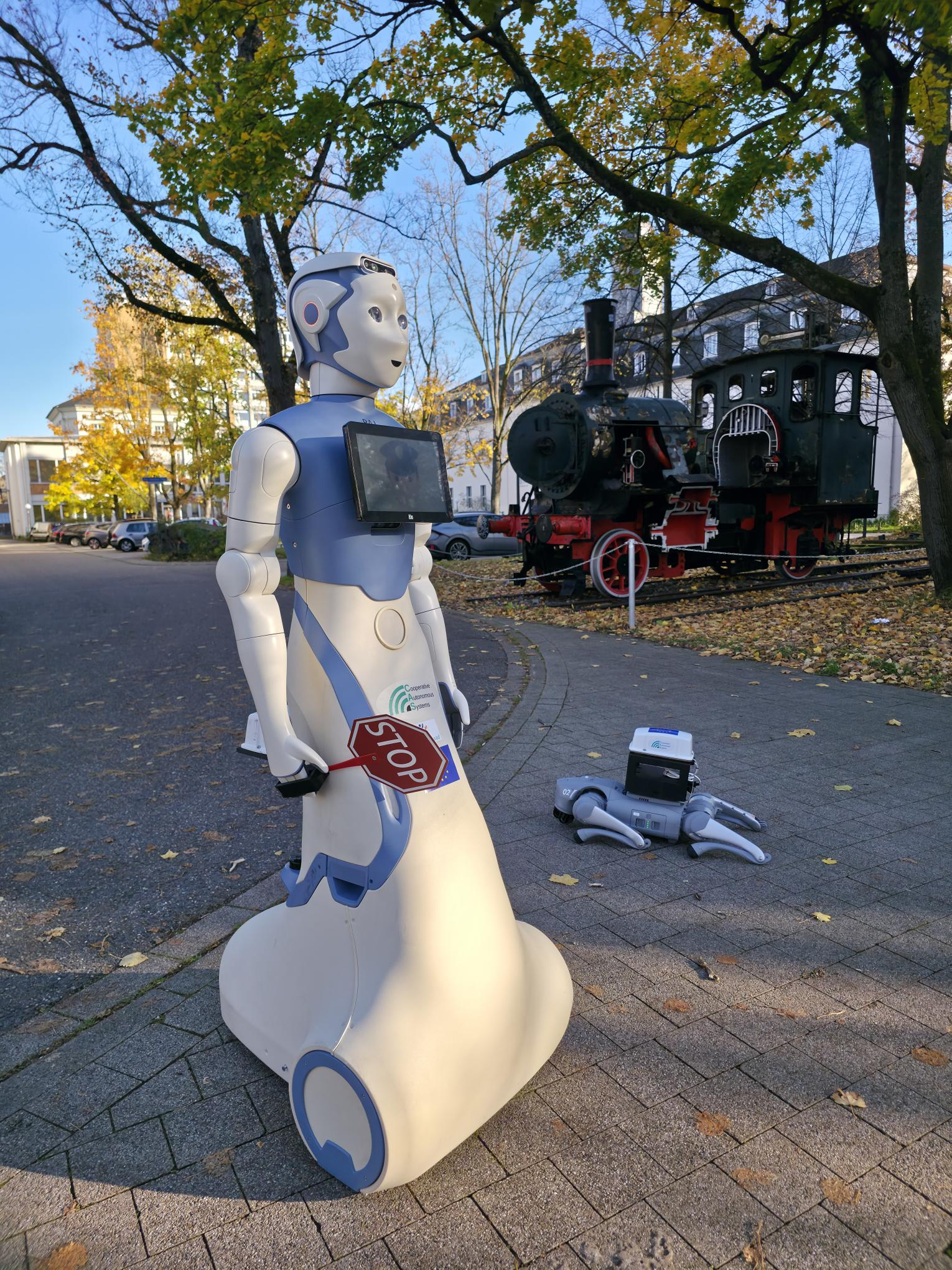
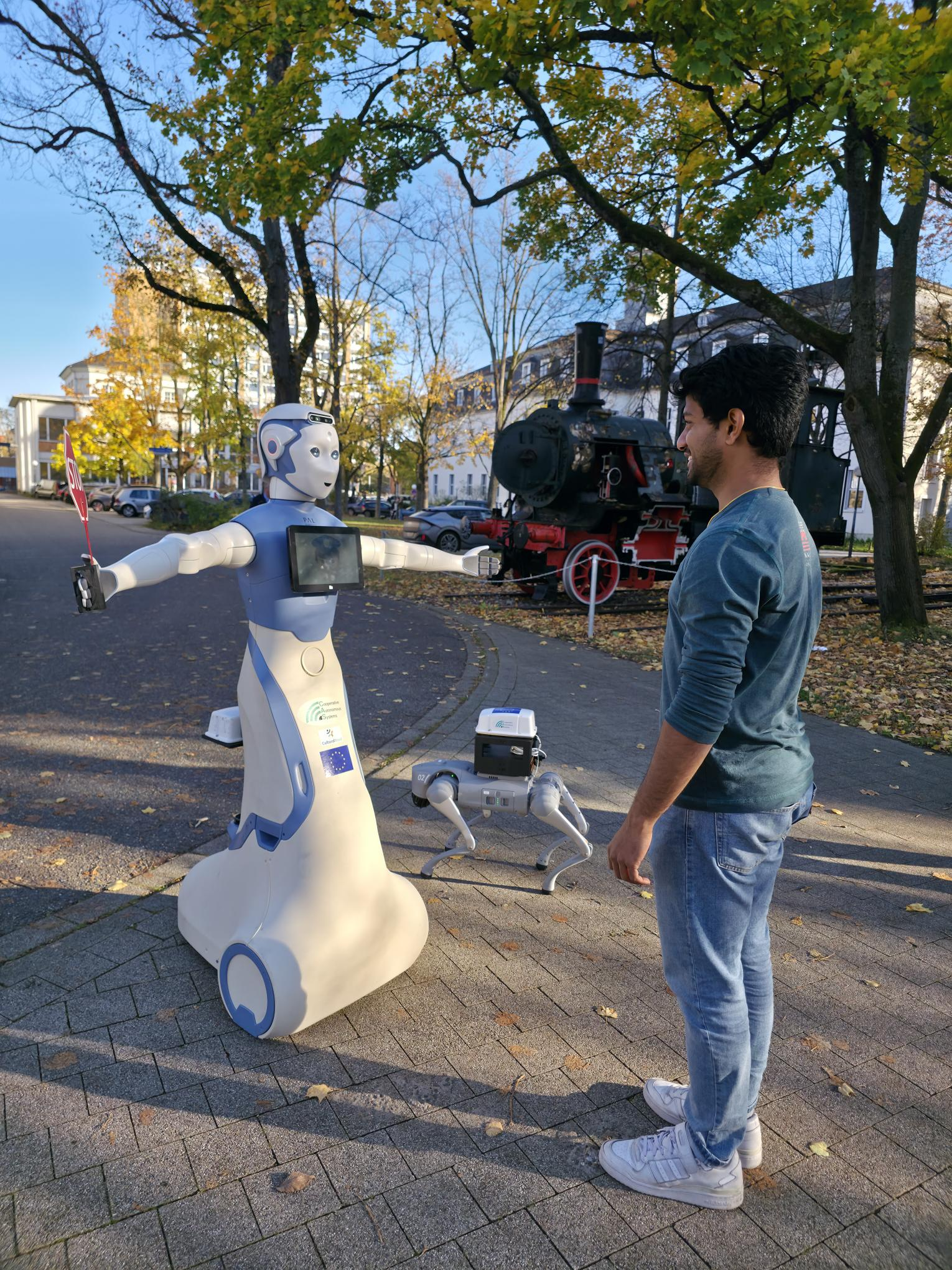
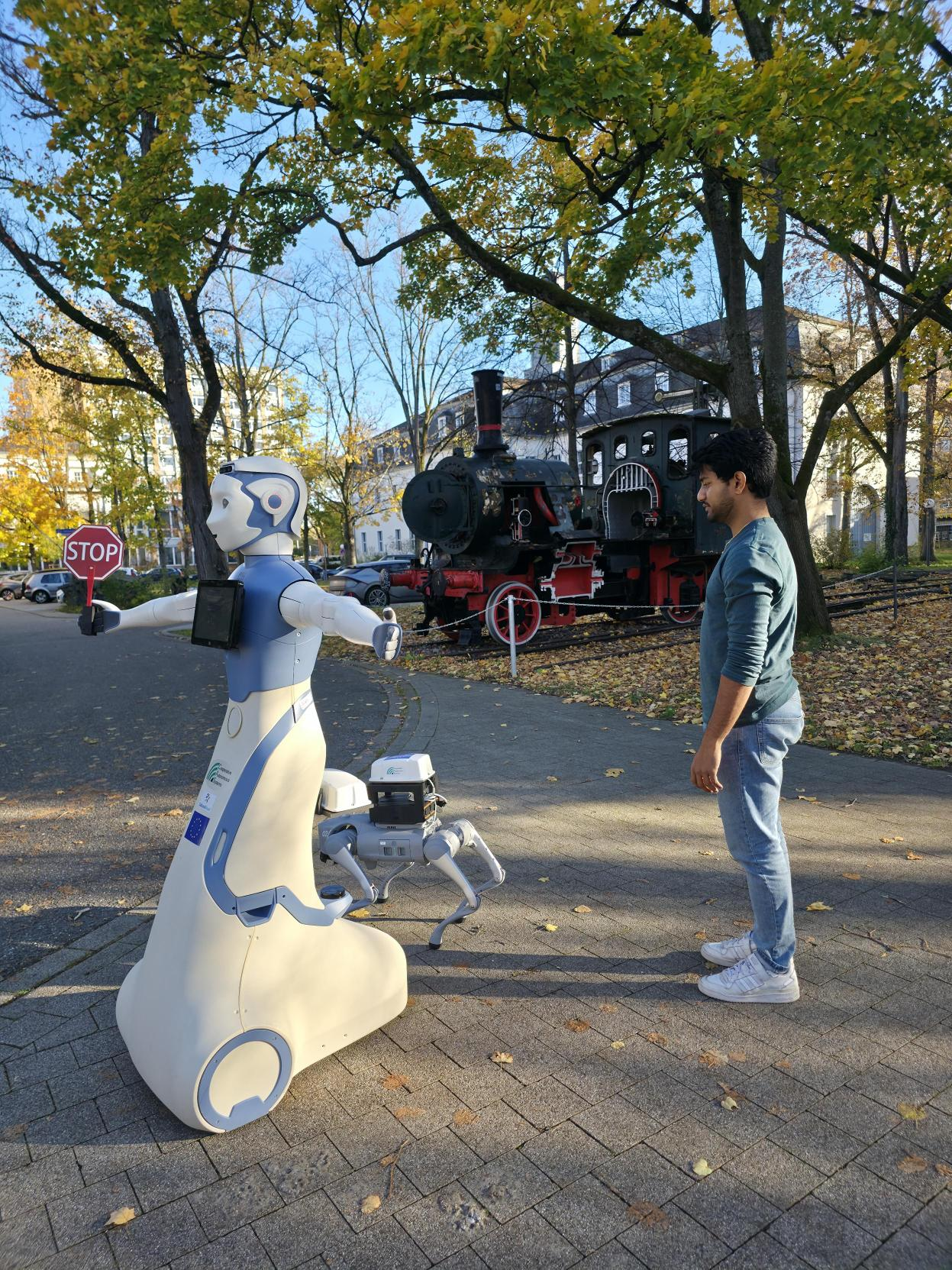
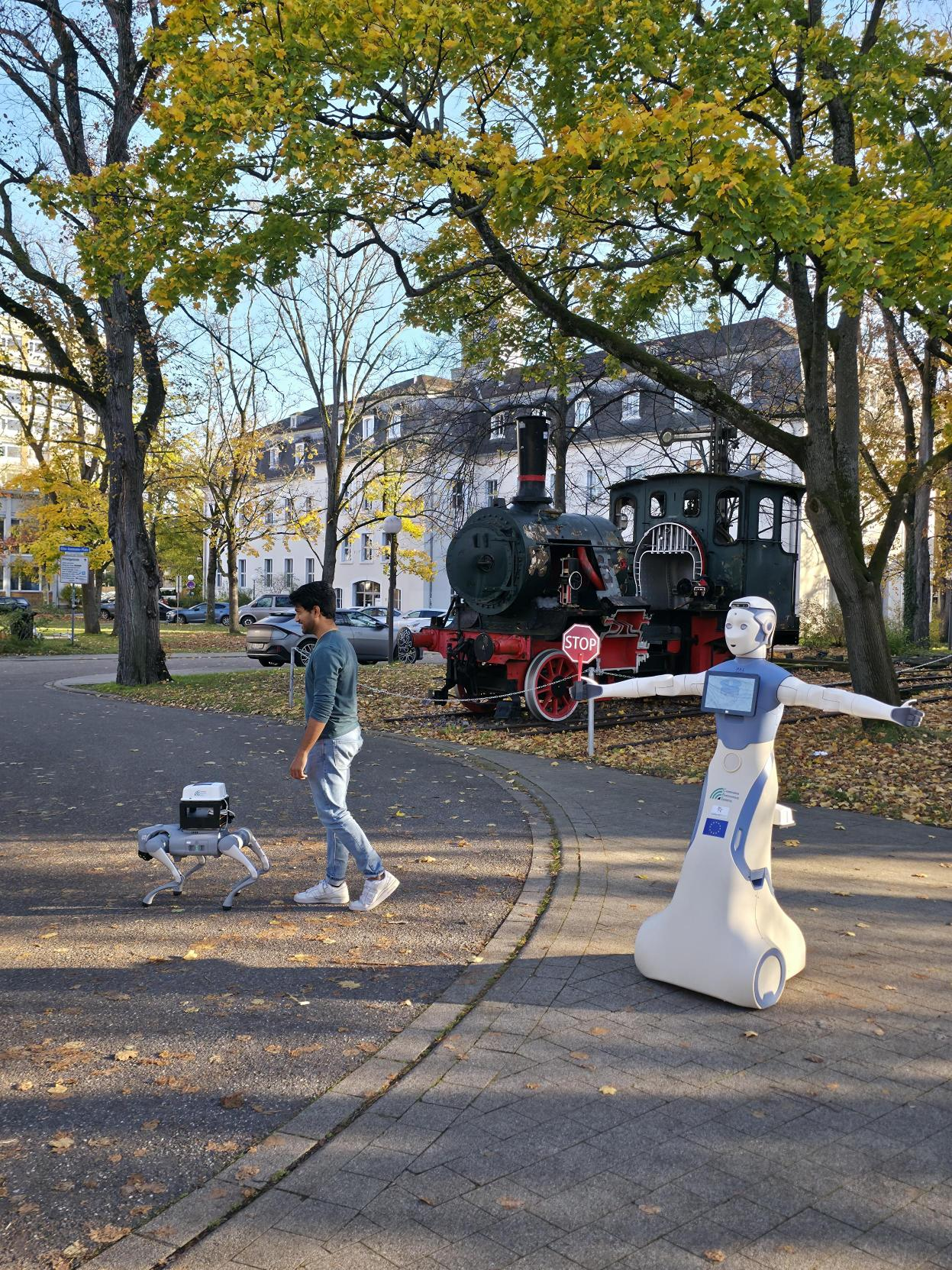
Figure 6: Photographic illustration of the five-stage V2X-mediated pedestrian assistance protocol involving heterogeneous robots at a crossing.
Scalable VRU Clustering and Channel Load Impact
The framework’s extension to real-world urban topology is evaluated via SUMO/Artery simulations (Manhattan grid model) for two cases:
Non-V2X Pedestrians
Robots endowed with bounded perception radii act as cluster heads, broadcasting RAM that aggregate non-equipped VRU positions into the cooperative domain. The observation coverage ratio (OBS) quantifies the proportion of pedestrian trajectories observed:
- 1 robot at a key intersection (15 m radius): ~5–6% OBS.
- 9 robots: ~17–18% OBS (at key safety-critical locations).
Observation coverage is highly localized, directly maximizing safety at possible collision points rather than attempting uniform, city-wide coverage.
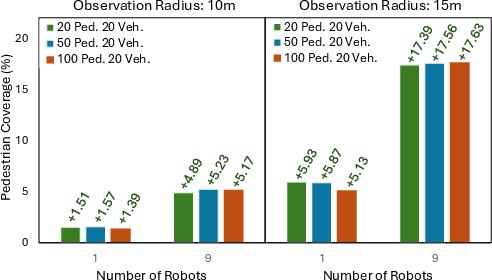
Figure 7: OBS vs. robot density, confirming that incremental robot deployments at intersections rapidly increase non-V2X VRU awareness where it most impacts safety.
V2X-Enabled Pedestrians and Channel Busy Ratio
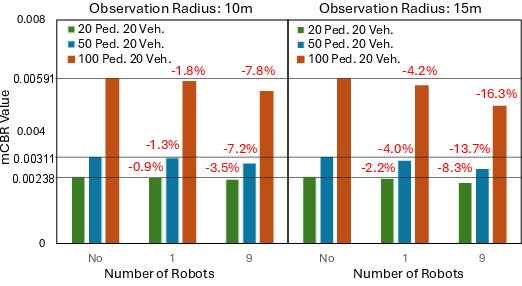
With all traffic agents V2X-enabled, robots exploit ETSI clustering mechanisms: on cluster detection, individual VRU VAM transmissions are suppressed in favor of robot-issued RAM, significantly lowering channel utilization.
Implications and Prospects
This work establishes a scalable, standards-aligned basis for decentralized robot integration into VANETs, with direct bearings on:
- Future CCAM deployments: Integrating social robots as first-class, coordinated agents for safety mediation, traffic guidance, or ad-hoc event management, without reliance on centralized control or fixed infrastructure.
- Protocol design: The modular extension preserves ITS-G5 security, compatibility, and low-latency operation, supporting large-scale adoption and further cross-vendor interoperability.
- Practical deployment heuristics: Results inform practitioners on effective robot placement, observation radius selection, and the trade-off between coverage, communication load, and safety impact.
- Expanding roles: The architecture supports heterogeneous teams, role flexibilities, and dynamic task assignments, paving the way for interaction with both conventional and fully automated CCAM actors.
While the approach’s scalability and flexibility are empirically validated, extensions are required for:
- Large-team, dynamic deployments with overlapping sensing zones.
- Robot-to-vehicle maneuver coordination (beyond VRU mediation).
- Comprehensive real-world field trials in complex, high-mobility and high-density environments.
- Expanded security, privacy, and HRI analyses, essential for public acceptance and certification.
Conclusion
The introduced framework realizes, for the first time, decentralized, semantically rich, and standards-compliant multi-robot coordination in V2X urban traffic by extending the facility-layer paradigm to natively support robot-specific awareness, role/task negotiation, and VRU inclusion. Both in vivo and simulated evaluations confirm deterministic, low-latency, and scalable operation, demonstrating significant gains in VRU safety coverage and network efficiency within realistic CCAM constraints. The foundation is well positioned for both rapid research exploration and eventual deployment in urban mobility systems.
For a complete technical exposition, refer to "Multi-Robot Coordination in V2X Environments" (2605.06662).