- The paper demonstrates that a universal, constant hadronic shift cannot fully explain the discrepancies observed in b→s ℓℓ decays.
- It introduces novel ratio observables derived from inclusive and exclusive branching fractions to differentiate between new physics and nonperturbative effects.
- Experimental data and theoretical comparisons, including high-q² measurements, mildly favor a new physics interpretation over hadronic explanations.
Discriminating Nonperturbative Hadronic Effects and New Physics in b→sℓℓ Transitions
Overview and Motivation
This paper interrogates the longstanding tension in the branching ratios and angular observables of b→sℓℓ-mediated B-meson decays, addressing whether these discrepancies arise from genuine New Physics (NP)—typically parametrized as a universal shift in the Wilson coefficient C9—or from an unknown, constant, nonperturbative hadronic contribution capable of mimicking NP effects. Crucially, the study leverages the distinct sensitivity of inclusive (B→Xsℓℓ) and exclusive (B→K(∗)ℓℓ) modes to nonlocal hadronic corrections, constructing new observables that unambiguously test the universality and constancy assumptions underlying hadronic explanations of these anomalies.
Theoretical Framework: Inclusive vs. Exclusive Modes
The analysis is rooted in the weak effective Hamiltonian formalism, focusing on semileptonic operators and predominantly on NP contributions to C9 in light of global fits. Exclusive decays at low and high-q2 employ SCET and OPE frameworks, respectively, with nonfactorizable charm-loop effects, encoded as "charming penguin" amplitudes, contributing to soft-gluon uncertainties. The recent theoretical advancements in modeling these effects (including LCSR and lattice QCD for form factors), alongside data-driven resonance-based techniques, allow for a refined estimate of the long-distance contributions.
Inclusive modes, by contrast, rely on operator product expansions, where factorizable contributions are reconstructed via e+e−→hadrons dispersion relations. Nonfactorizable corrections at low-q2 are found to be suppressed (estimated at b→sℓℓ0), while at high-b→sℓℓ1, the OPE is normalized against the b→sℓℓ2 rate to mitigate uncertainties in the endpoint region. The distinct theoretical handling ensures that hypothetical hadronic contributions, if present, affect exclusive but not inclusive modes in the same way.
Analysis of Universality and New Observables
Three scenarios for hypothetical hadronic contributions are considered:
- Universal and constant in b→sℓℓ3 and channels: Compatible with current global fit patterns and masquerading as a universal NP shift.
- Universal across channels but non-constant in b→sℓℓ4: Disfavored due to observed deviation signs at both low and high-b→sℓℓ5.
- Non-universal in b→sℓℓ6 and channels: Not supported by data, predicts a pattern not observed experimentally.
Scenario A, the universal and constant case, is the focal point given its ability to replicate observed NP results in fits. To test this, two new observables are defined as ratios of exclusive to inclusive branching fractions in specific b→sℓℓ7 regions:
b→sℓℓ8
b→sℓℓ9
These ratios are engineered to exploit the differing susceptibilities of exclusive and inclusive channels to nonlocal hadronic effects. Their measurements, especially possible without external normalization at LHCb, facilitate a direct confrontation between NP and hadronic scenarios.
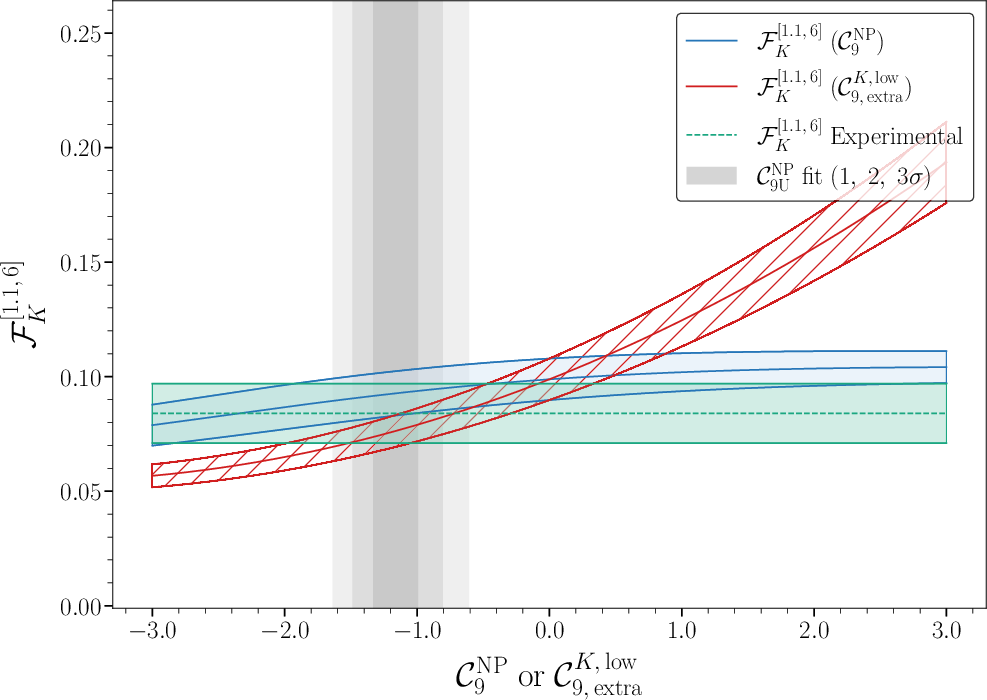
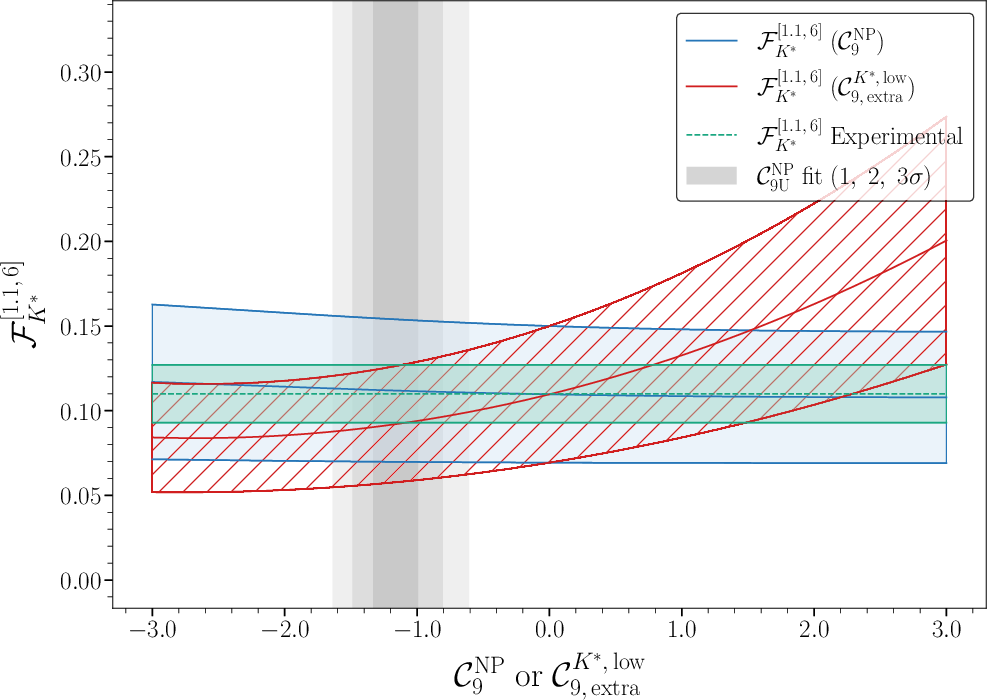
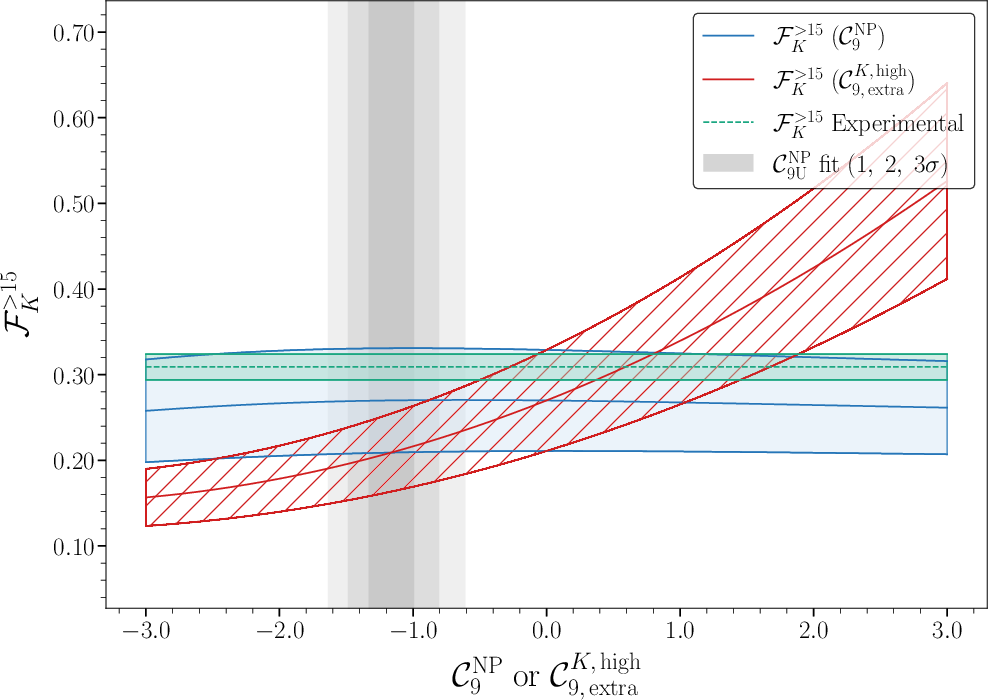
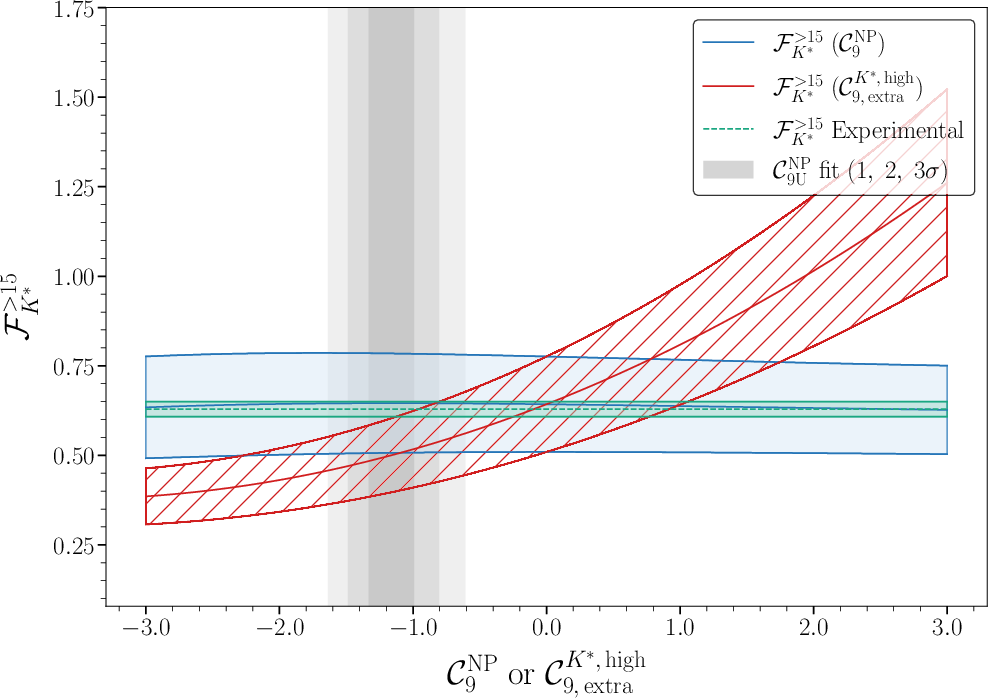
Figure 1: Current status of experimental and theoretical determinations of the observables B0 and B1.
Experimental Determinations and Theoretical Comparisons
The study presents detailed calculations and corrections for PDG and HFLAV averages, particularly emphasizing B2 branching fractions, isospin-breaking effects, and uncertainties propagated from normalization modes. Experimental determinations for the new B3 observables are constructed from recent LHCb, CMS, and Belle II measurements.
By comparing theoretical predictions for various combinations of NP and hadronic parameters with current experimental determinations, the paper demonstrates that the B4 and B5 ratios exhibit a mild preference for NP-driven scenarios: at B6 and B7 respectively, these are more consistent with a universal B8 than with a constant hadronic shift.
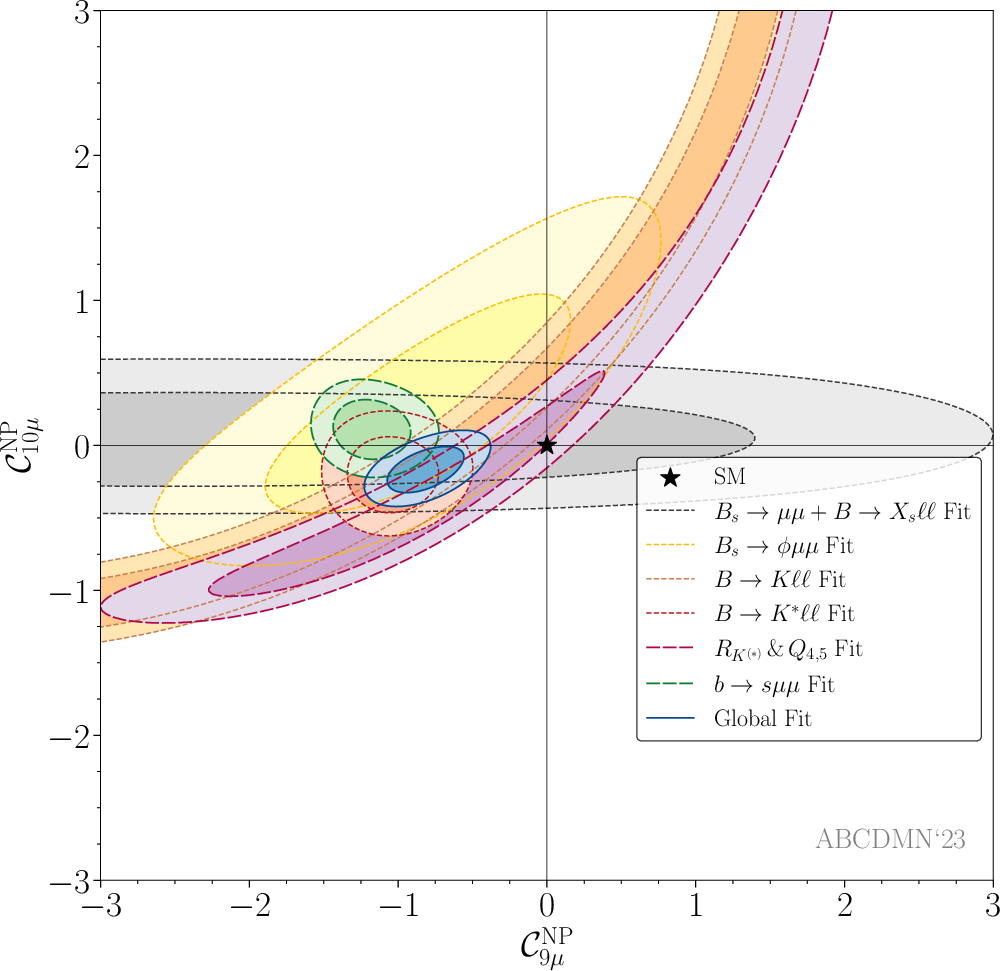
Figure 2: Global fit taken from Ref.~\cite{Alguero:2023jeh}, showing confidence regions for B9 in different mode selections.
Inclusive-Exclusive Sum Approach and Constraints on Hadronic Scenarios
A further test is performed by comparing the sum of exclusive branching ratios to the inclusive rate at high-C90. Employing a quadratic parameterization for each mode, the analysis shows that a universal hadronic shift—required to explain exclusive deficits—adversely impacts the agreement between inclusive and exclusive determinations, with the data disfavouring purely hadronic explanations.
C91
The theoretical uncertainty is dominated by the inclusive calculation; future measurements at Belle II and LHCb are projected to halve this uncertainty, tightening constraints against the hadronic scenario.
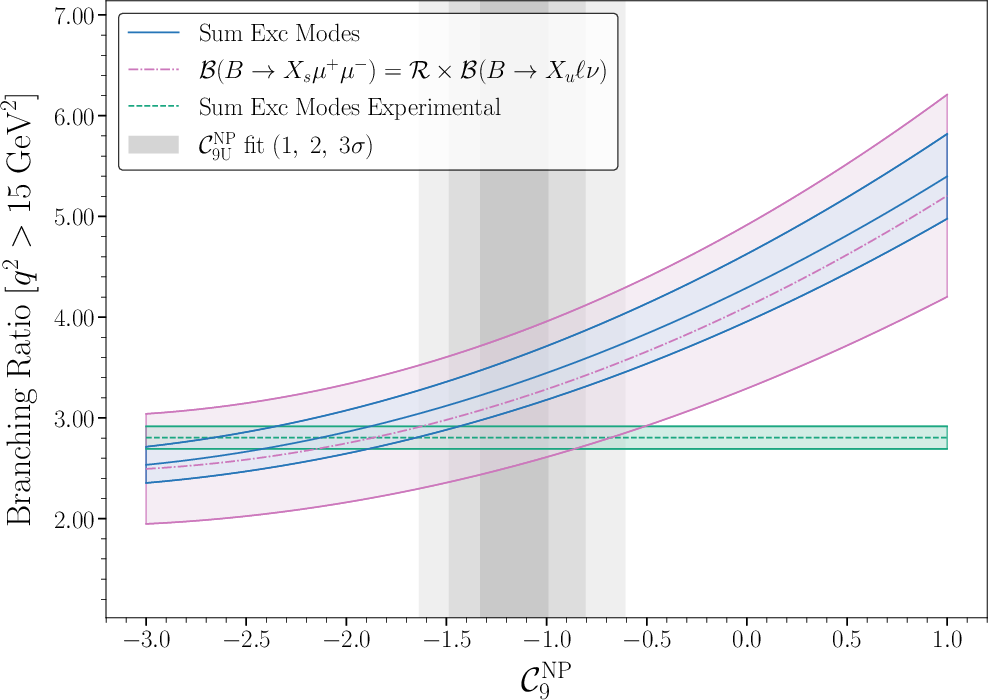
Figure 3: C92 branching ratio for C93 calculated via OPE and as a sum of exclusive modes; agreement favors NP.
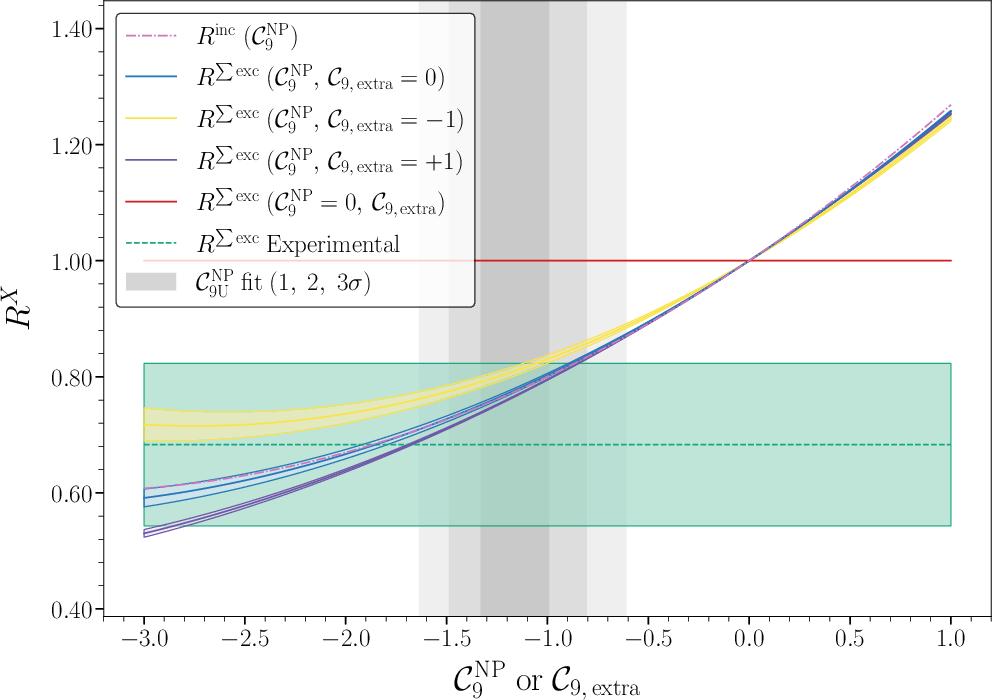
Figure 4: A comparison of the C94-dependence of the inclusive and sum-of-exclusive modes under various NP and hadronic hypotheses.
Implications and Future Directions
The analysis exhibits strong technical robustness: the construction of the C95 observables and the inclusive-exclusive sum comparison both provide systematic ways to discriminate NP shifts from constant hadronic effects. The present data, especially high-C96 ratios, disfavors a universal hadronic explanation with significance exceeding C97 and points toward an NP interpretation.
From a theoretical perspective, these results challenge models attributing anomalies solely to rescattering effects or charming-penguin amplitudes. Given the robustness of inclusive predictions (anchored in C98 data and power corrections), the distinction between exclusive and inclusive behavior places severe constraints on the size and universality of possible hadronic mimics.
With significant improvements forecast for both experimental measurements (inclusive branching ratios, normalization uncertainties) and theory (lattice calculations of C99 form factors and vacuum matrix elements), future developments are expected to further clarify the origin of these anomalies and sharpen the distinction between NP and hadronic scenarios.
Conclusion
The paper provides a comprehensive strategy for disentangling unknown nonperturbative effects and genuine NP contributions in B→Xsℓℓ0 transitions. By exploiting the differential sensitivity of inclusive and exclusive modes, and constructing robust, normalization-independent observables, the study demonstrates that current data favor the NP scenario and places stringent bounds on hypothetical universal hadronic contributions. Future advancements in measurement and theory are projected to significantly tighten these constraints and play a decisive role in resolving the B→Xsℓℓ1-flavor anomalies.