- The paper introduces a two-tone driving scheme that creates an effective two-mode squeezing Hamiltonian for macroscopic magnon entanglement.
- Numerical simulations using a Lindblad master equation validate strong entanglement despite realistic magnon and qubit decoherence.
- A joint Wigner tomography protocol is proposed for experimental verification, highlighting potential applications in quantum networks.
Macroscopic Entanglement Between Two Magnon Modes via Two-Tone Driving of a Superconducting Qubit
Introduction
Hybrid quantum systems that utilize magnons in yttrium iron garnet (YIG) spheres have emerged as promising platforms for quantum state engineering due to their exceptionally low magnon dissipation rates and their compatibility with a diverse range of coherent quantum interactions. This work investigates entanglement generation between two macroscopically large magnon modes in separated YIG spheres mediated by a transmon qubit, with the coupling realized through a common microwave cavity. The core innovation is a two-tone driving scheme applied to the qubit, which, with optimal tuning of driving frequencies and amplitudes, generates an effective two-mode squeezing Hamiltonian for the magnons. Theoretical analysis under experimentally feasible conditions shows that the protocol produces significant magnon entanglement despite realistic noise channels, and the authors further detail a measurement protocol for experimental verification.
System Architecture and Effective Hamiltonian Derivation
The model comprises two millimeter-scale YIG spheres and a superconducting transmon qubit co-located in a three-dimensional microwave cavity. Each YIG supports a magnon mode, tuned individually via local coils in a global bias field, while both magnons and the qubit couple strongly to the cavity via magnetic and electric dipole interactions, respectively. The qubit is subjected to two near-resonant microwave driving fields.
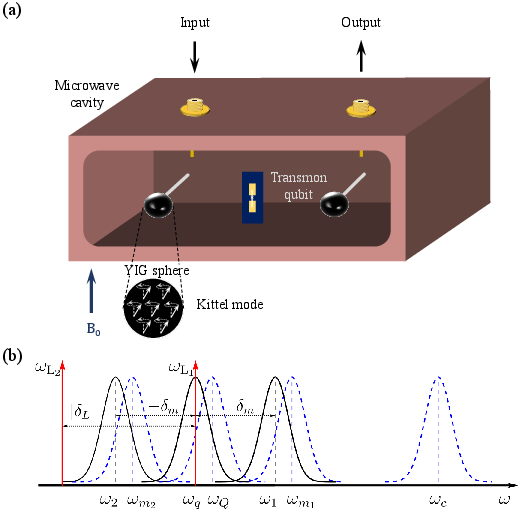
Figure 1: The cavity–magnon–qubit system: (a) layout of two YIG spheres and a transmon qubit coupled via a shared cavity, and (b) schematic of original/effective mode frequencies under two-tone qubit driving.
The cavity is operated in the large-detuning limit, where virtual photon exchange induces effective Jaynes-Cummings and beam-splitter couplings between the qubit and magnons, and directly between the magnons. Moving to suitable rotating frames and applying rotating-wave approximations under two-tone qubit driving, the authors analytically derive an effective Hamiltonian comprising magnon number-renormalization terms and, critically, a two-mode squeezing term proportional to (m1†m2†+m1m2) coupled to the qubit state. This term underpins the generation of Einstein–Podolsky–Rosen-type continuous-variable entangled states between the macroscopic magnon modes.
Dynamical Entanglement Generation
To account for non-idealities, the full system evolution is simulated using a Lindblad master equation incorporating realistic magnon and qubit dissipative/dephasing rates, as well as finite bath temperatures. The logarithmic negativity is employed to quantify transient bipartite magnon entanglement during time evolution.
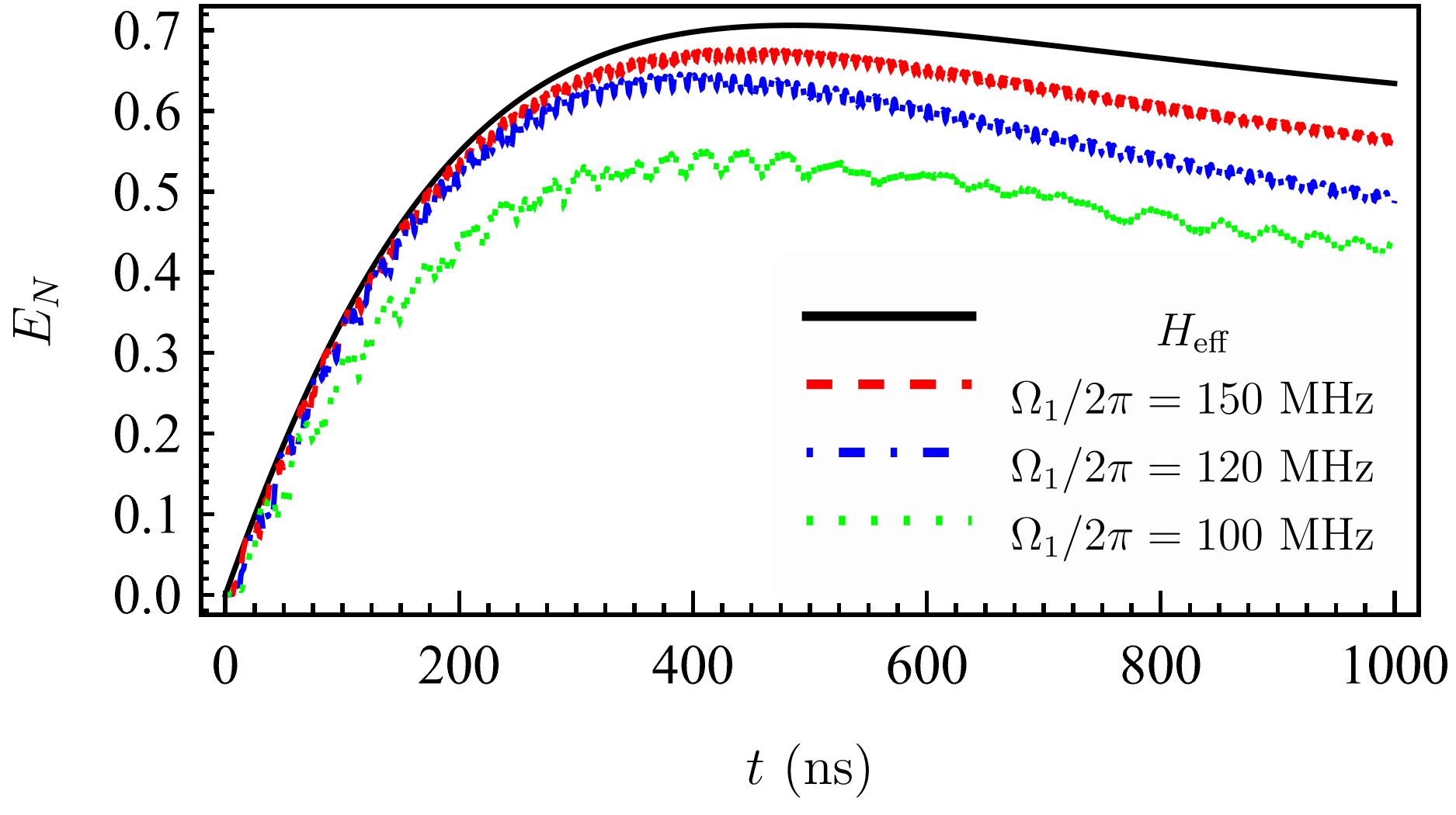
Figure 2: Time evolution of magnonic entanglement (logarithmic negativity) for various qubit drive strengths, showing close agreement between the exact and effective models.
Physical parameter values are selected based on the state-of-the-art in cavity magnonics and superconducting qubit technology, with coupling rates and decoherence rates taken from recent experiments. For optimal tuning (Ω1/2π=150 MHz), the maximum achievable logarithmic negativity is approximately 0.68 at ∼430 ns, with only minor dependence on the precise value of the drive amplitude if the detuning hierarchy is respected. These values validate that the effective Hamiltonian description is reliable for entanglement-rate estimates in typical experimental regimes.
Robustness Against Dissipation and Thermal Effects
The protocol's sensitivity to decoherence processes is investigated by systematically varying the magnon and qubit decay/dephasing rates. The simulation results demonstrate that magnon dissipation dominates over qubit-based noise in reducing entanglement, consistent with physical intuition due to the centrality of magnon-mode coherence. Both qubit dissipation and dephasing moderately degrade entanglement to similar extents, contrasting with previous studies where certain magnonic squeezing schemes were insensitive to qubit dephasing.
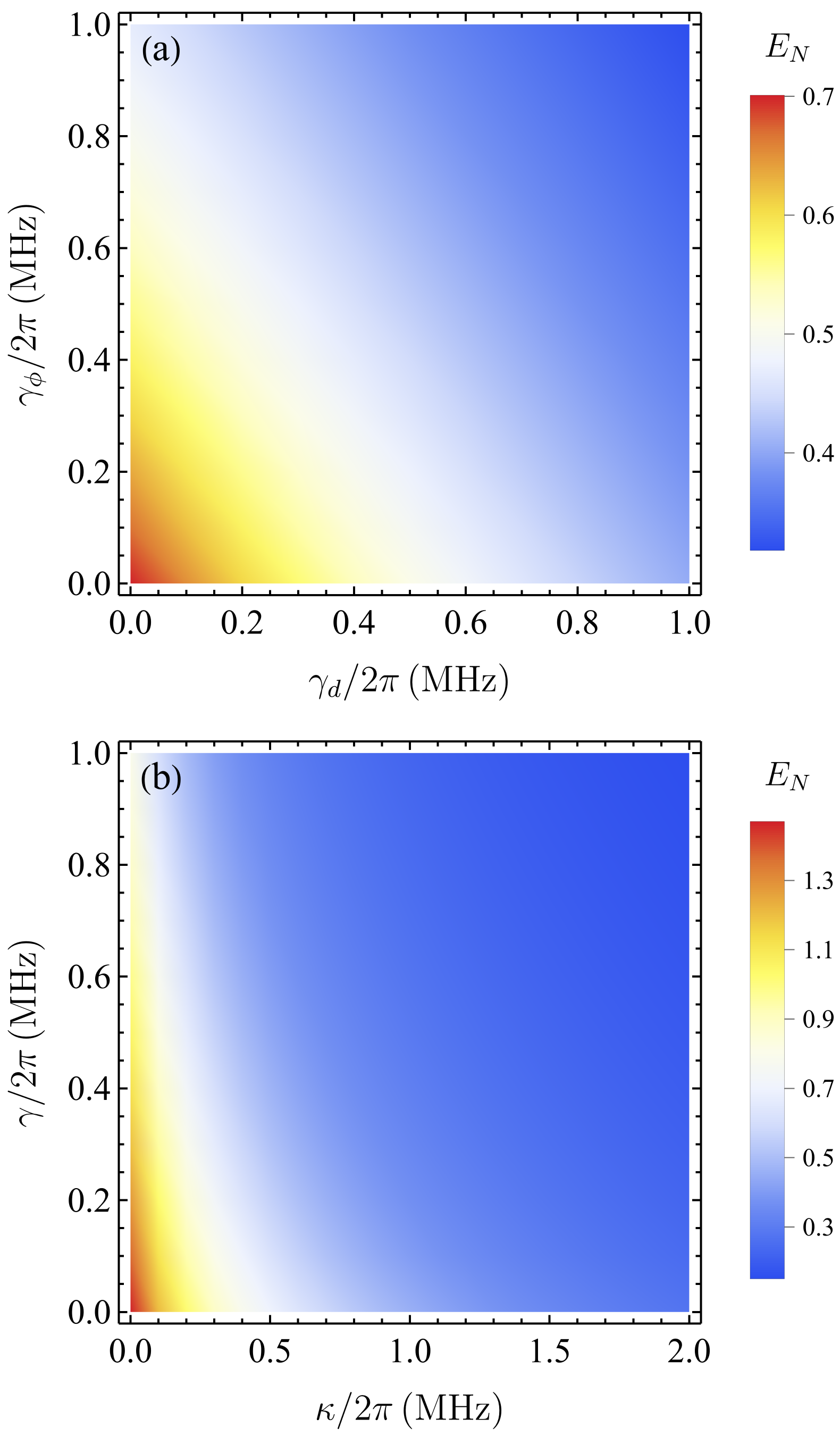
Figure 3: Maximum magnon entanglement as a function of (a) qubit dissipation and dephasing rates, and (b) both magnon and qubit losses.
Elevated environmental temperatures are also shown to diminish the peak entanglement and hasten its decay. For initial magnon thermal occupations exceeding one, the resulting entanglement at any time remains substantially lower and is only observable for very low noise and loss rates.
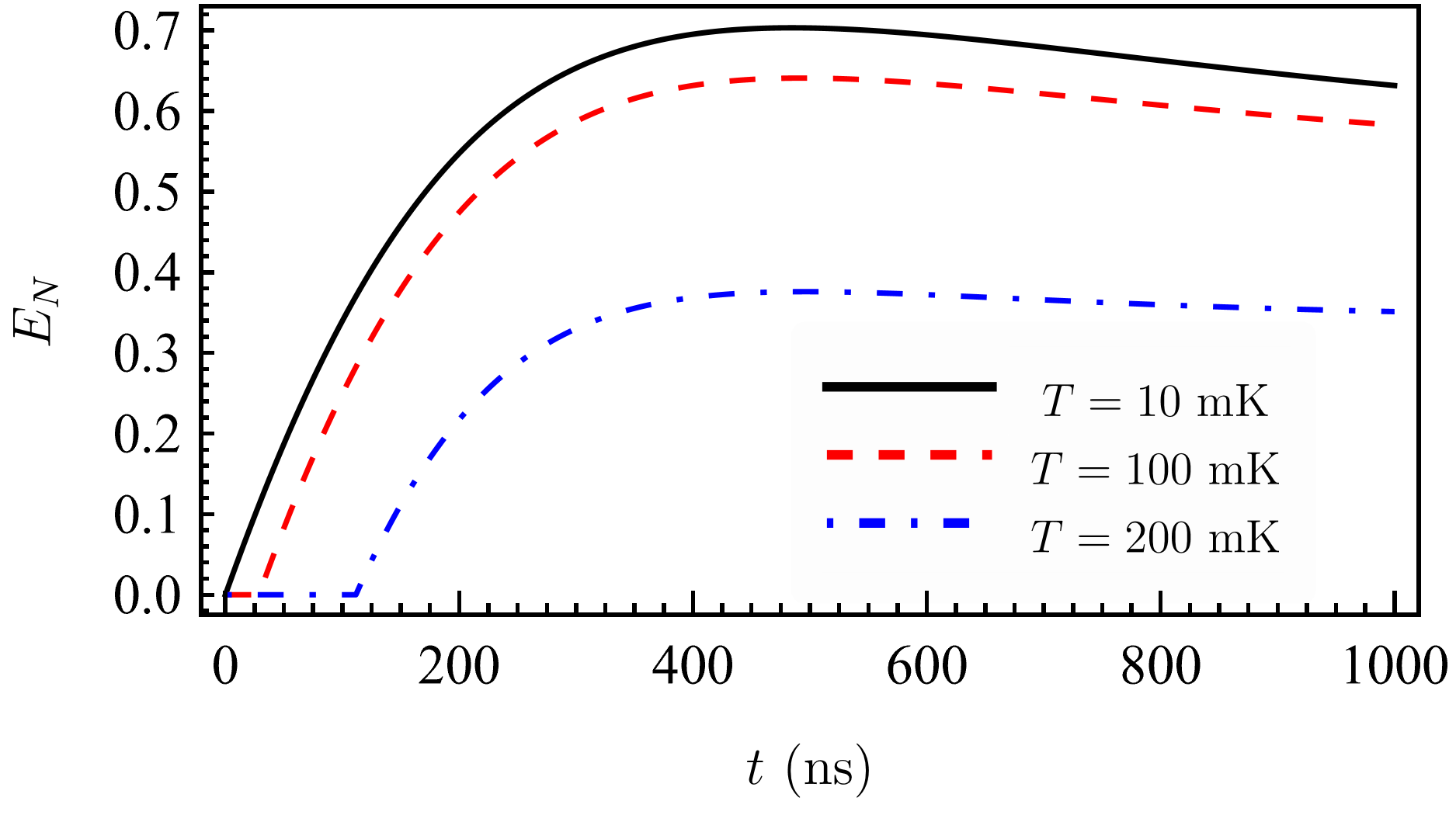
Figure 4: Logarithmic negativity as a function of time for different bath temperatures, illustrating the thermal suppression of entanglement.
Experimental Detection of Magnon Entanglement
The authors propose an entanglement verification protocol based on joint Wigner tomography of the two magnon modes, utilizing the dispersive coupling between the qubit and both magnon modes available in the large detuning regime. The protocol requires displacement operations on each magnon mode (implemented via microwave drives) and joint parity measurements inferred from dispersive shifts of the qubit transition frequency. Ramsey interferometry is employed to resolve the joint parity and reconstruct the Wigner function of the bipartite magnon state.
Joint Wigner functions calculated for different magnon loss rates exhibit signatures characteristic of two-mode squeezing and nonclassical correlations—oblique squeezing in the (X1,X2) and (P1,P2) quadrature planes at low loss, with the structure disappearing for large decay rates.
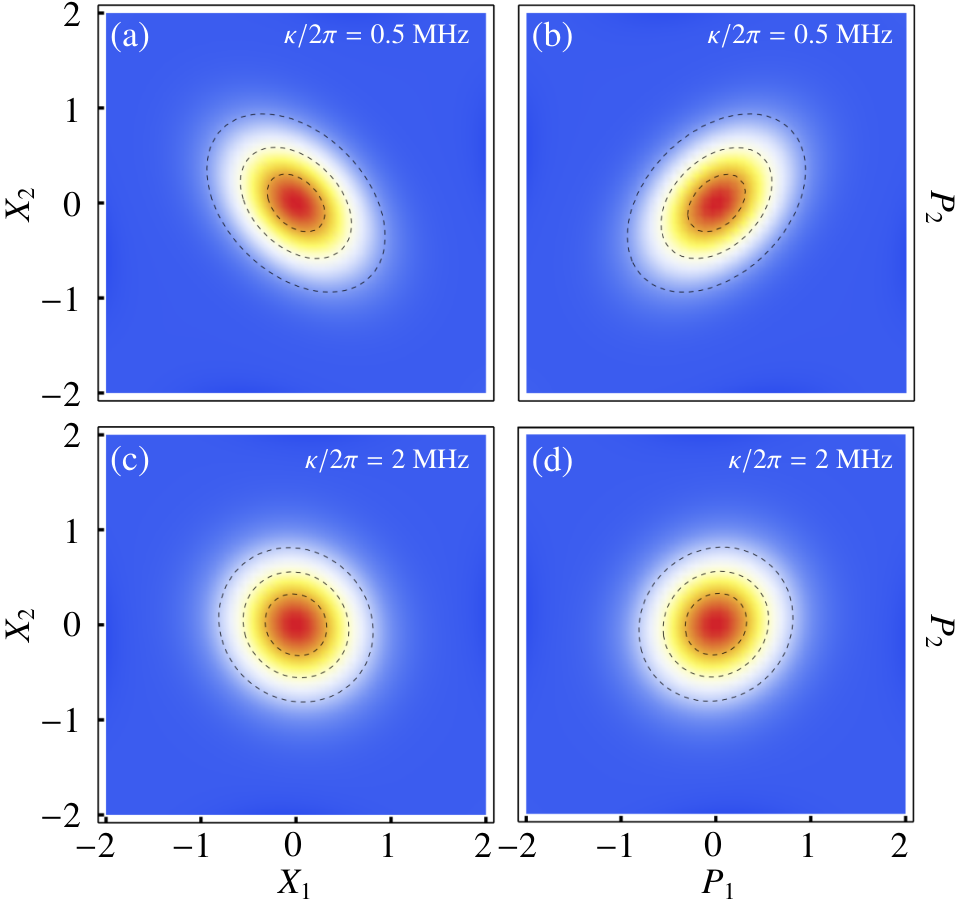
Figure 5: Joint Wigner functions W(X1,X2) and W(P1,P2) for two magnon modes with low (a–b) and high (c–d) magnon loss rates, evidencing squeezing and reduced coherence respectively.
Implications and Future Directions
This work demonstrates that genuine macroscopic entanglement---involving magnon modes comprised of more than 1018 constituent spins---can be robustly generated and verified with current hardware capable of strong cavity-magnon-qubit coupling. The capability to create, manipulate, and characterize entanglement between large-scale quantum subsystems offers new tools for probing the quantum boundary in mesoscopic systems, and provides fertile ground for investigations into decoherence models and nonclassical testbeds germane to the quantum-to-classical transition.
Practically, such hybrid architectures could enable the development of distributed quantum networks, quantum enhanced sensing, or transduction protocols leveraging magnonic degrees of freedom. The outlined entanglement verification technique sets a clear experimental route, and further integration with optical or phononic modes may extend these platforms into broader quantum information applications. Additionally, the two-tone qubit driving methodology detailed here could be generalized for engineering non-Gaussian magnon states or multipartite magnonic entanglement.
Conclusion
The scheme elucidated herein provides a rigorous, implementable method for generating and detecting macroscopic entanglement between YIG magnon modes through two-tone driven qubit mediation in a hybrid cavity system. Strong entanglement is achievable under contemporary experimental parameters. The analytic and numerical results clarify crucial dependencies, such as the dominant effect of magnon decoherence and the resilience to modest qubit noise. The work paves the way for both foundational studies of quantum macroscopicity and practical hybrid quantum network architectures.
(2605.06297)

