- The paper establishes an algebraic framework for unfolding quantum Reed Muller codes to design local magic state distillation factories with provable error suppression.
- It provides explicit 2D and 3D Z stabilizer layouts using polynomial evaluations and Gray code ordering, validated through numerical simulations.
- The work rigorously analyzes distillation exponents and prefactors across various QRM codes, offering practical schemes for noise-biased quantum architectures.
Local Distillation from Reed Muller Codes Unfolding
Introduction and Motivation
The paper "Local distillation from Reed Muller codes unfolding" (2605.06284) develops a rigorous algebraic framework for the unfolding of quantum Reed-Muller (QRM) codes. Distillation factories based on QRM codes, such as the widely used [[15,1,3]] code, are central to magic state distillation protocols for noise-biased qubits. State injection of non-Clifford gates is enabled by improving magic state fidelity, often via distillation based on triorthogonal codes. Following recent advances in local layouts for QRM distillation factories [ruiz2025unfolded], this work generalizes and formalizes the unfolding methods for a broader family of QRM codes by exploiting their algebraic and geometric structure. The paper provides explicit 2D and 3D layouts for the Z stabilizer groups of several QRM codes with different distances, demonstrates their product structure, analyzes their distillation exponents and prefactors, and links these structures to practical distillation schemes for highly biased noise platforms.
Algebraic Structure and Stabilizer Group Layouts
The central technical development is the characterization of QRM codes via polynomials and their evaluation on the vertices of an m-cube, encoding the geometric and algebraic structure of the stabilizers. The Z stabilizer group for QRMm(q,r) is generated by subcubes of dimension r+1, corresponding to sets of monomials as described in detail. Through product structure, the paper unfolds high-dimensional QRM codes into local 2D and 3D layouts for the Z stabilizers.
For instance, it unfolds the [[15,1,3]] QRM code into a planar layout for its Z stabilizer group, exploiting Gray code ordering and cartesian product decompositions.
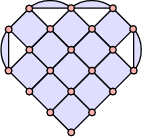
Figure 1: Planar layout for Z stabilizer generators of QRM4(1,1) where each vertex is a physical qubit and each square is a weight-4 Z stabilizer.
The same methodology is generalized to QRM6(1,1) and QRM6(1,2), producing layouts that allow for highly local implementations of distillation circuits, with explicit partitioning of cube coordinates into spatial axes.
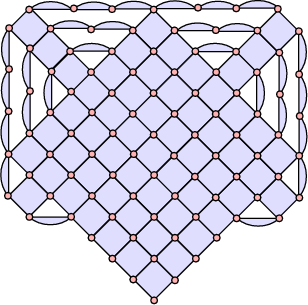
Figure 2: Planar layout for Z stabilizer generators of QRM6(1,1) showing weight-4 Z stabilizers mapped geometrically for spatial locality.
The construction leverages Gray code basis selection for edges and squares, yielding a compact and numerically validated basis for the relevant stabilizer groups.
Magic State Factories: Distillation Exponents and Prefactors
The paper systematically analyzes the error suppression achieved by these distillation factories, calculating both the exponent (minimum distance of Z stabilizer group) and the prefactor (number of minimum weight Z logical operators).
Key results:
- Small unfolded code / QRM4(1,1) (punctured): 15-to-1 T state factory, output infidelity 35p3 for input p.
- Big unfolded code (interpolation between r+10 and r+11): 64-to-1 r+12 state, output r+13.
- Rubik's cube code (r+14): 64-to-15 r+15 factory, output r+16.
- Punctured r+17: 127-to-1 r+18 factory, output r+19.
These claims are empirically validated and derive from explicit enumeration of minimum weight codewords in classical Reed-Muller codes via the Plotkin recursive construction.
The work provides full algebraic proofs of the product structure, translation invariance, and inclusion relations between logical and stabilizer groups, ensuring that the constructed layouts achieve the stated minimum distances and associated error suppression.
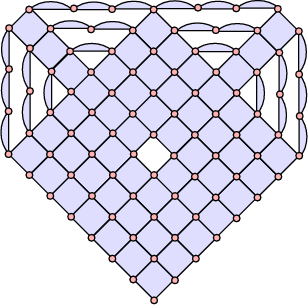
Figure 3: Planar layout of the big unfolded code, realizing a 64-to-1 QRM4(1,1)0 distillation factory with Z stabilizers as geometric squares.
3D Local Layouts: Rubik’s Cube and Higher Dimensional Codes
For codes with larger minimum distance, the paper constructs three-dimensional local layouts. QRM4(1,1)1 is laid out as a "Rubik's cube", enabling 64 input QRM4(1,1)2 states to distill 15 QRM4(1,1)3 states using cubes as local Z stabilizers.
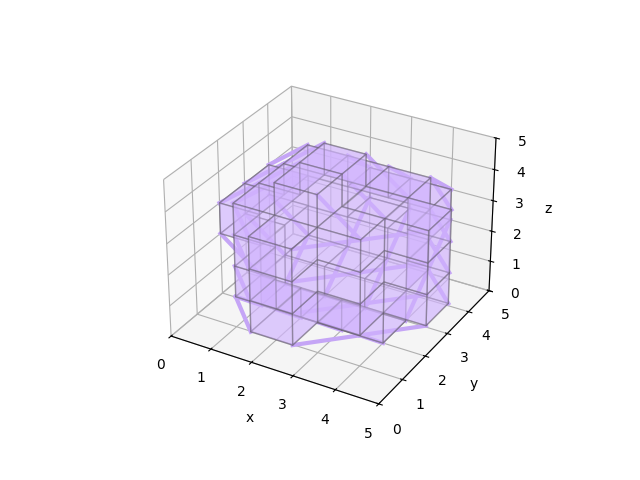
Figure 4: 3D interactive visualization of the Rubik’s cube layout for Z stabilizers of QRM4(1,1)4, with each cube corresponding to a local stabilizer.
The methodology is further extended to 127 qubits for punctured QRM4(1,1)5, achieving distance-7 distillation with output scaling as QRM4(1,1)6. Notably, all layouts are numerically verified to span the complete Z stabilizer group, and script-based generation is provided for visualization and further experimentation.
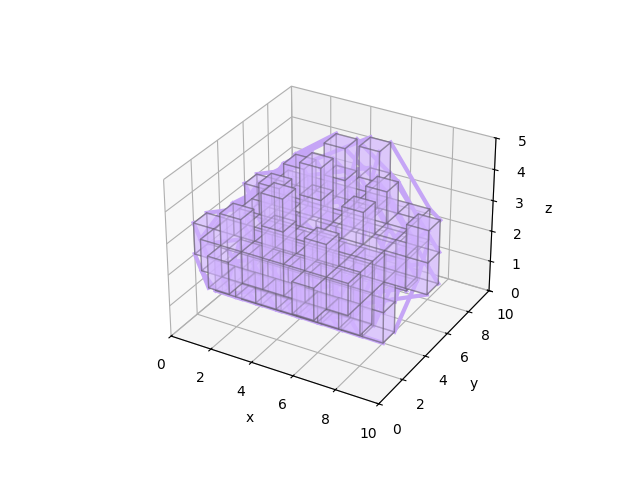
Figure 5: 3D local layout for the Z stabilizers of QRM4(1,1)7, suitable for high-distance distillation protocols.
Logical Action of Transversal Gates
Logical action of transversal QRM4(1,1)8 and QRM4(1,1)9 gates is rigorously analyzed. The paper applies algebraic techniques (including Clifford hierarchy conjugation analysis) to show that transversal QRM6(1,1)0 gates on these layouts induce QRM6(1,1)1 gates on logical qubit partitions through specific partitionings of cube coordinates. This implies that the layouts are compatible with efficient magic state distillation for QRM6(1,1)2- and QRM6(1,1)3-level gates in the Clifford hierarchy.
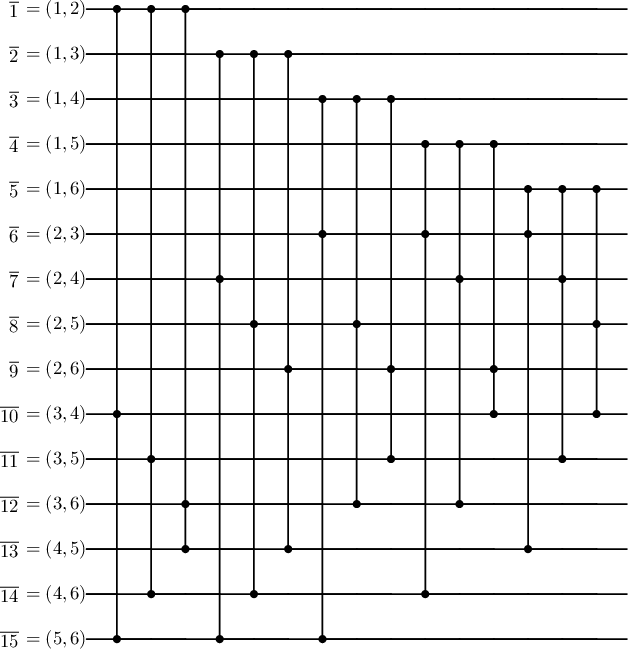
Figure 6: CCZ circuit obtained by applying T or variants transversally to the logical qubits of QRM6(1,1)4.
Implications and Future Directions
The formalization and generalization of the unfolding approach provides practical schemes for magic state distillation suitable for hardware with highly biased noise, such as cat qubits. The explicit layouts, algebraic proofs, and error analysis establish a foundation for scalable local distillation factories with provable exponents and prefactors.
Practical implications:
- Hardware locality: Enables low-overhead, highly local distillation circuits for architectures with restricted connectivity and biased noise.
- Factory scaling: Explicit construction and characterization of prefactors allow precise error budgeting and resource estimation for large-scale quantum computation.
Theoretical implications:
- Algebraic and geometric codes: Deepens the connection between algebraic code structure and physical layout, opening pathways for further code generalizations.
- Clifford hierarchy: Explicit realization of higher-order Clifford gates via transversal operations supports more flexible compilation and synthesis.
Future developments:
- Numerical simulation of the distillation protocols for extended layouts to confirm empirical error floors.
- Extension to QRM codes with larger dimension and more general stabilizer/logic relationships.
- Investigation of code unfolding for more exotic gate sets and magic state hierarchies, including those reachable via parity-unfolded distillation [tiurev2026parity].
Conclusion
The paper provides an authoritative algebraic and geometric account of unfolding QRM codes for local distillation factories, delivering explicit 2D and 3D layouts for codes with distances 4 and 7. The analysis yields rigorous exponents and prefactors, validates error suppression, and connects transversal gate implementations to logical Clifford hierarchy actions. This establishes a scalable blueprint for future magic state distillation on noise-biased quantum platforms.