- The paper introduces a unified framework for classical shadows protocols over type-I compact symmetric spaces, extending beyond conventional group-based methods.
- It employs advanced representation theory and Weingarten calculus to explicitly characterize measurement channels and assess variance and sample complexity.
- Results show that tunable protocols (e.g., AIII, BDI) can significantly reduce variance for diagonal observables, enhancing practical quantum state estimation.
Classical Shadows Protocols Beyond Group Unitary Ensembles: A Theory over Compact Symmetric Spaces
The paper "Classical shadows over symmetric spaces" (2605.05518) develops a thorough mathematical framework for classical shadows protocols where random unitaries are drawn from compact symmetric spaces rather than from compact groups. The work provides both a unifying theoretical structure and a set of explicit results concerning the resultant measurement channels, their sample complexity properties, and situational advantages over standard group-based shadow protocols.
Motivation and Context
Classical shadows provide a framework for efficient estimation of quantum expectation values by performing randomized measurements and reconstructing so-called "shadows" of the quantum state. Standard protocols select random measurements via unitaries sampled from Haar-distributed compact groups (such as the unitary group U(d), the orthogonal group O(d), or the symplectic group Sp(d)). These protocols have become essential in both theoretical and practical quantum information scenarios, especially as the system dimension grows, rendering full tomography infeasible.
However, the structure of compact groups is only one instance within the broader category of symmetric spaces, which are quotients of the form G/K with K the fixed points of an involutive automorphism of G. Whereas the mathematical structure and resulting statistics of group-based protocols are well mapped, little was previously known about protocols defined over such symmetric space ensembles.
Classical Shadows over Symmetric Spaces
The central technical contribution is the analysis of shadow protocols when the ensemble of unitaries is drawn from the uniform (invariant) measure on a type-I compact symmetric space. These can be algorithmically sampled via t=(g−1)g for g Haar-random in G, giving rise to non-uniform, non-invariant distributions when viewed as measures on G. The paper performs a systematic study over all seven classical families of type-I symmetric spaces as classified by Cartan, fully describing the resulting channels and their implication for shadow estimation.
In standard group-based protocols, the measurement channel is O(d)0-equivariant and structurally decomposable via Schur's lemma. Over symmetric spaces, this full equivariance does not persist. However, the authors prove that for subgroups O(d)1 satisfying a O(d)2-normalization property (where O(d)3 is the measurement basis), the induced measurement channel is block-diagonalizable over the irreps of O(d)4 acting on operator space, with each block being a scalar.
Structural Results and Channel Characterization
The key result is that classical shadow measurement channels defined using symmetric spaces have a universal form: O(d)5
where O(d)6 is the dephasing channel in basis O(d)7, O(d)8 the symplectic form in the appropriate case, and O(d)9, Sp(d)0 are parameters depending on the symmetric space and the choice of signature parameters (see Table 1 in the paper for explicit forms).
For certain classes (AI, AII, CI, DIII), Sp(d)1 decays as Sp(d)2, making the protocols essentially reproduce the properties of the group-based shadows. However, for AIII, BDI, and CII, the parameter Sp(d)3 can be tuned in Sp(d)4, affecting the protocol's sample complexity and bias structure.
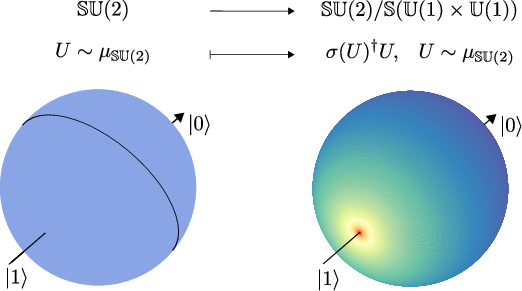
Figure 1: The Bloch-sphere probability distributions induced by sampling unitaries from Sp(d)5 and from the AIII symmetric space Sp(d)6. The latter exhibits anisotropy due to lifting the measure from the quotient to the group.
Sample Complexity and Variance Analysis
A central metric for evaluating shadow protocols is the sample complexity required for estimating expectation values of observables with a fixed accuracy. The variance of the shadow estimator is tightly connected to the sample complexity; minimizing the variance directly improves efficiency.
The authors compute both symbolic and numerical variances for protocols based on symmetric space ensembles, showing that, for observables aligned with the symmetry-induced preferred basis, the AIII and BDI protocols achieve non-vanishing improvements in variance and hence sample complexity compared to group-based shadows. Specifically, when observables are concentrated on the diagonal (in basis Sp(d)7), the variance reduction can be significant if the signature parameter Sp(d)8 is large.
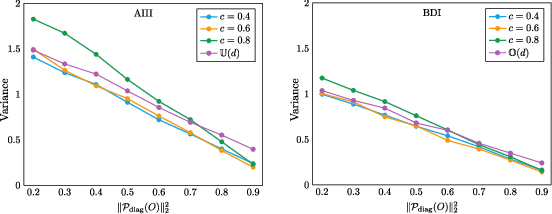
Figure 2: Numerical variances for random (symmetric) observables under shadows protocols for Sp(d)9, highlighting cases where AIII/BDI outperform standard unitary/orthogonal shadows for observables diagonal in the measurement basis.
Formally, when the observable G/K0 is highly diagonal (i.e., G/K1 projects mostly onto the dephasing channel), the sample complexity for AIII and BDI scales better than the G/K2 regime achieved with standard G/K3 and G/K4 shadows.
Algorithmic and Implementation Considerations
A practical aspect discussed is the circuit complexity for sampling unitaries from these novel ensembles. For group k-designs, efficient approximate sampling is known in some cases (e.g., logarithmic depth for unitary designs), but not for all (e.g., orthogonal/symplectic designs demand superlogarithmic depth). The symmetric space protocols require (at most) G/K5-designs over the parent group for full statistical matching, aligning their implementation complexity with that of higher-moment group designs.
The methods of analysis leverage advanced representation theory, Weingarten calculus for both group and symmetric space integration, and non-trivial algebraic decompositions of operator space relative to symmetry constraints.
Implications and Outlook
The results offer both theoretical and practical avenues for improved quantum shadow tomography:
- Theoretical: The paper unifies the known classical shadows theory over compact groups with its symmetric space generalization, describing all infinite families (AI, AII, AIII, BDI, CI, CII, DIII) within a single formalism. This unification suggests that any further generalizations will need to break fundamentally new mathematical ground beyond the type-I symmetric space domain.
- Practical: The existence of tunable protocols (AIII, BDI) with superior sample complexities for specific observable classes has the potential to reduce experimental quantum resource requirements for certain state characterization tasks.
Potential future directions include:
- Extending the framework to arbitrary, reducible representations or to matchgate contexts (e.g., DIII with SO acting as matchgates).
- Direct analytical characterization of all scalar coefficients G/K6 in the symmetric decomposition, analogous to the group case, to further automate protocol analysis.
- Engineering hardware-efficient circuits for log-depth sampling over non-unitary symmetric space ensembles.
Conclusion
This work delivers a comprehensive theory of classical shadow protocols informed by the geometry and representation theory of symmetric spaces. By explicitly characterizing the measurement channel for all seven classical families of type-I compact symmetric spaces, and by quantifying variance and sample complexity improvements, it extends the landscape of quantum shadow tomography beyond group-based frameworks. These insights are pertinent for the design of future quantum state estimation protocols, especially those targeting structure-aware measurements for physically relevant observables.

