Carroll fermions from null reduction: A case of good and bad fermions
Published 6 May 2026 in hep-th and hep-ph | (2605.05334v1)
Abstract: We derive Carrollian fermionic actions using the null reduction method from Bargmann spacetimes. In the Lorentzian light-cone formulation, the Dirac spinor naturally decomposes into dynamical and constrained degrees of freedom $-$ the so-called good' andbad' fermions $Ψ{(\pm)}$. These light-cone projections are intrinsically adapted to the null frame and, unlike the chiral decomposition into left- and right-handed spinors $Ψ{L(R)}$, are valid in arbitrary spacetime dimensions, both even and odd. As in the case of bosons, the magnetic Carroll sector for fermions is governed by the dynamical modes of the parent theory, while the electric sector arises from the constrained modes. Upon deforming to a Bargmann spacetime, these constraints are removed, promoting the `bad' fermions to dynamical modes that describe the electric Carroll fermions. We construct the Clifford algebra on the Carroll manifold through its embedding in the ambient Bargmann manifold, and obtain both electric and magnetic Carroll fermion actions from a \textit{single} Bargmann-invariant Dirac action. We analyze the canonical structure of both theories, establish their invariance under Carroll transformations, and compute the corresponding two-point functions, which exhibit the expected behavior in both sectors. We conclude with some comments on the quantization of these Carrollian theories.
The paper provides a systematic derivation of Carrollian fermionic field theories via null reduction of the Dirac Lagrangian, distinguishing good (dynamical) and bad (constrained) fermions.
It decomposes Dirac spinors using light-cone projections to construct distinct electric and magnetic sectors, applicable in any spacetime dimension with mass.
The analysis highlights quantization challenges in the magnetic sector, suggesting alternative frameworks such as rigged Hilbert spaces for proper functional treatment.
From Dirac Spinors to Carroll Fermions via Null Reduction
Introduction and Motivation
This paper, "Carroll fermions from null reduction: A case of good and bad fermions" (2605.05334), investigates the derivation of Carrollian fermionic field theories through null reduction of the standard Dirac Lagrangian formulated on a Bargmann spacetime. The study is motivated by recent developments in Carrollian field theory, including its relevance to Carrollian holography, and aims to resolve open questions regarding the systematic construction of fermionic Carrollian actions—especially in arbitrary spacetime dimensions and for theories with mass.
The work centralizes the decomposition of the Dirac spinor into dynamical and constrained degrees of freedom, known as "good" and "bad" fermions, via projection onto light-cone frames instead of the more restrictive chiral projections. This approach facilitates a first-principles derivation of both electric and magnetic Carrollian sectors and clarifies the role of constraints and symplectic structure under null reduction.
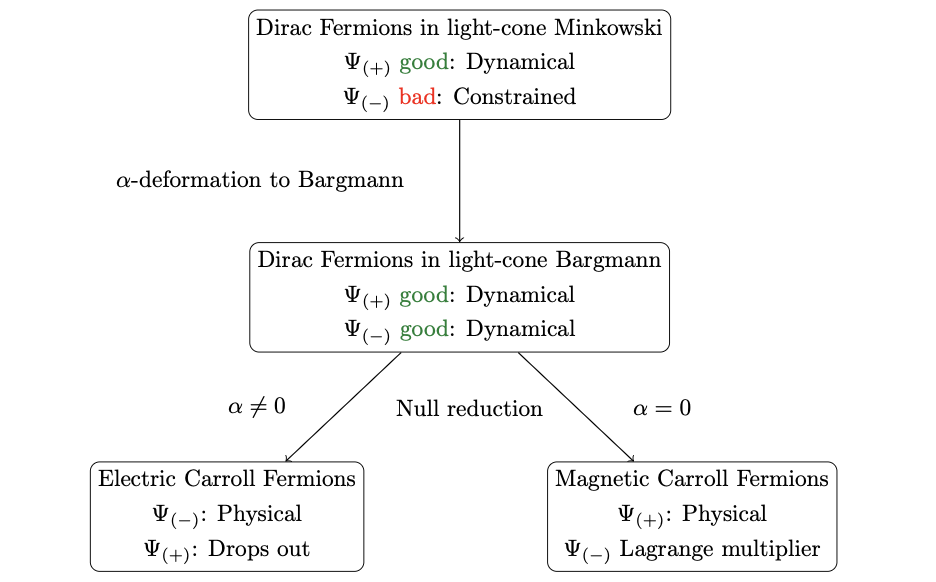
Figure 1: Carroll fermions from null reduction of light-cone Dirac fermions, illustrating the schematic path from Dirac spinors to electric and magnetic Carrollian actions.
Light-Cone Formulation and Spinor Decomposition
The analysis begins by reviewing the Dirac Lagrangian in light-cone coordinates, emphasizing the adapted Clifford algebra and the introduction of null gamma matrices. Light-cone coordinates are defined by x±=(x0±xd)/2, leading to the metric ds2=−2dx+dx−+δijdxidxj. In this frame, the Clifford algebra contains (Γ−)2=0, (Γ+)2=0, and {Γ+,Γ−}=−2.
Projecting the Dirac spinor with the operators P± results in two distinct components: Ψ(+) ("good" fermions, dynamical degrees) and Ψ(−) ("bad" fermions, constrained or non-dynamical due to primary first-class constraints in the Lorentzian theory). This decomposition is universally valid in all spacetime dimensions, bypassing the limitations induced by chiral projectors which are only valid in even dimensions and are constrained by the presence of mass terms.
The Lorentzian light-cone Lagrangian, rewritten in terms of these projections, displays a kinetic structure where only Ψ(+) possesses dynamics, and Ψ(−) is subject to primary constraints:
For ds2=−2dx+dx−+δijdxidxj0: ds2=−2dx+dx−+δijdxidxj1
For ds2=−2dx+dx−+δijdxidxj2: ds2=−2dx+dx−+δijdxidxj3
Deformation to Bargmann Geometry and Null Reduction
To systematically null-reduce the Dirac Lagrangian and obtain both electric and magnetic Carrollian sectors, the authors employ a deformation of the light-cone Minkowski metric to a Bargmann metric parameterized by a deformation ds2=−2dx+dx−+δijdxidxj4:
ds2=−2dx+dx−+δijdxidxj5
In this setting, the normally constrained ds2=−2dx+dx−+δijdxidxj6 becomes dynamical due to the ds2=−2dx+dx−+δijdxidxj7-deformation—effectively "promoting" the bad fermions into good, allowing a systematic extraction of the electric sector upon null reduction. The resulting theory is formulated intrinsically on a Carroll manifold, characterized by a degenerate metric and a preferred null direction.
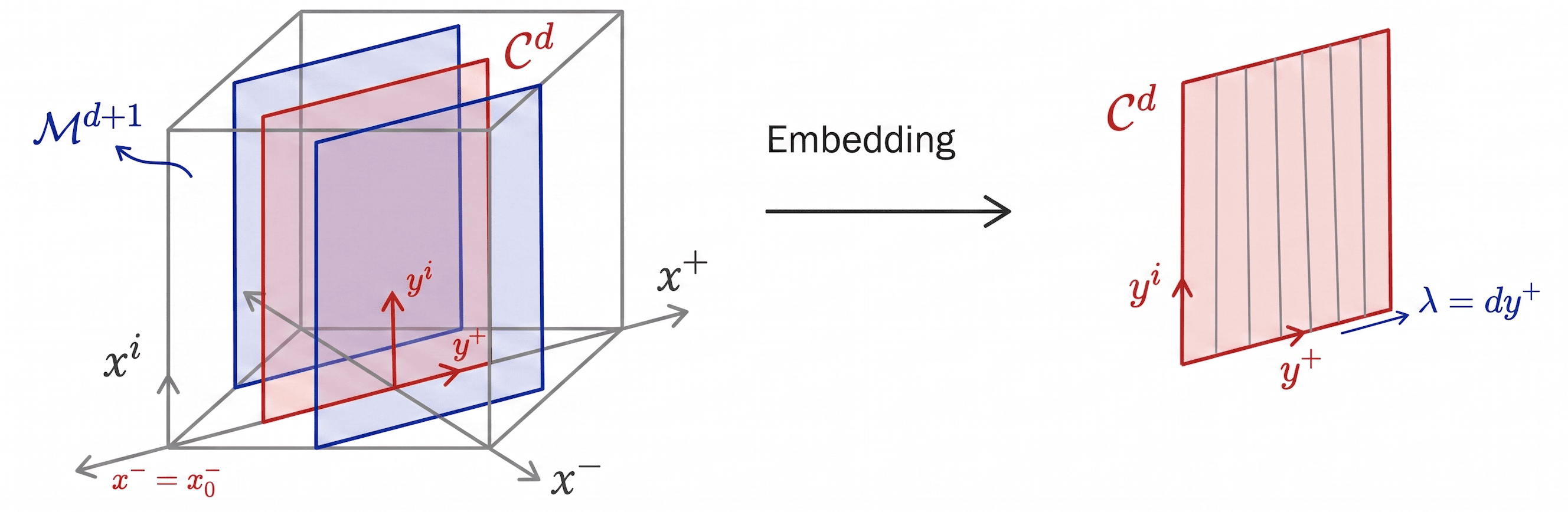
Figure 2: Carroll geometry from null reduction—embedding of the Carroll manifold ds2=−2dx+dx−+δijdxidxj8 in an ambient Bargmann manifold.
Carroll Clifford Algebra and Fermionic Actions
The Carrollian Clifford algebra is established via the pullback of ambient gamma matrices and metric to the null hypersurface, resulting in a degenerate algebra reflecting the ultralocality of Carrollian kinematics. In this setup, the two Carrollian sectors arise:
Electric Sector: Derived from modes originating as non-dynamical (bad) in the parent theory, rendered dynamical via deformation; the electric Carroll action involves only temporal derivatives and supports strictly ultralocal evolution.
Magnetic Sector: Descends from the dynamical (good) modes of the parent theory; the magnetic Carroll action maintains a more intricate symplectic structure wherein both components are interdependent, exhibiting nontrivial constraints and kinetic mixing.
The canonical analysis is performed for both sectors, demonstrating that the Hamiltonian structure satisfies the characteristic Carroll commutation relations and invariance under Carroll boosts and translations.
Two-Point Functions and Quantization
For the electric sector, the two-point function is computed explicitly and displays pure ultralocality, in line with prior results—propagators collapse to delta functions in spatial directions, and time evolution is trivial except for a mass-induced phase:
ds2=−2dx+dx−+δijdxidxj9
In the magnetic sector, the two-point function and quantization reveal a fundamental ambiguity in defining the Hilbert space. The canonical anticommutators are off-diagonal, and the kinetic structure requires consideration of both spinor components as a coupled symplectic pair, precluding a conventional Fock space construction. The magnetic two-point function deviates from the expected spatial power-law decay encountered in Carrollian CFTs, instead reflecting strict ultralocality consistent with a "rigged Hilbert space" approach rather than the more common highest-weight vacuum.
Theoretical and Practical Implications
The results underscore the generality and systematic power of null reduction with light-cone projections for constructing Carrollian theories of fermions, unconstrained by dimensionality or mass. Notably, the framework provides a concrete route to constructing both electric and magnetic sectors from a unified higher-dimensional action—a property absent in previous approaches reliant on chiral projections or tailored massless constructions.
The study identifies a critical distinction in the quantization and correlation structure of Carrollian fermions, especially in the magnetic sector, where a standard Hilbert space construction is likely infeasible. This leads to the explicit claim—supported by the non-standard two-point functions—that quantization of Carrollian magnetic fermions may necessitate alternative functional analytic frameworks, such as rigged Hilbert spaces.
The methodology and results are immediately relevant to the program of Carrollian holography, flat space holography, and for the construction of Carrollian field theories as possible duals to asymptotically flat quantum gravity. The dimensional and mass generality is essential for further advances in Carrollian QFT, including the development of supersymmetric and higher-spin Carrollian theories.
Outlook and Future Developments
The framework crafted in this paper opens explicit avenues for further exploration:
Quantum Structure: The ambiguity in defining a Hilbert space for the magnetic sector motivates further functional analytic investigation, with potential implications for the understanding of quantum Carrollian field theories and their applications to flat space holography.
Interacting Theories: Exploration of interactions, e.g., of Yukawa type, will probe the renormalization structure and quantum consistency of Carrollian theories.
Gauge Theories: Extension to Carrollian gauge and non-Abelian fields, and the mapping of light-cone gauge-fixing and redundancy in QCD to the Carrollian limit.
Higher-Spin and Supergravity: Application to Fronsdal and Rarita-Schwinger fields, and consequent development of consistent Carrollian supersymmetry and supergravity.
Holographic Duals: The formalism's compatibility with holography highlights its importance for constructing and understanding Carrollian CFTs dual to flat space gravities.
Conclusion
The paper provides a comprehensive and systematic derivation of Carrollian fermionic field theories via null reduction of Dirac fermions, establishing the roles of good and bad light-cone projections in constructing electric and magnetic sectors. The canonical and correlation structure is explicitly clarified, and the framework’s generality with respect to dimension and mass is emphasized. Ambiguities concerning the magnetic sector's quantization are identified as directions for future research, with implications for both theoretical physics and the formal development of Carrollian quantum field theory.
“Emergent Mind helps me see which AI papers have caught fire online.”
Philip
Creator, AI Explained on YouTube
Sign up for free to explore the frontiers of research
Discover trending papers, chat with arXiv, and track the latest research shaping the future of science and technology.Discover trending papers, chat with arXiv, and more.