- The paper demonstrates a hybrid quantum-classical protocol using JC interactions to map optical information onto qubit registers.
- It employs quantum shadow tomography and an iterative inversion procedure to accurately reconstruct 2n²+3n Gaussian parameters.
- The method offers exponential gains in the mode dimension and polynomial improvements in energy efficiency compared to classical optical protocols.
Learning Gaussian Optical States with Quantum Computers: An Expert Analysis
The paper "Learning Gaussian optical states with quantum computers" (2605.05325) approaches the sample-optimal characterization of multimode optical Gaussian states using a hybrid quantum-classical protocol. The primary contribution is a quantum computational imaging and sensing (QCIS) scheme that leverages qubit-based quantum computers to achieve a provable reduction in the number of state copies required to estimate all parameters of an n-mode Gaussian electromagnetic (EM) field, providing an exponential gain in the mode dimension n and a polynomial improvement in the energy parameter compared to the best existing optical protocols.
Problem Statement and Motivation
The estimation and tomography of quantum states, particularly continuous-variable (CV) Gaussian states that model most optical fields used in imaging and sensing, traditionally entail significant resource overhead. Classical protocols typically require poly(n) copies, with statistical bounds depending critically on the energy per mode. Quantum learning theory has recently revealed that, with access to joint quantum operations and multicopy measurements, sample complexity can be reduced, sometimes exponentially in relevant parameters, compared to any classical learning approach [Chen2021-qi, Huang2022-tz].
The authors aim to instantiate these theoretical results in a physically realistic imaging and sensing context, proposing a QCIS approach: information from an n-mode Gaussian field is first transduced into a register of n qubits—one for each mode—using Jaynes–Cummings (JC) interactions, followed by measurement of local and bilocal Pauli observables on the qubits to estimate the entire set of Gaussian parameters of the field.
QCIS Protocol Outline
The QCIS scheme proceeds as follows:
- Transduction: Each optical mode of the Gaussian state interacts independently with a dedicated qubit via a JC Hamiltonian HJC=j=1∑ngj(ajσj++aj†σj−) for suitable time t, mapping information about the field's means and covariances onto the state of the qubits.
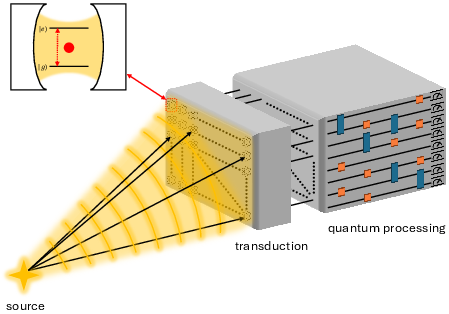
Figure 1: Schematic of the QCIS scheme illustrating transduction of an n-mode field onto an n-qubit register, pixelated spatially and decomposed in wavevector components; each field mode is coupled locally to a qubit via Jaynes–Cummings interaction.
- Measurement: Quantum classical shadow tomography is used to efficiently estimate a collection of one- and two-qubit Pauli expectation values across the n-qubit register.
- Estimation: An iterative inversion procedure is employed—starting from a linear approximation (valid for short JC interaction times) and refining via nonlinear perturbative corrections—to reconstruct the n0 parameters (means and covariances) characterizing the original n1-mode Gaussian state from the measured Pauli data.
- Resource Optimization: The entire protocol is repeated on logarithmically many (n2) distinct initial qubit states to ensure parameter identifiability for all pairs of modes, as per a constructive combinatorial argument (see Lemma \ref{n-mode initial states} and Figure 2).
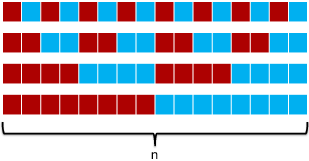
Figure 2: Visual demonstration of the minimal set of initial n3-qubit states required for full pairwise mode coverage in parameter estimation.
Sample Complexity Analysis
A central result is the rigorous upper bound on the number of copies of the field (samples) required to estimate all n4 Gaussian parameters within additive error n5 and failure probability at most n6. The main theorem asserts that
n7
copies suffice, where n8 is the maximum permitted energy per mode.
The logarithmic scaling in n9 is significant, as naive optical learning schemes typically require at least polynomial scaling in the mode number. The protocol's sample complexity matches continuous-variable classical shadow schemes in poly(n)0 [gandhariPrecisionBoundsContinuousVariable2024, beckerClassicalShadowTomography2024] but provides a polynomial improvement in poly(n)1: the number of copies only grows quadratically with energy per mode, compared to poly(n)2 or worse in strictly optical shadows protocols.
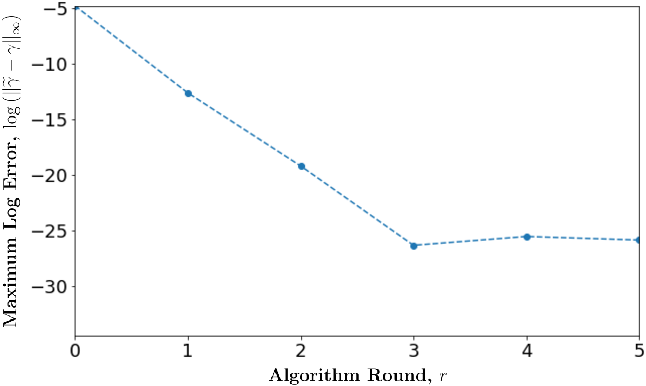
Figure 3: Convergence of maximum parameter estimation error versus algorithm iteration for a simulated two-mode Gaussian state using the proposed iterative estimation algorithm.
Key to the performance guarantee is an explicit error analysis of the truncated JC interaction as a function of interaction time, energy constraints, and iterative correction steps. The analysis establishes bounds on both bias (from neglecting higher order terms in poly(n)3) and statistical error (from shadow tomography), showing rapid convergence with successive iterations.
Technical Innovations and Claims
Several novel points distinguish this work:
- Transduction Universality: The paper establishes that JC-type interactions suffice for transferring all relevant information for full Gaussian characterization from optical to qubit registers.
- Iterative Estimation Procedure: The use of an explicit, provably convergent iterative algorithm enables controlled suppression of nonlinear truncation errors.
- Parameter Identifiability with Minimal Overhead: The protocol only needs poly(n)4 distinct initial qubit states, rather than exhaustively preparing all possible pairwise initializations.
- Polynomial Gain in Energy Parameter: The protocol's sample complexity depends only quadratically on poly(n)5, a significant practical benefit in the low-photon regime crucial for many imaging applications.
Importantly, the authors show that, for Gaussian optical fields, QCIS cannot offer an exponential quantum advantage in the number of modes poly(n)6 over the best possible classical/optical protocols—but does yield polynomial improvements in other parameters, notably energy.
Comparative Context and Implications
The methodology synthesizes advances in quantum shadow tomography [huangPredictingManyProperties2020, Huang2021-xl], energy-constrained tomography [meleLearningQuantumStates2025, bittelOptimalEstimatesTrace2025], and continuous-variable state processing [gandhariPrecisionBoundsContinuousVariable2024, beckerClassicalShadowTomography2024]. By mapping a physically meaningful imaging/sensing problem onto the quantum learning paradigm, the authors provide a bridge between abstract theoretical results and technology-relevant quantum optical practice.
The result has practical implications for quantum-enhanced imaging and sensing where complete quantum state reconstruction is required, such as in advanced satellite imaging [koseQuantumenhancedPassiveRemote2022, koseSuperresolutionImagingMultiparameter2023] or multi-parameter quantum metrology. However, the inability to surpass poly(n)7 scaling in poly(n)8, due to the existence of optimal classical optical measurement schemes for Gaussian fields, limits the regime where QCIS offers a game-changing advantage. This insight redirects interest toward more general, e.g., non-Gaussian, states where quantum processing may provide exponential advantage [Mokeev2026-ia, ohEntanglementEnabledAdvantageLearning2024].
Prospects and Open Directions
The work provides a blueprint for fundamentally optimal quantum protocol design for state learning in Gaussian quantum optics. Several natural extensions and challenges remain:
- Experimental Robustness: The analysis abstracts from noise and imperfections in both optical-to-qubit transduction and qubit measurement, which are likely to affect practical performance.
- Generalization Beyond JC Interactions: Leveraging entangling Hamiltonians or collective interactions (e.g., Tavis–Cummings) may further reduce experimental overhead.
- Beyond Gaussianity: The development of analogues for non-Gaussian state learning, where well-structured joint quantum measurements and quantum memories may yield exponential sample complexity improvements [liuQuantumLearningAdvantage2025].
Conclusion
This paper rigorously establishes that quantum computers can significantly improve the efficiency of learning multimode Gaussian optical states via a QCIS approach, though only up to polynomial factors for practical energy constraints. While the exponential quantum sample complexity separations are unachievable for Gaussian states due to the efficacy of optimized classical shadow tomography, polynomial advantages—particularly in low-photon, high-mode scenarios—may be practically relevant. Future breakthroughs will likely focus on extending these quantum-advantage protocols to non-Gaussian states and integrating robust error mitigation for real-world quantum-optical transduction interfaces.