- The paper introduces a novel operator-level neural model that maps time-dependent driving protocols to accurate many-body quantum propagators.
- It employs a hybrid Fourier Neural Operator and autoregressive transformer architecture, achieving fidelities above 0.98 across diverse states and system sizes.
- Its self-supervised training and fine-tuning capabilities allow efficient transfer learning for optimizing quantum control across various protocols and initial conditions.
Universal Neural Propagator: Transferable Learning of Many-Body Quantum Time Evolution
Motivation and Background
The direct simulation of real-time dynamics in quantum many-body systems is computationally intractable owing to both exponential Hilbert space scaling and entanglement growth during evolution. Traditional methods—tensor networks, DMRG, and neural quantum states (NQS)—typically produce a single trajectory for a fixed Hamiltonian and initial state. Any variation in either requires rerunning computations from scratch, severely limiting efficiency, especially in contexts like quantum optimal control where repeated scans over different protocols and initial preparations are pivotal.
While recent advances in foundation models have enabled partial transferability—either across Hamiltonians for fixed initial states or across initial states with fixed Hamiltonians—these approaches fail to generalize across both axes simultaneously. The Universal Neural Propagator (UNP) addresses this gap by learning a functional mapping from time-dependent driving protocols to time-evolution propagators, thus enabling transferability across an infinite-dimensional space of protocols and exponentially large space of initial states.
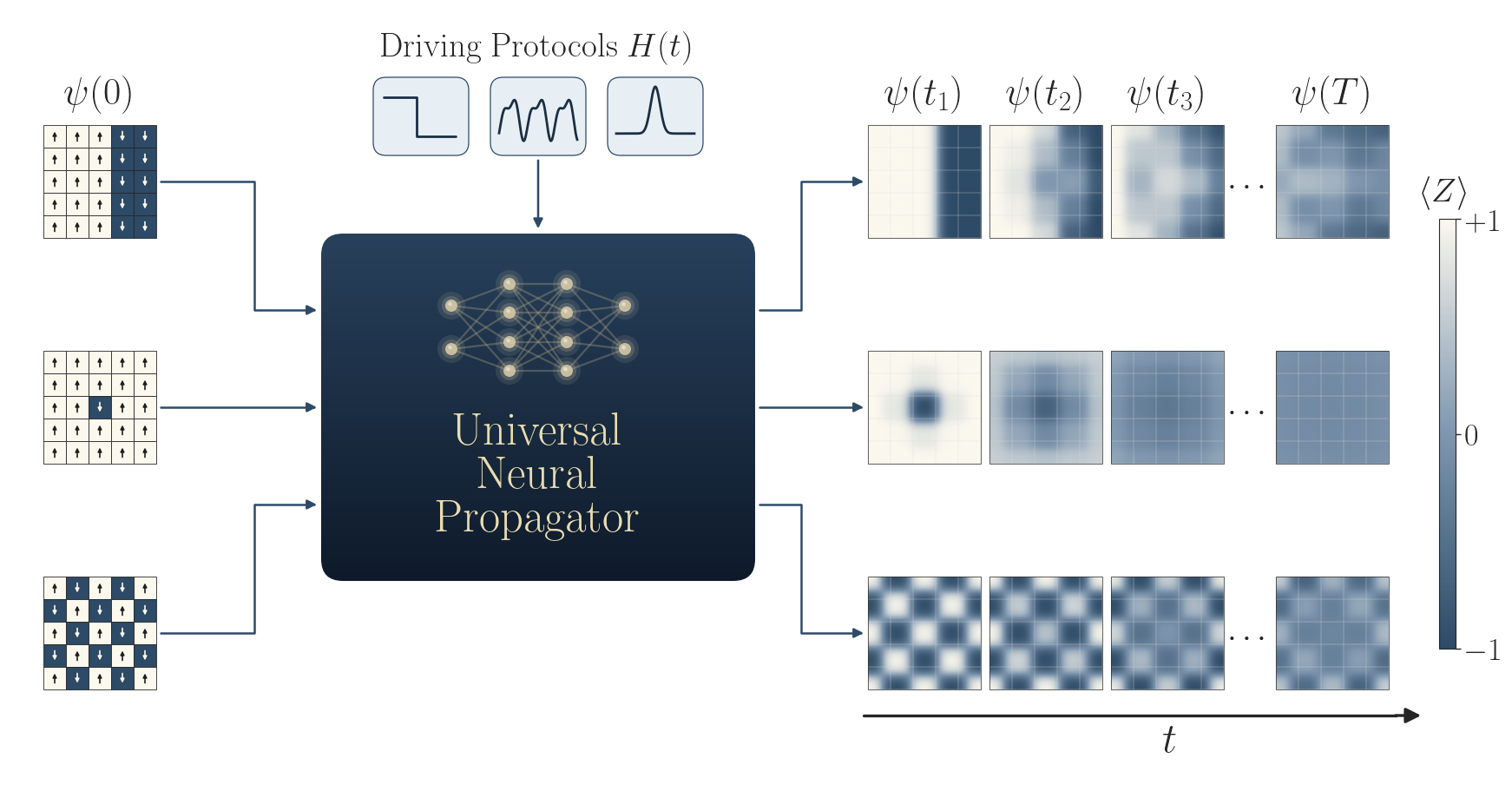
Figure 1: UNP framework illustrating prediction of a propagator for arbitrary driving protocols, enabling evolution from arbitrary initial states and transfer across functional spaces.
UNP Architecture: Functional Representation of Propagators
The UNP construction shifts the object of learning from states to operators. Specifically, it parameterizes the unitary time-evolution propagator U(t) in doubled Hilbert space, where each doubled-space token corresponds to a pair of input/output configuration indices. This operator-centric representation is analogous to density matrix vectorization in Liouville space, allowing for efficient neural quantum state encoding.
The architecture comprises two principal modules:
- Fourier Neural Operator (FNO): Processes time-dependent driving protocols H(t), encoding temporal structure into context tokens M(t). The FNO operates in the frequency domain, using spectral convolutions to compress the driving history into a compact latent representation.
- Autoregressive Transformer Backbone: Receives doubled-space token sequences and processes them via masked self-attention and cross-attention to context tokens. Outputs are the amplitude p(σ;t) and phase ϕ(σ;t) for each configuration, synthesizing the matrix elements Uαβ(t).
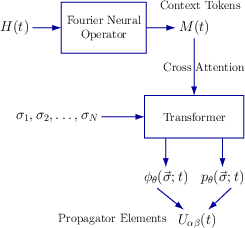
Figure 2: UNP architecture with FNO encoding protocol history and Transformer producing propagator matrix elements in doubled space.
Context tokens are constructed as velocity fields M˙(t) via FNO, integrated numerically to M(t). The cross-attention in transformers ensures that spatial representations at each site incorporate global temporal driving information, enabling generalization across protocols.
Self-Supervised Training Protocol
The training objective directly targets the operator-level Schrödinger equation in log-derivative form:
i∂tlogUαβ(t)=Eloc(α,β,t)
where Eloc is the standard variational local estimator. The residual,
H(t)0
constitutes the physical loss, centered per time step to eliminate global phase gauge. An anchor loss enforces correct initial conditions, making the total loss
H(t)1
Training operates in a fully self-supervised manner—no explicit time-evolved trajectory data or supervised target states are needed. The model must learn the functional map from H(t)2 to H(t)3 purely from physical constraints.
Numerical Evaluation on 2D Ising Dynamics
UNP is benchmarked on a two-dimensional driven transverse-field Ising model (TFIM) with random Fourier-sampled driving fields. After training, the same UNP instance can predict time-evolution for arbitrary initial computational-basis states and arbitrary driving protocols—including those outside the training distribution.
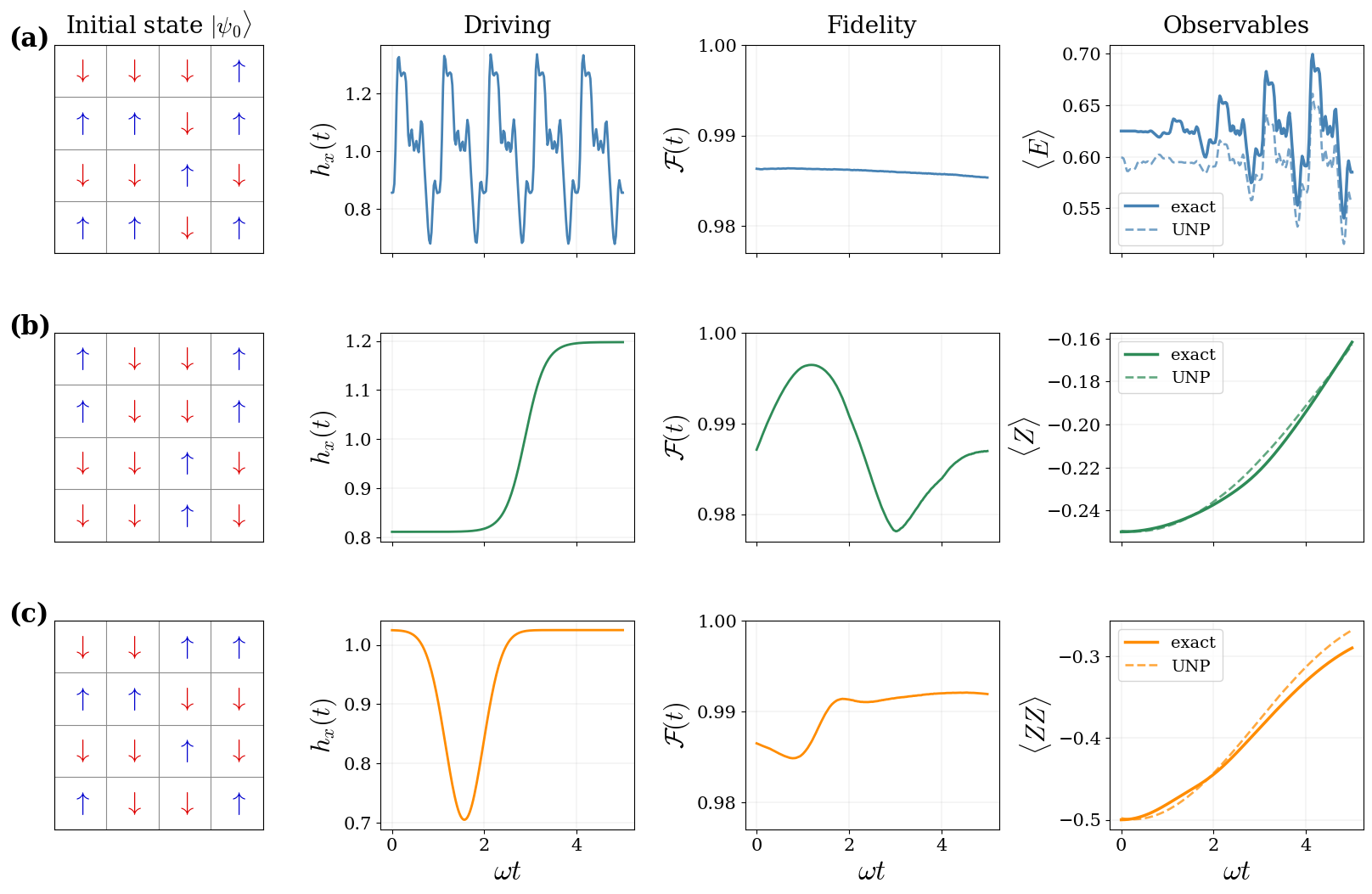
Figure 3: UNP performance for H(t)4 TFIM across random initial states and both in- and out-of-distribution protocols, showing high fidelity and accurate observable evolution.
The fidelity between UNP-evolved and exact states remains above H(t)5 throughout, and observables (magnetization, energy, correlators) are reproduced with minimal error. Notably, UNP transfers seamlessly to even highly entangled initial states such as GHZ states, maintaining phase coherence between columns.
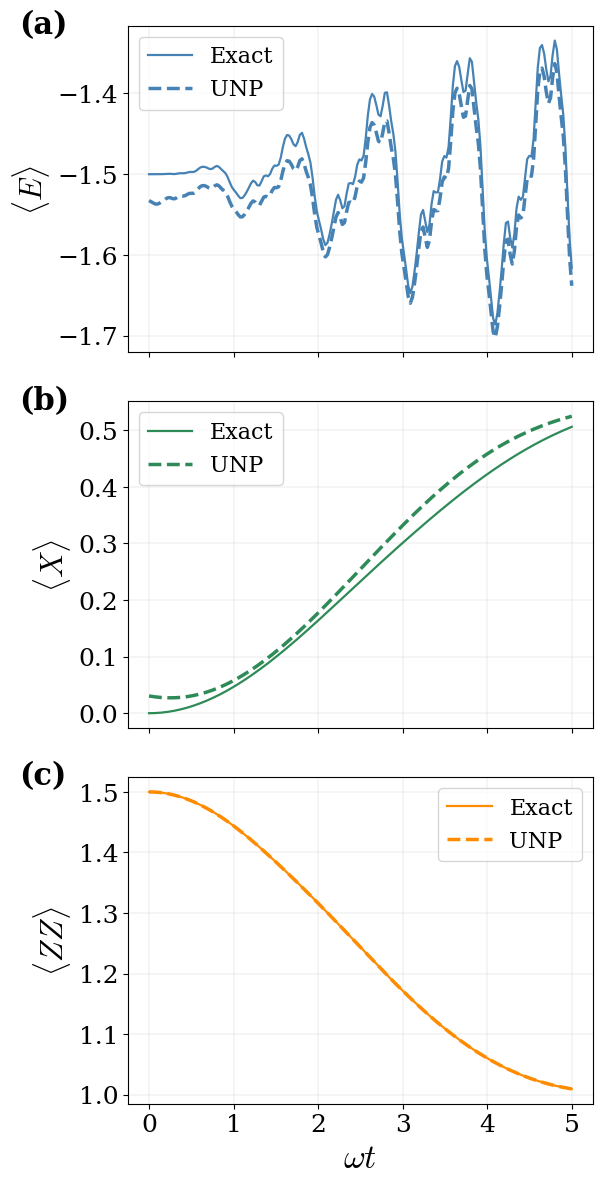
Figure 4: UNP evolution from GHZ initial state, validating preservation of nonlocal entanglement and relative phase structure.
Data-Efficient Fine-Tuning and Generalization
A salient feature is the ability to fine-tune the context tokens H(t)6 with small numbers of observable trajectories for a fixed protocol, improving accuracy across all initial states—not merely those used for fine-tuning. This approach leverages the protocol-specific nature of H(t)7; the entire transformer and FNO modules are kept fixed. This enables efficient protocol-conditioned refinement akin to transfer learning with sparse experimental or simulated observable data.
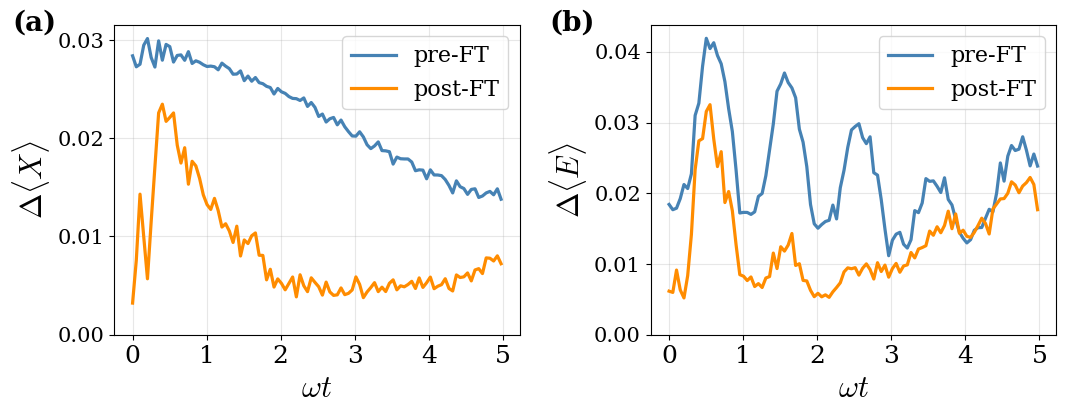
Figure 5: Reduction in mean absolute error for observables after fine-tuning, demonstrating improved predictive accuracy for unseen basis states using sparse data.
Scalability Beyond Exact Diagonalization
UNP scales to system sizes (H(t)8) well beyond reach of exact methods; comparison with tDMRG for larger systems confirms accurate prediction of local dynamical observables. Training cost is amortized, with once-trained models reusable for arbitrary protocols and initial states at negligible additional computation, unlike tDMRG or ED.
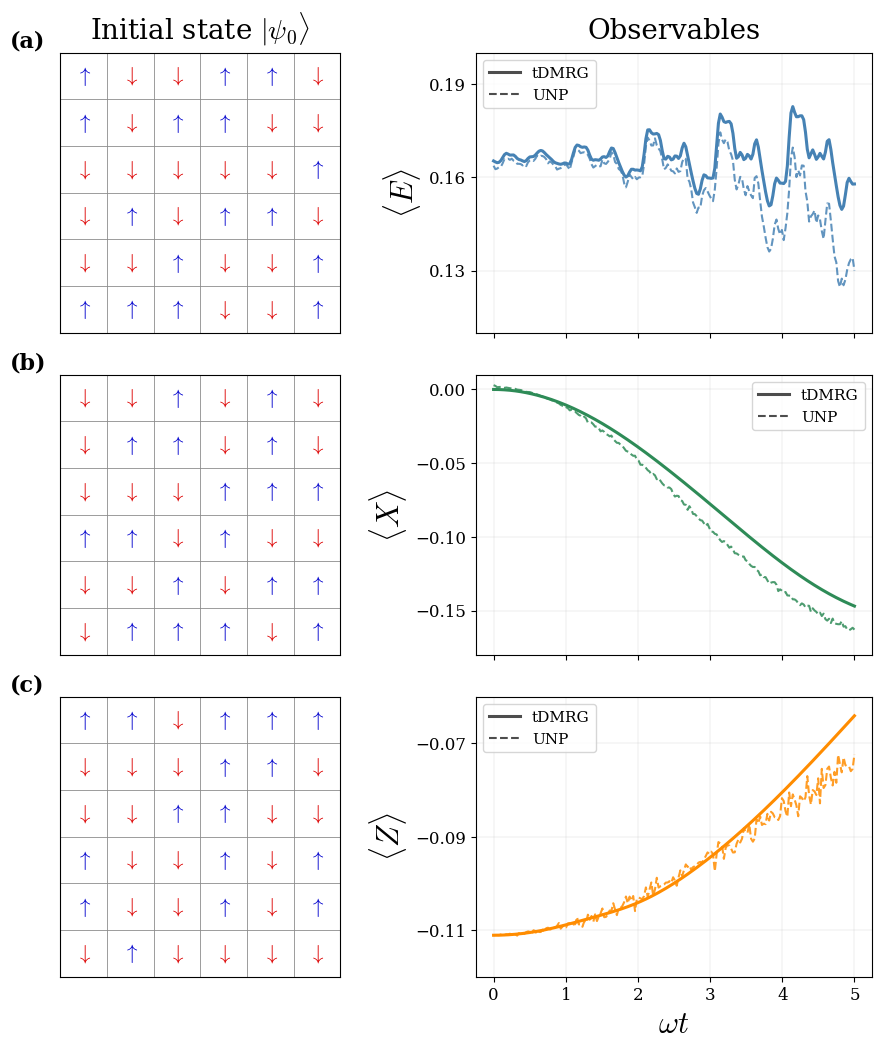
Figure 6: UNP results on H(t)9 TFIM, matching tDMRG predictions for observables under diverse driving protocols.
Architectural Details
The FNO module consists of pointwise lifting, spectral convolution layers, and projection. Transformers employ snake-ordered doubled-space tokens, embeddings, positional encoding, masked self-attention, cross-attention, and feed-forward layers; outputs are conditional amplitudes and phases for autoregressive sampling.
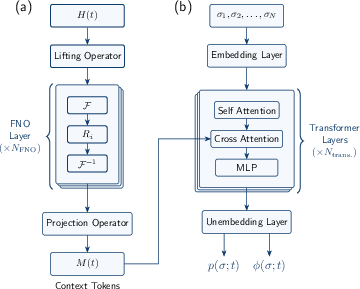
Figure 7: Inner workings of the FNO context token generator and Transformer decoder structure, illustrating masked self-attention and cross-attention to context tokens.
Implications and Outlook
The UNP paradigm represents a significant advance in transferable quantum simulation: a single trained model represents the propagator, enabling efficient reuse for arbitrary protocols and initial states. This operator-level approach is particularly impactful for contexts requiring high-throughput dynamical simulations—quantum optimal control, driven quantum experiments, and protocol design.
Practically, the propagator in doubled space incurs only a modest increase in representation cost (local token vocabulary increases, sequence length remains M(t)0), similar to Liouville-space density matrices; the scalability is thus retained.
Future directions include:
- Data-assisted global fine-tuning: Incorporation of multi-protocol, multi-state observable data can enhance UNP generalization and accuracy.
- Extension to open quantum systems: Lindblad dynamics may be learned analogously by vectorizing quantum channels as superoperators in Liouville space.
- Foundation models for quantum dynamics: UNP sets the stage for foundation dynamical models transferable across multi-modal protocols and initial state distributions.
Conclusion
The Universal Neural Propagator establishes a framework for transfer learning in quantum dynamics, enabling operator-level simulation across functional spaces. Its self-supervised training, efficient architecture, and demonstrated accuracy—across both small and large systems, diverse protocols, and initial states—underscore its utility for scalable quantum simulation and control. This approach suggests further avenues for neural operator representations in quantum science, including the simulation, calibration, and manipulation of complex quantum systems.
Citation: "Universal Neural Propagator: Learning Time Evolution in Many-Body Quantum Systems" (2605.05299).

