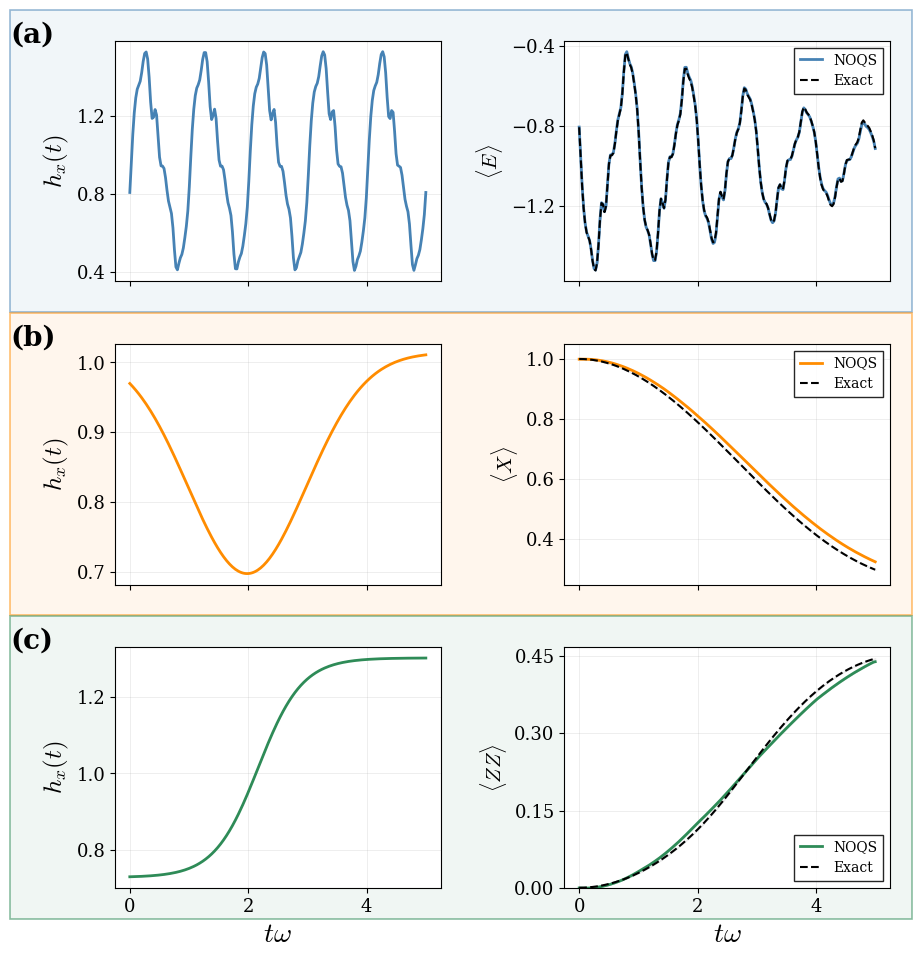
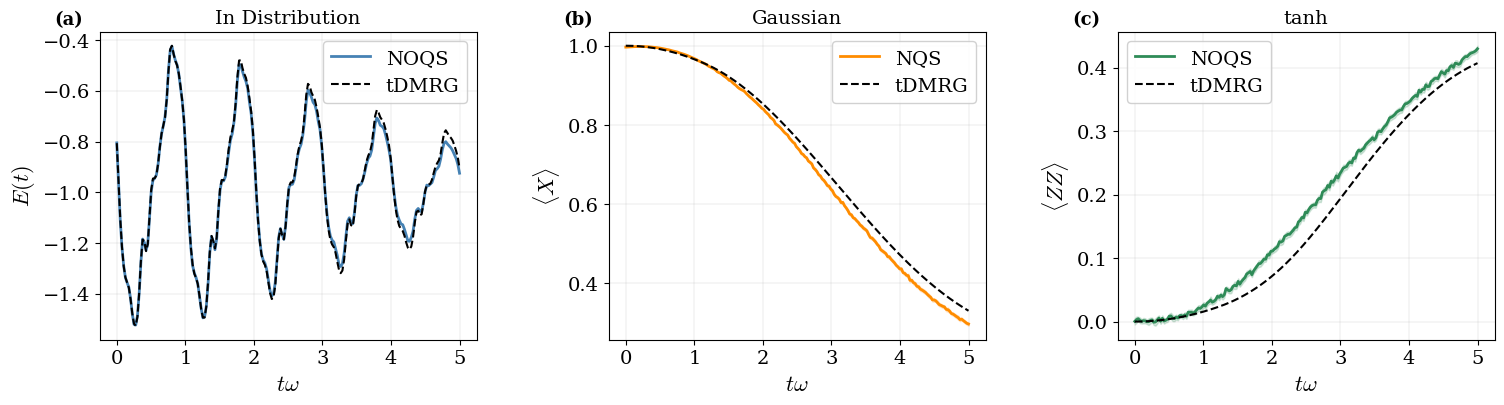
- The paper introduces a novel operator learning method that maps arbitrary driving protocols H(t) to quantum states |ψ(t)⟩.
- It integrates Transformer-based autoregressive NQS with Fourier Neural Operator, achieving zero-shot temporal super-resolution and robust protocol generalization.
- Fine-tuning using sparse experimental measurements enhances accuracy, demonstrating NOQS's scalability and adaptability across quantum systems.
Neural Operator Quantum State as a Foundation Model for Quantum Dynamics
Background and Motivation
Simulation of quantum many-body dynamics under arbitrary, time-dependent driving protocols is a fundamental challenge, exacerbated by the exponential scaling of Hilbert space with system size. Traditional approaches such as tensor networks (MPS, DMRG, PEPS) are constrained by resource-dependent entanglement representation and are computationally prohibitive for highly entangled or large-scale systems. Neural-network quantum states (NQS), particularly autoregressive architectures (RNN, Transformer), circumvent limitations of entanglement and the sign problem, offering direct sampling of the Born distribution in quantum systems. However, existing NQS treatments of quantum dynamics are protocol-specific: each H(t) trajectory requires a new round of optimization, impeding practical multi-protocol applications such as experimental pulse optimization and quantum simulator benchmarking.
NOQS: Operator Learning Architecture
The "Neural Operator Quantum State" introduces a paradigm shift: the model learns an operator mapping from arbitrary driving protocols H(t) to the corresponding time-evolved quantum state ∣ψ(t)⟩, rather than pointwise solving for individual H(t). This hybrid architecture integrates:
The model is trained via a physically inspired, self-supervised loss built upon the Time-Dependent Variational Principle (TDVP):
LTDVP=∫dt∥(i∂t−H(t))ψθ(Nη[H(t)])∥2
Expectations over configurations are estimated stochastically using autoregressive sampling. The loss includes an anchor constraint enforcing the correct initial condition of the wavefunction, supplemented by a variance minimization of the local Schrödinger residuals to stabilize optimization. The entire training protocol does not require external data and is agnostic to external numerical methods.
Numerical Benchmarks and Generalization
Validation focuses on the two-dimensional transverse-field Ising model (TFIM) with time-dependent transverse (hx(t)) and longitudinal (H(t)0) fields:
H(t)1
The NOQS demonstrates:
Protocol-specific Fine-Tuning and Computational-Experimental Interface
Post pre-training, NOQS enables protocol-specific fine-tuning using sparse experimental measurements of local observables (H(t)4, H(t)5). Fine-tuning solely on such data further improves accuracy across all observables at negligible computational cost, outperforming previous NQS fine-tuning schemes that require retraining on full datasets or extended parameter sets.
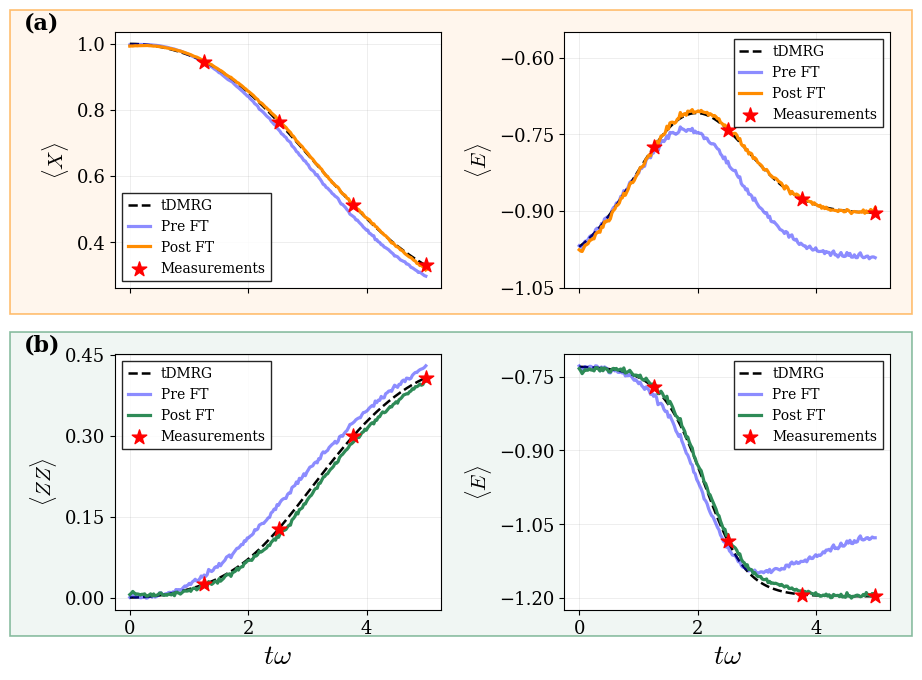
Figure 3: With only four measurement points, NOQS fine-tuning significantly improves predictions for the Gaussian and tanh protocols on a H(t)6 lattice.
Temporal Discretization Invariance
By leveraging the frequency-domain parameterization intrinsic to FNO, NOQS transfers seamlessly across temporal grids. Models trained on coarse time discretizations (H(t)7) are evaluated at finer resolutions (H(t)8) without retraining or interpolation artifacts, achieving zero-shot temporal super-resolution.
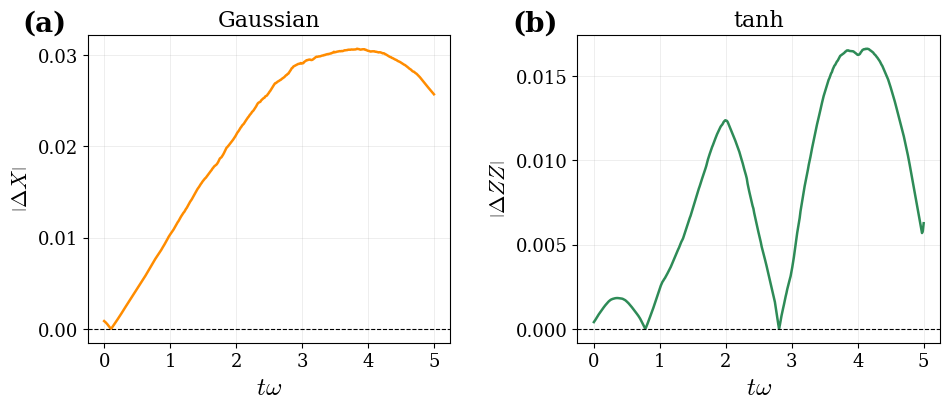
Figure 4: NOQS maintains smooth, low-error predictions in temporal super-resolution tasks, confirming discretization invariance inherited from the FNO backbone.
State-agnostic Generalization
NOQS architectures and training can be adapted to arbitrary initial conditions. For ferromagnetic initial states, the model achieves similar accuracy and protocol generalization, reinforcing its foundation model character for quantum dynamics.
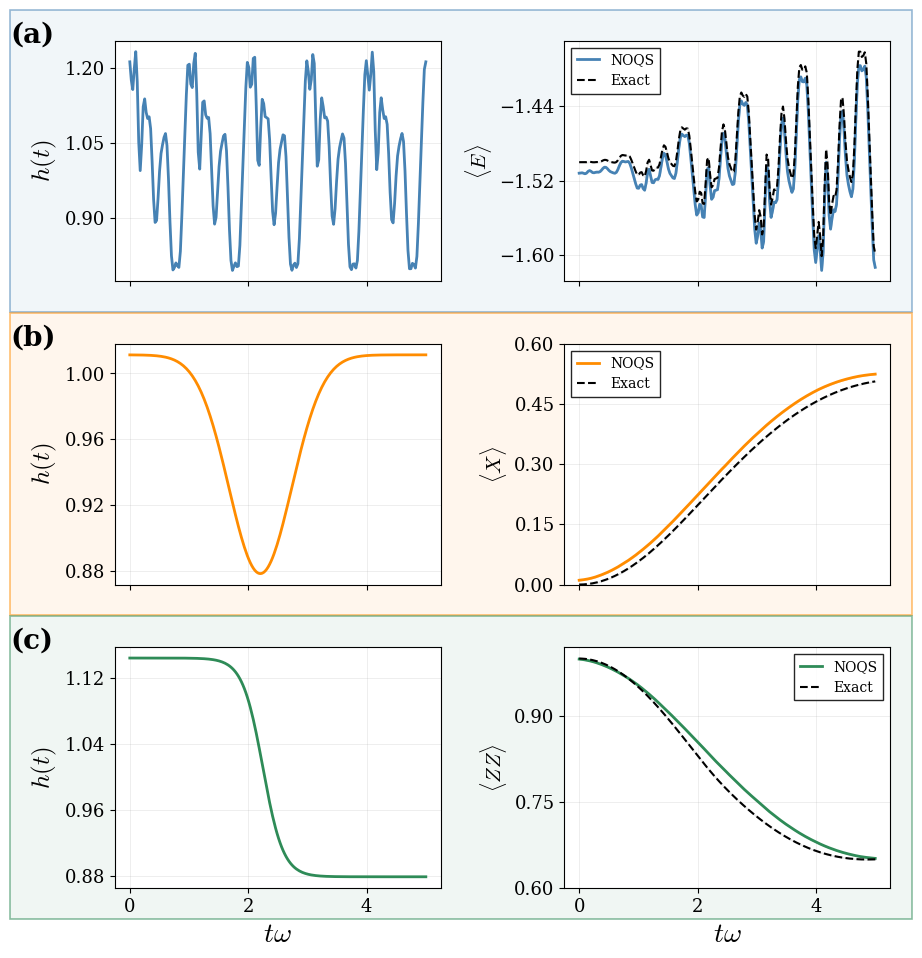
Figure 5: When initialized in a ferromagnetic state, NOQS continues to predict observables accurately for a variety of unseen driving protocols.
Implications and Outlook
NOQS establishes an operator learning framework for quantum many-body dynamics, enabling single-model prediction across a function space of driving protocols, transferability across temporal discretizations, and hybrid computational-experimental workflows. Practically, this accelerates state preparation and benchmarking in experimental platforms, bridging the gap between simulation and measurement. Theoretically, the approach opens inquiry into learnability boundaries imposed by protocol complexity, disorder, and criticality.
Future developments may involve joint conditioning on static parameters (coupling constants, disorder, dissipation) to expand the operator mapping over both protocol and system parameter spaces—addressing open quantum systems and driven-dissipative regimes. Further analysis of context token representational capacity could illuminate the information-theoretic limits of operator-based quantum state modeling.
Conclusion
The Neural Operator Quantum State presents a formally rigorous, computationally scalable, and experimental-adaptable foundation model for quantum dynamics simulation. Its demonstrated accuracy, generalization, transferability, and fine-tuning efficacy position it as a versatile framework for future algorithmic and practical advances in quantum many-body physics (2603.25066).