- The paper introduces SERS, which electronically toggles a permanent magnet’s field using ferromagnetic shunts to achieve rapid, stable switching.
- Numerical FEM and analytical models validate that SERS provides up to five orders-of-magnitude reduction in current-induced noise while maintaining low power consumption.
- The study demonstrates SERS’s application in trapped-ion quantum processing by delivering high field gradients with improved energy efficiency compared to conventional electromagnets.
The Saturable Electronic Reluctance Switch: A Low-Noise, Low-Power, Switchable Magnetic Field Generation Paradigm
Introduction
Magnetic field generation for quantum technologies and precision experiments necessitates a balance between field stability and switchability. Permanent and superconducting magnets offer superior stability with minimal noise but lack rapid field on/off modulation. Conversely, current-carrying electromagnets are intrinsically switchable but introduce considerable technical and thermal noise due to current fluctuations. This dichotomy is particularly restrictive for applications such as trapped-ion quantum computing, where extended coherence times require ultra-stable but rapidly switchable magnetic fields. The paper introduces the Saturable Electronic Reluctance Switch (SERS), a non-mechanical, hybrid ferromagnetic circuit capable of electronically toggling a permanent magnet’s field with high bandwidth and minimal power dissipation (2605.05158). SERS achieves a step-change in the usable magnetic field while maintaining thermal and current noise at the physical device limit.
Principle and Architecture of SERS
SERS is a magnetic circuit composed of a permanent magnet, an air-gap (for field delivery to the experiment), and one or more high-permeability soft ferromagnetic shunts wound with solenoids. In its low-field (OFF) state, the shunts provide a low-reluctance path, diverting magnetic flux away from the air-gap. Application of a threshold current to the solenoids drives the shunt(s) into full single-axis saturation, increasing their reluctance so flux is redirected into the air-gap (ON state). Critical to SERS function is its anti-parallel solenoid configuration, which ensures that net solenoidal field at the air-gap cancels, eliminating output dependence on the drive current in the ON state and isolating the magnet from demagnetization.
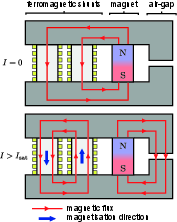
Figure 1: A cross-sectional schematic of the SERS magnetic circuit showing the flux path in OFF (top) and ON (bottom) states: shunt saturation diverts the flux to the air-gap upon current application.
The circuit equations, derived from Hopkinson's and Gauss's laws, quantitatively model the balance of magnetomotive forces, reluctances, and fluxes through the circuit. The SERS design imposes clear geometric and material constraints for non-saturation in the OFF state and single-axis saturation in the ON state. Analytical and numerical studies validate the bi-stable behavior of the air-gap field as a function of the drive current.
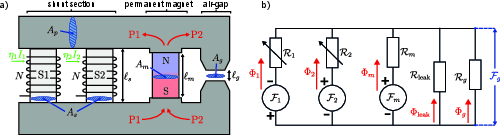
Figure 2: Schematic illustration of the SERS device highlighting parallel flux paths and idealized magnetic circuit abstraction.
The paper provides a comparative study using three canonical shunt alloys: MuMetal, Nickel Steel 4750, and Vanadium Permendur, with their differential permeability characteristics and switching profiles analyzed through finite element methods (FEM). The sharpness of the switching transition and efficacy of noise suppression depend on the BH curve characteristics of the shunt material. MuMetal, with its low saturation field, achieves nearly ideal step-like switching and minimal current sensitivity (κ drops below 10−8 T/A in the ON state).
Numerical simulations with realistic device geometries—factoring in non-idealities such as leakage and primary core reluctance—demonstrate robust agreement between analytical circuit models and 3D nonlinear FEM, validating SERS's operational principles and quantifying the achievable noise suppression.
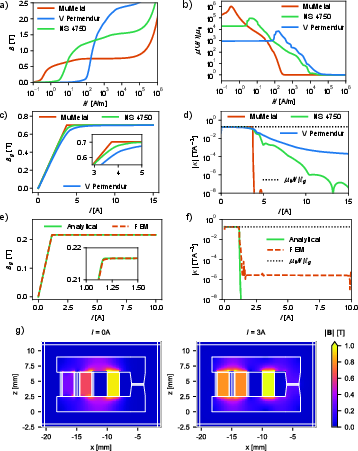
Figure 3: B-H curves, differential relative permeabilities, numerically calculated air-gap fields, and FEM simulation of SERS switching for three shunt materials. Field redistribution and current sensitivity data confirm highly robust switching.
Noise Immunity, Repeatability, and Error Tolerance
In the ON state, provided the shunts are fully saturated and solenoid-induced fields cancel in the primary core, the SERS device suppresses current-to-field transduction by orders of magnitude compared to electromagnets. The limiting noise floor is dictated by material-intrinsic processes (thermal magnetization fluctuations and after-effect drift). Fabrication errors such as solenoid asymmetry or finite primary core reluctance create a finite but extremely low residual current sensitivity, analytically captured by the switching ratio α; for modest fabrication inaccuracies (∼1–10%), suppression factors of 104–105 are retained.
Magnetization cycling is confined to the shunt and core materials, and strategy is provided for conditioning the device for repeatable switching by exploiting the magnetic accommodation effect, thus mitigating the effects of ferromagnetic hysteresis.
Application: SERS-Driven Fringe-Field Quadrupole for Trapped-Ion Quantum Processing
The SERS method is adapted to the generation of strong, switchable field gradients via the Fringe Field Quadrupole (FFQ) architecture. Unique ring-core (RCA) and linear-core (LCA) geometries project quadrupolar fringe fields into miniaturized quantum processor zones, optimized for large field gradients at targeted heights.
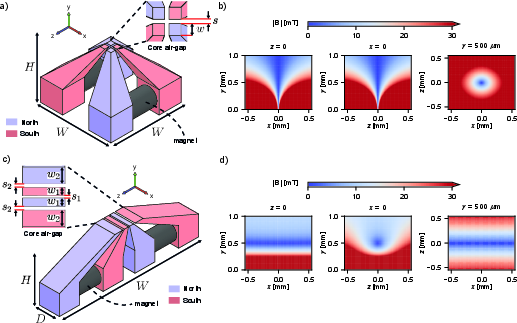
Figure 4: Geometries and FEM-simulated field magnitudes for ring-core and linear-core fringe field quadrupoles, showing central field nulls and strong gradient uniformity.
By pairing the SERS circuit with an RCA core, the authors simulate a gate-zone compatible gradient device for a trapped-ion quantum information processor. Switching between a remnant low-gradient (ON current = 0) and a high-gradient ON state (with only 2.5 A drive current), the device achieves a field gradient of 70.5 T/m, with residual field changes due to current fluctuations suppressed to the order 10−3 T/(m·A). Compared to state-of-the-art current-carrying wire (CCW) solutions, the SERS-driven device achieves an order of magnitude lower power dissipation (2.05 W at 300 K vs 17.9 W) and up to five orders of magnitude less current-induced field noise.
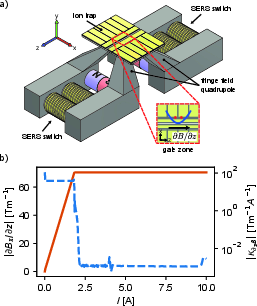
Figure 5: Schematic and simulated performance of a SERS-driven fringe field quadrupole for ion trap quantum gates, demonstrating large gradient modulation and noise suppression versus drive current.
Implications and Future Perspectives
The SERS paradigm enables a new class of magnetic field generators—passive broadband filters for current noise with binary ON/OFF operation and minimized Joule losses. Practically, it shifts the limiting factor for switchable high-stability field generation from electronic supply design to attainable manufacturing and materials tolerances. The SERS circuit can potentially function as a switch for superconducting magnets without risk of quenching, or for stable solenoidal sources, broadening utility to a range of applications from NMR to spin qubit control. The FFQ approach enables miniaturized, high-gradient field delivery without constraining experimental access, facilitating integration in quantum computing, precision measurement, microfluidics, and more.
Conclusion
The Saturable Electronic Reluctance Switch advances the state of the art in switchable magnetic field engineering by uniting the stability of permanent/superconducting magnets with rapid electronic controllability. Analytical and numerical results confirm that SERS circuits offer bi-stable field switching with negligible current sensitivity, large immunity to fabrication errors, and minimal power dissipation. The architecture enables practical scaling for quantum and atomic systems requiring switchable high-gradient, low-noise fields—exemplified by trapped-ion quantum information processors. This approach redefines the field-generation trade-off between stability and bandwidth, charting a pathway for both improved device integration and reduction of technical complexity in precision experiments.

