- The paper introduces an external memory architecture with multi-timescale dynamics to balance rapid adaptation and long-term consolidation in LLM systems.
- It employs coupled fast and slow variables to encode temporal associations, reducing catastrophic forgetting and enhancing episodic recall.
- Empirical results on COVID-19 data demonstrate superior retention and selective forgetting compared to traditional single-timescale memory models.
Continual Knowledge Updating in LLM Systems via Multi-Timescale Memory Dynamics
Introduction and Motivation
The challenge of continual learning in LLM systems deployed in dynamically evolving environments is articulated with precision in "Continual Knowledge Updating in LLM Systems: Learning Through Multi-Timescale Memory Dynamics" (2605.05097). The paper identifies fundamental limitations with canonical approaches: parametric continual learning and memory-augmented retrieval. In parametric continual learning, updating the model’s weights is both computationally intensive and susceptible to catastrophic forgetting—a single parameter-update mechanism lacks the granularity to handle knowledge that inherently changes at different rates. Augmented memory systems, while improving access to new information, typically do not allow the organization of knowledge to themselves evolve in response to evidence. Existing memories accumulate or are pruned but lack intrinsic dynamic reorganization or selective adaptation to ongoing experience.
Theoretical Foundation: Multi-Timescale Associative Memory
A key claim advanced is that continual learning for LLM systems can be reframed as the autonomous reorganization of an associative, external memory governed by multi-timescale coupled dynamics. The Memini system proposed in the paper exemplifies this principle: external knowledge is encoded as a directed associative graph where each edge represents an entity co-occurrence and is annotated with two persistent variables—a fast and a slow variable—adapted from the Benna-Fusi model of synaptic consolidation.
The architectural novelties comprise:
- Dynamic edge weights: Association strength evolves via continual reinforcement and decay, not static addition.
- Multi-timescale learning: Both rapid (episodic) and slow (consolidated) plasticities coexist, echoing observed biological mechanisms.
- Emergent selective forgetting: Memory retention and forgetting are not hard-coded but arise from the differential reinforcement of associations.
The fast variable wfast provides immediate episodic recall but decays quickly absent reinforcement, while the slow variable wslow reflects gradual consolidation from repeated co-occurrences, enabling robust retention undergirded by prior confirmation of the association.
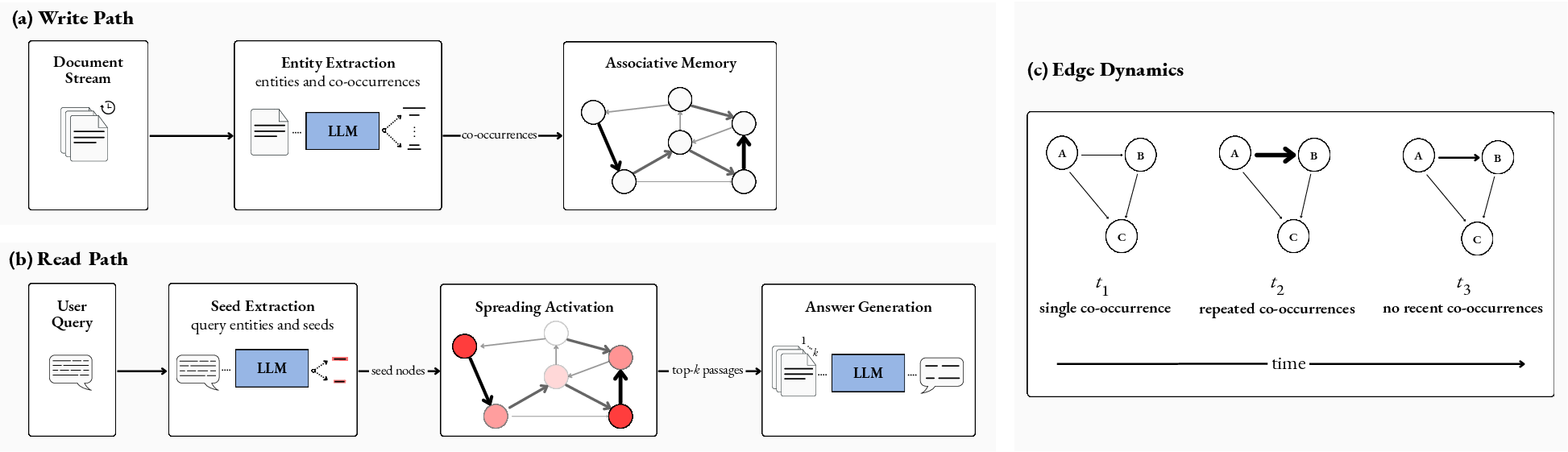
Figure 1: Overview of Memini, with its LLM-driven entity extraction, dynamic associative memory graph, and the coupled evolution of edge weights underpinning fast recall and slow consolidation.
This two-timescale memory organization is motivated by—and rigorously follows—the designs by Benna and Fusi for synaptic consolidation, supporting both plasticity and stability without explicit manual rules for deletion or archiving.
Memory Dynamics and Emergent Behavior
The coupled differential equations governing memory evolution,
dtdwfast=−τfastwfast+C(wslow−wfast)+I(t)
dtdwslow=−τslowwslow+C(wfast−wslow)
systematically separate retention timescales. Only wfast is queried during retrieval, ensuring that the system distinguishes recent from consolidated associations. An association reiterated across time results in elevated wslow, granting long-term retention and slow decay, while a one-time co-occurrence never traverses beyond a transient working trace.
Emergent memory behaviors include:
- Episodic traces: Single events yield transient recall.
- Consolidation: Repeatable co-occurrence slowly builds robust associations.
- Selective forgetting: Lack of reinforcement weakens associations naturally; only those supported by repeating evidence persist.
This framework’s subtlety is that selectivity and decay are not externally imposed but are a direct consequence of the differential equation structure.
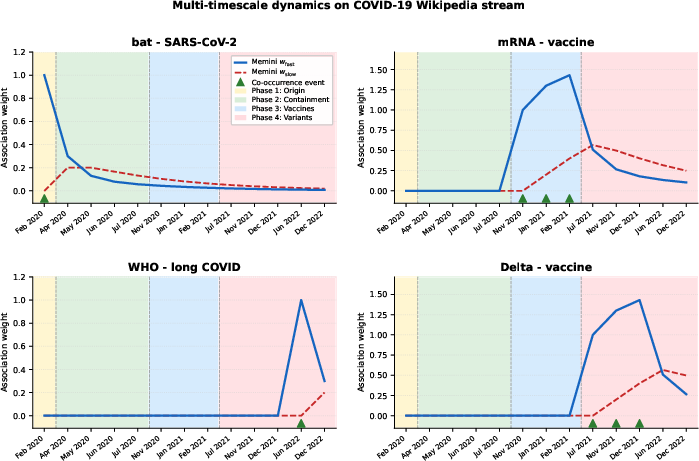
Figure 2: Multi-timescale association dynamics on real data, showcasing episodic, consolidated, and fading associations via time-evolution of wfast and wslow on the COVID-19 Wikipedia stream.
Retrieval Mechanism and Temporal Adaptivity
Retrieval is implemented via deterministic spreading activation, inspired by classical cognitive models. Query entities activate seed nodes; their activation propagates across the association graph, modulated by wfast and attenuated by the out-degree to penalize hub nodes. This mechanism, adapted from the cognitive literature and prior LLM-augmented retrieval systems, here differs crucially: path weights and retrieval outcomes are themselves contingent on the memory’s trajectory of interactions.
Because retrieval relies on edge weights shaped by the entire experience stream, the same query at different temporal junctures can yield different retrieved contexts—capturing change and adaptation in the underlying world and discourse.
Empirical Illustration
The appendix presents a proof-of-concept evaluation using a temporally ordered stream of 13 Wikipedia articles on COVID-19. Entities and their co-occurrences are algorithmically extracted and serve as the event stream driving associations. The analysis validates the emergence of the key dynamical regimes:
- Episodic regime: Associations from transient discourse fade rapidly.
- Consolidation regime: Frequently reinforced pairs (e.g., "mRNA–vaccine") persist well beyond the phase of evidence.
- Selective forgetting: Weakly supported pairs decay, preventing indefinite accumulation of stale or spurious connections.
An ablation against a single-timescale system conclusively demonstrates that only the two-timescale formulation yields robust retention for associations no longer present in recent discourse but previously reinforced.
Implications and Future Directions
This approach reframes continual learning for LLMs as an autonomous process internal to the external memory representation, eliminating reliance on brittle manual management policies or computationally intensive model re-tuning. Practical implications are clear: external memory provides adaptive, experience-driven integration and forgetting of knowledge, raising possibilities for long-lived LLM deployments coping with real-world concept drift.
Theoretically, this work positions memory not as mere storage but as an active substrate of learning. The system’s retention and forgetting are determined by operational statistics rather than fixed rules, echoing adaptive value theories of forgetting and empirical power-law findings in human memory. Future research should focus on scaling the empirical evaluation to larger corpora, benchmarking retrieval quality on temporally evolving datasets, and exploring how the paradigm generalizes to other modalities and joint memory architectures.
Conclusion
Memini establishes a multi-timescale, dynamically evolving memory layer for LLM systems that unifies rapid adaptation, gradual consolidation, and selective forgetting within a single, coupled dynamical framework. The presented architecture moves beyond static, accumulating, or externally pruned memories, offering instead a foundation where knowledge organization, retention, and forgetting are emergent and adaptive—a step toward robust, continual knowledge updating in genuinely open-world AI systems.