Provable imitation learning for control of instability in partially-observed Vlasov--Poisson equations
Published 6 May 2026 in cs.LG, math.AP, math.OC, and physics.plasm-ph | (2605.05081v1)
Abstract: We consider the stabilization of Vlasov--Poisson plasma dynamics, a central control problem in nuclear fusion. Our focus is the gap between what an ideal controller would use and what experiments can actually observe: while optimal policy may rely on the full phase-space state, practical feedback is typically limited to sparse macroscopic diagnostics. We therefore study imitation learning methods that distill a fully observed expert policy into controllers operating only on macroscopic measurements. We show the stability guarantees of the learned policy, where the error floor depends on the minimal behavior cloning loss achievable under the observation constraints. We further characterize this minimal loss in terms of a notion of entropy that quantifies the complexity of the initial distribution. Our results demonstrates the theoretical feasibility of learning stabilizing feedback policies for kinetic plasma dynamics from macroscopic observations, and exhibits the adaptivity of the learning approach to low-complexity structures. Through extensive numerical experiments, we validate our theory and show that the learned policies can stabilize the system using only macroscopic observations, within a significantly longer time horizon than non-adaptive baseline controllers.
The paper presents a provably stable imitation learning framework that translates expert full-state control into macroscopic feedback for Vlasov–Poisson dynamics.
It employs behavior cloning with temporal convolution and attention, achieving exponential stabilization of electric energy with quantifiable error bounds.
Empirical results show that the neural controller significantly outperforms spectral baselines under sparse, noisy observations, ensuring robust plasma control.
Provable Imitation Learning for Stabilization of Partially-Observed Vlasov–Poisson Dynamics
Introduction and Problem Formulation
This paper addresses stabilization in kinetic plasma systems, specifically the Vlasov–Poisson (VP) equations, under the severe partial observability constraints naturally imposed by real-world diagnostics. The central issue is the mismatch between the high-dimensional kinetic state required for theoretically optimal feedback and the sparse, low-dimensional macroscopic measurements (e.g., density at a handful of spatial locations) available in practice. The authors frame the stabilization of the VP system as an imitation learning (IL) problem, where an expert policy (using full-state information) supervises the learning of a feedback controller that acts solely on macroscopic, noisy measurements.
The VP system under consideration is 1D in both position and velocity, modeling a physically motivated reduction of the full $3+3$ dimensional dynamics in strongly magnetized regimes. The expert controller is built from analytical stabilization strategies—applying an electric field Ht∗(x)=−Et(x) to cancel internal oscillations, which is provably exponentially stabilizing under sufficient phase-space regularity assumptions. The challenge is to distill this high-dimensional, privileged-policy into actionable, robust controllers driven by extremely sparse and noisy observational feedback.
Imitation Learning Framework and Theoretical Guarantees
The proposed IL framework is based on behavior cloning: given a supervised dataset composed of trajectories from the expert (full-state control), the learner is trained to map a temporal window of macroscopic observations to control actions via empirical risk minimization in a chosen function class (notably, neural networks with temporal convolution and attention mechanisms). The key step is to rigorously analyze the fundamental gap between what is statistically learnable given the observation architecture and what is theoretically required for stability.
A two-stage analysis is presented:
1. Stability of the Learned Policy (Main Theorem)
The authors prove that exponential stabilization of the electrical energy under the learned policy is achieved up to an error floor, which is directly determined by:
The BC risk residual: the minimum achievable imitation (population) loss given the observation model and policy class.
Standard statistical estimation terms, such as covering numbers and sample size, reflecting the learnability of the mapping.
The electrical energy under the learned policy satisfies, for constants c1,c2>0 and for suitable policy regularity,
where c3(t) quantifies possible error accumulation over time, and R is the population risk defined via the discrepancy between learned and expert control fields.
2. Behavior Cloning Loss and Entropic Characterization
A central contribution is the formal upper bound on the minimal BC loss, showing that it adapts to both the spatial/temporal resolution of observations and, critically, to the complexity (entropy) of the initial kinetic distribution. Specifically, for distributions over initial conditions with low empirical ε-resolution entropy, the BC loss can be small, making stabilization feasible even under drastic sparsity. If the observation system is sufficiently informative (more sensors, longer and denser history), and/or the kinetic ensemble is concentrated in a low-complexity region, the imitation learner can drive the error floor arbitrarily low. The analysis reveals an adaptive aspect: the same neural architecture automatically achieves improved stabilization for simpler initial data, without explicit prior knowledge of its complexity.
Numerical Implementation and Empirical Results
The learning architecture is instantiated with a temporal convolutional network (TCN) augmented by multi-head attention, mapping sparse, noisy observation windows (as few as N=4 sensors and K=50 time steps) to truncated spatial Fourier representations of the control field. The loss is a scale-aware combination of absolute and relative errors on these coefficients, mitigating bias toward early transient high-amplitude errors and ensuring long-term stabilization fidelity.
Baselines and Evaluation Metrics
The learned controller is benchmarked against:
(B0) Uncontrolled dynamics,
(B1) Instantaneous Fourier-Poisson reconstruction from sparse observations,
(B2) The full-information expert policy.
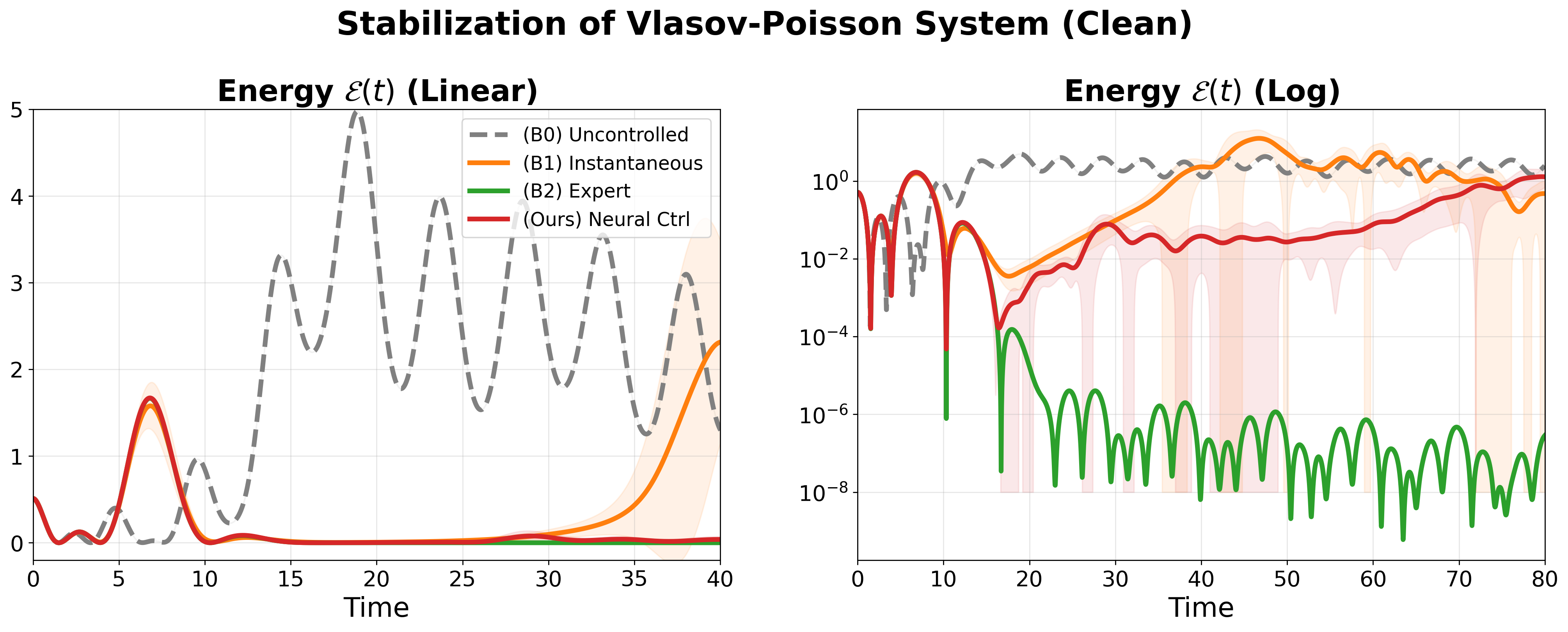
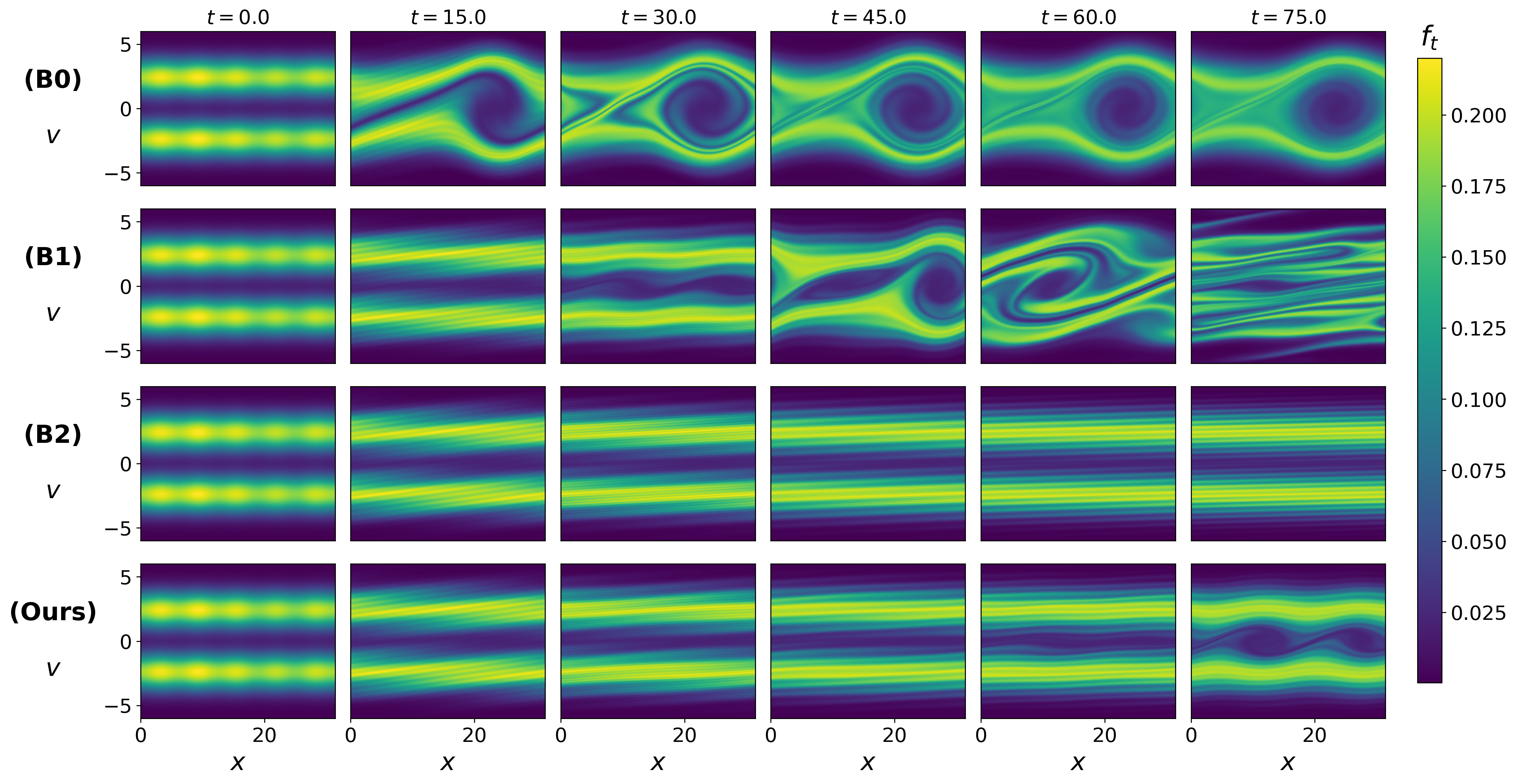
Metrics include macroscopic electric energy E(t) and phase space snapshots Ht∗(x)=−Et(x)0 under different noise levels and sensor configurations.
Key empirical findings include:
Superior stabilization with sparse, noisy inputs: The neural controller robustly suppresses instability and delays nonlinear saturation significantly beyond classic spectral baselines.
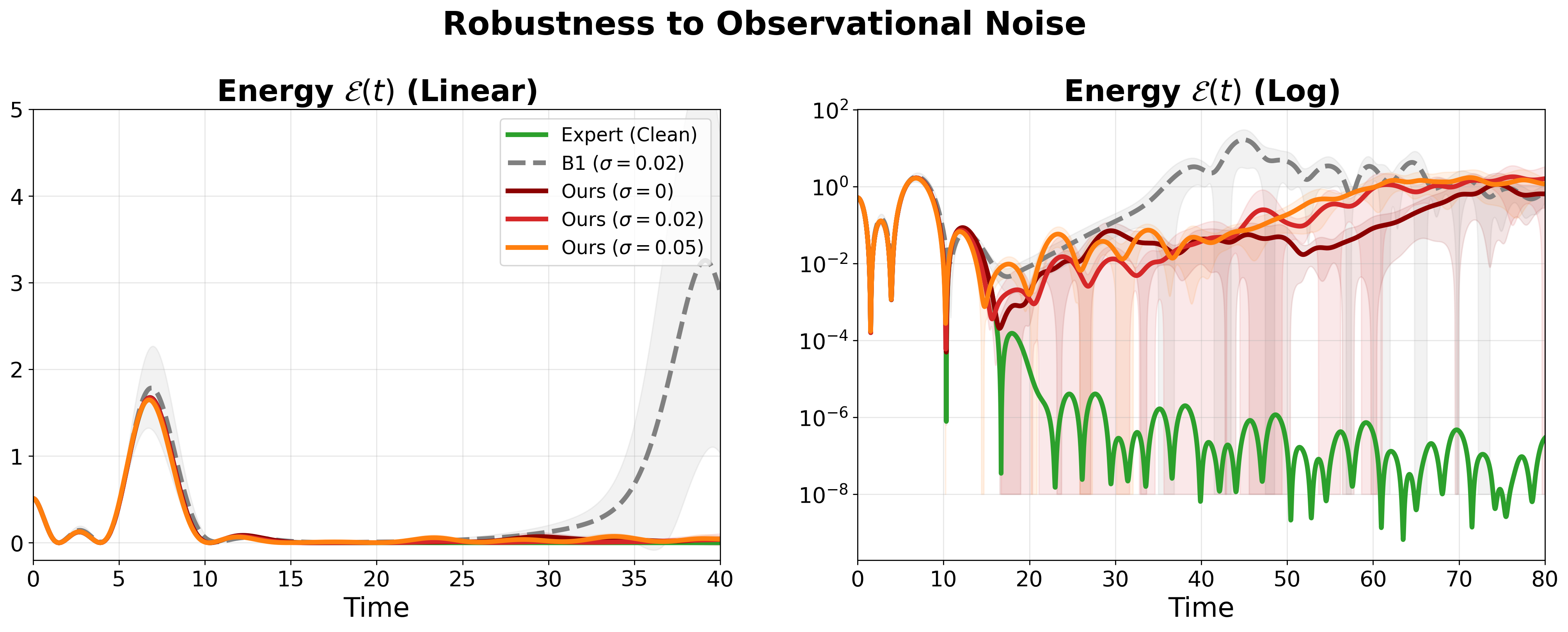
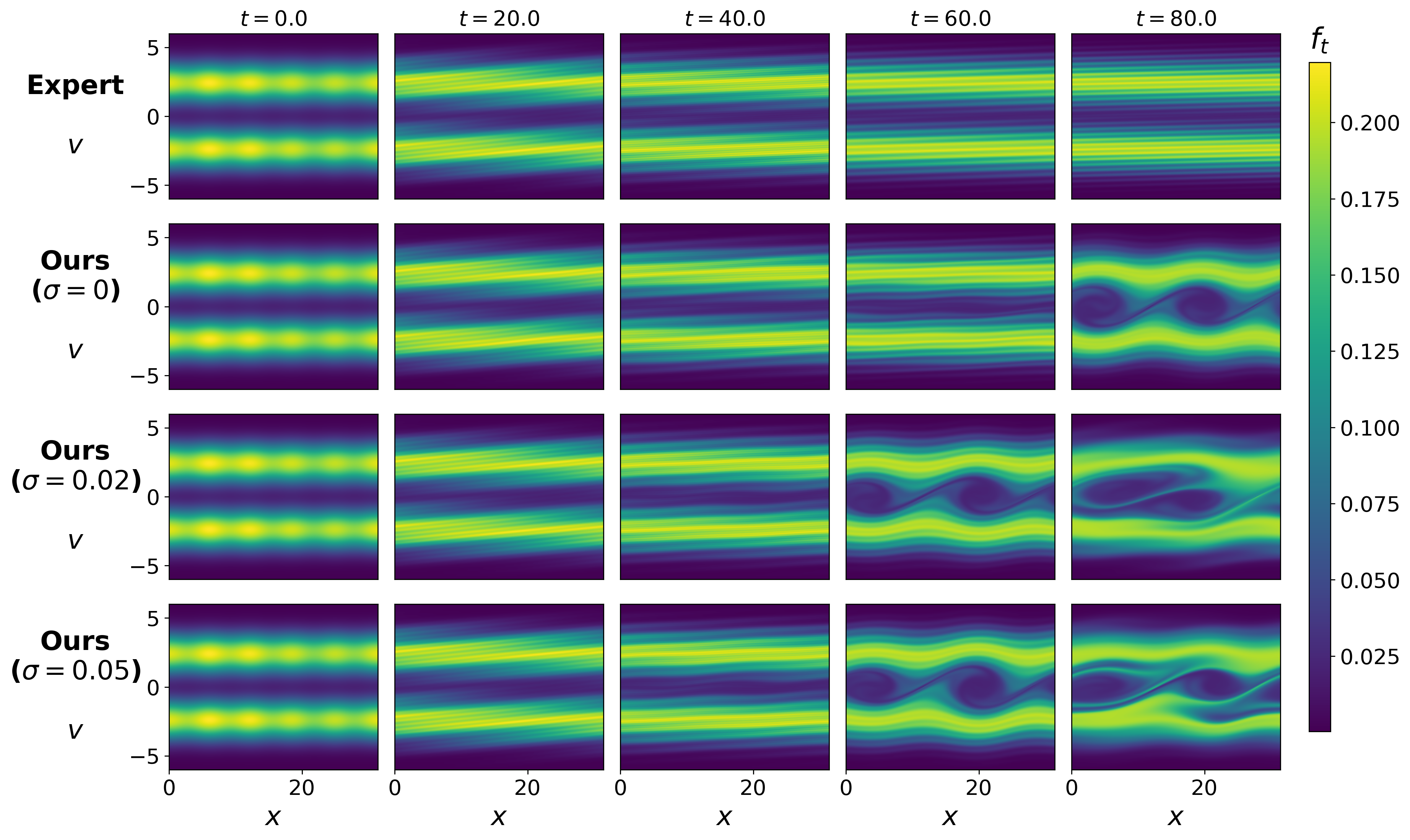
Resilience to observational noise: Learned policies degrade gracefully with increasing real-time noise, maintaining operational stability for extended horizons.
Figure 1: Electric-energy stabilization under clean observations. The Neural Controller overcomes aliasing-induced divergence present in the spectral baseline and tracks the expert upper bound over the main control window.
Figure 2: Phase-space stabilization under clean observations. The Neural Controller suppresses vortex formation and restores uniform equilibrium, qualitatively matching expert-level stabilization.
Figure 3: Electric-energy robustness against observational noise. The Neural Controller almost doubles the stable control window, maintaining performance significantly longer than the B1 baseline across all noise scales.
Figure 4: Phase-space robustness against observational noise. Networks trained with high noise display implicit regularization, suppressing sharp small-scale filamentation even in late-time failure regimes.
Implications and Future Directions
This work bridges the gap between mathematically optimal control derived from analytically tractable kinetic models and genuinely deployable macroscopic feedback in plasma physics. The theoretical results provide a constructive route for the practical realization of stabilizing controllers in settings where full phase-space measurements are unviable. The entropy-adaptive feature of the proposed methodology suggests that learning-based approaches can be particularly advantageous in scenarios where initial conditions (e.g., post-conditioning or in devices with stable pre-plasma) are naturally low-complexity.
Practically, this enables stabilization techniques for plasma applications—magnetic confinement fusion, for example—where only low-dimensional aggregate measurements are available in real time but high-fidelity control is required.
Theoretically, the entropic BC risk perspective clarifies the conditions under which imitation learning is sufficient for stabilizing infinite-dimensional PDEs under partial observation, generalizing limitations/capabilities well beyond classical finite-dimensional control theory.
Conclusion
The paper provides both a theoretical and practical foundation for imitation learning-based stabilization of kinetic systems under realistic sensor constraints. Strong performance is demonstrated—stabilization time windows up to twice that of traditional controllers under severe observation noise and sparsity. The explicit adaptation to distributional complexity and the mathematical transparency of the learning architecture establish a pathway for further developments, notably extensions to higher-dimensions, improved sample efficiency (e.g., using DAgger-type methods), and combinations with reinforcement learning or data assimilation approaches for even broader classes of nonlinear plasma control tasks.
References
(2605.05081) – "Provable imitation learning for control of instability in partially-observed Vlasov--Poisson equations"