- The paper introduces Bayes-THIS, a Bayesian extension with ARD priors for sparse hypergraph inference that reduces threshold sensitivity in noisy conditions.
- It employs posterior credible intervals and predictive checks to robustly distinguish genuine higher-order interactions from spurious ones, improving inference reliability.
- Bayes-THIS consistently outperforms traditional STLS methods in low-sample and ill-conditioned regimes, demonstrating scalable and uncertainty-aware network reconstruction.
Bayesian Hypergraph Inference from Scarce and Noisy Dynamical Observations: An Expert Analysis
Background and Motivation
Network inference, the task of reconstructing underlying interaction structure from dynamical observations, has traditionally relied on pairwise models. However, numerous biological, physical, and social systems exhibit genuine higher-order interactions, which are not reducible to dyadic couplings and instead necessitate hypergraph or simplicial complex representations. Prior work, notably Taylor-based Hypergraph Inference using SINDy (THIS), leverages sparse regression on local Taylor expansions to identify active monomial terms corresponding to hyperedges. Yet, the original THIS relies on fixed-threshold sparse regression (STLS), which is sensitive to data limitations and measurement noise—conditions ubiquitous in empirical studies.
The presented paper introduces Bayes-THIS, recasting the regression problem in a Bayesian framework using automatic relevance determination (ARD) prior. This formulation models residual variance explicitly and enables adaptive, term-wise shrinkage, mitigating issues of threshold tuning and robustness. Noise in time-series observations is assumed to be additive, zero-mean Gaussian, which preserves analytical tractability and conjugacy with the Gaussian likelihood.
Each node's dynamics are approximated via a sparse collection of monomials generated from deviations around a reference point, defining a design matrix $\TTheta(\XX)$. The ARD prior assigns a precision hyperparameter to each coefficient, maximized via type-II maximum likelihood, resulting in a closed-form posterior:
- Posterior mean $\V{\mu}$ gives the MAP estimate,
- Posterior covariance $\V{\Sigma}$ quantifies uncertainty and enables principled statistical inference over edge presence.
Robustness, Data Efficiency, and Ill-Conditioning
Comparison across data availability and noise regimes demonstrates that Bayes-THIS consistently outperforms THIS, especially in low-sample/high-noise conditions. The adaptivity of ARD allows recovery of genuine interactions without manual threshold calibration, even as the complexity (number of nodes/interactions) increases.
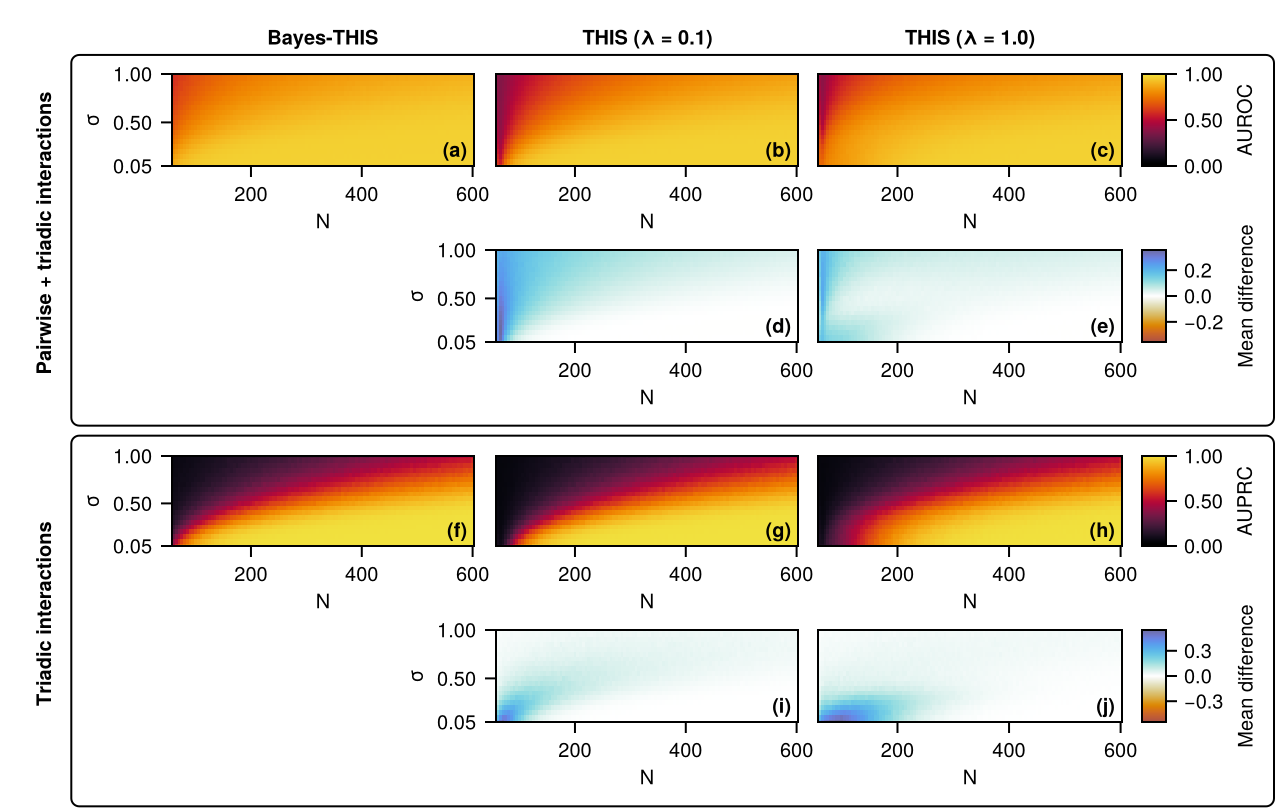
Figure 1: AUROC and AUPRC comparison across data sizes and noise levels, showing Bayes-THIS's superiority in challenging regimes and its resilience to choice of hyperparameters.
When design matrices are ill-conditioned (e.g., due to synchronization dynamics causing concentration in low-dimensional regions), Bayes-THIS exhibits enhanced stability and lower variance in inferred coefficients compared to STLS. This translates to improved reconstruction quality, as shown by the concentration of true coefficients away from zero and false coefficients tightly centered at zero.
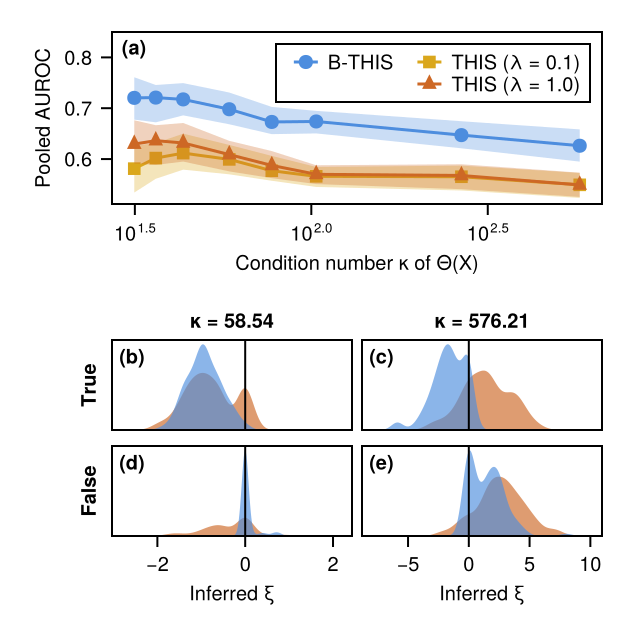
Figure 2: Stability of coefficient inference in Bayes-THIS versus STLS as monomial libraries become ill-conditioned; ARD regularization maintains discrimination between true/spurious interactions.
Uncertainty-Aware Pruning and Statistical Credibility
Bayes-THIS leverages posterior credible intervals to select statistically distinguishable hyperedges, eschewing fixed-magnitude heuristics. This approach adapts automatically to noise and conditioning, delivering superior F1 scores and reducing sensitivity to hyperparameter settings.
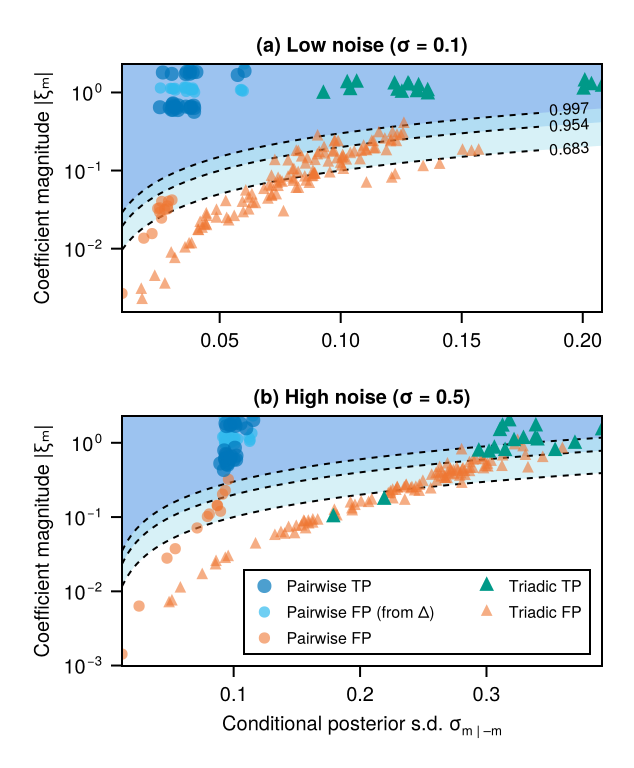
Figure 3: Decision space for edge retention based on credible intervals under varying noise, highlighting improved discrimination and identification of spurious edges originating from triadic interactions.
Magnitude-based filtering is highly dependent on threshold choice; credible-interval pruning, in contrast, reliably separates genuine from spurious hyperedges across a broad parameter range.
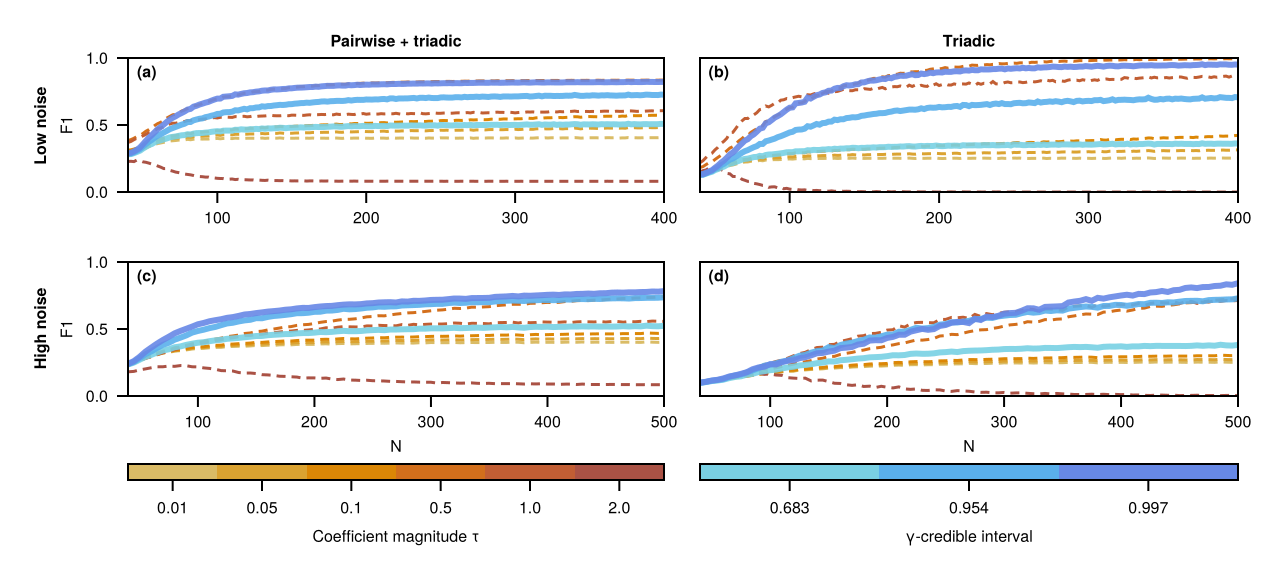
Figure 4: Comparison of credible-interval filtering and magnitude-based thresholding for hyperedge inference, demonstrating robust and consistent F1 scores regardless of dataset size or noise.
Posterior Predictive Checks and Data Informativeness
Bayes-THIS introduces posterior predictive checks (PPCs) to assess whether data are informative enough for higher-order inference. The PPC quantifies whether triadic structure in residuals, after fitting a pairwise model, is statistically distinguishable from noise. This pre-inference diagnostic provides a necessary criterion for pursuing triadic inference.
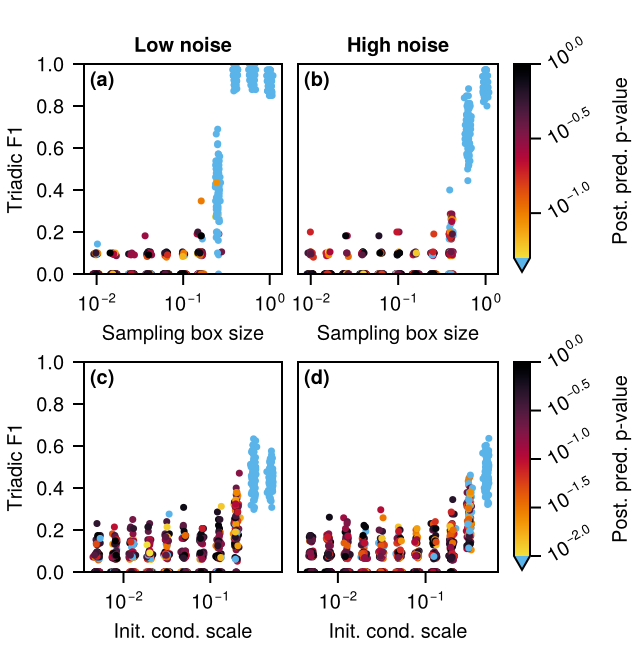
Figure 5: Posterior predictive p-values as a function of sampling region and noise, identifying regimes where triadic signal is not detectable and inference should be restricted to pairwise.
The PPC is operational even when derivatives are numerically estimated from noisy data, making it practical for real-world experiments.
Structural Inferability and Cross-Order Degree Correlation
A structural limitation emerges: triadic interactions contribute to lower-order coefficients, producing spurious pairwise edges, particularly in hypergraphs with low cross-order degree correlation (DC). In such cases, genuine and spurious pairwise coefficients are structurally non-identifiable, independent of data quality or inference method.
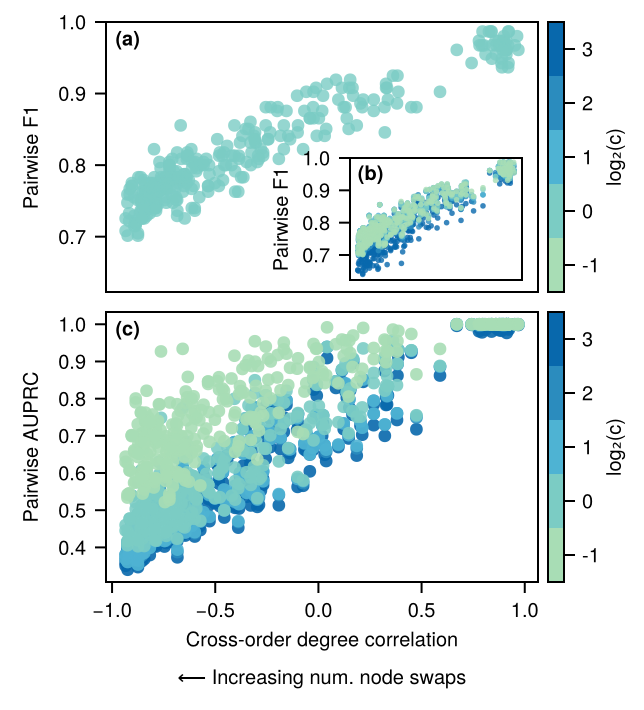
Figure 6: Degradation in pairwise F1 and AUPRC as cross-order degree correlation decreases, showing the increase in structurally non-identifiable false positives with strong triadic couplings.
Uncertainty-aware pruning attenuates, but does not resolve, this non-identifiability when triadic couplings dominate and cross-order DC is low.
Scaling with Network Size and Edge Density
Bayes-THIS maintains advantages across increasing network size and combinatorial complexity. In dense regimes, the sparsity bias inherent in ARD modestly reduces recall of weak interactions, but the impact is generally limited compared to benefits in sparse and noisy settings.
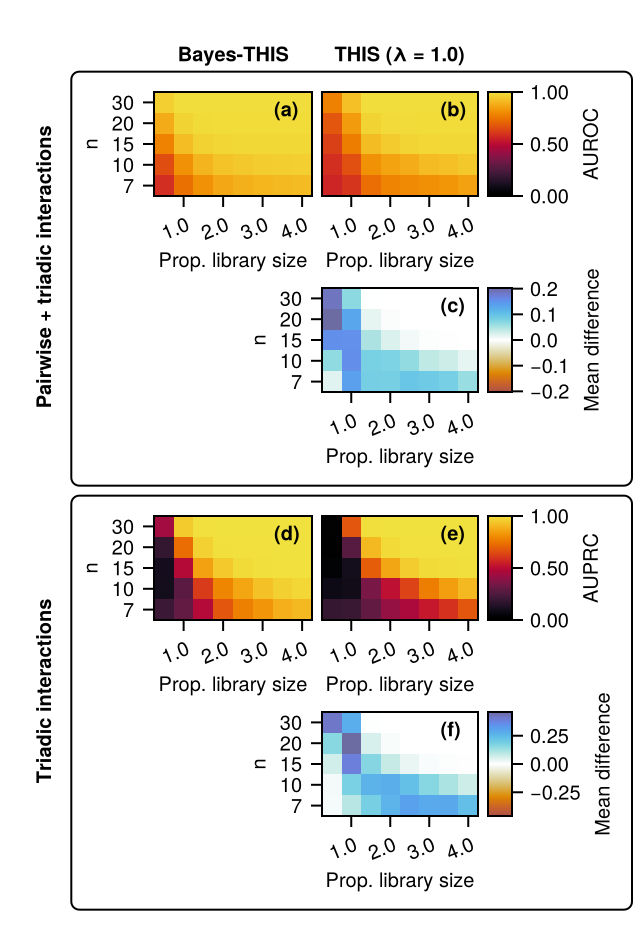
Figure 7: Performance scaling with network size, dataset size, and combinatorial complexity; Bayes-THIS offers consistent improvements across varying conditions.
Edge density affects performance as well, with marginal losses when the true hypergraph is highly dense and ARD's sparsity bias comes into play.
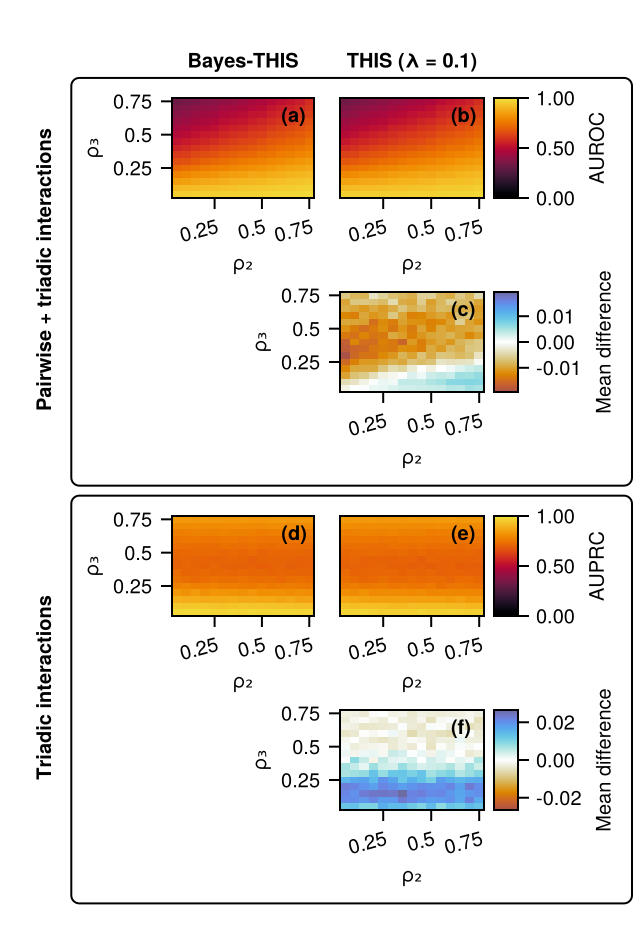
Figure 8: AUROC and AUPRC as a function of pairwise and triadic edge densities, confirming the limited impact of sparsity bias in practical regimes.
Practical Implications, Limitations, and Theoretical Outlook
Bayes-THIS constitutes a robust framework for sparse hypergraph inference from dynamical observations, alleviating prior difficulties via adaptive, data-driven regularization and enabling principled uncertainty quantification. Its workflow synthesizes data quality assessment (PPC), Bayesian inference, and uncertainty-aware pruning, requiring minimal manual hyperparameter tuning.
However, the method assumes independent noise across nodes; correlated errors may necessitate preprocessing (whitening transformation) or methodological extensions. Structural non-identifiability due to cross-order DC is a fundamental limitation inherent to Taylor-based representation—addressing it may require modeling pairwise and triadic coefficients jointly, albeit at a steep computational cost.
The relationship between functional reducibility and inferability in higher-order networks is highlighted as an unresolved research direction, with implications for understanding which structures are recoverable from dynamic data.
Conclusion
Bayes-THIS advances hypergraph inference methodology under realistic constraints of noise and data scarcity, synthesizing Bayesian model selection, adaptive shrinkage, and diagnostic data assessment. While offering substantial improvements over classical approaches, it clarifies the importance of structural priors—particularly cross-order degree correlation—in determining inferability. The method establishes a scalable and principled workflow, paving the way for further advances in uncertainty-aware higher-order network reconstruction and the theory of structural identifiability from dynamical observations.