- The paper introduces a Bayesian framework that infers both network topology and functional forms in dynamical systems using sparse modeling.
- It employs spike-and-slab priors and parallel tempering MCMC to compute posterior inclusion probabilities, effectively quantifying model uncertainty.
- Experiments on oscillator networks and metronome systems demonstrate improved identifiability and robustness under noisy and phase-locked conditions.
Bayesian Model Averaging for Uncertainty-Aware Sparse Identification of Dynamical Systems
Overview and Motivation
The paper "Uncertainty-Aware Sparse Identification of Dynamical Systems via Bayesian Model Averaging" (2604.10854) presents a unified Bayesian framework for inferring both the interaction structure and functional forms of unknown dynamical systems by integrating sparse modeling with Bayesian model averaging (BMA). The approach targets high-dimensional systems where the governing equations, including network topology and candidate basis functions, are not known a priori and must be selected from a large set of possibilities. Crucially, the methodology quantifies the uncertainty associated with model selection, providing principled probabilistic estimates for each candidate term's inclusion.
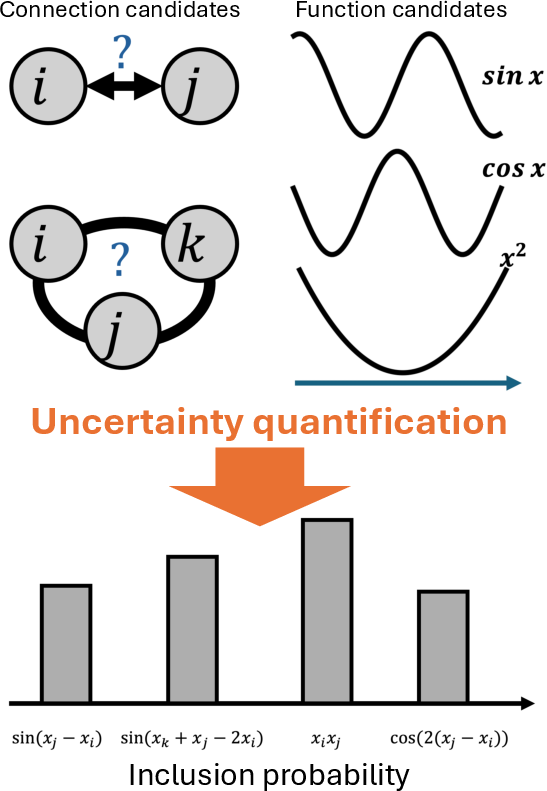
Figure 1: The methodology infers both interaction structure and functional forms in dynamical systems, quantifying uncertainty through posterior inclusion probabilities via Bayesian model averaging.
Sparse Modeling Framework and Bayesian Inference
The class of dynamical systems considered encompasses nonlinear models whose dynamics can be represented as linear combinations of candidate basis functions, including oscillator networks (Kuramoto/Sakaguchi–Kuramoto), ecological Lotka–Volterra systems, and gene regulatory circuits. A generalized edge formalism enables flexible modeling of pairwise, higher-order, and multi-body interactions.
Sparse regression is performed using binary indicator variables for each candidate term, allowing joint inference of network topology and basis selection. The Bayesian hierarchical model employs spike-and-slab priors on coefficients, facilitating inference of posterior inclusion probabilities. Bayesian model averaging provides interpretable uncertainty quantification for candidate terms, offering probabilistic assessment rather than point estimates.
Sampling the posterior landscape is achieved using parallel tempering—a replica exchange MCMC strategy mitigating poor mixing and trapping in combinatorial spaces with rugged energy landscapes.
Numerical Experiments: Oscillator Networks
The framework is validated on synthetic oscillator networks, focusing on the recovery of interaction structure from time-series phase observations. Three configurations highlight key phenomena:
- Configuration 1: Asynchronous Dynamics
In networks with asynchronous trajectories, the methodology accurately infers underlying sparse interactions, phase-lag components, and harmonic orders with high posterior credibility.
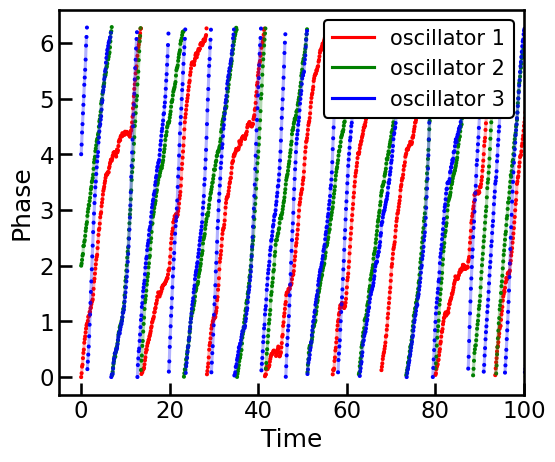
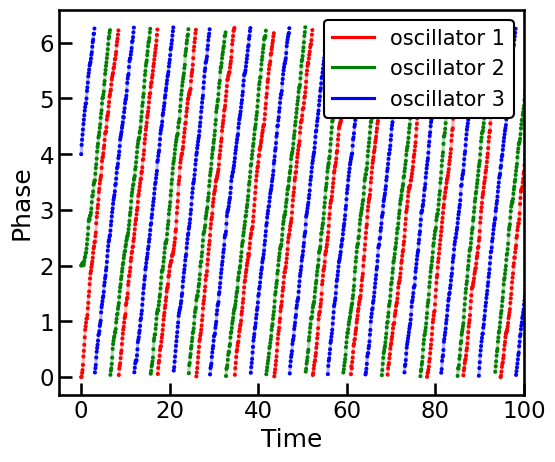
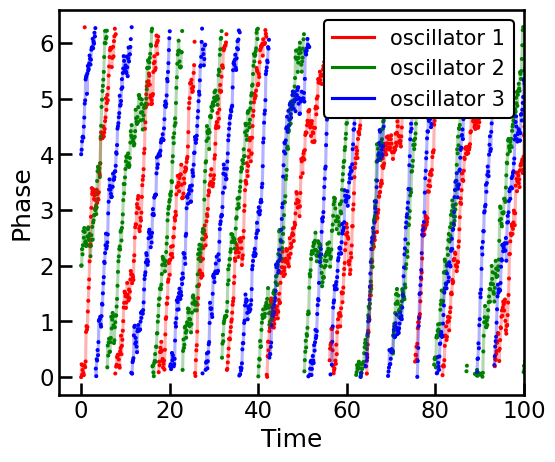
Figure 2: Synthetic phase time-series reveals asynchronous dynamics, facilitating identification of interactions.
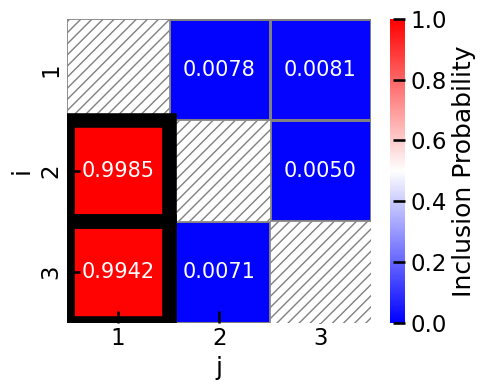
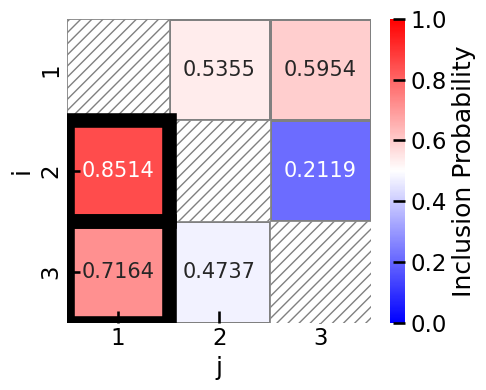
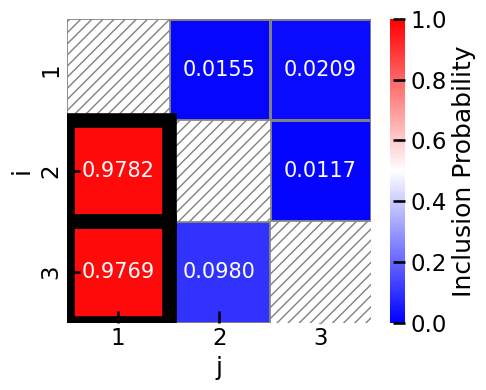
Figure 3: Posterior inclusion probabilities for pairwise interactions cij demonstrate selective recovery of true couplings.
- Configuration 2: Phase-Locked Dynamics
Phase-locking imposes effective linear dependence among basis functions, compromising identifiability and yielding high uncertainty or spurious inclusions in the inferred structure. Bayesian model averaging appropriately reflects this through suppressed inclusion probabilities.
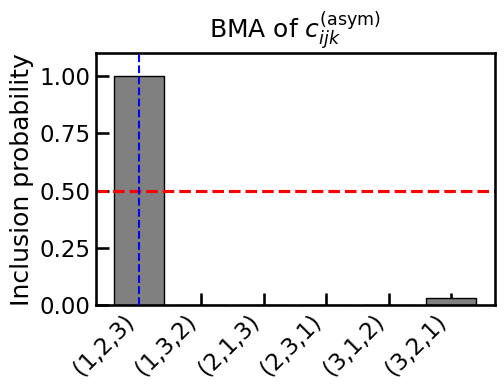
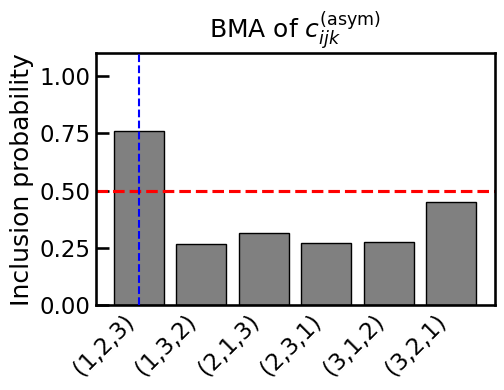
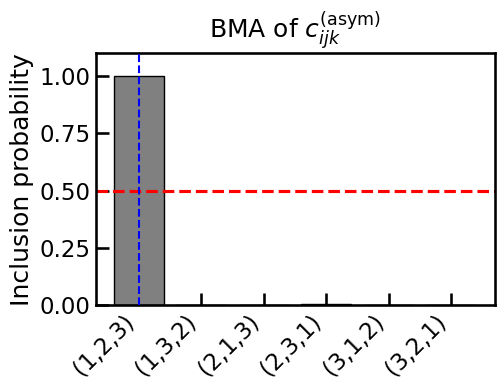
Figure 4: In phase-locked regimes, BMA signals low credibility for structurally ambiguous components.
- Configuration 3: Noise-Perturbed Dynamics
Moderate dynamical noise breaks phase locking, restores variability in observed data, and significantly improves estimation accuracy and certainty.
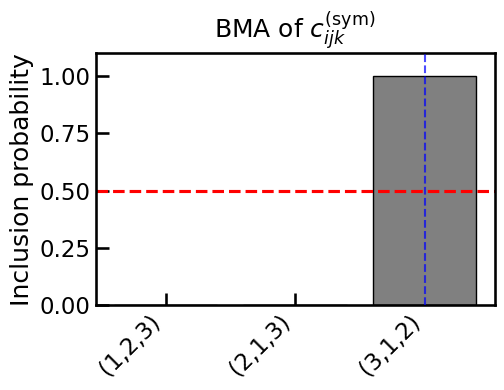
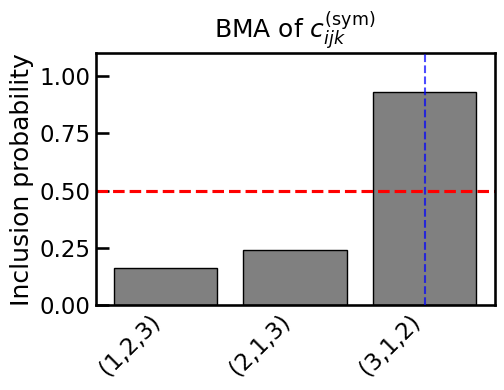
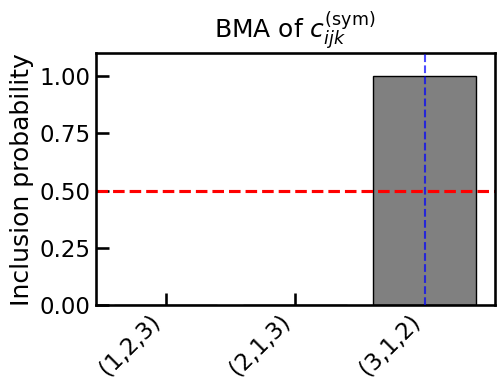
Figure 5: Robustness plots quantify Hamming distance and MSE as functions of data volume and noise, demonstrating enhanced identifiability with increased dynamical variability.
Harmonic complexity and phase-lag structure are also correctly inferred when identifiability is improved, with notable numerical results showing minimal discrepancy (normalized Hamming distance and RMSE) as sample size increases or noise is optimally tuned.
Data-Driven Phase Reduction: Application to Metronome Systems
The methodology is extended to phenomenological modeling, specifically, the phase reduction of a mechanically coupled metronome system. Even when the governing equations are not contained in the candidate model class, Bayesian model averaging identifies effective functional components (e.g., sin(2ψ) terms responsible for bistability in phase difference dynamics) with quantified uncertainty. This is demonstrated by incrementally expanding the time window, which increases the inclusion probability of bistability-generating basis functions.
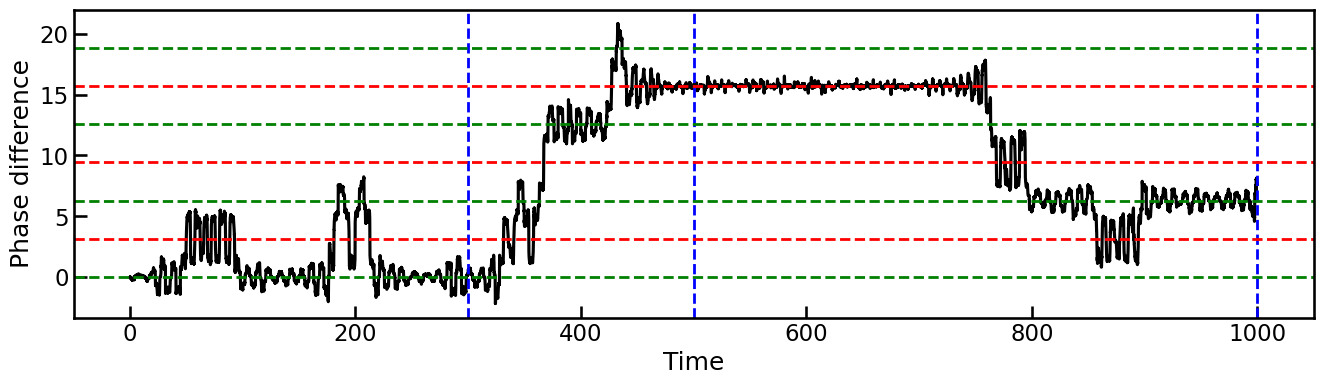
Figure 6: Phase difference dynamics in coupled metronomes exhibit bistability, with synchronization states marked and analyzed across varying time windows.
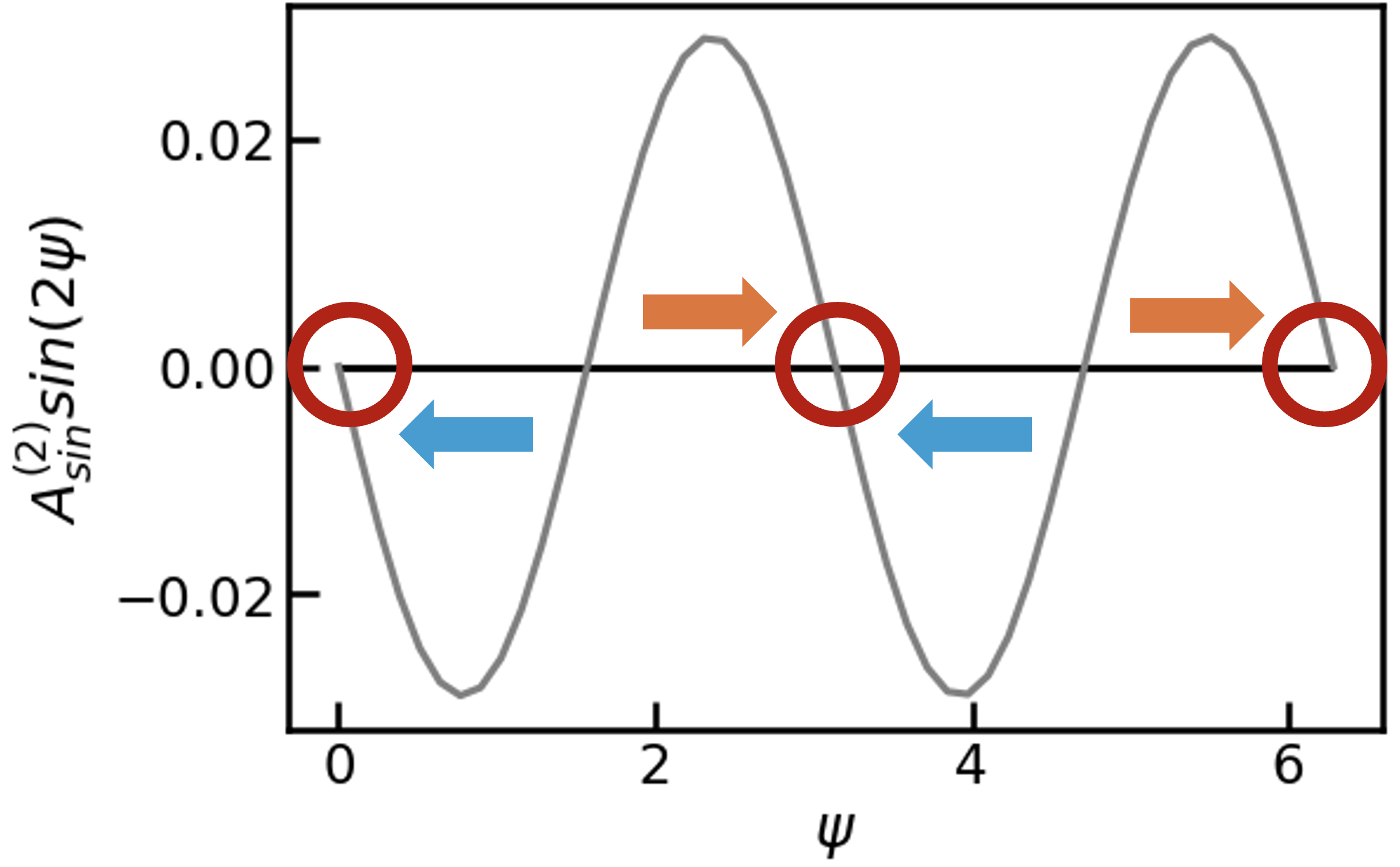
Figure 7: Inferred phase coupling sin(2ψ) quantifies stable fixed points consistent with bistable synchronization.
Implications and Limitations
This framework advances uncertainty quantification in dynamical model discovery by offering robust sparse identification and interpretable posterior probabilities. Practically, it enables the reliable reconstruction of network structure and functional forms from limited or noisy observations, supporting model selection in regimes where classical approaches yield overconfident or misleading results. Theoretical implications include an improved understanding of identifiability and degeneracy in coupled systems, particularly under phase-locking and limited dynamical variability.
The principal limitation is computational scalability: the number of candidate interactions grows rapidly with system size and interaction order (O(N2) for pairwise, O(N3) for three-body), and parallel tempering becomes demanding for large networks. The paper suggests future directions in approximate Bayesian inference (variational Bayes, belief propagation) and coarse-grained modeling to alleviate computational burden and extend applicability to larger systems.
Conclusion
The presented Bayesian sparse identification method provides a comprehensive framework for data-driven modeling of complex dynamical systems, integrating principled uncertainty quantification with interpretable model selection. It demonstrates accurate structure recovery in oscillator networks and effective identification of functional components in phenomenological settings, highlighting the necessity of uncertainty metrics in high-dimensional, data-limited, or structurally ambiguous regimes. Future research should pursue scalable inference techniques and network coarse-graining to broaden relevance in large-scale nonlinear system modeling.