- The paper demonstrates that the reservoir phase reference crucially governs the formation of steady-state entanglement in coupled quantum harmonic oscillators.
- It employs Gaussian-preserving master equations and covariance matrix analysis to link local, phase-sensitive dissipation with nonlocal quantum correlations.
- The study provides experimental insights by showing how optimal intermediate squeezing and coherent coupling regulate both entanglement magnitude and thermal robustness.
Phase-Reference Control of Steady-State Entanglement in Open Quantum Systems
Introduction
The paper "Phase-Reference Control of Steady-State Entanglement in Open Quantum Systems" (2605.03978) provides a systematic investigation of how steady-state entanglement in coupled continuous-variable (CV) quantum systems is fundamentally governed by the reference phase of the local dissipative environment. By leveraging the framework of Gaussian-preserving master equations and covariance matrix analysis, the authors elucidate the precise mechanism linking local, phase-sensitive dissipation to the generation and regulation of nonlocal quantum correlations. The main focus is the entanglement characteristics established in the steady state of two linearly coupled harmonic oscillators, each dissipatively coupled to individually engineered squeezed reservoirs without direct bath-mediated connections.
The system considered comprises two linearly coupled bosonic modes governed by the Hamiltonian:
HS=ω1a1†a1+ω2a2†a2+J(a1†a2+a1a2†)
where J is the coherent coupling, and each mode interacts with an independent squeezed thermal reservoir. Open quantum dynamics are described using Born–Markov approximations and Lindblad master equations, with each local bath characterized by a squeezing parameter rk and phase ϕk. The covariance matrix formalism is applied for the exact steady state solution under Gaussian-preserving (quadratic) dynamics. The choice of phase reference—whether the reservoirs are phase-locked to the system's rotation ("rotating-frame") or referenced to the laboratory quadrature basis ("laboratory-frame")—forms the central variable controlling the steady-state entanglement structure.
Steady-State Entanglement: Analytical Structure and Numerical Characterization
The entanglement analysis relies on the steady-state solution of the Lyapunov equation for the system covariance matrix, quantifying quantum correlations via logarithmic negativity EN, determined from the smallest symplectic eigenvalue ν~− of the partially transposed covariance matrix. Notably, the steady-state entanglement is not monotonic with either the squeezing strength r or the coherent coupling J.
In the parameter plane of squeezing (r1, r2), a finite region supporting entanglement is found. Both weak and strong squeezing regimes suppress entanglement: insufficient correlation injection in the former, and noise dominance in the latter. An optimal intermediate squeezing regime maximizes J0 for approximately balanced reservoirs.
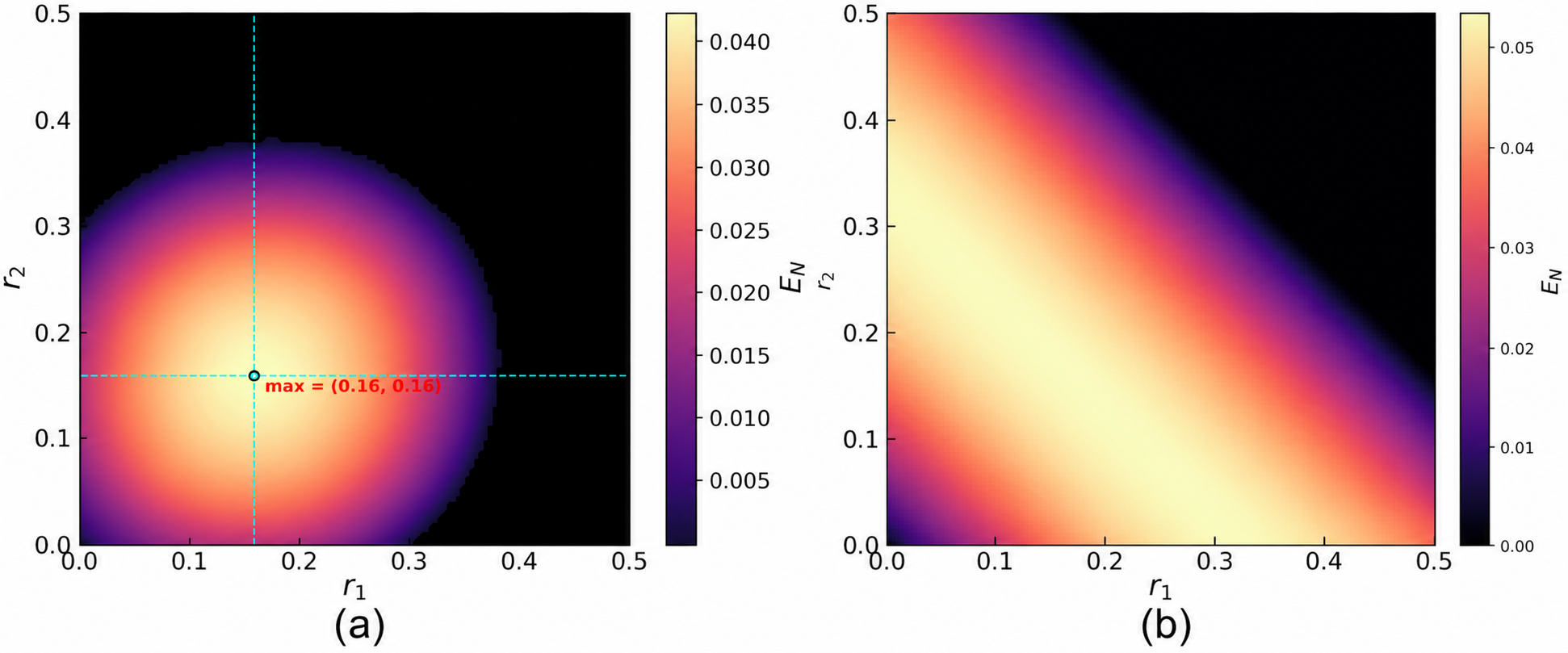
Figure 1: Logarithmic negativity J1 for two coupled harmonic oscillators with independent squeezed reservoirs, evaluated at J2, J3, and J4. (a) Laboratory-frame result. (b) Rotating-frame (phase-locked) result. The entangled region exhibits a finite optimal squeezing, reflecting competition between correlation generation and noise amplification.
The dependence of entanglement on the reference phase of the reservoir, encoded in J5, exhibits clear interference patterns. The maximal entanglement occurs along bands where the local squeezing phases are relatively aligned, revealing direct phase control over the nonlocal steady-state quantum correlations.
Impact and Physical Interpretation of Reservoir Phase Reference
A principal result established is that the phase reference of the squeezed reservoir qualitatively modifies the structure of the steady-state, yielding inequivalent entanglement properties for laboratory- and rotating-frame implementations. While both operational scenarios are experimentally realizable, they produce strikingly different critical temperature J6 boundaries (above which entanglement vanishes), as well as distinct J7 profiles as functions of system parameters.
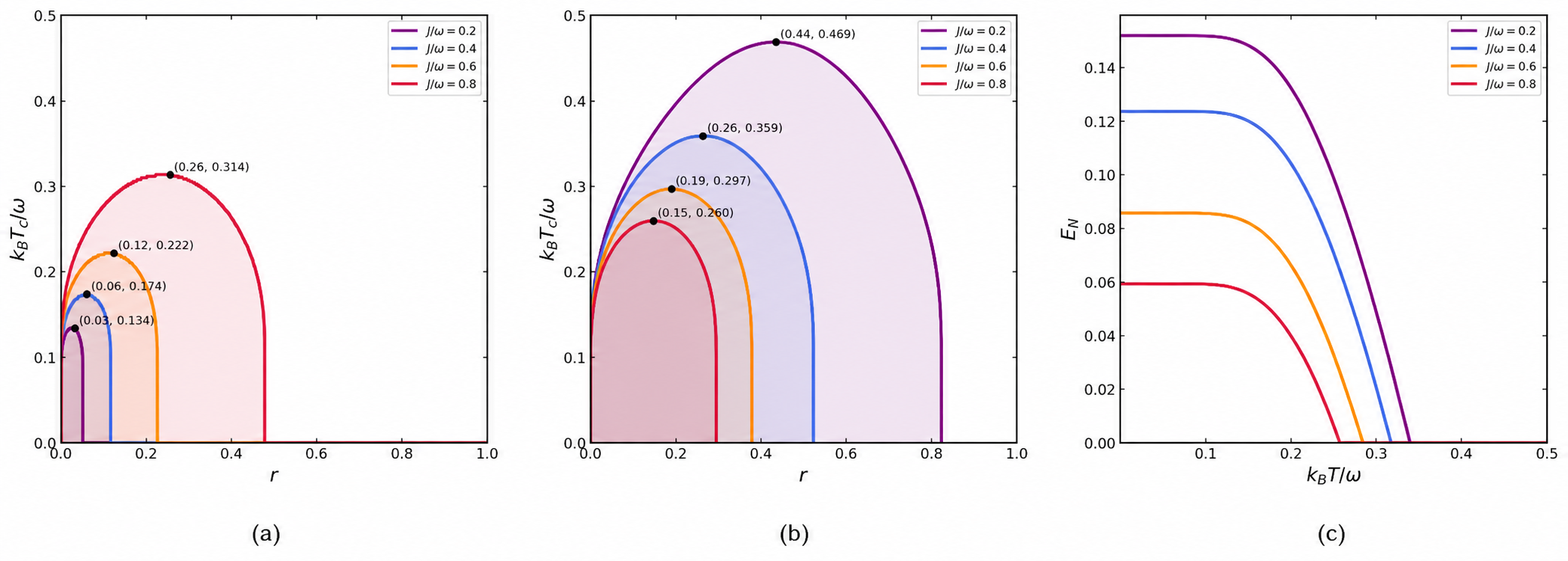
Figure 2: Critical temperature J8 and steady-state entanglement for laboratory-frame and rotating-frame implementations of the squeezed reservoir. (a) Laboratory-frame calculation of J9 for several couplings rk0, where the anomalous bath correlations are fixed relative to the laboratory quadratures. (b) Rotating-frame (phase-locked) result for rk1, exhibiting bounded, dome-like behavior. (c) Logarithmic negativity rk2 at fixed squeezing, computed in the rotating frame. The ordering of rk3 with respect to rk4 depends on the reservoir phase reference, demonstrating that steady-state entanglement is not invariant under changes in this reference.
In the rotating-frame (phase-locked) description, the steady-state solution is stationary and the critical temperature demonstrates a non-monotonic, dome-like dependence on squeezing. For the laboratory-frame, in contrast, the covariance matrix becomes explicitly time dependent (a Floquet steady state), and the ordering of entanglement robustness with respect to rk5 is altered. Thus, the entanglement observed in the steady state is not invariant under shifts in the reservoir phase reference, emphasizing the essential physicality of the reference choice. The role of coherent coupling is also highlighted: it acts not merely as a monotonic enhancer or suppressor, but as a regulator converting local squeezing into nonlocal quantum correlations, with entanglement maximized at an intermediate coupling.
Experimental Relevance and Implications
The model directly maps to state-of-the-art experimental quantum optics and circuit-QED systems, where the local engineering and phase-locking of squeezed reservoirs is a routine capability. These results provide actionable guidance for the robust dissipative generation of steady-state entanglement by tuning both the amplitude and phase relationships for local squeezing resources, particularly in platforms requiring phase-locked homodyne detection or where only local reservoirs are available. The observation that the entanglement structure fundamentally depends on the reference frame underscores the necessity of precise phase calibration in quantum reservoir engineering and, more generally, in dissipative quantum technology design.
The findings challenge the assumption that steady-state quantum correlations in open CV systems are reference-invariant, introducing a new degree of control via the reservoir phase frame. This provides a theoretical basis and practical framework for exploiting not just the spectral properties of engineered baths, but also their reference phase in quantum information experiments and protocols.
Conclusion
This study establishes that steady-state entanglement in open continuous-variable quantum systems is explicitly controlled by the phase reference of engineered local reservoirs. Both the magnitude and thermal robustness of entanglement are dictated by the combined interplay of squeezing, coupling strength, and, crucially, the chosen phase reference of the local dissipators. The results extend the operational control landscape for dissipative quantum technologies and provide both analytical and numerical tools for customizing steady-state quantum correlations by exploiting phase-sensitive reservoir engineering. The explicit physical dependence on the phase reference invites deeper exploration into phase-engineered environments, including generalizations to many-body systems, non-Gaussian dissipative processes, and the controlled generation of more complex quantum resources.