- The paper introduces a dual parametric amplification scheme that significantly enhances optomechanical entanglement through integrated optical feedback.
- It details optimal conditions for transitioning between one-way and two-way EPR steering by tuning cavity reflectivity, modulation frequencies, and amplitude ratios.
- Results show enhanced mechanical squeezing and thermal robustness, offering advanced control over quantum correlations in cavity optomechanical systems.
Coherent Control of Optomechanical Entanglement and Steering via Dual Parametric Amplification
System Architecture and Physical Model
This study presents a coherent-control paradigm for engineering quantum correlations in cavity optomechanical (COM) systems. The setup consists of a Fabry–Pérot cavity with an embedded χ(2) nonlinear medium and a mechanical membrane, enhanced by a coherent optical feedback loop (Figure 1). The optical cavity and the membrane are each subjected to parametrically modulated pumps: the nonlinear medium enables OPA, while the membrane undergoes MPA. The feedback architecture—a high-reflectivity mirror (HRM) and a controllable beam splitter (CBS)—coherently routes the cavity output back into the system, circumventing measurement backaction and classical noise typically associated with measurement-based feedback.
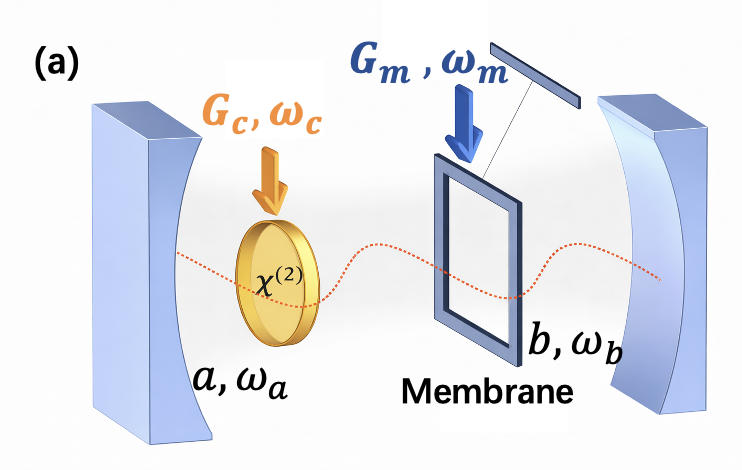
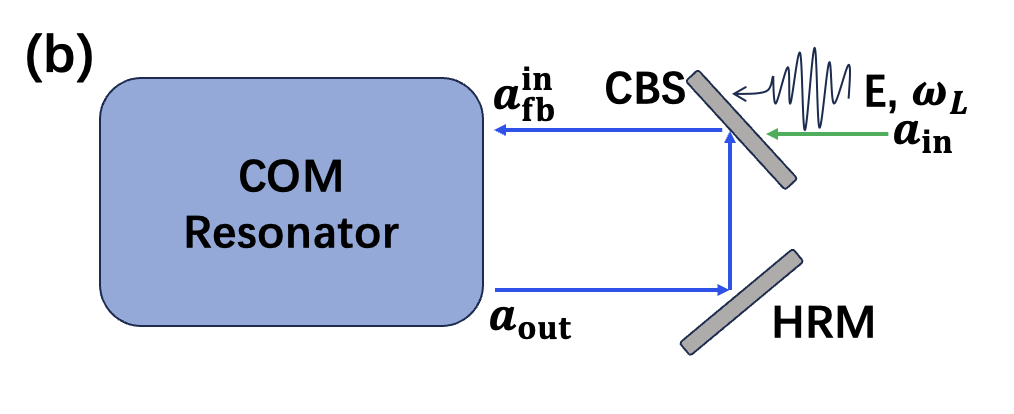
Figure 1: Schematic of the COM system comprising the embedded membrane, the χ(2) nonlinear medium, and the coherent feedback configuration.
The feedback loop modifies both the effective cavity decay rate and the quantum noise spectrum, opening additional control channels. Dynamically, the system operates under a time-dependent Hamiltonian incorporating both parametric amplifications and coherent feedback. By linearizing the quantum Langevin equations around classical steady states, the evolution of quantum fluctuations is captured by a time-periodic drift matrix, leading to Floquet steady states characterized by periodic covariance matrices.
Limit-Cycle Dynamics and Interferometric Enhancement
Numerical simulations reveal the emergence of limit-cycle oscillations in the cavity amplitude, whose radii and amplitudes grow monotonically with increasing CBS reflectivity rb, consistent with reduced effective cavity loss. Notably, the quantum entanglement, quantified by the maximal logarithmic negativity EN,max, displays a nonmonotonic dependence on rb—initially rising and then dropping as the system approaches the instability threshold. This behavior results from the interplay between enhanced cooperativity (favoring entanglement) and increased feedback-induced photon-number fluctuations (diminishing correlations) as rb becomes large.
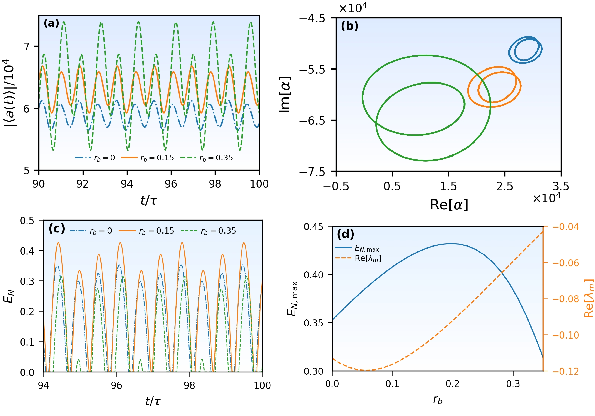
Figure 2: Limit-cycle cavity dynamics and entanglement EN,max versus CBS reflectivity rb; optimal entanglement occurs at intermediate rb.
Dual Parametric Amplification: Joint Modulation and Quantum Resource Engineering
By scanning both the OPA-MPA modulation frequency and amplitude ratios alongside CBS reflectivity, the study maps out the conditions for optimal generation and control of quantum correlations. Maximum entanglement is realized when the MPA frequency matches approximately twice the mechanical resonance, making the effective squeezing Hamiltonian time-independent in the phonon frame. The amplitude ratio Gm/Gc serves as another lever: entanglement is minimal without feedback or MPA and reaches up to χ(2)0 at optimal settings—substantially outperforming configurations relying solely on OPA or MPA. This architecture extends the tunability and robustness of COM entanglement well beyond previous schemes.
Steering: Transition Between One-Way and Two-Way Nonlocality
The system supports both entanglement and quantum steering, with the latter exhibiting strong asymmetry (directionality). Without feedback, only one-way steering is achieved. The introduction of coherent feedback broadens the parameter space for one-way steering and, importantly, induces a feedback- and reflectivity-controlled transition between one-way and two-way EPR steering. This tunability of steering, as a function of frequency ratio, amplitude ratio, and CBS reflectivity, allows precise modulation of the nonlocal character of quantum correlations, which is critical for device-independent quantum communication protocols.
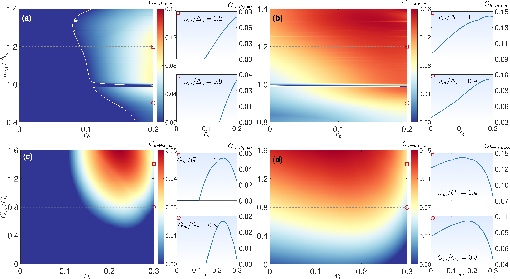
Figure 3: Parameter maps for Gaussian steering showing feedback-controlled transitions between one-way and two-way regimes and the extension of nonlocal quantum correlations.
Local Mechanical Quantum Properties: Squeezing and Purity
The approach allows simultaneous optimization of the purity and quadrature squeezing of the local phonon state. Regions of strong mechanical squeezing coincide with high-purity phonon states under appropriate parameter regimes and feedback. This dual optimization is advantageous for quantum metrology and nonclassical state preparation, providing more favorable conditions for quantum-limited sensing and macroscopic quantum state engineering.
Phase Control and Thermal Robustness
The phase shift χ(2)1 of the feedback loop emerges as a powerful control variable, enabling periodic enhancement (or suppression) of both entanglement and steering. Increasing the modulation-amplitude ratio further amplifies these quantum correlations, although the region of strong steering remains narrower than that of entanglement, evidencing greater sensitivity to feedback phase and amplitude.
Thermal robustness is significantly improved: within the feedback-optimized parameter domain, both χ(2)2 and steering persist up to higher bath temperatures relative to schemes without coherent feedback or only single-parametric amplification. However, proximity to the dynamical stability threshold can reverse this effect due to the amplification of instability-driven noise.
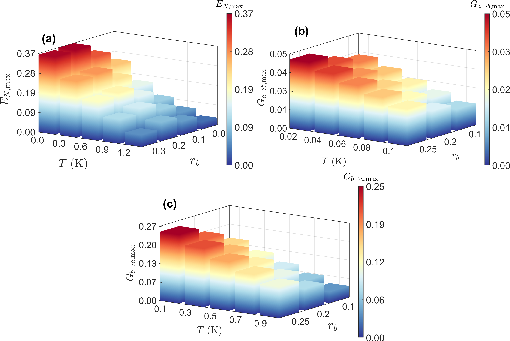
Figure 4: Maximum entanglement and steering as functions of environment temperature χ(2)3 and reflectivity χ(2)4, demonstrating enhanced thermal robustness in the feedback-controlled regime.
Experimental Feasibility and Outlook
All ingredients of the proposal—OPA using intracavity pumped χ(2)5 crystals, MPA via periodic piezo- or capacitive actuation, and coherent feedback with tunable optical delay—are within current experimental capabilities. Quantum correlations can be verified through homodyne/heterodyne tomography of cavity output and indirect inference of mechanical quadratures using auxiliary probe modes. The coherent feedback delay is negligible for conventional cavity sizes, validating the instantaneous feedback approximation adopted in the model.
Practically, the scheme enhances both the tunability and resilience of quantum nonlocal resources, supporting applications in continuous-variable quantum key distribution (including one-sided device-independent variants), quantum networking, and precision metrology. Theoretically, the results indicate that coherent control using dual parametric amplifiers and feedback is essential for optimal generation and manipulation of macroscopic quantum states in hybrid quantum systems.
Conclusion
This work details a general methodology for robust, tunable coherent control of optomechanical entanglement and steering combining dual parametric amplification with phase-tunable coherent optical feedback. The approach achieves strong, thermally robust, and widely tunable quantum correlations, surpassing previous architectures that relied solely on single-field driving or measurement-based feedback. The modulation of entanglement, steering, mechanical squeezing, and purity through OPA/MPA pump ratios and feedback parameters consolidates this scheme as a versatile tool for quantum information processing tasks. These findings provide a path toward integrated, feedback-controllable quantum devices leveraging both photonic and mechanical degrees of freedom for advanced quantum technologies.

