Quantum metrology of mixed states via purification
Published 5 May 2026 in quant-ph and math.ST | (2605.03975v1)
Abstract: We introduce new formulations of the quantum Cramér-Rao bound (QCRB) and the Holevo Cramér-Rao bound (HCRB) in multi-parameter quantum metrology via purification, where we show their values for any mixed state are connected to that for its purification with nuisance parameters introduced on the environmental system. Using this technique, we develop a new method for asymptotically attaining either the HCRB or twice the QCRB for arbitrary mixed states using random purification channels and individual measurements.
The paper's main contribution is a purification framework that reduces mixed-state parameter estimation to pure-state analysis, enabling effective computation of QCRB and HCRB bounds.
It introduces an efficient two-stage measurement protocol using random purification channels and adaptive local measurements that scale polynomially with system size.
Numerical results confirm that the protocol asymptotically saturates the Holevo Cramér-Rao bound and achieves twice the QCRB, highlighting its practical and theoretical impact.
Quantum Metrology of Mixed States via Purification
Introduction and Theoretical Context
The study addresses multi-parameter quantum metrology for mixed states, centering on Cramér-Rao bounds and their attainability. Whereas the single-parameter quantum Cramér-Rao bound (QCRB) is always tight and attainable via independent measurements, multi-parameter settings introduce incompatibility of optimal POVMs which prevent, in general, the saturability of the QCRB. The Holevo Cramér-Rao bound (HCRB) provides a tighter bound in the multi-parameter regime but is known to be difficult to attain both practically and computationally: it generally requires collective measurements on an asymptotically large number of state copies and the identification of optimal measurement strategies presents significant complexity.
For pure states, these limitations are mitigated: the HCRB becomes efficiently computable, and optimal strategies involve only local (individual-copy) measurements that can be found efficiently. This paper leverages purification to extend pure-state metrology machinery to arbitrary mixed states, formulating a unified framework to compute and attain the QCRB and HCRB for mixed states via their canonical purifications.
Purification-Based Formulation of Quantum Bounds
The core result introduces the purification framework for metrological bounds. For a rank-r mixed quantum state ρθ parameterized by θ, the canonical purification is
∣ψθ,ξ⟩=j=1∑rλj,θ∣ej,θ⟩S⊗∣fj,ξ⟩E,
where the set {∣fj,ξ⟩} forms an orthonormal basis of the environmental system E. By promoting ξ to a set of nuisance parameters, it is shown that both the QFIM and HCRB for ρθ become sub-blocks (or restrictions for θ parameters) of those for the purified system, where all parameters—including nuisance ones—are considered.
where the subscript ρθ0 means the block relating to the original parameters ρθ1, and ρθ2 extends the original cost matrix ρθ3 to the larger parameter set by filling remaining entries with zeros.
This establishes that optimal estimation theory for mixed states reduces to the theory for pure states if we allow for environmental nuisance parameters introduced via purification.
Efficient Protocol for Attaining Holevo and Quantum Cramér-Rao Bounds
The paper presents an explicit measurement protocol—implementable with only polynomial circuit complexity—that enables asymptotic attainability of either the HCRB or twice the QCRB for arbitrary mixed states. The procedure is as follows:
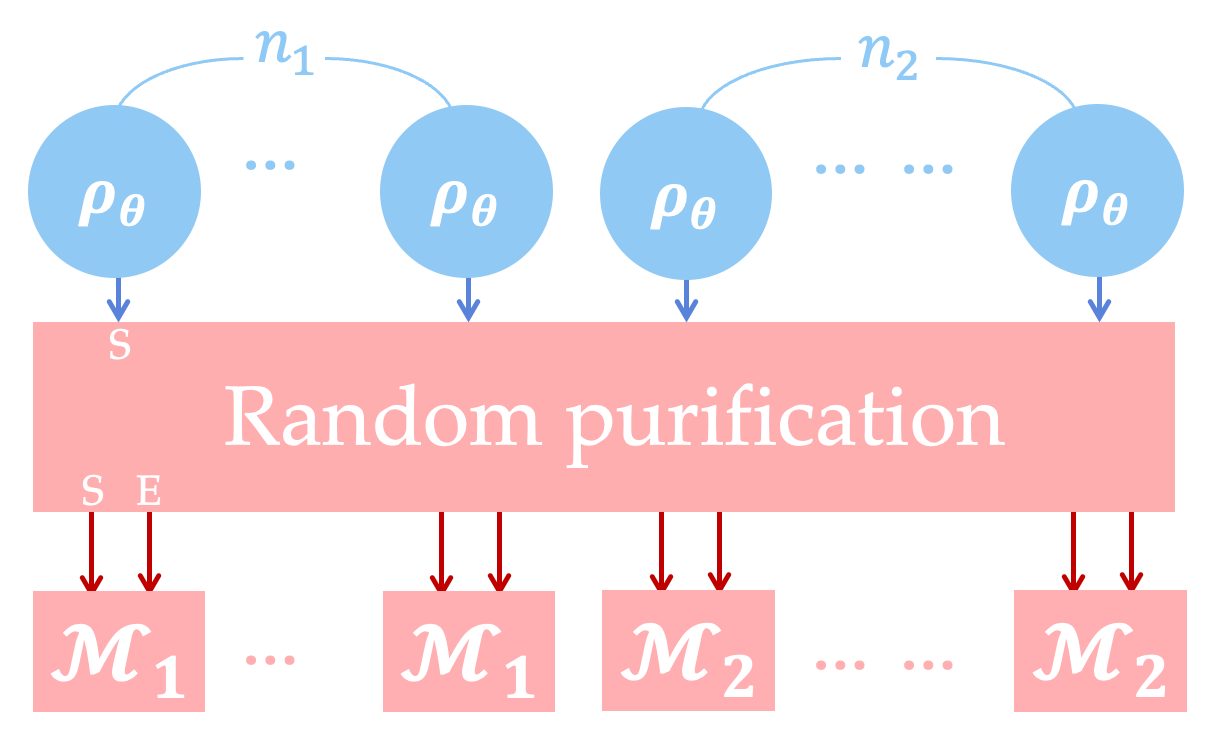
Random Purification Channel: Apply a random purification channel to multiple copies of the mixed state ρθ4. This operation produces purifications with randomized environmental degrees of freedom while scaling efficiently with system parameters.
Two-Stage Estimation Protocol:
Stage I: Use a small fraction of the purified copies for tomographic state estimation to yield a coarse estimator of ρθ5.
Stage II: Utilizing the rough estimator, adaptively perform locally optimal measurements on the remaining purified copies. For HCRB saturation, use the individual optimal measurement for the pure state at the estimated parameter; for the QCRB (up to a factor of two), invoke a Fisher-symmetric measurement.
The key is that all measurements are local (acting on individual copies), and all resources scale polynomially with the system size and number of copies, in contrast to collective measurements on large states.
Figure 1: Schematic of the measurement protocol: a random purification channel is applied to ρθ6 copies of ρθ7, followed by tomographic and locally-adapted measurements.
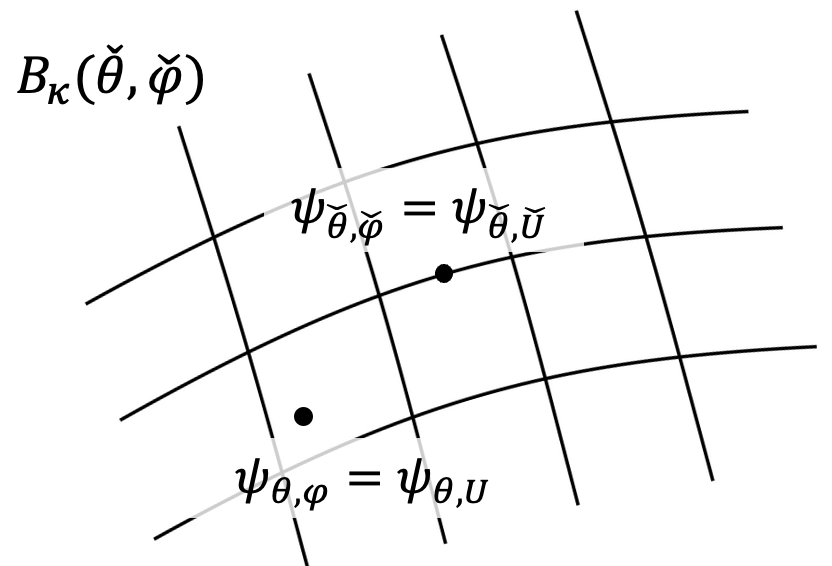
Figure 2: For sufficiently accurate tomographic estimates, unique identification of ρθ8 in a local neighborhood is guaranteed, enabling the protocol to focus locally-optimal measurements.
Numerical Optimality and Technical Results
Two strong claims are substantiated:
HCRB Attainability: For any regular ρθ9-rank state and positive definite cost, the weighted mean square error (WMSE) of the estimator produced by this protocol converges to the HCRB:
θ0
Twice the QCRB Achievability: By modifying the locally optimal measurement in Stage II to a Fisher-symmetric one, the mean-square error matrix converges in the large-θ1 limit to twice the inverse QFIM:
θ2
The content rigorously verifies the uniform boundedness, continuity, and differentiability needed to make all asymptotic and estimator claims precise under mild spectrum conditions, generalizing previous attainability results by relaxing earlier requirements on spectral non-degeneracy.
Practical and Theoretical Impact
The explicit purification formalism bridges the previously separated mathematical treatment of pure- and mixed-state multiparameter metrology. By leveraging efficient random purification channels and locally-adapted measurements, it allows for computationally tractable implementation and theoretical analysis of precision bounds for general mixed quantum systems.
Practically, this opens the way for scalable experimental designs in quantum sensing and quantum information processing with realistic, non-pure probe states. The protocol's efficiency makes it directly relevant to quantum-enhanced metrology in the presence of noise, decoherence, or imperfect state preparation. The approach is also extendable to quantum channel estimation and related tasks.
Theoretically, the core purification reduction provides a systematic means for transferring analytical results and intuition from pure-state to mixed-state settings. This methodology could be further developed for problems involving dynamical estimation, quantum process tomography, or correlated environmental models.
Future directions include handling a priori unknown rank via adaptive pre-estimation and leveraging the purification machinery to develop robust protocols under spectrum or support variation, as well as extending the framework to quantum channel and process metrology.
Conclusion
This work establishes purification as a unifying tool for quantum metrology of mixed states. Both the fundamental and practical limitations in attaining precision bounds (HCRB and QCRB) for arbitrary states are reduced to the pure-state case via purification and appropriate inclusion of nuisance parameters. Efficient, fully local measurement protocols are constructed that mathematically attain these bounds asymptotically, with strong technical support for regularity and optimality. Implications span both metrological theory and quantum information science, with substantial potential for future extension and application.
“Emergent Mind helps me see which AI papers have caught fire online.”
Philip
Creator, AI Explained on YouTube
Sign up for free to explore the frontiers of research
Discover trending papers, chat with arXiv, and track the latest research shaping the future of science and technology.Discover trending papers, chat with arXiv, and more.