- The paper rigorously replicates EQC benchmarks using classical optimization methods, revealing that observed gains stem from known stochastic heuristics.
- It demonstrates that using weak coherent states, rather than true quantum states, aligns Dirac-3 behavior with classical simulated annealing techniques.
- The critique shows that Dirac-3's performance on easy instance ensembles does not challenge NP-hard optimization limits or suggest genuine quantum advantage.
Critical Evaluation of Entropy Quantum Computing and Its Photonic Implementation
Introduction
The critique targets the "Entropy Quantum Computing" (EQC) paradigm implemented on the Dirac-3 photonic system and detailed in Nguyen et al. It systematically examines the claims concerning leveraging environmental noise and decoherence for NP-hard optimization, arguing that rigorous scrutiny reveals fundamental limitations underlying the reported computational advantage. The assessment centers on the photonic implementations, benchmark selections, comparative analyses, and theoretical implications for optimization and complexity theory.
System Architecture and Operational Principles
Dirac-3 represents a hybrid analog-digital device employing photon qudits in time-frequency modes, optical amplification, mode mixing, and lossy feedback loops. The core claim is that the system, by sampling from stochastic optical fluctuations (primarily Poissonian shot noise), performs a form of simulated annealing that preferentially stabilizes lower-energy (i.e., optimal or near-optimal) solution states. The control of photon number and feedback parameters is posited as an analog to tuning effective temperature—solidifying the correspondence with canonical ensemble sampling.
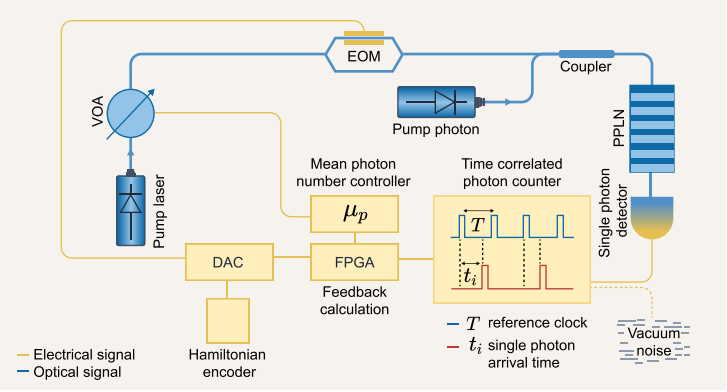
Figure 1: Dirac-3 system schematic highlighting optical amplification, mode mixing, and feedback loops for quantum-inspired stochastic optimization.
Despite assertions of accessing quantum advantage, the critique emphasizes that the input states are weak coherent states rather than single-photon Fock states. The distinction is pivotal: weak coherent states retain classical Poissonian statistics and lack non-classical features (e.g., anti-bunching, sub-Poissonian variance) necessary for genuine quantum computational leverage. This reinforces the underlying analogy to classical stochastic optimization methods (e.g., SA), negating claims of harnessing uniquely quantum stochasticity.
Reproduction of Numerical Benchmarks
The paper performs rigorous reproduction of the Dirac-3's reported benchmarks—including non-convex polynomial optimization, continuous quadratic minimization (QPLIB_0018), and combinatorial graph partitioning (Max-k-Cut)—using standard classical hardware and optimization libraries (JuMP, Ipopt, HiGHS, Metaheuristics.jl). Classical metaheuristics (SA, Tabu Search, PSO) and exact solvers efficiently solve all considered instances, often matching or exceeding Dirac-3's solution quality and success rate, with orders-of-magnitude lower runtime.
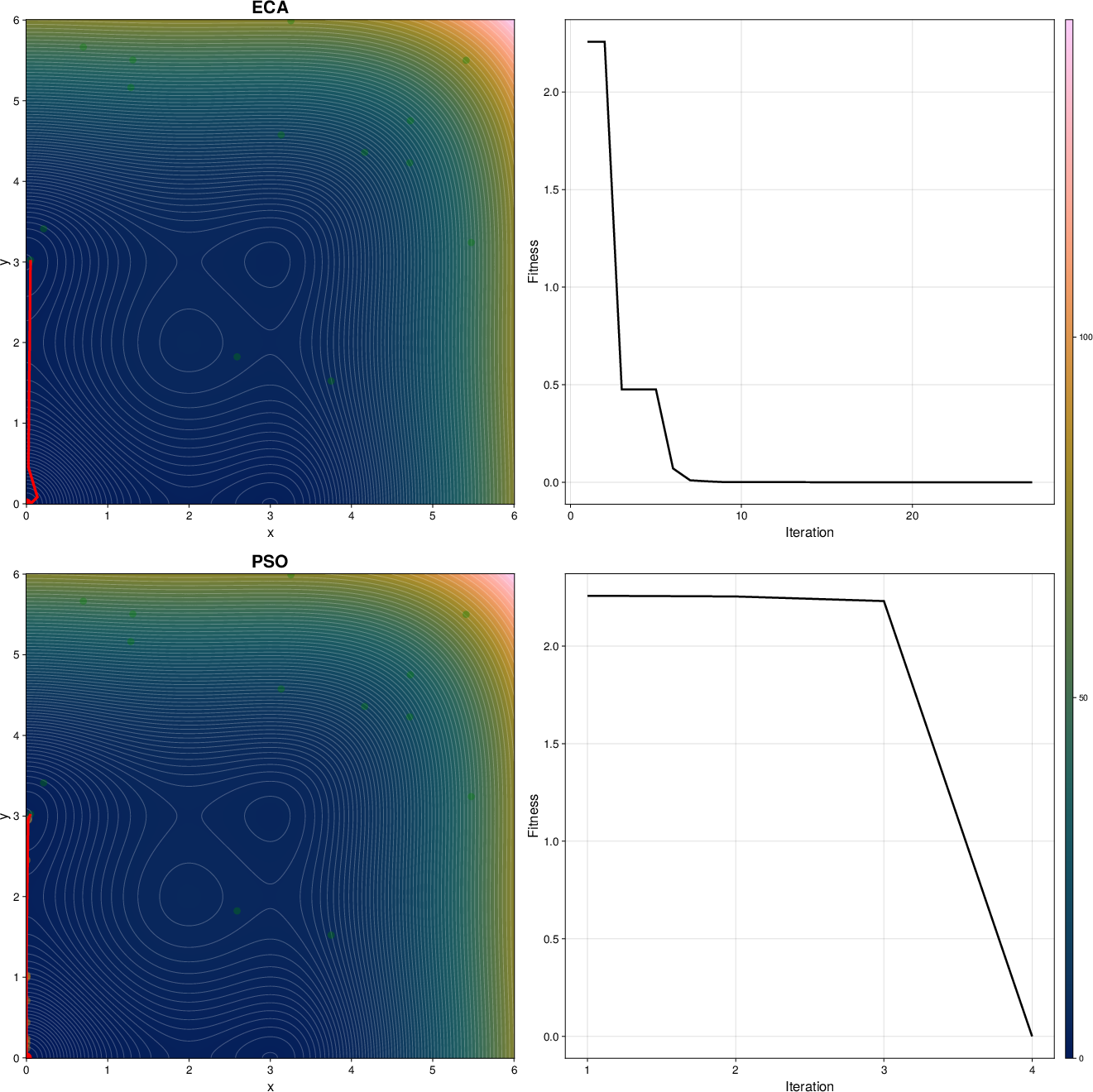
Figure 2: Trajectory of ECA and PSO convergence to the global minimum, illustrating rapid, robust performance on non-convex landscapes.
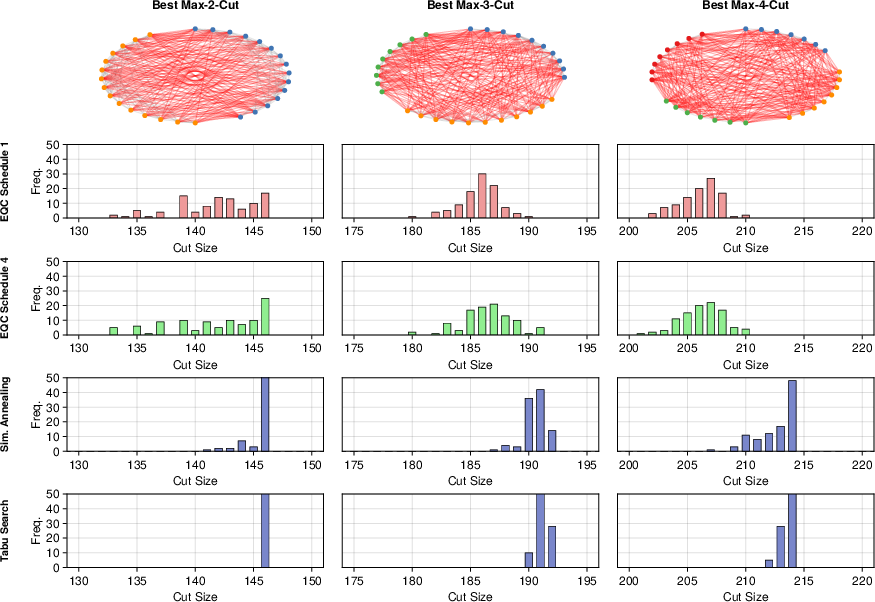
Figure 3: Classical vs Dirac-3 Max-k-Cut solution distributions, showing classical heuristics achieving optimal cuts with far higher success probabilities.
These results underscore that benchmark scale and problem structure are insufficiently challenging for contemporary classical algorithms. In particular, the use of small graphs (n=30) and quadratic programming instances solvable in fractions of a second suggest that observed optimization performance is not indicative of computational relevance to harder NP-hard instances. Furthermore, the energy efficiency claims are contextualized as comparable to other photonic and analog approaches, lacking decisive practical advantage.
Statistical Thermodynamics and Configuration Space Analysis
The critique models Dirac-3's sampling behavior as canonical ensemble selection, with cut configurations distributed according to the Boltzmann law. The interplay between energetic minimization and entropic multiplicity is precisely characterized, with high-value cut solutions arising as rare but highly favored states in random graph ensembles.
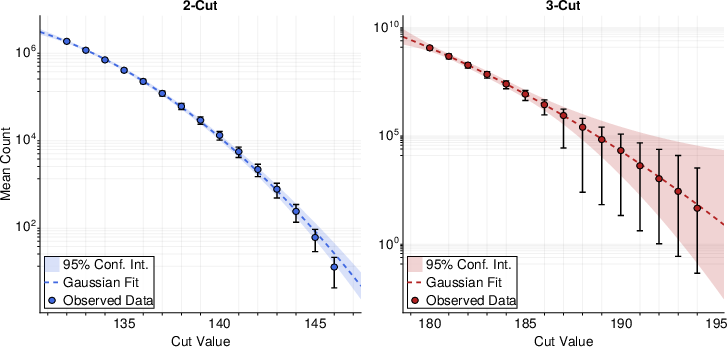
Figure 4: Averaged configuration counts for cut values across sampled random graphs, illustrating the exponential concentration of solution density.
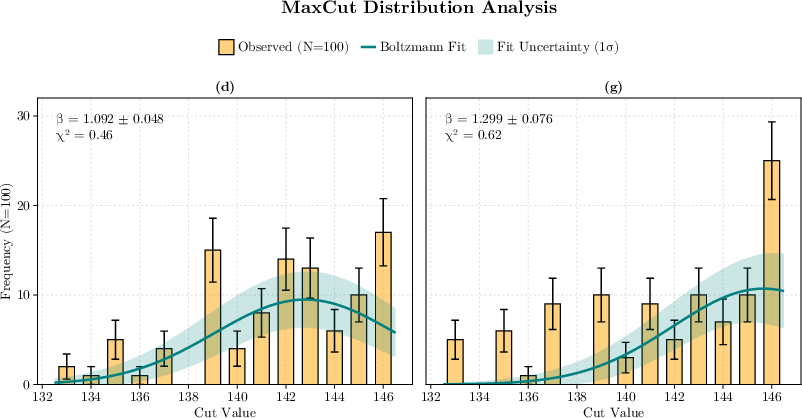
Figure 5: Statistical fit of model prediction to Dirac-3 measurement outcomes, validating the Gibbs distribution hypothesis and revealing effective temperature shifts.
Analytical derivations show that, in the limit, the distribution of cut configurations at the spectral edge converges to Poisson statistics. The probability of observing high-value cuts is dominated by both the exponential weight of the Boltzmann factor and the vanishing degeneracy at the optimal regime. The thermodynamic modeling confirms that Dirac-3's behavior is fully consistent with classical analog sampling mechanisms, governed by effective temperature and configuration space topology.
Scaling Laws and Comparison to Approximation Hardness
The theoretical analysis demonstrates that, on dense random graphs (G(n,1/2)), even trivial random algorithms asymptotically beat established worst-case approximation thresholds (Goemans-Williamson constant αGW≈0.87856, Håstad's 16/17≈0.941) for MaxCut as n→∞. The critique provides explicit bounds proving that Dirac-3, viewed as a Gibbs sampler, surpasses these thresholds overwhelmingly, but notes this reflects not computational power, but the leniency of the instance class and the underlying statistical physics.
The existence of PTAS for MaxCut on dense graphs further diminishes the import of observed near-optimal solutions. The critique stresses that worst-case hardness is not challenged; instead, Dirac-3's behavior exemplifies a generic property of stochastic samplers on easy instance ensembles.
Implications and Future Directions
Practically, the evidence suggests that EQC and Dirac-3 presently exemplify physically motivated analog heuristic optimizers, not computationally distinct engines capable of outperforming classical solvers on genuinely hard NP-hard instances. The absence of rigorous quantum resource utilization, the classical correspondence of input states, and the limitations of benchmarking directly point to the need for expanded, diversified testing—especially on structurally intractable classes or scaling regimes—alongside robust algorithmic comparisons.
Theoretically, the critique situates the EQC paradigm squarely within the established class of thermodynamical and sampling-based heuristics, governed by known principles from statistical mechanics and randomized optimization. The broader implication is that observed optimization power does not signal the emergence of novel complexity-theoretic phenomena or quantum advantage.
Conclusion
This critical analysis rigorously interrogates the computational claims of entropy quantum computing and its photonic implementation in EQC/Dirac-3. Strong numerical and theoretical evidence demonstrates that the system's optimization behavior is consistent with classical stochastic heuristics, exhibiting no decisive advantage on the tested benchmarks. Instead, its performance illustrates the generic efficacy of analog samplers on statistically easy problems, falling short of substantiating quantum or photonic advantage on hard combinatorial landscapes. Future research is encouraged to broaden benchmark selection, integrate theoretical comparisons, and more precisely characterize scaling properties within the algorithmic and statistical mechanics frameworks.