- The paper presents a novel stellarator design using tilted circular toroidal field coils and poloidal compensation to simplify engineering while maintaining competitive plasma confinement.
- It systematically optimizes coil parameters, identifying an optimal range (tilt 30–50° and radius 0.25–0.65 m) that reduces effective ripple below 10⁻² and suppresses the neoclassical D11 transport coefficient.
- Alpha confinement simulations indicate over 65% retention for reactor-relevant fusion alphas, demonstrating the practical viability of simplified coil configurations.
Development and Analysis of a Simple Stellarator Using Tilted Circular Toroidal Field Coils
Introduction
This work presents a systematic study and optimization of a simple stellarator configuration based on tilted circular toroidal field (TF) coils, aiming to balance magnetic confinement performance with engineering simplicity. Traditional stellarators utilize intricate, non-planar coil architectures to tailor neoclassical transport properties and enhance fast-particle confinement, but such complexity introduces prohibitive manufacturing challenges. By employing only circular, planar TF coils tilted with respect to the midplane, supplemented by axisymmetric poloidal field (PF) coils to compensate vertical field components, the present work explores the attainable plasma confinement and transport characteristics in simplified coil topologies. The investigation focuses on the formation of nested flux surfaces, the minimization of neoclassical transport (quantified via the effective ripple and D11 coefficients), and the assessment of collisionless confinement for fusion-born alpha particles.
Methods: Coil System, Field Computation, and Optimization
The study considers an eight-coil TF arrangement, each coil of radius r and tilt angle θ, with the full system incorporating a pair of PF coils (Figure 1 and Figure 2). The methodology for calculating the vacuum magnetic field and resultant free-boundary equilibrium involves sequential use of customized coil geometry files, Biot–Savart field computation (MAKEGRID), flux surface validation via Poincaré mapping (MGTRC), and high-accuracy equilibrium reconstruction with DESC, benchmarked against VMEC for solver consistency (Figure 3, Figure 4, Figure 5).
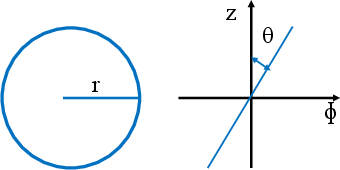
Figure 1: Schematic illustration of a tilted toroidal field (TF) coil showing (a) the R–Z plane and (b) the ϕ–Z plane.
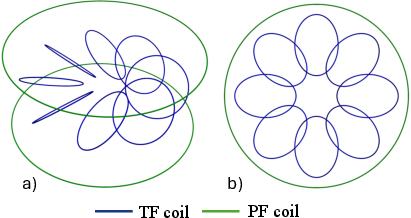
Figure 2: Isometric and top views of the stellarator coil set geometry.
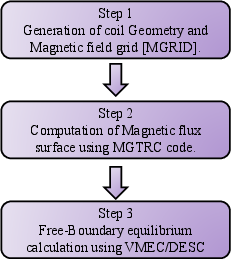
Figure 3: Methodology flow for determining free-boundary stellarator equilibria.
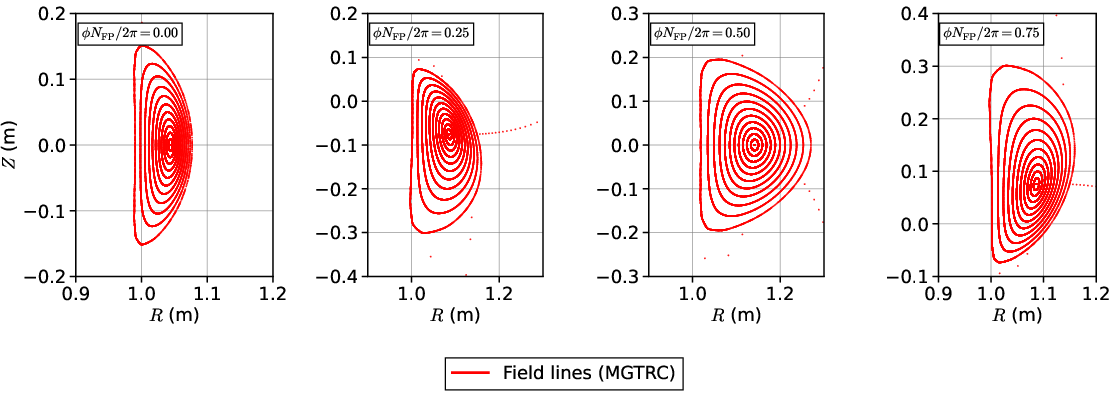
Figure 4: Poincaré plots confirming well-defined nested magnetic flux surfaces at four representative toroidal cross-sections.
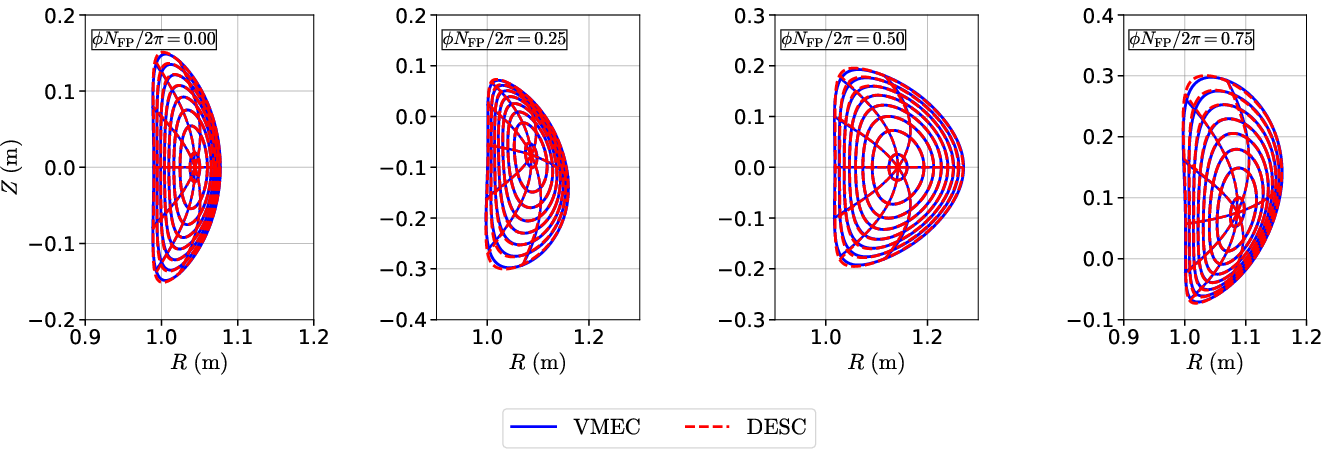
Figure 5: Excellent agreement in magnetic flux surfaces computed by VMEC (solid blue) and DESC (dashed red), reinforcing equilibrium solver consistency.
The partial optimization targets the TF coil tilt angle (30–50∘) and coil radius (0.25–0.65 m), resulting in 45 distinct coil sets. For each configuration, DESC equilibria define the coil currents and global parameters. Key figures of merit extracted include effective ripple ϵeff, neoclassical transport coefficient D11, and fast-particle confinement via collisionless guiding-center simulations of MeV-scale alphas.
Effective Ripple and Neoclassical Transport
Central to transport optimization, the effective ripple r0 is monitored as a function of coil geometry (Figure 6). An optimal region is identified near r1 m and r2, where r3 falls below r4, indicative of reduced magnetic field non-uniformity, suppressed r5-regime neoclassical transport, and minimized trapped particle losses.
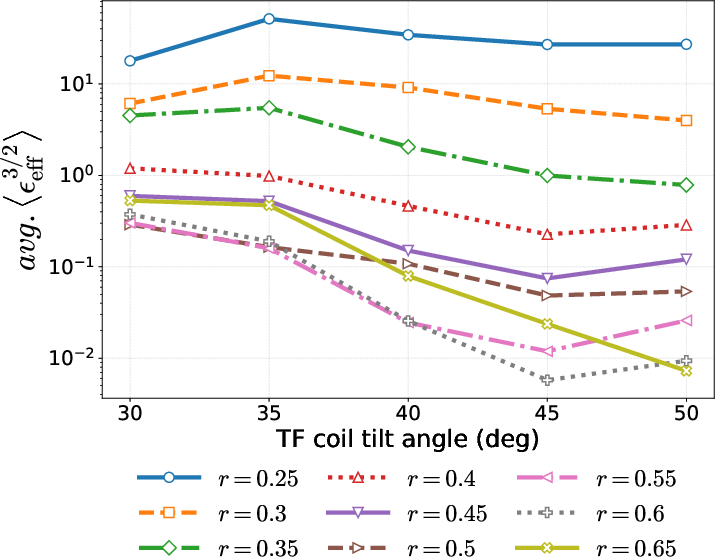
Figure 6: Variation of averaged effective ripple r6 with TF coil tilt angle for multiple coil radii.
Radial profiles discriminate between high- and low-ripple cases and benchmark the optimized simple-coil system against advanced devices (W7-X, LHD) (Figure 7). The best-performing configuration (8.1_0.60_45) achieves ripple and transport characteristics approaching those of major experiments, without recourse to non-planar or modular coils.
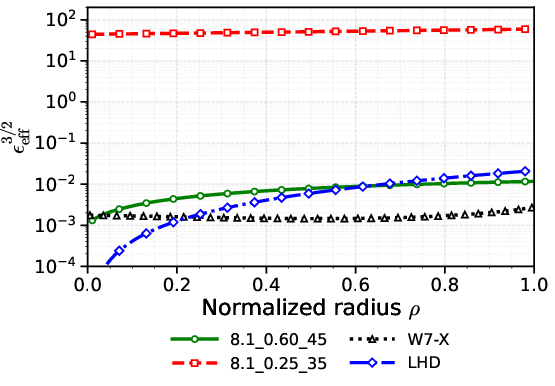
Figure 7: Radial profiles of the neoclassical effective ripple r7 demonstrating competitive performance with W7-X and LHD.
Systematic comparison between high (8.1_0.25_35) and low (8.1_0.60_45) effective ripple configurations is performed using 3D r8 maps, Boozer coordinate contours, rotational-transform profiles, and cross-sectional flux surfaces (Figure 8). Mirror ratio analysis quantifies the reduction in magnetic well depth in the optimized scenario.
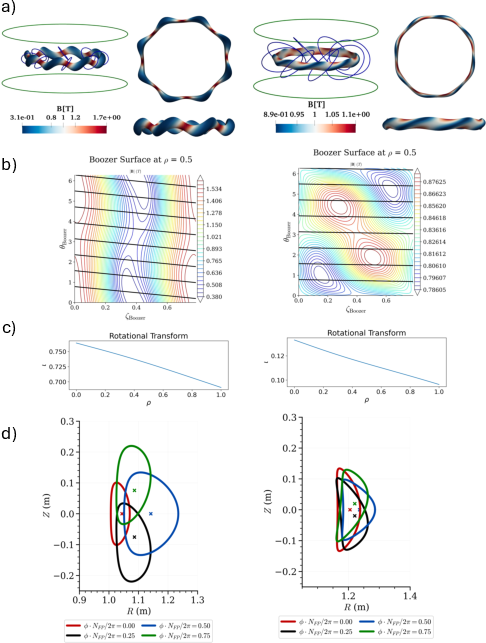
Figure 8: Multivariate comparison of representative coil configurations showing (a) 3D r9, (b) Boozer contours, (c) rotational transform, and (d) flux surface cross-sections.
Further, the mono-energetic neoclassical transport coefficient θ0, assessed using DKES, reveals strong suppression of radial transport in the optimized regime across relevant collisionality ranges (Figure 9), substantiating ripple minimization as the primary route to improved neoclassical confinement.
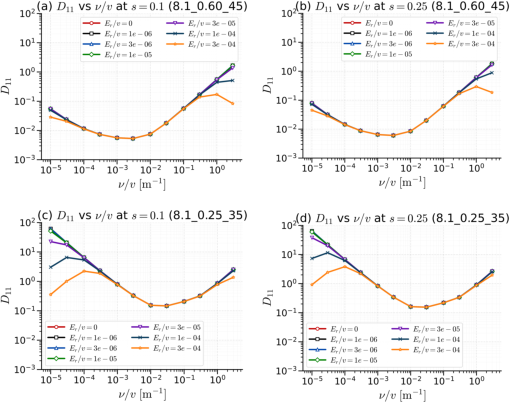
Figure 9: Mono-energetic neoclassical radial transport coefficient θ1 for both coil configurations at representative radii and collisionalities.
Fast-Particle and Alpha Confinement
Collisionless guiding-center calculations employing the SIMPLE and OFIT3D codes quantify alpha confinement for reactor-relevant energetic populations (Figure 10). The optimized configuration (8.1_0.60_45) sustains over 65% alpha confinement for centrally launched trajectories within θ2 s, outperforming less optimal simple-coil setups and approaching the quality of fully optimized stellarators for certain radial regions.
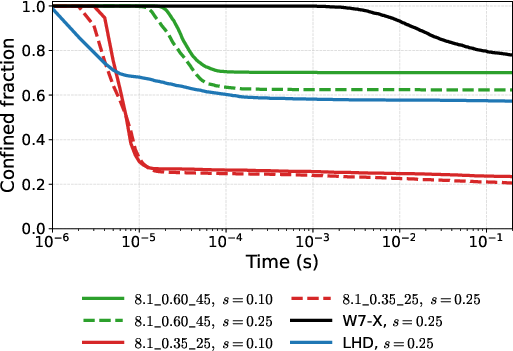
Figure 10: Confined fraction of fusion-born alpha particles over time for various configurations at two launch radii.
Correspondingly, the collisionless proxy θ3, a diagnostic for the closure of θ4-contours and secular radial fast-ion drifts, is minimized in the optimized coil set and remains comparable to values for LHD and W7-X—indicating that key structures of omnigeneity can be realized with planar, tilted coils (Figure 11).
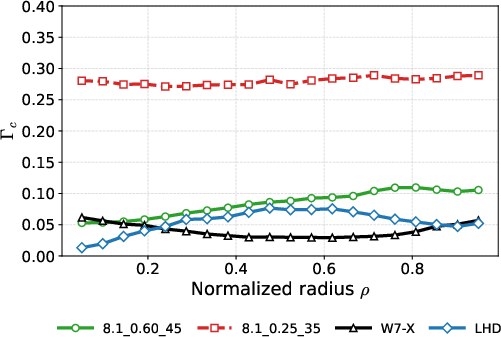
Figure 11: Radial profiles of the collisionless proxy θ5, demonstrating minimization and approach to LHD/W7-X performance.
Single particle orbit analysis in the θ6 plane visualizes the reduction in prompt/trapped-loss phase-space volume for both thermal protons and fusion alphas (Figure 12, Figure 13).
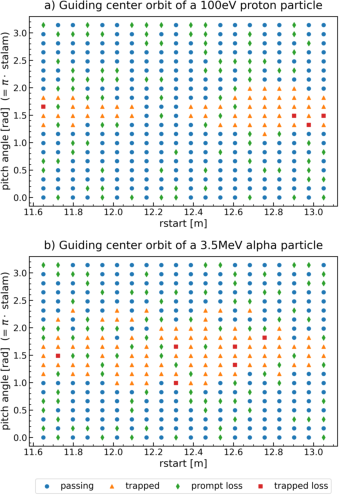
Figure 12: Guiding-center orbit classification by phase space for 100 eV protons and 3.5 MeV alpha particles.
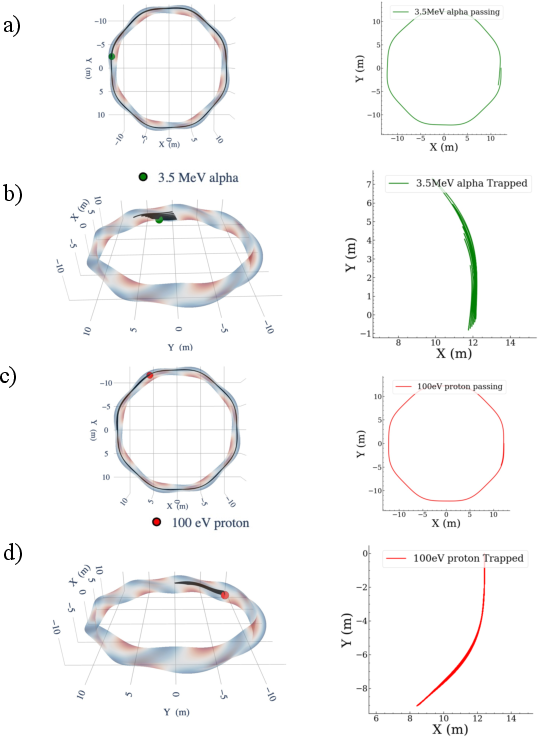
Figure 13: Example guiding-center trajectories for representative passing and trapped orbits, contextualized by the 3D plasma boundary and θ7 projections.
Theoretical and Practical Implications
The results demonstrate that, with systematic variation of geometry in simple-coil stellarators, it is possible to approach effective ripple and fast particle confinement levels previously associated only with highly complex, optimized systems. Conventional wisdom—dictating that only non-planar, modular coils are viable for high-performance neoclassical optimization—is partially challenged. The trade-off elucidated here centers on a possible narrowing of the favorable parameter space: while tailored coil sets can produce competitive metrics, the absence of built-in quasi-symmetry limits the ultimate confinement ceiling vis-à-vis devices like W7-X.
From a practical perspective, the reduction of coil complexity may facilitate future reactor-scale stellarator design by mitigating manufacturing and assembly constraints that previously inhibited scalability (e.g., NCSX). However, to match the full transport optimization possible in modular designs, further systematic exploration and algorithmic optimization targeted to simple coil sets remain essential. Such efforts may yet discover novel coil arrangements exploiting untapped regions of the design space.
Conclusion
The study provides compelling evidence that stellarators based on tilted circular toroidal field coils—devoid of non-planar modularity—can achieve low effective ripple, suppressed θ8, and strong confinement of fusion alphas by judicious selection of coil radius and tilt. While not achieving strict quasi-symmetry or outperforming the most optimized devices, these configurations represent a highly attractive balance point between engineering tractability and plasma performance. Identification of the narrow optimal parameter subspace remains a computational and theoretical challenge, emphasizing the need for dedicated optimization strategies explicitly tailored for simple coil designs. Future advancements in algorithmic coil optimization and deeper understanding of three-dimensional magnetic field effects will likely play a critical role in establishing the viability of simple-coil stellarators for practical fusion energy applications.

