- The paper elucidates Nasir al-Din al-Tusi's advanced treatment of spherical quadrilaterals and compounded ratios that pioneered pre-modern trigonometry.
- It systematically analyzes the transition from Euclidean sector figures to their spherical analogs, laying a foundation for an early form of Menelaus’ Theorem.
- The treatise employs detailed geometric constructions and exhaustive case analysis to classify spherical triangles, influencing subsequent astronomical computations.
Spherical Trigonometry Before the Modern Era: The Treatise of Naṣīr al-Dīn al-Ṭūsī
Introduction and Context
The treatise analyzed in this work, “Spherical trigonometry before the modern era: The treatise of Nasir al-Din al-Tusi” (2605.03516), offers a rigorous historical and mathematical exposition of Naṣīr al-Dīn al-Ṭūsī’s 13th-century “Treatise of the Quadrilateral”—a foundational text in the development of spherical geometry. The edition and translation discussed, by Alexandre Carathéodory (1891), provided European scholars with access to this pivotal manuscript. The more accurate translation of the Arabic title is “Disclosing the Secrets of the Secant Figure”, indicative of the treatise’s deep exploration of the so-called “complete spherical quadrilateral”, the object underpinning Menelaus’ Theorem and a cornerstone for astronomical computation prior to the proliferation of trigonometric formulae.
Structure and Mathematical Foundation
al-Ṭūsī’s treatise is systematically organized into five books:
- Book I: Compounded ratios and their manipulation,
- Book II: Properties of the plane quadrilateral figure and its ratios,
- Book III: Lemmas for the spherical quadrilateral and essential tools for their application,
- Book IV: Detailed analysis of ratios in the spherical quadrilateral,
- Book V: Modern methods for deducing arcs of great circles, circumventing reliance on the quadrilateral figure.
The rigorous formalism and methodology are evident throughout, especially in the systematic treatment of ratios and geometric constructions. al-Ṭūsī’s work is characterized not only by the development of advanced formulae but by comprehensive, case-by-case consideration, establishing exhaustive classifications of triangles and quadrilaterals on the sphere.
A central motif is the abstraction and generalization of the sector (or secant) figure from the Euclidean to the spherical context. In the Euclidean case, four lines form a complete quadrilateral with two appended triangles, yielding the well-known sector figure.
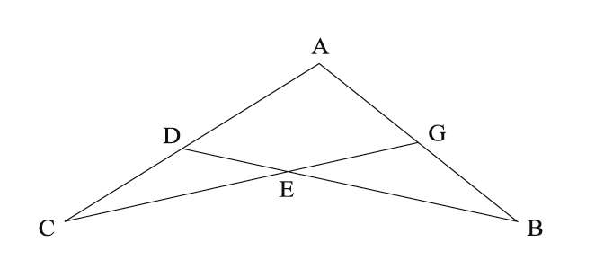
Figure 1: The Euclidean sector figure, or complete Euclidean quadrilateral.
Transitioning to the sphere, intersections of great circles generate a richer combinatorial and geometric structure. al-Ṭūsī demonstrates that three generic great circles partition the sphere into eight spherical triangles, arranged as antipodal pairs which are isometric under the antipodal map.
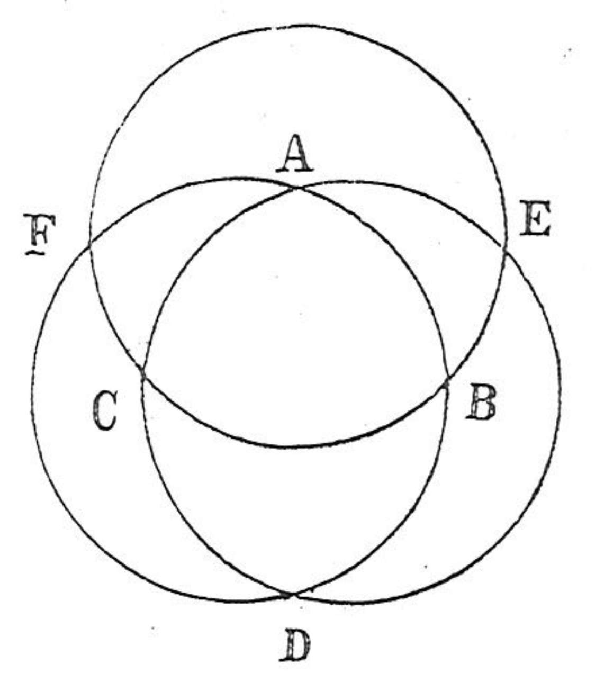
Figure 2: The eight triangles made by three great circles on the sphere. The figure is extracted from Carathéodory’s edition.
If one triangle’s side and angle data are known, all combinatorially related triangles are determined, underlining the redundancy inherent in the combinatorial construction. This structure underpins the later generalizations of Menelaus’ Theorem.
Spherical Complete Quadrilaterals and Menelaus’ Theorem
The extension to spherical geometry introduces the complete spherical quadrilateral, generated by extending the sides of a spherical quadrilateral to form two appended triangles. This rich configuration is central in al-Ṭūsī’s discussion and was already fundamental for Ptolemaic and post-Ptolemaic astronomers’ computations.
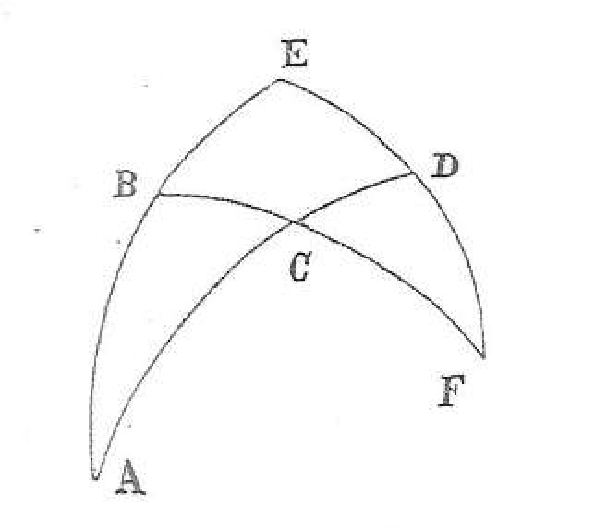
Figure 3: A complete spherical quadrilateral. Figure extracted from Naṣīr al-Dīn al-Ṭūsī’s treatise.
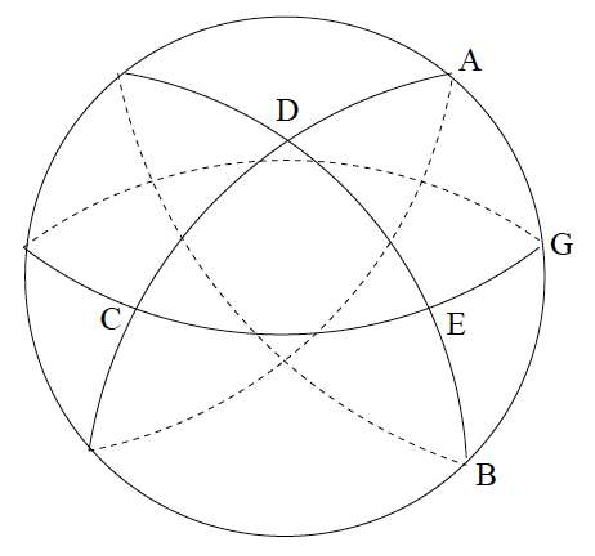
Figure 4: The spherical quadrilateral ADEG with appended triangles DCE and EGB, realizing a complete spherical quadrilateral.
The treatise provides an explicit formulation of Menelaus’ Spherical Theorem in trigonometric terms:
sinBGsinAG=sinCDsinAC⋅sinEBsinDE
This formula is historically significant, being employed in astronomical calculations well before the widespread adoption of the sine rule. al-Ṭūsī underscores that the later discovery of the spherical Sine Rule rendered the sector figure theorem largely obsolete for practical trigonometric calculation, a paradigm shift detailed in Book V.
Book I of al-Ṭūsī's treatise contains a rigorous investigation of compounded ratios, foundational to the subsequent geometric and trigonometric developments. The treatise systematically derives properties and transformation rules for such ratios, anticipating modern field-theoretic algebraic manipulations but carried out in the geometric idiom of Antiquity and the medieval Islamic tradition.
The arguments leverage implicit geometric identities, as in Euclid’s Elements, Book VI Proposition 23, and extrapolate these results to support the compounded ratio manipulations necessary for Menelaus’ Theorem and its spherical analog.
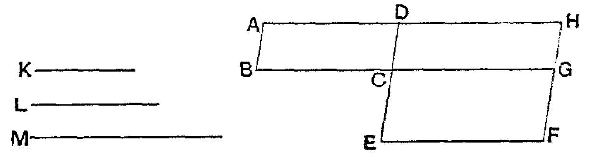
Figure 5: Figure for Euclid's Proposition 23 of Book VI, illustrating the application of compounded ratios.
The explicit handling of these algebraic devices marks a transition in mathematical practice, presaging later syntactic approaches to trigonometry.
Classification of Spherical Triangles and Theoretical Developments
al-Ṭūsī’s Book V and related sections provide a thorough classification of spherical triangles generated by the intersection of three great circles. He exhaustively enumerates cases by the magnitudes of their sides relative to a quadrant (quarter circle) and by their angle measures (acute, right, or obtuse). This complete taxonomy forms the basis for universal formula derivation, facilitating robust solution methodologies in astronomical and geometric applications.
The treatise asserts, and demonstrates via explicit constructive arguments, that knowledge of a single triangle determines all others in its intersection class, accounting for antipodal symmetry and supplementary relationships.
Book V presents a full system of spherical trigonometric formulae, including the Sine Rule, Cosine Rule, and tangent-based formulae, provided with multiple proofs by a range of mathematicians—Abu al-Rayḥān al-Bīrūnī, Abū Naṣr, Abū al-Wafā', al-Khujandī, and others. The treatise investigates the geometric consequences of these formulae and discusses their implications for practical computation and theoretical geometry.
Of particular note is the derivation and prioritization of the Spherical Sine Rule:
sinαsina=sinβsinb=sinγsinc
where a, b, c are side lengths and α, β, γ the respective opposite angles in a spherical triangle.
The treatise positions the Sine Rule not merely as a computational tool but as an advance obviating the convoluted sector figure computations. The commentary meticulously describes the mathematical and historical context surrounding the attribution and dissemination of these identities within the medieval Arabic mathematical corpus.
The treatise analyzes the “shadowed” figure, corresponding to tangent relations in spherical triangles, and credits Abū al-Wafā' al-Būzjānī for contributions in this direction. al-Ṭūsī provides explicit relations involving tangents, identifies numerical difficulties related to their unbounded growth as the angle approaches 90∘, and proposes computational stratagems for tabulation and practical calculation.
Implications and Future Directions
al-Ṭūsī’s treatise serves as both a mathematical and a historiographical milestone in trigonometry. The synthesis and abstraction of previously scattered formulae, together with their rigorous deduction and organization, proto-typifies the axiomatic method that would later be formalized in the West. The methods of classification, exhaustive case analysis, and emphasis on algebraic manipulation anticipate later advances in analytic and synthetic geometry.
On the practical side, the systematic trigonometric framework facilitated the solution of complex spherical astronomical problems, underpinning improvements in observational accuracy in the pre-modern era.
Theoretically, the treatise illustrates the organic acceleration of abstraction and algebraization in Islamic mathematics, setting the stage for subsequent analytic developments in both East and West.
Conclusion
The “Treatise of the Quadrilateral” by Naṣīr al-Dīn al-Ṭūsī, as explicated in this comprehensive overview, exemplifies an advanced pre-modern systematization of spherical geometry and trigonometry. The work is distinguished by its exhaustive formalism, systematic classification, detailed derivation of fundamental identities, and precise algebraic groundwork in compounded ratios. Its influence was substantial, both through its immediate practical impact on astronomy and later through its role in the cross-cultural transmission and abstraction of geometric thought. The treatise is indispensable for understanding the transition from geometric to algebraic trigonometry in the centuries preceding the European mathematical Renaissance.
(2605.03516)