- The paper introduces FINER-SQL, a reinforcement learning framework that leverages dense execution feedback, specifically memory and atomic rewards, to improve small language models in Text-to-SQL tasks.
- It employs a two-stage pipeline of supervised distillation followed by GRPO-based RL, refining policy optimization through interpretable reward signals from multiple reasoning traces.
- FINER-SQL achieves competitive SQL accuracy while reducing inference latency and resource requirements, outperforming larger models on complex, compositional SQL queries.
FINER-SQL: A Reinforcement Learning Framework for Small LLMs in Text-to-SQL
Introduction and Motivation
Recent works have demonstrated that LLMs achieve strong results in Text-to-SQL (NL2SQL) tasks, but their resource demands, privacy risks, and inference latency hinder many practical deployments. This has motivated increased attention toward small LLMs (SLMs, ≤3B parameters), which can be deployed efficiently and privately on commodity hardware. However, SLMs are fundamentally constrained by weaker reasoning and poor instruction following, resulting in diminished performance in complex generative tasks. Traditional RL techniques for Text-to-SQL utilize sparse, binary rewards that are not conducive to learning in the sparse-success regime typical for SLMs.
The FINER-SQL framework addresses these limitations by leveraging dense and interpretable execution feedback within a reinforcement learning (RL) paradigm tailored for SLMs. Two principal reward components—memory and atomic—enable continuous, fine-grained feedback to guide efficient and stable policy optimization. FINER-SQL closes the accuracy gap with much larger models while drastically reducing latency and resource requirements.
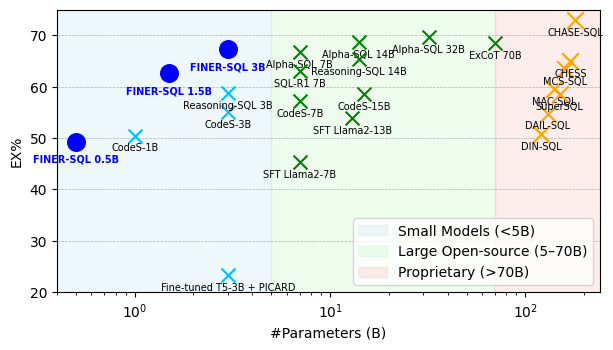
Figure 1: Execution accuracy (EX%) of FINER-SQL on BIRD dev. The FINER-SQL 3B model outperforms several >14B baselines and proprietary systems, highlighting the efficacy of SLMs with fine-grained feedback.
FINER-SQL Architecture
FINER-SQL consists of a two-stage pipeline: (i) supervised distillation to endow SLMs with explicit reasoning structures, and (ii) GRPO-based RL utilizing dense reward signals for iterative policy refinement. The training pipeline is as follows:
- Distillation: Multiple LLM teacher models (e.g., GPT-4o, DeepSeek-R1, Qwen-2.5-72B) are prompted with question-schema pairs, producing both reasoning traces and executable SQLs across diverse logical strategies. These outputs are compiled into a “Reasoning Bank.” SLMs undergo supervised fine-tuning exclusively on these completions, promoting robust reasoning and structured SQL generation from the outset.
- Reinforcement Learning: The distilled model is then trained with group relative policy optimization (GRPO), dispensing with separate critics in favor of efficient, candidate group-based advantage estimation. Dense reward design obviates the problem of reward sparsity, crucial for SLM convergence.
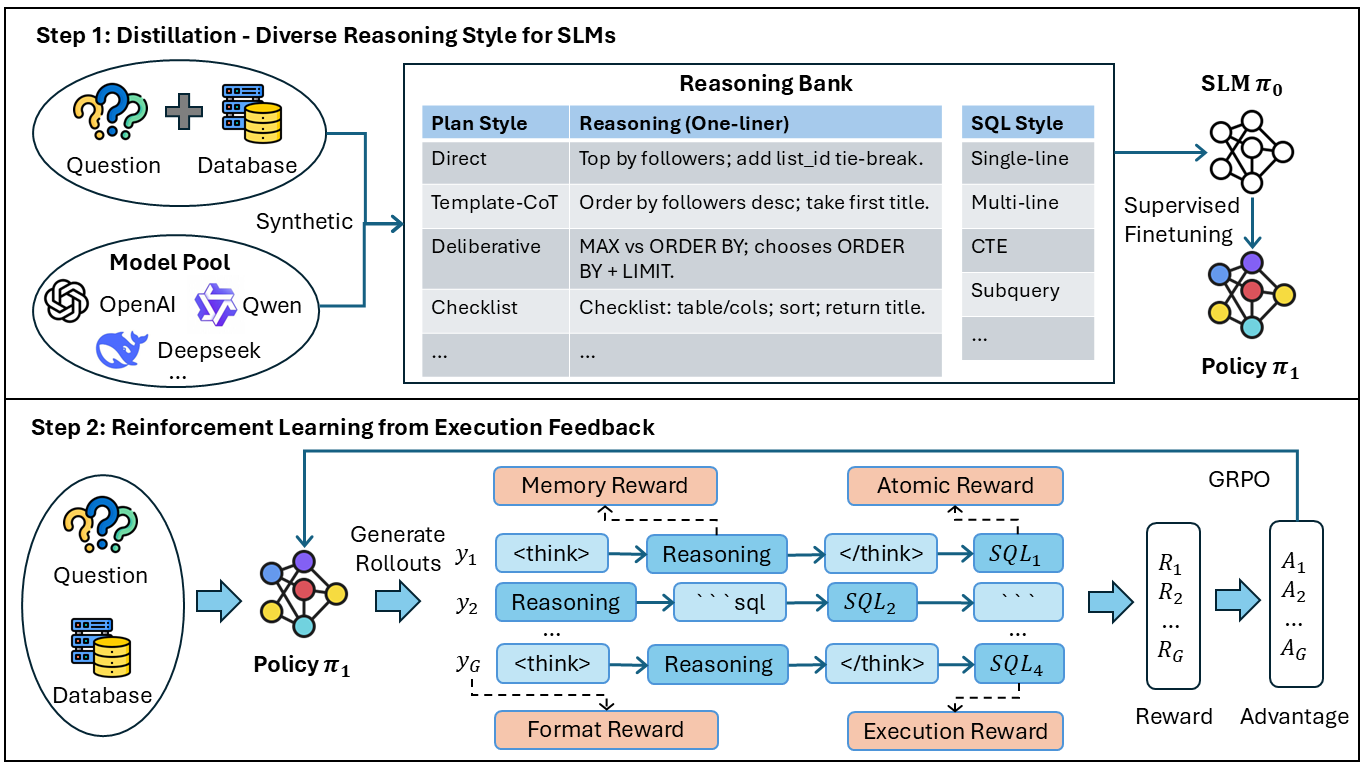
Figure 2: FINER-SQL’s end-to-end training pipeline—distillation from multiple reasoning teachers followed by RL with dense, fine-grained feedback signals, coordinated by the GRPO objective.
Reward Modeling: Dense and Interpretable Feedback
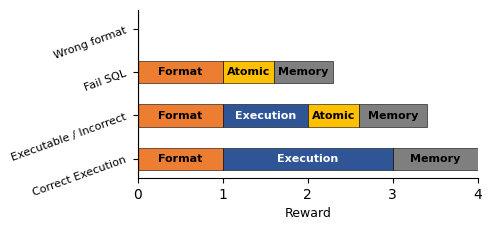
FINER-SQL overcomes the limitations of sparse binary signals by decomposing the reward into four parts: format, execution, atomic, and memory. The composition and scaling of these rewards are illustrated as predictions gain increasing SQL correctness.
The memory reward module maintains a vector database of expert-like reasoning traces, indexed by embeddings. For each candidate rollout, the system computes the cosine similarity between the candidate reasoning and the centroid of the top-k similar traces retrieved from other databases. This approach regularizes RL exploration, suppressing degenerate paths and preserving cross-database generalization.
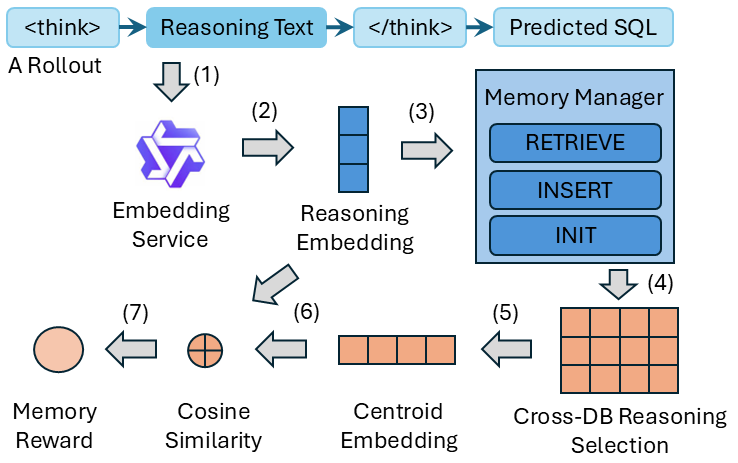
Figure 4: The memory reward flow, showing embedding-based retrieval, centroid calculation, and updates that maintain a diverse set of high-quality reasoning prototypes.
Atomic Reward: Structural Credit Assignment
Each predicted SQL is parsed into atomic operations (projections, joins, predicates, etc.). The reward is computed as the maximal Jaccard overlap between those operations and those from reference SQLs (including augmented, execution-verified variants). A shaped transformation is applied to avoid over-rewarding near-perfect but structurally incomplete solutions, concentrating the signal where the model requires additional refinement.
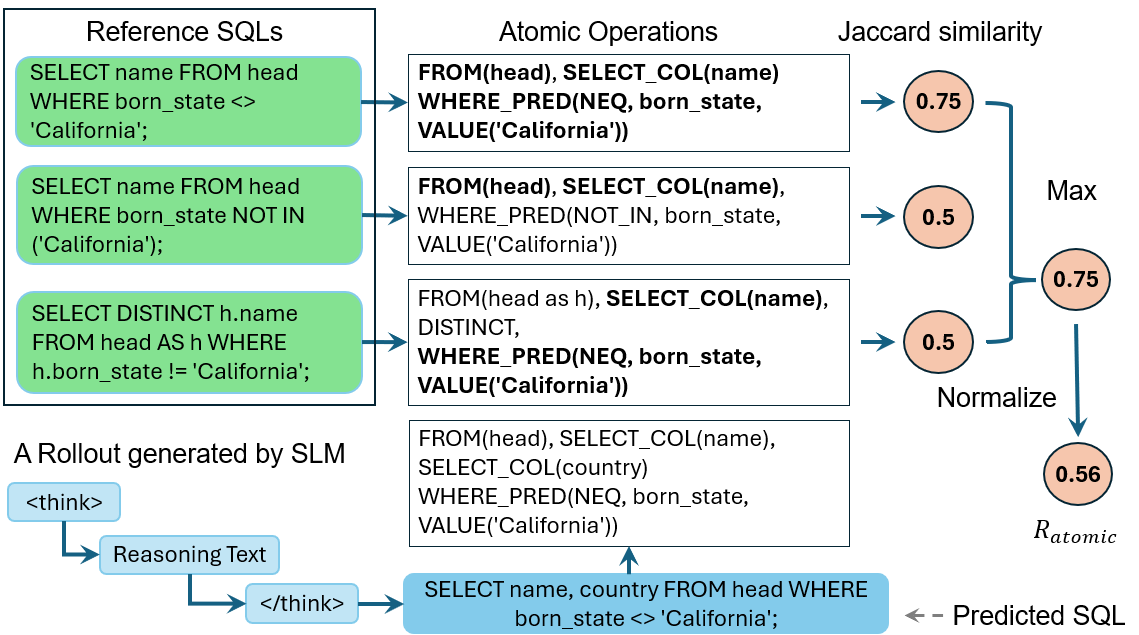
Figure 5: Atomic reward computation: prediction is aligned with reference SQL operation sets, and final reward is the maximal overlap across semantically equivalent ground-truths.
Empirical Analysis
FINER-SQL achieves strong execution accuracy (67.73% on BIRD Dev and 85% on Spider Dev with a 3B model), matching or outperforming models with ≥14B parameters and even proprietary GPT-4 pipelines. Notably, inference latency and VRAM usage are drastically reduced, with the 3B variant requiring ∼10GB, running on a single consumer-grade GPU, and incurring only 5.57s average latency per sample.
Hyperparameter Sensitivity and Ablation
Sampling diversity (number of candidates drawn with stochastic decoding) and temperature are both critical—accuracy saturates at ∼30 candidates and <0. Larger memory retrieval top-<1 and exclusive cross-database retrieval further stabilize RL and improve generalizability.
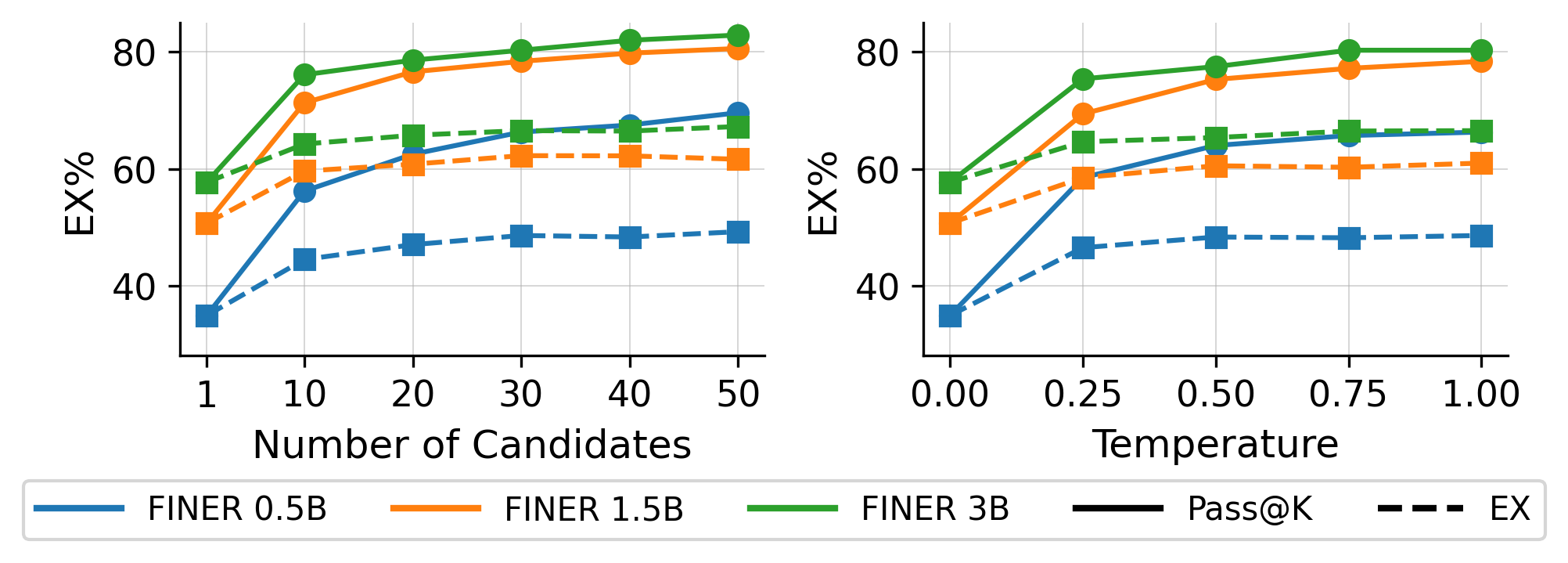
Figure 6: Pass@K and EX% as a function of candidate count and sampling temperature. Both show monotonic improvement, plateauing beyond moderate values.
Ablations clearly show that both memory and atomic rewards are necessary—for the 3B model, removing memory and atomic rewards drops EX by 2.22% and 3.26% respectively, and their absence notably increases syntax error rates. Memory reward sharply reduces reasoning variance and the number of distinct execution clusters per prompt, thus enhancing majority voting reliability.
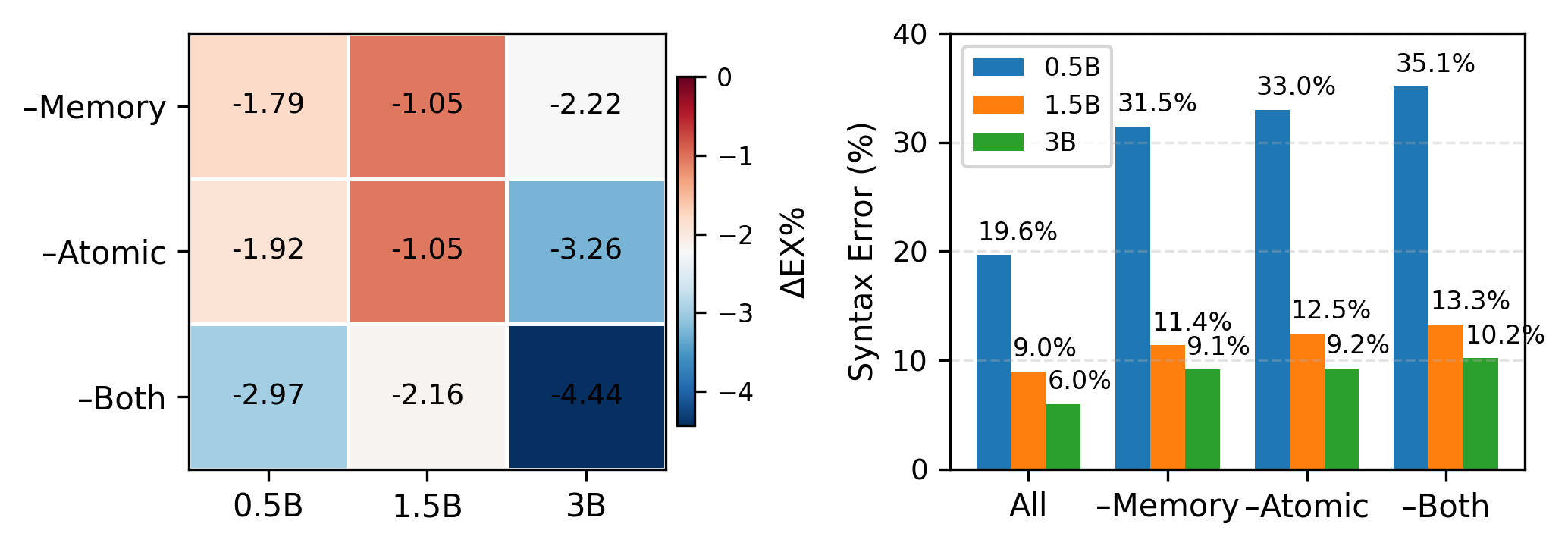
Figure 7: Impact of removing reward components on EX% and syntax errors. Both memory and atomic rewards are essential for optimal performance and stability.
Benefits to Complex, Compositional SQL Generation
FINER-SQL’s advantage is most pronounced as SQL complexity increases. The 1.5B and 3B variants consistently outperform both similar-sized and much larger (e.g., 14B, 32B) models on queries requiring deep compositional reasoning. RL with dense rewards robustly closes the complexity gap for challenging database schema scenarios.
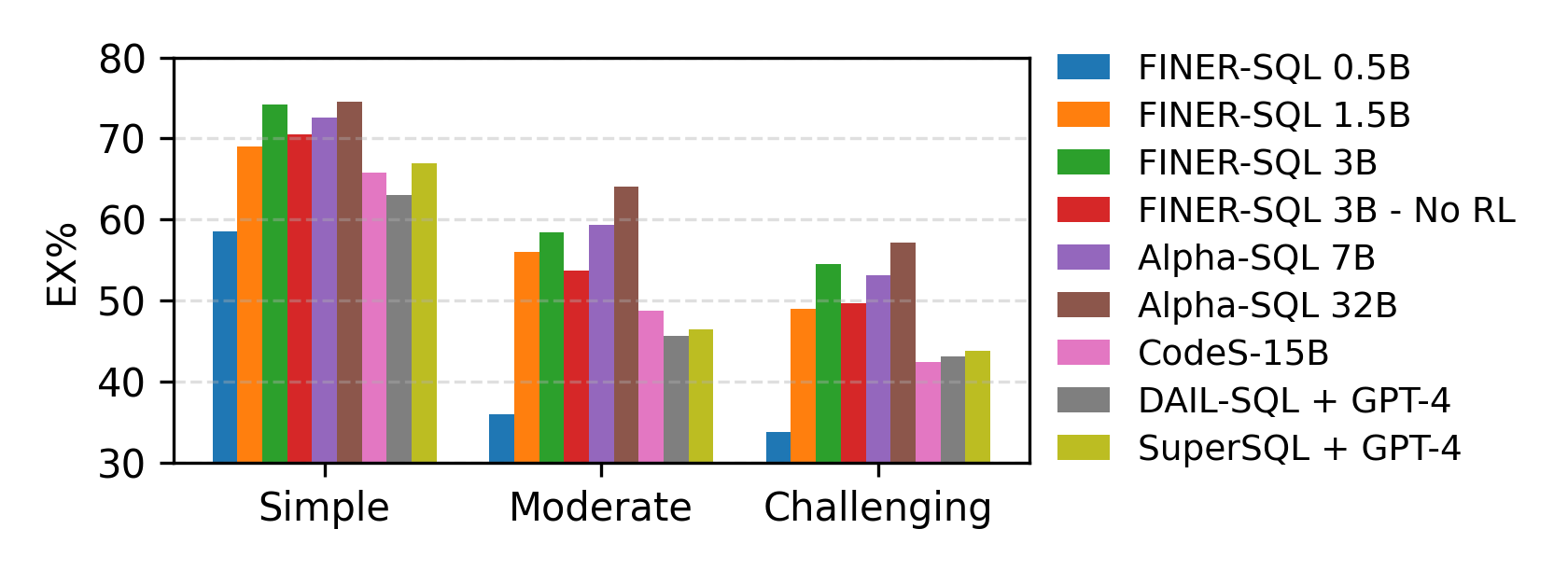
Figure 8: Execution accuracy by SQL complexity. FINER-SQL (1.5B, 3B) matches or surpasses much larger LLM-based competitors on the most difficult queries.
Evolution of Model Reasoning
The dense reward regime encourages the transition from verbose, aimless reasoning to concise, coherent, and targeted reasoning trajectories. Post-RL, reasoning traces are significantly shorter and more precise, directly yielding higher SQL correctness.
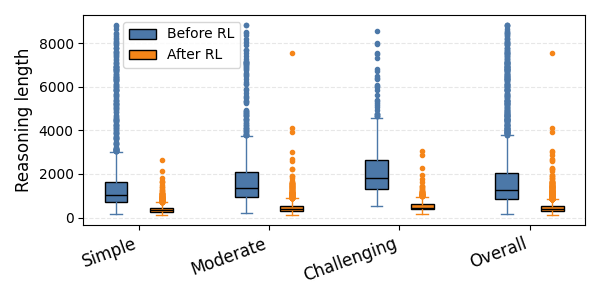
Figure 9: Reasoning trace length before and after RL. RL yields more compact and effective reasoning strategies, particularly in challenging queries.
Implications and Future Directions
FINER-SQL demonstrates that, when equipped with fine-grained, interpretable feedback, SLMs achieve competitive NL2SQL results compared to LLMs at orders-of-magnitude lower resource consumption. This finding challenges prevailing assumptions regarding parameter scaling in database NLP tasks and opens opportunities for private, low-latency, and sustainable deployment of NL2SQL systems in industry.
Theoretically, the dense memory and atomic rewards serve not only as a practical tool to stabilize RL for SLMs but also as an architectural blueprint for dense credit assignment in other structured reasoning tasks (e.g., program synthesis, step-by-step mathematical derivation). The cross-database memory retrieval could further be exploited for cross-domain generalization and transfer learning. Continued innovation around fine-grained reward design and efficient policy optimization stands to extend SLM applicability to a variety of high-stakes, resource-constrained NLU settings.
Conclusion
FINER-SQL establishes that SLMs, augmented with dense execution feedback and efficient RL training, can rival much larger models in the Text-to-SQL domain. This framework provides concrete advances in inference efficiency, privacy, and deployability, making high-accuracy NL2SQL tractable beyond restricted research infrastructure. The contributions in reward modeling present avenues for the broader adoption of SLMs in structured output tasks where rapid, robust generalization is paramount.
Reference:
"FINER-SQL: Boosting Small LLMs for Text-to-SQL" (2605.03465)