- The paper develops a multifractional framework with q-derivatives that reproduces the Schwarzschild solution in a geometric frame while highlighting profile-induced thermal modifications.
- It employs covariant phase-space methods to clearly distinguish between profile-insensitive canonical charges and profile-sensitive physical temperature.
- The study extends the first law by incorporating multifractional parameters as external couplings, leading to an integrable thermal entropy formulation.
Noether Charges and Thermodynamics of Multifractional Schwarzschild Black Holes in the q-Derivative Theory
Introduction and Context
This work critically advances the thermodynamic analysis of black holes in the multi-fractional spacetime framework with q-derivatives. In this approach, the structure of spacetime is encoded by nontrivial geometric coordinates qμ(xμ) designed to capture scale-dependent dimensional flow, a phenomenon present in diverse quantum gravity models. This "multi-scale" structure modifies gravitational dynamics via an anomalous integration measure and replacement of derivatives by q-derivatives.
Within the q-derivative theory (Tq), static, spherically symmetric vacuum solutions admit a geometric frame where the metric is exactly Schwarzschild in terms of the areal coordinate q. Canonical Noether charges are computable in this frame using standard covariant phase-space/Hamiltonian methods. However, physical observables such as the Hawking temperature, when defined in the fractional (physical) radial coordinate r, acquire explicit dependence on the multiscale profile parameters through the derivative q′(r) evaluated at the horizon. This distinct separation between profile-insensitive canonical charges and profile-sensitive thermal quantities underpins much of the paper’s technical development.
The Multifractional Schwarzschild Solution and Profile Parametrization
The multifractional Schwarzschild geometry is constructed by importing the Schwarzschild solution to the geometric coordinate q, with the relation q0 set by the chosen profile:
q1
for q2 and characteristic scale q3. With log-oscillating modifications,
q4
q5
where q6, q7, and q8 encode amplitude and frequency of discrete scale invariance, with q9 a further scale.
The metric in the physical frame is then
qμ(xμ)0
qμ(xμ)1
The horizon is located at qμ(xμ)2.
Physical Temperature and Integrability Obstruction
The physical Hawking temperature is given in terms of the fractional coordinate as
qμ(xμ)3
qμ(xμ)4
This temperature inherits explicit profile dependence via qμ(xμ)5. For binomial profiles, qμ(xμ)6, so qμ(xμ)7. For log-oscillating profiles, the temperature acquires a log-periodic modulation due to the oscillatory structure of qμ(xμ)8.
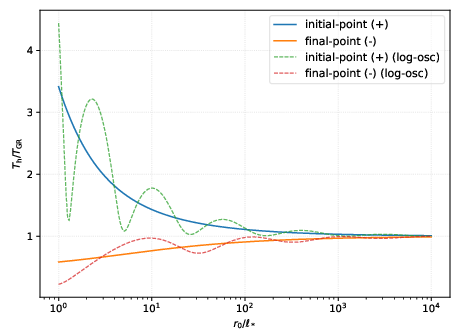
Figure 1: Temperature ratio qμ(xμ)9 as a function of the rescaled Schwarzschild parameter, illustrating the dependence on binomial and log-oscillating profiles and the distinct thermal behavior arising from multifractional corrections.
A critical observation is that, on an extended state space including the profile parameters q0 (e.g., q1, q2, q3, q4, q5), the differential form q6 fails to be integrable: q7, which is nonzero if q8 depends on q9. This obstructs the definition of a naive thermodynamic entropy.
Covariant Phase Space: Canonical Mass and Noether Charge Entropy
Using the covariant phase-space formalism (Lee–Wald/Iyer–Wald), the canonical mass is identified with the coefficient of the q0 term in q1 in the geometric frame, yielding
q2
This is independent of the profile parameters at fixed q3.
The Noether (Iyer–Wald) entropy is
q4
again depending solely on the geometric horizon radius q5, and similarly insensitive to the multifractional profile.
Extended First Law: Integrability Restoration and Thermal Entropy
To resolve the integrability problem, the thermodynamic state space is enlarged to include the profile parameters as external couplings. Along this extended space, the entropy compatible with the physical temperature is defined via
q6
leading to an integrable entropy
q7
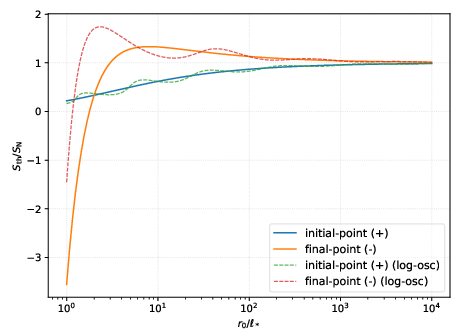
Figure 2: Ratio of the integrable thermal entropy q8 to the Noether entropy q9 as a function of Tq0, quantifying the departure from the geometric frame area law due to multifractional corrections for different profiles.
Allowing variations of Tq1, the full differential reads
Tq2
The extended first law becomes
Tq3
Tq4
For the binomial profile, explicit expressions for Tq5 and Tq6 are provided, with the dimensionless multifractional work potential Tq7 quantifying the work associated with varying Tq8.
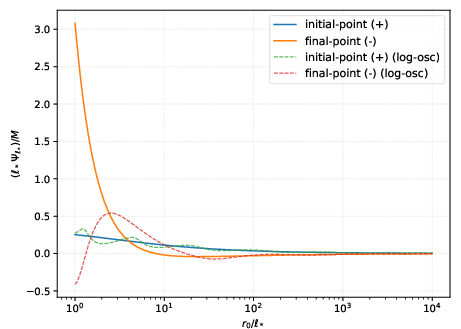
Figure 3: Dimensionless multifractional work potential Tq9 for binomial and oscillatory profiles, highlighting the impact of profile variation on the extended thermodynamic law.
Profile and Presentation Dependence
Thermal quantities such as q0, q1, and q2 are strongly profile-dependent, with both the binomial sign (presentation) and log-oscillations generating q3 fractional changes in q4 and q5 at small q6, though all such effects decay in the infrared (large black holes).
For oscillatory profiles, the entropy correction integrates to a closed analytic form exhibiting log-periodic modulations, with the overall amplitude suppressed for q7. The presence of additional structure in q8 can generate further horizon loci and complexify the exterior region, a fact carefully treated via branch and monotonicity restrictions.
The canonical charges q9, r0 remain unaffected by detailed profile or presentation choices, sharpening the distinction between the underlying geometric frame charges and the profile-sensitive thermal observables.
Implications and Prospects
The theoretical implications are significant. Adopting the physical frame for temperature definitions in multifractional gravity necessitates a redefinition of black-hole thermodynamics, yielding an integrable thermal entropy that is not simply the area in the geometric frame, and enforcing extra work terms in the first law conjugate to the multifractional couplings. This structure mirrors, at a technical level, extended black hole thermodynamics with variable couplings and enriches the thermodynamic landscape with new operational observables.
The explicit separation between profile-insensitive and profile-sensitive charges may have practical ramifications for phenomenological searches for quantum gravity signatures, especially in multimessenger astrophysics, where constraints on multifractional parameters continue to tighten.
The formalism established here provides a foundation for future analyses of rotating, charged, or otherwise structured black holes in multifractional frameworks. The phase-space methodology and the treatment of external parameter variations are extensible, and it is anticipated that the presentation-induced uncertainty bands and log-periodicity will persist as operational features in more general solutions.
Conclusion
This work delivers a comprehensive and technically rigorous analysis of static vacuum black hole thermodynamics in the multifractional r1-derivative gravity framework. The careful distinction between geometric-frame Noether charges and profile-dependent thermal observables leads to a generalization of the first law on an extended state space, with integrability enforced by inclusion of work terms conjugate to all multifractional parameters. The methodology and results lay a robust groundwork for further study of black hole mechanics in multi-scale gravitational models and their phenomenological implications.
References: See (2605.03311).