- The paper reveals that multi-particle radiation in high-energy shockwave scattering can be modeled as generalized squeezed coherent states with negative binomial statistics.
- It employs the Lipatov vertex and Wilson line resummation to connect coherent gluon emissions in QCD with graviton emissions in GR through the double-copy principle.
- The findings imply that enhanced quantum noise in gravitational wave detectors may be detectable, offering novel insights into nonperturbative QCD dynamics and quantum gravity.
Squeezed-State Radiation in Shockwave Scattering and the QCD-Gravity Double Copy
Introduction
This paper addresses the quantum statistical nature of radiation produced in high-energy shockwave collisions in quantum chromodynamics (QCD) and general relativity (GR), focusing on the double-copy structure relating gluon and graviton emissions. It demonstrates that the multi-particle spectra of both gluon and graviton radiation in such processes can be described as generalized Susskind-Glogower (gSG) squeezed coherent states, characterized by negative binomial multiplicity distributions, and analyzes the properties and implications of these states for both QCD phenomenology and gravitational wave detection.
Multiparticle Production in High-Energy QCD Shockwave Scattering
The study begins with an analysis of shockwave scattering in QCD within the dilute-dilute and dilute-dense regimes, employing the Color Glass Condensate (CGC) effective field theory framework. The central result is that the multi-gluon emission amplitude is governed by the Lipatov vertex — an effective operator encoding reggeized gluon emissions in the high-energy (multi-Regge) limit. In such kinematics, 2→n multi-gluon production is built by iteratively sewing together 2→3 elementary processes via t-channel reggeized gluon exchanges.
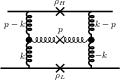
Figure 1: Dilute-dilute regime of shockwave scattering in QCD. Inclusive gluon radiation is produced from the interaction of reggeized gluons via the Lipatov vertex, illustrated by bold lines and a black dot, respectively.
In the dilute-dilute limit, coherent multiple scatterings are suppressed and the gluon emissions can be calculated using linearized Yang-Mills equations. Conversely, in the dilute-dense regime, the resummation of multiple scattering insertions on the emitted gluon leads to the appearance of Wilson lines in the analytic expressions.
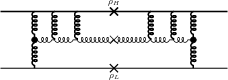
Figure 2: Dilute-dense scattering—Wilson line resummation encodes coherent multiple scatterings for ρH/∇⊥2∼1.
The inclusive n-gluon distribution obtained from the correlation structure of the fields leads directly to the negative binomial distribution (NBD) for multiplicity, where the NBD parameter r is calculable in terms of the number and size of coherent gluonic flux tubes (essentially R2QS2 for nuclear radius R and saturation scale QS).
Generalized Susskind-Glogower Squeezed States and the Glasma
The central technical advance of the paper is the mapping between the negative binomial statistics of the emitted gluons and a gSG (generalized phase) squeezed coherent state. This is constructed as a nonlinear coherent state with Fock basis expansion matched to the NBD, interpolating between Poissonian (coherent state, r→∞) and geometric/Bose-Einstein statistics (for 2→30).
The gSG state shares some, but not all, properties of standard single-mode squeezed states in quantum optics. One robust property is strong squeezing in the 2→31 quadrature for certain parameter regimes, with the product 2→32 approaching the minimum uncertainty bound for 2→33. The structure is such that large squeezing is achievable for large occupation numbers 2→34, with the degree of squeezing scaling logarithmically as 2→35 in the high-occupancy limit.
This quantum statistical property suggests that the far-from-equilibrium non-Abelian Glasma formed in heavy-ion collisions may behave analogously to a squeezed, possibly superfluid-like condensate, with rapid decoherence and thermalization — relevant for understanding QGP hydrodynamization.
Double Copy to Gravity: Graviton Radiation in Strong Shockwave Scattering
Leveraging the color-kinematics double copy principle, the analysis is extended to describe graviton radiation in shockwave collisions in GR. In this context, the gravitational Lipatov vertex is proportional to the bilinear of the QCD Lipatov vertex, inheriting the ladder structure and combinatorial properties of gluon emission but encoding multi-graviton amplitudes.
The paper conjectures, supported by the double-copy structure and matched analytic solutions for single inclusive graviton radiation, that the radiated graviton field in the strong field, near the Schwarzschild radius, can similarly be described as a gSG squeezed coherent state, with the multiplicity distribution encoded in a negative binomial.
Of particular interest is the regime where the mean occupancy 2→36 is extraordinarily large (e.g., for astrophysical gravitational wave sources, 2→37). In such cases, the squeezing parameter can reach 2→38, amplifying quantum noise in gravitational wave detectors well above the Planck scale, potentially to observable levels.
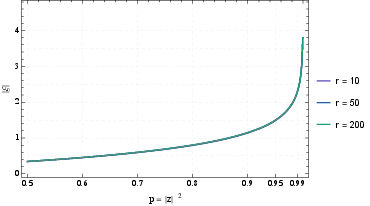
Figure 3: Squeezing parameter 2→39 as a function of t0 for various t1. t2 grows logarithmically as t3 (large occupancy).
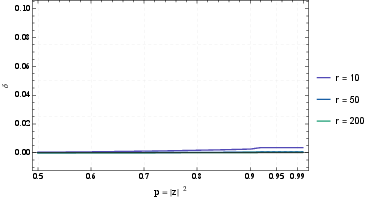
Figure 4: The minimal uncertainty violation parameter t4 as a function of t5 for various t6. For increasing t7, t8 as t9.
Physical Implications and Detection Signatures
The prediction that gravitational radiation in the strong field regime exists in a highly squeezed quantum state has direct implications for quantum-limited gravitational wave detection. The variance in quantum fluctuations of the strain could be enhanced to scales of ρH/∇⊥2∼10 m, several orders of magnitude above the Planck length and well within the reach of advanced detectors such as LIGO and successors.
However, the state realized in such processes is super-Poissonian, and distinguishing quantum noise associated with squeezed coherent graviton states from classical stochasticity remains a formidable experimental and theoretical challenge. The paper notes that only sub-Poisson statistics provide unambiguous quantum signatures, though the measurement of anticorrelations or Hanbury-Brown--Twiss-type effects may strengthen the case for genuine quantum gravity observations.
Analytical Framework and Future Directions
The methodology supplies precise formulas for the variances of the gSG states, their limiting behaviors with respect to ρH/∇⊥2∼11 and ρH/∇⊥2∼12, and the scaling of squeezing with increasing mean occupancy. The analytic analysis is supported by numerical evaluation of the nontrivial series for higher momenta and parameter scans.
The work opens several avenues for further research. These include: explicit calculation of multi-graviton (beyond one-graviton) emission in the Lipatov regime, determining the precise value of ρH/∇⊥2∼13 in gravity via RG analysis of the gravitational shockwave collision, understanding possible corrections due to deviations from the eikonal limit, and probing the degree to which quantum statistics persist or are decohered in cosmological and astrophysical contexts.
Conclusion
This paper establishes a robust link between quantum statistics in multi-particle radiation emitted during QCD and GR shockwave collisions, showing that both gluon and graviton spectra can be encoded as generalized Susskind-Glogower squeezed coherent states with negative binomial number statistics. The logarithmic scaling of squeezing with mean occupancy implies large quantum noise is, in principle, accessible in gravitational wave detectors, provided the radiation is indeed in a squeezed state. The results consolidate the double-copy paradigm in the context of strong-field, nonperturbative radiation, with compelling implications for quantum effects in both collider QCD and gravitational wave astrophysics (2605.03038).

