- The paper introduces optimal constructions for approximate unitary k-designs and strong PRUs on geometric grids using a novel gluing lemma.
- It details two methods—direct grid-based construction without auxiliary qubits and a routing-based approach with improved scaling using auxiliary qubits.
- Both constructions meet theoretical lower bounds, achieving depth-optimal designs and linking quantum pseudorandomness to cryptographic hardness via LWE.
Strong Random Unitaries and Geometric Locality: Constructing Optimal-Depth Strong Unitary Designs and PRUs on Grids
Introduction and Motivation
The paper "Arts & crafts: Strong random unitaries and geometric locality" (2605.03023) addresses the efficient construction of strong approximate unitary k-designs and strong pseudorandom unitaries (PRUs) in quantum systems subjected to geometric locality constraints, specifically on D-dimensional grids and Cartesian product graphs. Random quantum processes underpin applications in quantum information theory, benchmarking, tomography, cryptography, machine learning, many-body physics, and quantum gravity. However, Haar-random unitaries—idealized models for quantum randomness—are resource-intensive and physically infeasible for large systems. Thus, ensembles such as unitary k-designs and PRUs are preferred, enabling an efficient yet functionally random behavior.
Traditional constructions achieve optimal depth for strong designs in all-to-all connectivity but suffer exponential depth overheads in highly local architectures. Intermediate geometries, notably D-dimensional grids representative of practical quantum hardware like superconducting qubits and silicon quantum dots, remain theoretically underexplored, particularly for strong notions—where adversaries access both U and U†. This work resolves the optimal scaling of strong designs and PRUs in such architectures, proving both theoretical bounds and providing constructive methods.
Background: Strong Unitary Designs and PRUs
Unitary k-designs are ensembles that approximate the Haar measure such that any experiment involving up to k queries (including U, U†, D0, or D1) cannot distinguish them from truly random unitaries up to some D2 error in trace distance. The "strong" variant considers adversaries able to access both the forward and inverse operations, relevant for quantum algorithms and physical processes where reversibility matters.
Strong PRUs extend this notion to ensembles that are computationally indistinguishable from Haar random for any polynomial-time adversary, also requiring efficient constructibility. Importantly, strong PRUs are secure against any adversary capable of querying a unitary polynomially many times, but are strictly non-equivalent to strong D3-designs unless D4 grows faster than any polynomial.
In all-to-all connectivity, strong designs can be constructed in logarithmic depths [schuster2025strong], and the lower bound in 1D is linear in D5. The depth scaling for intermediate connectivities, such as D6-dimensional grids, had been open prior to this work.
Gluing Lemma: Compositional Construction of Strong Designs
A foundational technical result is the strong gluing lemma, which enables composing small strong unitary designs into larger ones contingent upon the presence of strong 2-designs acting as "gluing layers." Specifically, ensembles D7 (where D8 and D9 are strong 2-designs, k0 and k1 are strong k2-designs) can be glued into ensembles indistinguishable from Haar random up to a small error, provided sufficient overlap and sandwiching by strong 2-designs.
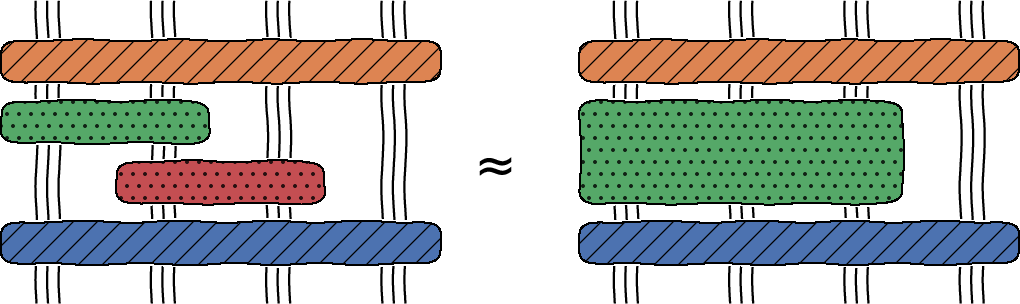
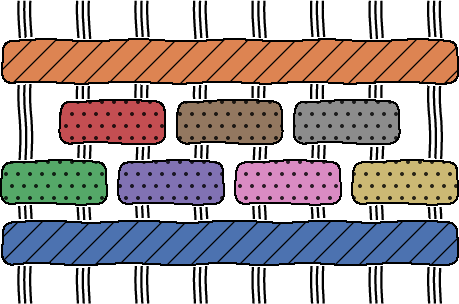
Figure 1: Illustration of the strong gluing lemma; two strong k3-designs are composited, sandwiched by strong 2-designs, to yield a larger strong design.
Iterative application of the gluing lemma allows construction of global strong designs from local building blocks, as shown in the procedural diagram below.
(Figure 2)
Figure 2: Iterative application of the gluing lemma—beginning and ending with strong 2-designs, with intermediate layers of strong k4-designs.
Main Results: Optimal-Depth Strong Designs and PRUs on Grids
Optimal-Depth Constructions
The paper provides two principal constructions:
- Direct Construction for Grids: By combining the gluing lemma with a new strong 2-design construction tailored for k5-dimensional grids, the authors realize strong k6-approximate unitary k7-designs in depth k8, with no auxiliary qubits. This matches the lightcone lower bound, confirming depth-optimality for constant k9.
- Routing-Based Construction: Leveraging classical results in qubit routing and circuit compilation for geometric graphs (grid architectures), the authors port known all-to-all strong designs—with near-optimal scaling in D0 and D1—to D2-dimensional grids at a depth overhead set by the routing number. This yields strong D3-designs with improved D4- and D5-scaling at the cost of added auxiliary qubits:
- Depth D6 with D7 auxiliary qubits.
- Depth D8 with D9 auxiliary qubits.
Both approaches achieve the optimal U0-dependence for constant U1 when auxiliary qubits are limited.
Strong PRUs Construction
Assuming the sub-exponential hardness of Learning With Errors (LWE), the authors construct strong PRUs with depth U2, again without auxiliary qubits. The construction relies on building strong PRUs on U3 qubits (for some constant U4), routing them efficiently in grid topology, and gluing to produce global strong PRUs.
Theoretical Bound
A matching lower bound is proved via lightcone arguments: any circuit ensemble forming a strong U5-approximate unitary 2-design for U6 on U7-dimensional grids requires circuit depth U8. Thus, all constructions in the paper saturate this bound.
Technical Framework: Pauli Mixing and Cartesian Product Graphs
A key technique is Pauli mixing under Cartesian product graphs: by composing ensembles acting on subgraphs (rows and columns), one achieves effective Pauli mixing over the grid, thereby facilitating the construction of strong 2-designs. Iterative application allows the construction on arbitrary U9-dimensional grids, with the TV distance to the ideal random ensemble decaying exponentially in U†0. This forms the backbone of the direct strong design construction.
Routing-based approaches exploit permutation routing algorithms, using swap networks and permutation theorems (e.g., Baumslag-Annexstein, Benes) to translate all-to-all operations onto geometric local grids with a depth overhead proportional to U†1.
Implications and Future Directions
The results confirm that strong quantum pseudorandomness—crucial for cryptographic, benchmarking, and complexity-theoretic applications—can be achieved in geometrically local architectures at optimal depth scaling. Practically, this enables efficient randomized protocols and cryptosystems (device-independent verification, secure delegation, etc.) in architectures aligned with scalable quantum hardware. The existence of strong PRUs under LWE further links cryptographic hardness to quantum hardware feasibility.
Theoretically, the gluing lemma and Cartesian product techniques offer a compositional framework for extending strong design constructions to other non-grid geometries, such as hexagonal lattices or biplanar graphs relevant to exotic error correction codes and platform-dependent quantum devices. Extending routing-and-gluing methods to irregular connectivities remains an open challenge.
The numerical bounds, especially the exponential decay of error in U†2 and the dependence on U†3 and U†4 in the constructions, establish strong quantitative guarantees.
Conclusion
This work resolves the depth-optimality of strong unitary designs and strong PRUs in geometrically local quantum architectures, specifically U†5-dimensional grids and Cartesian product graphs. Through the gluing lemma, Pauli mixing arguments, and circuit routing techniques, the authors provide explicit constructions that saturate theoretical lower bounds. The results have direct implications for the feasibility and efficiency of practical randomized and cryptographic protocols in next-generation quantum devices, and offer powerful compositional tools for further exploration of pseudorandomness in constrained quantum systems.