- The paper establishes near-optimal quantum circuits for ε-approximate unitary k-designs on n qubits with depth scaling as O(log k log log(nk/ε)).
- It employs a two-layer brickwork architecture combined with classical k-wise independent hash functions and local Clifford operations to efficiently mimic Haar randomness.
- These constructions nearly match lower bounds up to logarithmic factors, enhancing applications in quantum benchmarking, cryptography, and modeling quantum chaos.
Nearly Optimal-Depth Unitary Designs and Their Circuit Constructions
Introduction and Motivation
This paper establishes the existence of ε-approximate unitary k-designs on n qubits implementable in quantum circuit depth O(logkloglog(nk/ε)). This exponentially improves previously best-known depth constructions in all relevant parameters (n,k,ε) and matches derived lower bounds up to exponentially smaller factors. The construction leverages long-range two-qubit gates and ancilla to efficiently combine classical k-wise independent hash functions with quantum operations, introducing an explicit random unitary ensemble that saturates the aforementioned bounds.
Random unitary designs are central to modeling quantum chaos, benchmarking quantum computation hardware, realizing efficient tomography, and underpinning quantum cryptography. The crucial question addressed here is the minimal circuit depth at which one can certify the emergence of highly random (Haar-like) quantum unitaries—fundamental for both the scaling of near-term experiments and for the analysis and construction of quantum cryptographic primitives.
Low-Depth Design Constructions
The authors present a blocked, two-layer brickwork architecture for both state and unitary designs, structured as follows:
- State designs: The circuit prepares a product state, applies blocks of random phase (Z-type) gates instantiated via k-wise independent Boolean hash functions, and composes multiple such layers with overlapping connectivity of depth O(logkloglog(nk/ε)) or, trading ancilla for depth, O(kloglog(nk/ε)).
- Unitary designs: For the unitary ensemble, each random phase layer is sandwiched between local Clifford 2-designs and classically defined conditional-shuffle gates, which permute qubits within local blocks conditioned on the value of neighboring blocks. All circuit ingredients rely only on classical k-wise independent hash functions over 2ξ bits (with ξ=O(log(nk/ε))).
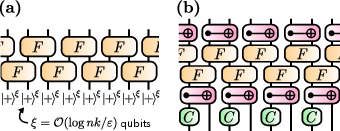
Figure 1: Schematic of low-depth constructions: (a) shows the two-layer random phase brickwork for state k-designs; (b) displays the architecture for unitary k-designs with interleaved shuffles and local Clifford unitaries, all defined on ξ=O(log(nk/ε)) qubit patches.
These constructions crucially achieve ancilla and randomness consumption close to proven lower bounds: O~(nk) ancilla and O(nk) random bits, optimal up to logarithmic factors.
Design Proof Techniques and Analytical Innovations
The design proofs rely on a formally precise notion of local distinctness: projectors enforce that, within each patch, none of the k simultaneously queried bitstrings coincide. By employing these projectors, the authors reduce both state and unitary moment analyses to tractable computations on highly symmetric subspaces. For the unitary design case, they develop a general analytical framework applicable to any random unitary ensemble, bounding the so-called measurable error—the maximum statistical distinguishability achievable by any experiment with k queries to the unknown unitary, incorporating arbitrary adaptive ancilla and measurements.
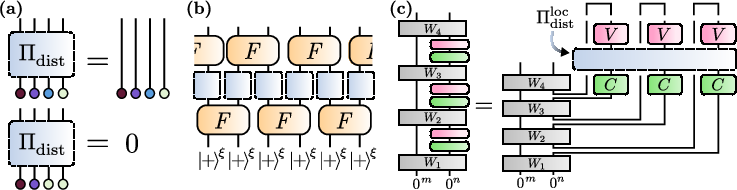
Figure 2: (a) The local distinct subspace and the corresponding projector eliminates coinciding bitstrings across k copies. (b) The design proof inserts these projectors between circuit layers, ensuring equivalence to Haar twirls on the relevant subspace. (c) For random unitary ensembles with measurable error, sequential quantum experiments can always be written as parallel experiments with EPR ancilla and intermediate projections.
This approach generalizes and streamlines prior technical frameworks, making explicit use of postselection over locally distinct subspaces and analyzing the action of classical random functions and Clifford unitaries. The selection of k-wise independence ensures the k-th moment matches that of a truly random function, crucial for the design property, allowing efficient circuit realization.
Lower Bounds
The authors introduce an efficient statistical test to distinguish any n-qubit quantum state prepared in circuit depth less than loglog(n/ε) from Haar-random. This test, based on repeated random basis measurements and collision counting in local patches (parameterized by the circuit light-cone size), establishes that any design construction (state or unitary) must have circuit depth at least Ω(logk+loglog(n/ε)) for any meaningful notion of error.
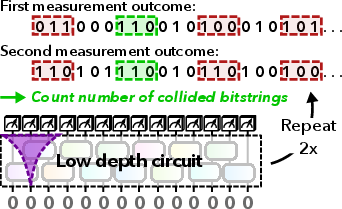
Figure 3: Any state prepared in low depth can be distinguished from Haar randomness using random product basis measurements and analysis of local collisions. Haar randomness leads to exponentially rarer collisions than structured circuits.
Notably, this lower bound applies to essentially any error metric meaningful for physical experiments, including both additive and measurable error for designs. Thus, the constructions presented are optimal up to logarithmic corrections in all key parameters.
Ancilla, Randomness, and Circuit Depth Tradeoffs
The constructions explicitly address the tradeoff between ancilla and depth, with alternative instantiations achieving reduced ancilla count (O~(n)) at a logarithmically increased circuit depth (O(kloglog(nk/ε))). Implementation of k-wise independent hash functions via polynomial evaluation over finite fields is analyzed in detail; e.g., evaluation in reversible circuits scales as depth O(logkloglogn), using sub-quadratic ancillary memory. The Clifford 2-design layers can also be implemented in near-logarithmic depth with nearly-optimal ancilla resources.
Applications to Pseudorandom Unitaries and Adaptive Security
The framework supports straightforward alternate proofs for the existence of pseudorandom unitary (PRU) ensembles with adaptive security—i.e., indistinguishability from Haar measure by any efficient k-query quantum experiment (potentially making adaptive queries and using arbitrary ancilla). This recasts and complements the path-recording approach to quantum pseudorandomness, elucidating the minimal requirements for physical (measurable) indistinguishability. The notion of measurable error is advocated as the most operationally meaningful definition for quantum pseudorandomness and design in practical settings.
Theoretical and Practical Implications
The results clarify that, provided non-local (long-range) connectivity is available, and using k-wise independent random hash functions, one can realize extremely efficient circuits for all practical applications of k-designs—including device benchmarking, cryptographic protocols, and modeling of quantum chaos or thermalization—where measurable or additive error suffices. The theory also exposes the exponential gap between optimal scaling in 1D architectures and those with more general connectivity.
However, while the theoretical scaling is nearly optimal, the practical realizability of these designs on existing quantum hardware remains contingent on the ability to effect rapid nonlocal gates and to efficiently implement reversible Boolean circuits for high-k-wise independence. Near-term architectures with primarily local connectivity or severely restricted ancilla will be limited to higher-depth realizations.
Open Questions and Future Directions
Primary theoretical open directions include the decoupling of logk and loglog(n/ε) in circuit depth, i.e., reaching pure O(logk+loglog(n/ε)) scaling. Furthermore, practical constructions for higher-order unitary designs (k>3) with minimal resources remain largely unexplored in experimental contexts, despite their importance for quantum complexity growth and fine-grained randomization tasks. Extending these techniques to fully hardware-efficient (e.g., nearest-neighbor only) settings is an important challenge for quantum information and quantum simulation.
Conclusion
This work closes key complexity-theoretic gaps regarding the circuit depth and resources required to instantiate physical ensembles that accurately simulate k-designs. The construction is explicit, resource-optimal up to logarithmic corrections, and rigorously justified for the strongest meaningful distinguishability metrics. The analytic techniques and design architectures inaugurated here provide a foundation for future theoretical and practical progress in pseudorandom quantum dynamics.
References
- [Unitary designs in nearly optimal depth, (2507.06216)]
- See citations within the paper for relevant technical and implementation details.