- The paper demonstrates that synchronized scalar hair induces non-monotonic EVPA dephasing in polarization images of accretion disks around Kerr black holes.
- It employs a ray-tracing algorithm of photon geodesics with varied observer inclinations to quantify polarimetric deviations in both vertical and equatorial magnetic fields.
- Results suggest that enhanced EHT polarimetric imaging can effectively test deviations from Kerr geometry, particularly in mildly scalarized models with unexpectedly strong dephasing.
Polarized Emission Signatures around Kerr Black Holes with Synchronized Scalar Hair
Introduction
This paper presents a comprehensive investigation of the polarization properties of direct images from geometrically and optically thin accretion disks surrounding Kerr black holes endowed with synchronized scalar hair (2605.03006). Unlike standard Kerr black holes in General Relativity, these scalarized solutions admit non-trivial massive scalar fields modifying the spacetime exterior to the event horizon. The analysis is motivated by the increased observational capabilities of the EHT and next-generation instruments, which now enable polarimetric imaging of SMBH accretion flows with horizon-scale resolution. The aim of the study is to quantify the imprint of synchronized scalar hair on the observed polarization structure, and to assess the prospects for using polarimetric measurements as discrimination tools for beyond-Kerr black hole metrics.
Synchronized Scalar Hair and Spacetime Configuration
The theoretical foundation consists of Einstein gravity minimally coupled to a set of massive real scalar fields subject to a synchronization condition, ωs=mΩH, where ωs is the scalar field frequency, ΩH is the horizon angular velocity, and m is the field's azimuthal quantum number. Stationary solutions are possible only under this condition, ensuring no scalar flux through the horizon and enabling globally stationary metrics with a non-trivial toroidal scalar field distribution exterior to the black hole.
The main parameters controlling the solutions are the ADM mass M, total angular momentum J, and the normalized Noether charge q=mQ/J, where Q encodes the scalar field's contribution. For q→0, the solution is close to pure Kerr (the "scalar cloud" limit), while q→1 yields the boson-star limit. These configurations interpolate between standard Kerr black holes and horizonless, solitonic objects.
The regions of existence for these solutions, their proximity to extremality, and the locations of their ISCO orbits are mapped and classified.
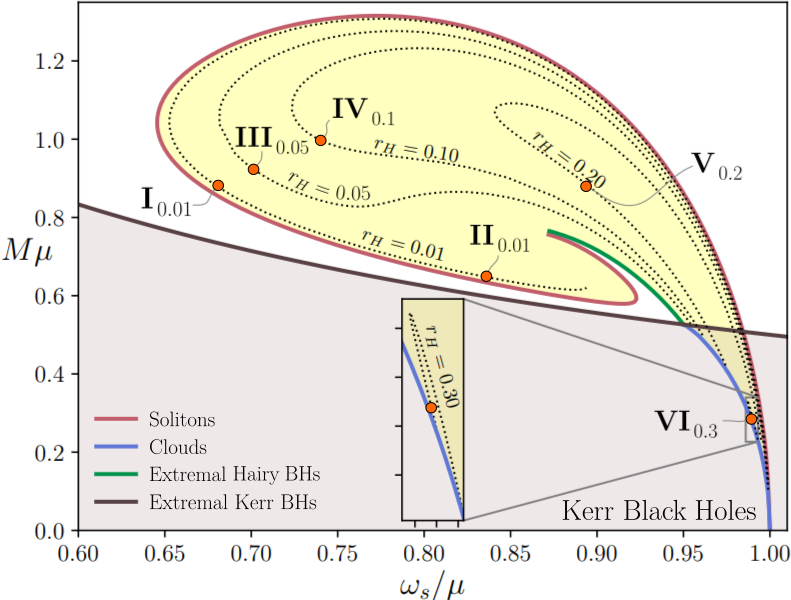
Figure 1: Solution curves in the mass–frequency plane for fixed horizon radii, indicating the domain of existence of Kerr black holes and hairy black holes with synchronized scalar hair.
Emission and Polarization Modeling
The accretion disk is modeled as a geometrically and optically thin Keplerian ring, emitting synchrotron radiation with a field geometry parameterized independently of the spacetime. The emission is simulated at EHT observational frequencies (ωs0230 GHz), dominated by optically thin synchrotron processes. Both vertical and equatorial ordered magnetic field configurations are considered, motivated by analytic and GRMHD models [Narayan et al, ApJ 2021].
The polarization vectors are initialized to be orthogonal to both the photon wavevector and the local magnetic field, in the fluid comoving frame, and are parallel transported numerically along the geodesic connecting the emission region to a distant observer. This formalism enables extraction of the specific intensity and the observed EVPA for arbitrary spacetimes admitting analytic or numerical metrics.
Ray-Tracing Algorithm and Data Generation
The photon geodesic and associated polarization transport equations are integrated numerically via a first-order Hamiltonian formalism, utilizing the fact that these spacetimes are stationary and axisymmetric with two Killing vectors. Observer inclinations of ωs1, ωs2, and ωs3 are probed—where the lowest angle is relevant for M87*, for which EHT polarization data exist [EHT-Collaboration, ApJL 910:L12 (2021)].
For benchmarking, each scalarized black hole model is paired with a "Kerr analog"—a Kerr spacetime with the same ADM mass and horizon radius. This allows comparative identification of genuine scalar-hair-induced signatures.
Results: Polarization Patterns and Deviations
Low-Inclination, Vertical Magnetic Field
The global polarization pattern across the disk for vertical magnetic fields at low inclination is qualitatively similar between scalarized solutions and Kerr analogs. However, the EVPA twist exhibits a measurable systematic dephasing in scalarized models, which is most pronounced for models with lower ωs4 (less scalarized, closer to Kerr limit).
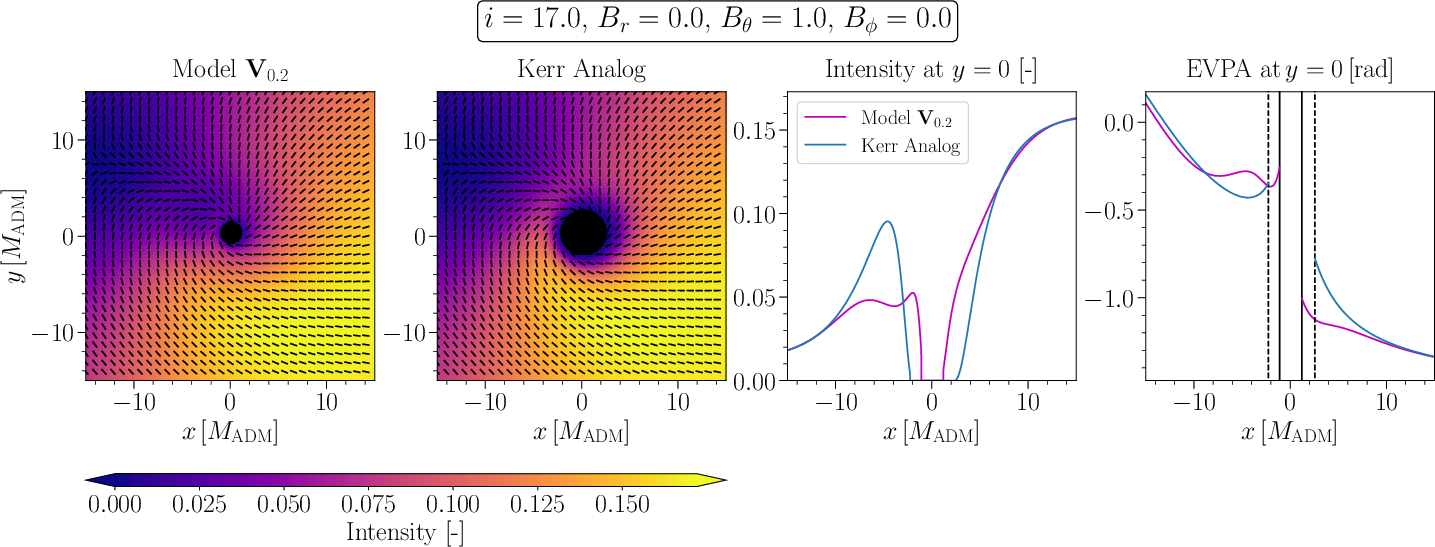
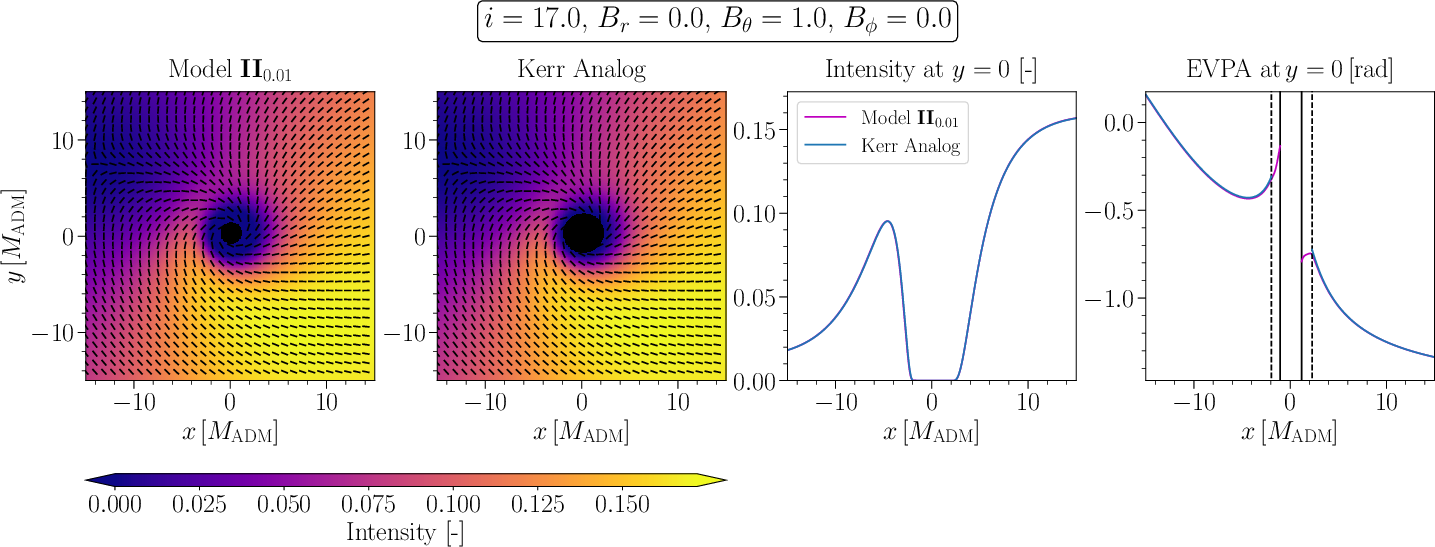
Figure 2: Polarized direct image and EVPA structure of a thin disk around a highly scalarized model and its Kerr analog under vertical field, ωs5.
A counterintuitive result is observed: the dephasing in the polarization twist is larger for the least scalarized (small ωs6) solutions, in contrast to black hole shadow distortions, which typically increase with ωs7.
Zooming into the inner disk (near the ISCO), the specific intensity and EVPA as functions of azimuthal angle reveal that the receding and approaching sides of the disk exhibit expected Doppler-boosted asymmetries, but with surprising dependence on ωs8.
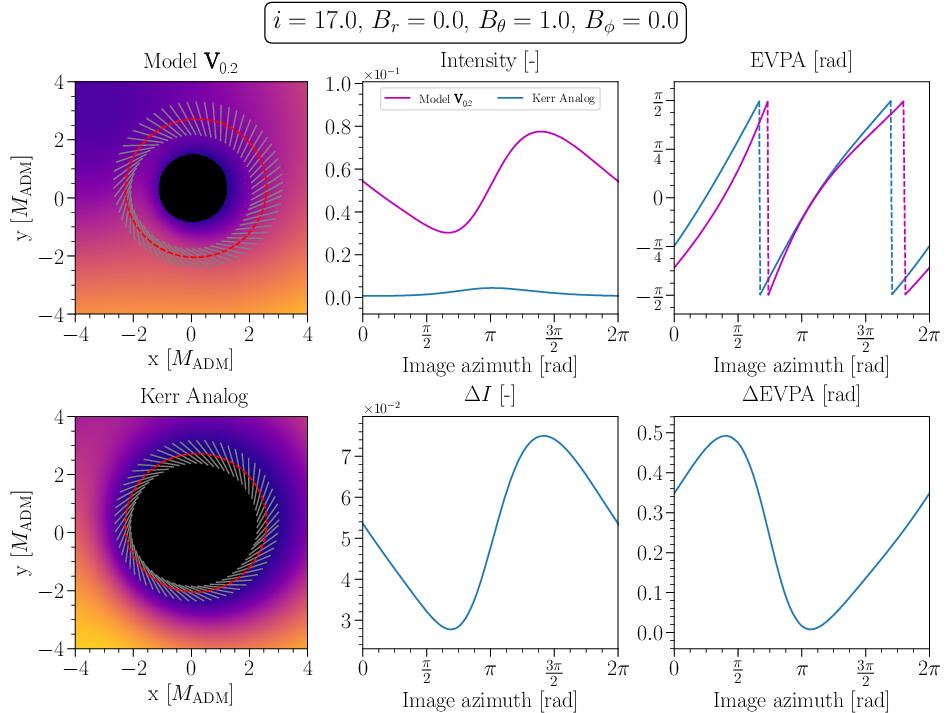
Figure 3: Detail of polarization and intensity in the near-ISCO region for a low–ωs9 (mildly scalarized) model and its Kerr analog.
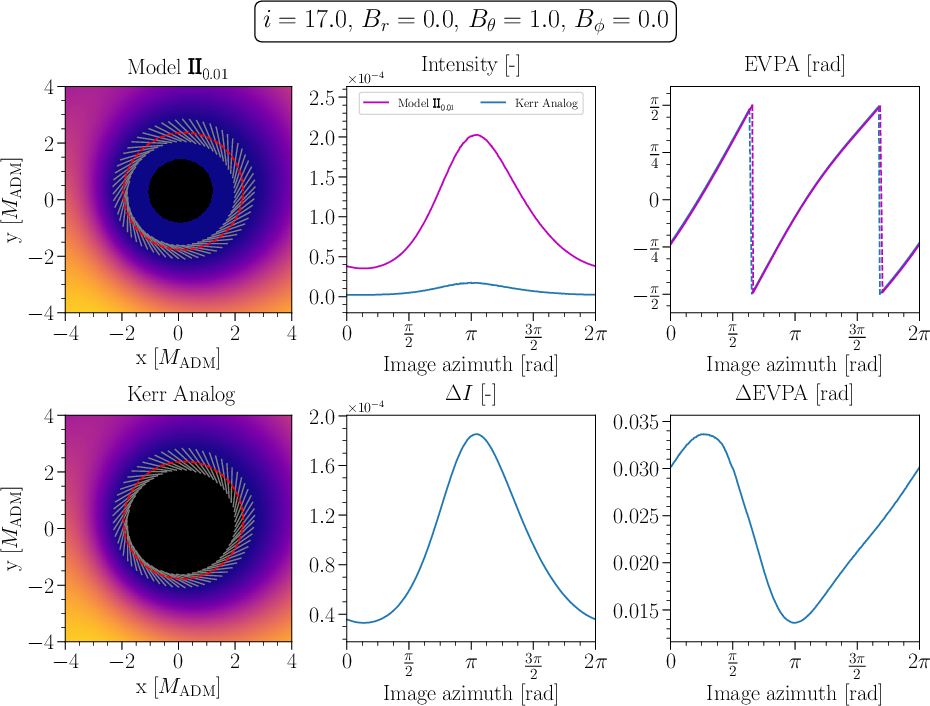
Figure 4: Analogous zoom for the highly scalarized case, showing a reduced intensity and EVPA deviation compared to its Kerr analog.
High-Inclination, Vertical Magnetic Field
At high inclination (ΩH0), the polarization pattern's deviations become more dramatic. In particular, a reversal of the EVPA twist direction emerges in the inner disk for vertical magnetic fields—an effect present both in Kerr and scalarized solutions but affecting the apparent ISCO position due to modifications of geodesic structure.
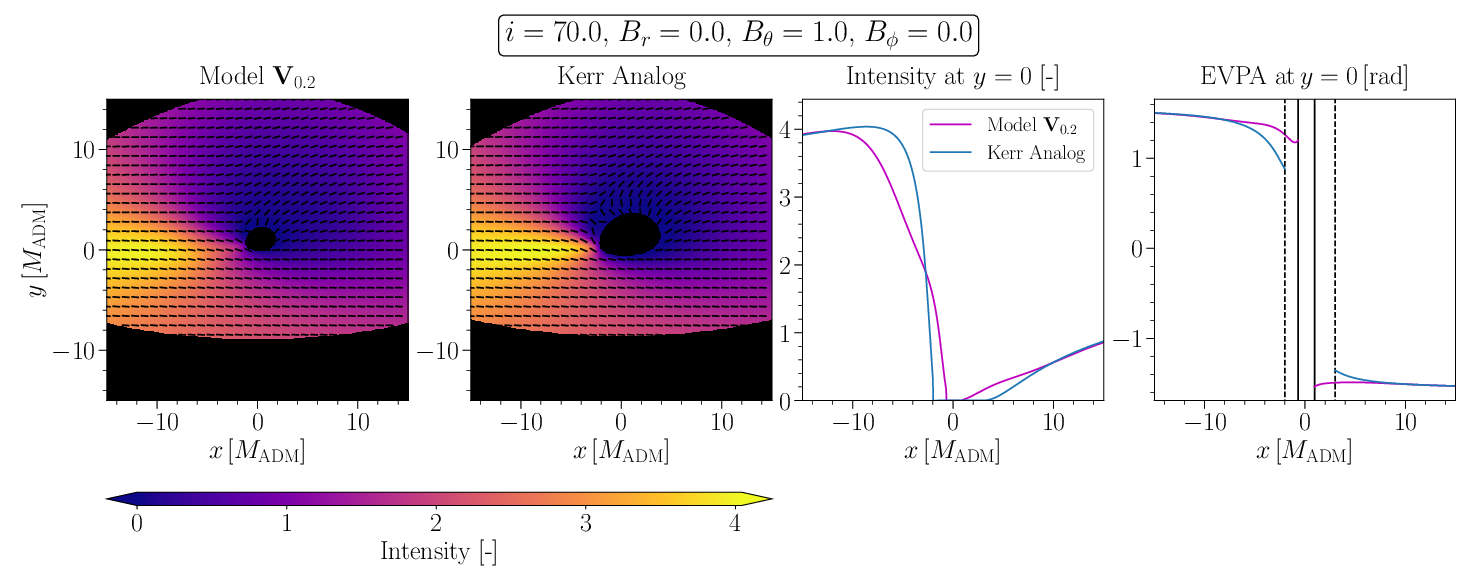
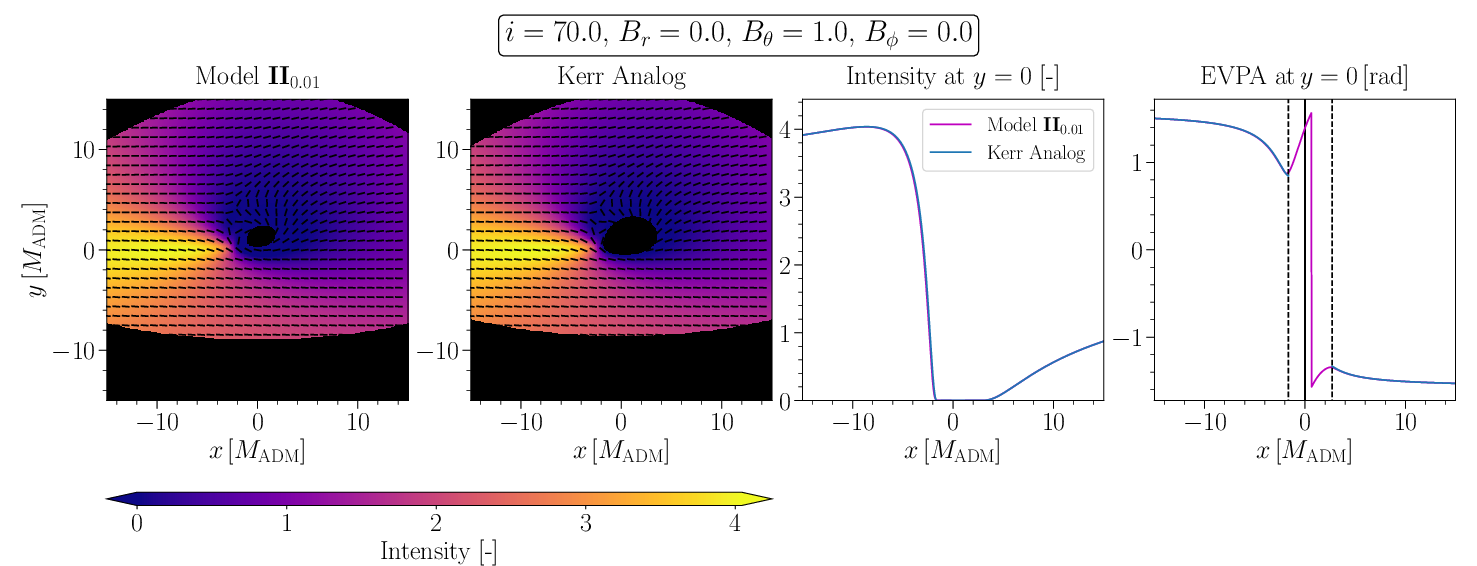
Figure 5: Polarized direct image of the thin disk at ΩH1 inclination for a vertical field—showing strong azimuthal localization and Doppler dominance.
Detailed analysis shows this EVPA twist reversal primarily depends on both the emission radius and the magnetic field's orientation: it appears at inner radii for less scalarized models and at larger radii for high-ΩH2 solutions.
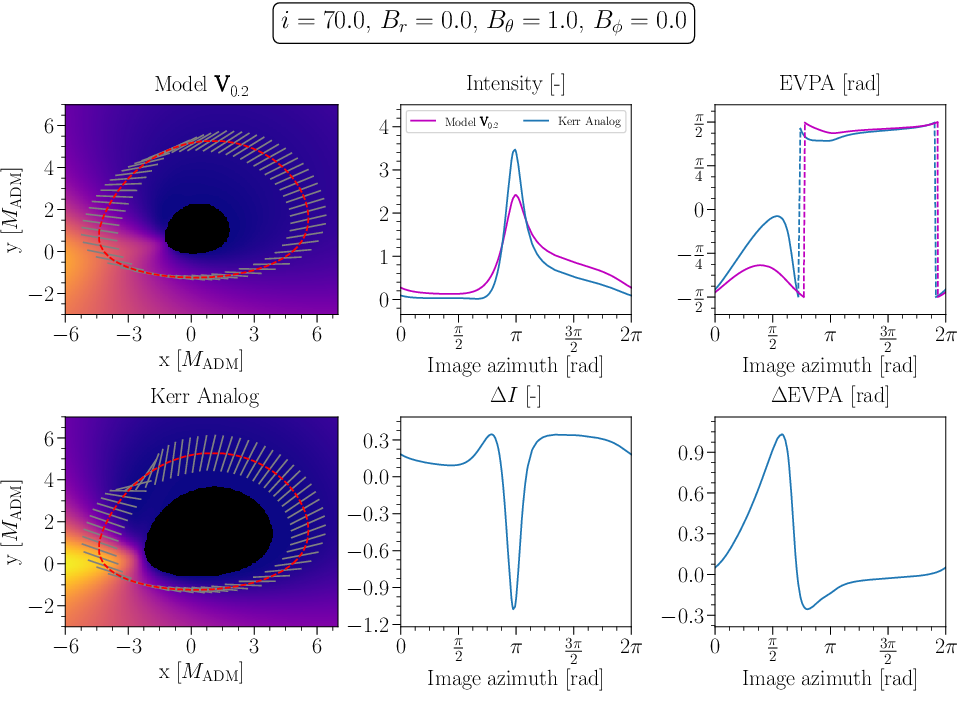
Figure 6: Close-up of the EVPA structure showing reversal of twist direction for a mildly scalarized solution.
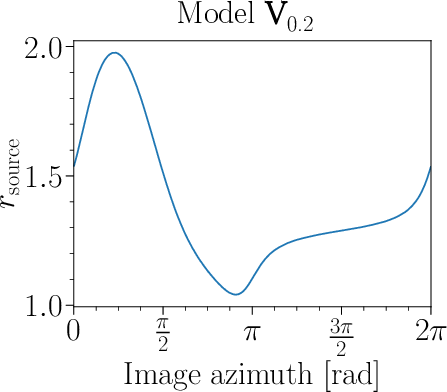
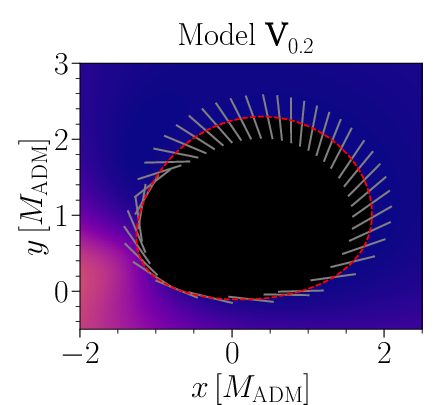
Figure 7: Variation of radial emission coordinate around the image for a fixed ISCO, demonstrating the impact of spacetime on lensing and polarization.
Equatorial Magnetic Field Cases
For equatorial magnetic fields, regardless of inclination, the overall polarization pattern remains more similar to the Kerr baseline, and the EVPA twist reversal is absent—even at high inclination. The dominant effect is a systematic EVPA dephasing, stronger for mildly scalarized models, as with the vertical field at low inclination. The intensity patterns are also systematically higher, reflecting the angular dependence of synchrotron emissivity.
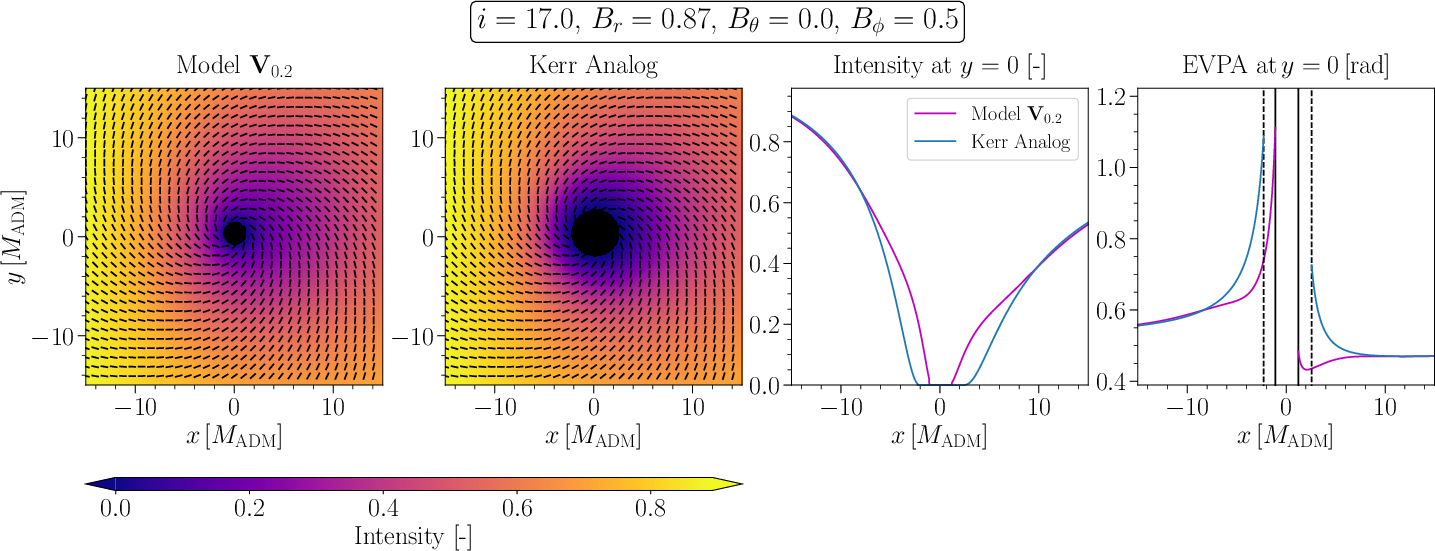
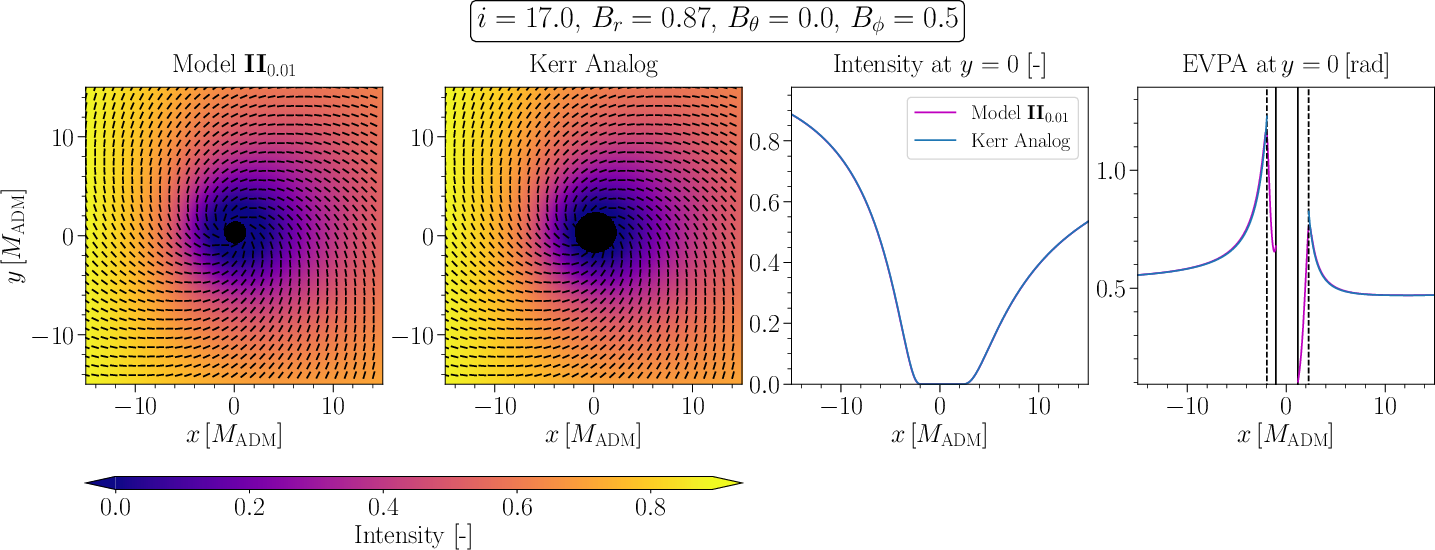
Figure 8: Polarized direct image for an equatorial field, ΩH3: higher intensity and regular polarization structure compared to the vertical field.
Quantitative Trends
Tabulated analysis (in the paper) demonstrates that the maximum intensity and EVPA deviations relative to Kerr are largest for low-ΩH4 scalarized models, and decrease for highly scalarized cases, especially at larger emission radii and higher inclination. The EVPA deviation (dephasing) can reach values close to orthogonality (ΩH5) in specific configurations, notably for low-ΩH6 models at high inclination in vertical fields.
Origin of Polarization Dephasing
The study follows photon geodesics that contribute to maximal EVPA deviation, revealing that for low-ΩH7 models, the ISCO typically resides between the central black hole and the peak of the scalar torus, forcing geodesics to experience strong lensing as they pass between these regions. In high-ΩH8 models, the ISCO is within the scalar torus and so the geodesics and polarization vectors are less affected, resulting in smaller deviations from Kerr.
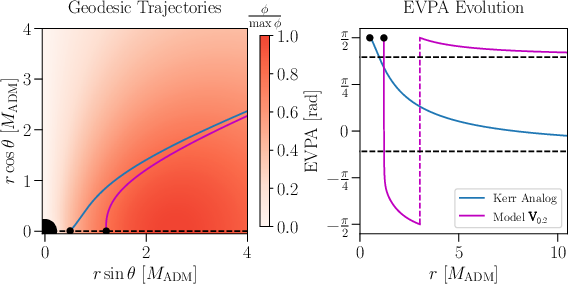
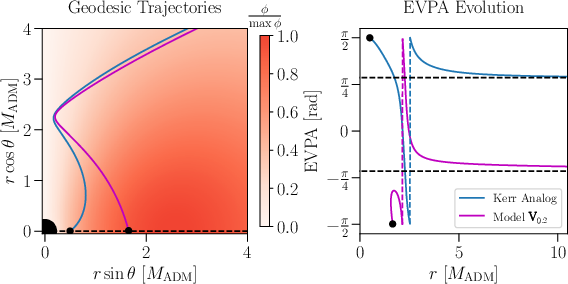
Figure 9: Trajectories of photons in the high-inclination, vertical field case, overlaid on the scalar field distribution. Large deviations from Kerr analogs occur as geodesics traverse regions between the horizon and scalar torus.
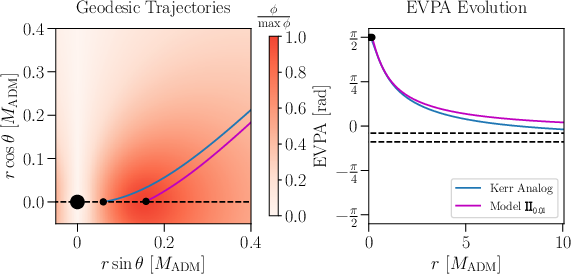
Figure 10: EVPA accumulated phase evolution along chosen geodesic paths, showing the accrual of dephasing relative to Kerr as a function of location.
Theoretical and Observational Implications
The results underline that polarization observables, particularly spatially resolved EVPA maps, probe local geometric and transport effects along photon trajectories with high sensitivity to even moderate deviations from Kerr geometry. This is in contrast to other observables such as the black hole shadow's overall diameter, which are more sensitive to global properties and are less affected by weak scalarization.
This has two immediate theoretical implications:
- The diagnostic potential of polarimetric imaging is heightened for weak and intermediate-coupling black hole solutions that appear shadow-wise similar to Kerr.
- The surprising non-monotonicity in polarization deviations with respect to the scalar hair parameter ΩH9 suggests that observational constraints derived solely from shadow geometry likely underestimate the viability of certain beyond-Kerr black hole solutions.
On the observational side, as the EHT and future ngEHT polarimetric capabilities improve, the sensitivity to such subtle EVPA pattern dephasing will become a powerful test of no-hair conjecture violations and alternative gravity models.
Conclusion
By providing the first polarized synchrotron images for fully nonlinear, self-consistent numerical models of Kerr black holes with synchronized scalar hair, this study demonstrates that the presence and distribution of scalar hair can affect the twist and dephasing of polarization vectors in direct accretion disk images in distinctive, counterintuitive ways. EVPA dephasing is maximized for solutions that are only weakly scalarized (m0), contradicting naive expectations based on shadow morphology. This points to the necessity of full polarimetric modeling in interpreting horizon-scale imaging results and places polarimetric observables at the forefront for constraining exotic extensions to the Kerr paradigm.
Future theoretical work should address the effects of more complex disk and magnetic field geometries, plasma microphysics, and Faraday rotation, as well as extend the analysis to alternative scalar-tensor gravity frameworks. On the observational side, multi-frequency, time-resolved polarimetric imaging will be critical for distinguishing Kerr from non-Kerr (scalarized) spacetimes in the strong gravity regime.

