- The paper introduces a dual-expert architecture that decouples molecular reasoning via LLMs from geometric generation, enhancing interpretability.
- It demonstrates improved antibody redesign metrics with lower RMSD, superior lDDT, and enhanced interface and thermodynamic properties.
- The methodology supports modular, interpretable protein design and generalizes to various generative backbones for scalable applications.
Proteo-R1: Deliberative Foundation Modeling for De Novo Protein Design
Motivation and Paradigm Shift
Current deep learning-based approaches in de novo protein design, especially geometric diffusion and flow-based generative models, have achieved atomic-level structural fidelity and facilitated rapid binder, antibody, and peptide creation. Despite these advances, conventional models entangle molecular reasoning with generative sampling, treating all residues uniformly, thus limiting interpretability and controllability. This approach sharply contrasts with expert-driven molecular engineering, where designers first identify key functional residues before optimizing the geometry under explicit constraints.
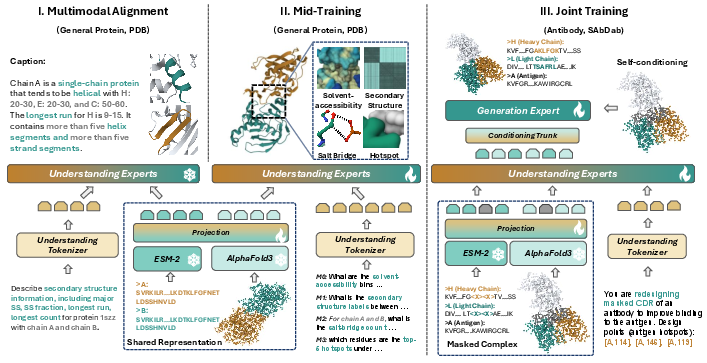
Proteo-R1 introduces a dual-expert architecture that explicitly factorizes protein understanding from geometric generation. This design integrates a multimodal LLM (MLLM) as a reasoning expert (understanding critical molecular features) and a geometric diffusion model (generation expert) that synthesizes sequences and structures respecting residue-level constraints inferred by the reasoner. This blueprint operationalizes reasoning as explicit commitments at the residue level, which are then enforced throughout the generative process.
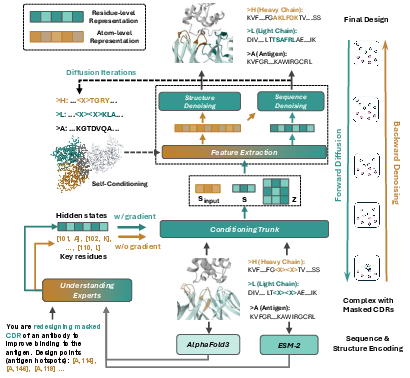
Figure 1: Proteo-R1 couples a multimodal reasoning expert with a geometric diffusion expert to unify molecular understanding and generation; the reasoner selects key residues, which the generator enforces throughout conditional co-design.
Methodological Architecture
Understanding Expert
The understanding expert consumes multimodal context—sequence embeddings (ESM-2), CDR-masked structural tokens (AF3-style trunk), and optional text—that map into a unified language representation space. The model analyzes masked complexes, identifying residues critical for functional specificity and binding by reasoning over biochemical, structural, and contextual features, deriving sparse residue-level representations.
Geometric Diffusion Generation
Residue-level decisions from the MLLM are communicated to the geometric generator through explicit identity specification and embedding anchoring. Anchor residues are clamped in the sequence, and their reasoning-derived hidden representations are injected as conditioning embeddings. The diffusion-based generator (AF3-like) performs sequence and coordinate synthesis on CDRs given these anchors, while non-anchor residues remain masked and fully resolved by generation.
Three-Stage Training Curriculum
Proteo-R1 is trained through a curriculum that stabilizes optimization:
Experimental Evaluation
Geometry-centric Antibody Redesign
Proteo-R1 outperforms other diffusion and graph-based models across multi-CDR redesign benchmarks (SAbDab dataset), achieving lower RMSD (especially on CDR-H1/H2), fewer steric clashes, and improved backbone dihedral distribution fidelity. On the RAbD benchmark for CDR-H3 redesign, Proteo-R1 achieves superior lDDT, TM-score, RMSD, and DockQ, favoring structurally valid alternative solutions over native-sequence imitation. Strong interface improvement and geometric realism metrics demonstrate reasoning-guided anchoring enhances both accuracy and physical validity compared to purely generative baselines.
Structure-sequence Consistency
Proteo-R1 yields higher sequence recovery under structure-conditioned inverse folding (IF-AAR) even if native-sequence AAR is lower, indicating its designs are more compatible with realizable sequences and less overfit to historical solutions.
Antibody LLM Perplexity
Antibody-specific LLMs (IgLM, AbLang, IgT5) report perplexity for Proteo-R1-designed sequences comparable or lower than ground-truth, confirming in-distribution validity and highlighting alternative sequence diversity as legitimate and not indicative of sequence quality loss.
Compatibility with Alternative Generative Backbones
The residue-aligned reasoning interface generalizes to alternative generative models (e.g., UniMoMo, BoltzGen) without modification, consistently improving geometric and thermodynamic metrics. Oracle anchor ablations further establish substantial upper bounds, indicating future gains will come from refining the reasoning expert.
Practical and Theoretical Implications
Proteo-R1's explicit separation of reasoning and generation enables modular, interpretable, and controllable molecular design. By factoring design intent into enforceable constraints, it provides more reliable and reusable design signals, integrates human prior knowledge, and avoids destabilizing generative dynamics by preserving architectural inductive biases. These properties facilitate scalable agentic protein design, allow systematic incorporation of biological domain knowledge, and provide rationalizable outputs amenable to downstream audit and transfer across generative architectures.
Speculation on Future Developments
Future directions include:
- Enhancing the biochemical reasoning capabilities of LLMs for even more accurate anchor identification.
- Extending to high-fidelity design in other molecular domains (enzymes, peptides, small molecules).
- Incorporating scientific literature and multimodal context to further enrich reasoning.
- Systematic alignment with biosecurity best practices and integration of experimental feedback loops for real-world validation.
Conclusion
Proteo-R1 operationalizes explicit residue-level reasoning as an independent molecular understanding stage, decoupled from geometric generation. This paradigm achieves stable, interpretable integration of LLM reasoning with geometric generative models, improves antibody design on structural and interface metrics, and provides a blueprint for scalable, cognitively grounded foundation models in protein design. The approach is general and modular, supporting integration with diverse generative frameworks, and advances the capacity for agentic, deliberative molecular engineering.