- The paper introduces Disco, a generative framework that jointly designs protein sequences and 3D structures in the presence of diverse molecular partners.
- It employs masked discrete diffusion and continuous denoising diffusion to achieve co-adaptive, high-foldability designs with enhanced novelty and diversity.
- Experimental results on heme-based carbene transferases highlight high catalytic yields and structural novelty, paving the way for de novo enzyme design.
General Multimodal Protein Design Enables DNA-Encoding of Chemistry
Introduction
The work introduces Disco, a generative framework that performs joint sequence and 3D structure protein generation in the presence of arbitrary molecular context, including ligands, metallocofactors, reactive intermediates, and nucleic acids. Disco advances beyond traditional two-stage or motif-based enzyme design by integrating conditional co-generation of sequence and structure, enabling reliable synthesis, interface engineering, and catalytic activity without reliance on explicit residue motifs, theozymes, or sequential pipelines vulnerable to misalignment and search limitations. Critically, Disco enables direct DNA encoding of new-to-nature chemistry by leveraging deep multimodal generative modeling.
Architecture and Generative Approach
Disco is based on masked discrete diffusion for sequences and continuous denoising diffusion for atomic coordinates, allowing training of a single model that learns the coupled distribution of sequence and structure. Notably, the architecture employs a cross-modal framework with a frozen pretrained LLM (DPLM 650M) for sequence priors, a structure encoder (LigandMPNN), and an SE(3)-equivariant attention stack. The joint diffusion module explicitly denoises both the sequence and backbone, with independent modality noise schedules facilitating robust multimodal learning. Crucially, sequence and structure are conditioned on each other through recycling mechanisms at every generation step, enforcing co-adaptation across modalities.
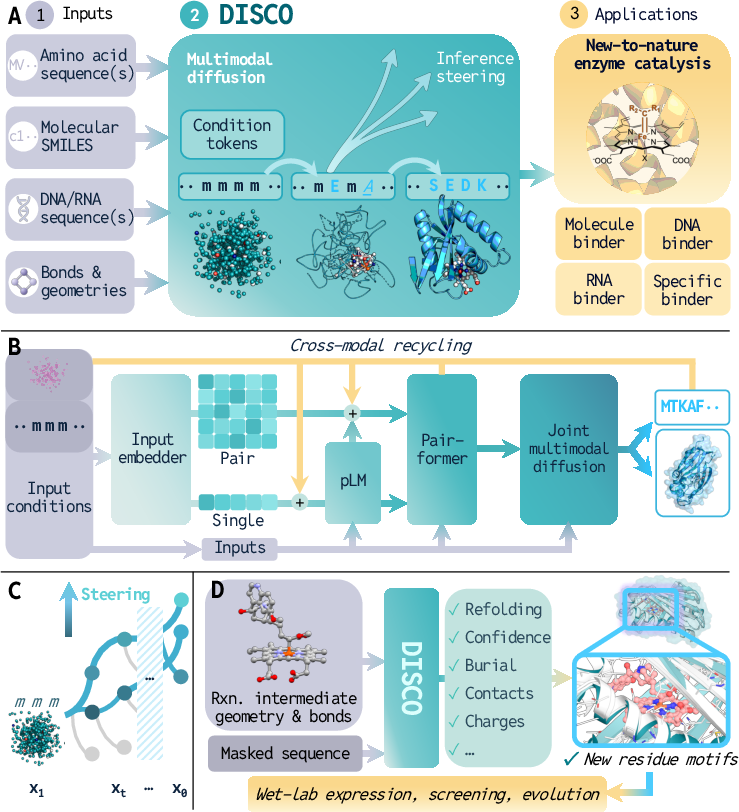
Figure 1: Overview of the Disco workflow for sequence-structure co-generation, multimodal inference steering, and enzyme design from reactive intermediates.
Training is performed solely on unfiltered PDB data, without explicit selection for "designable" proteins. Disco's joint sampling approach enables real-time correction (remasking) and entropy adaptive temperature schedules during inference, overcoming typical mode collapse and token commitment issues encountered in standard masked diffusion and autoregressive models.
Multimodal Protein Design and Conditional Generation
Disco's generative process natively supports conditioning on arbitrary, spatially resolved molecular partners (e.g., small molecules, nucleic acids, metalloclusters), permitting dynamic co-folding and interface customization. Biomolecules are represented with discrete chemical identity and explicit atomic coordinates, fully integrated into the generation and denoising pipeline. Conditioning is not limited to static scaffolds—ligand and protein coordinates are both jointly denoised, enabling the model to adapt to conformational change and generate entirely novel binding modes or catalytic architectures.
Disco was benchmarked using a comprehensive ligand library (Studio-179), comprising small molecules, natural and non-natural ligands, metallocofactors, and nucleic acids. Co-designability—defined as the ability of the generated sequence to fold in-silico as predicted—and diversity are evaluated across targets.
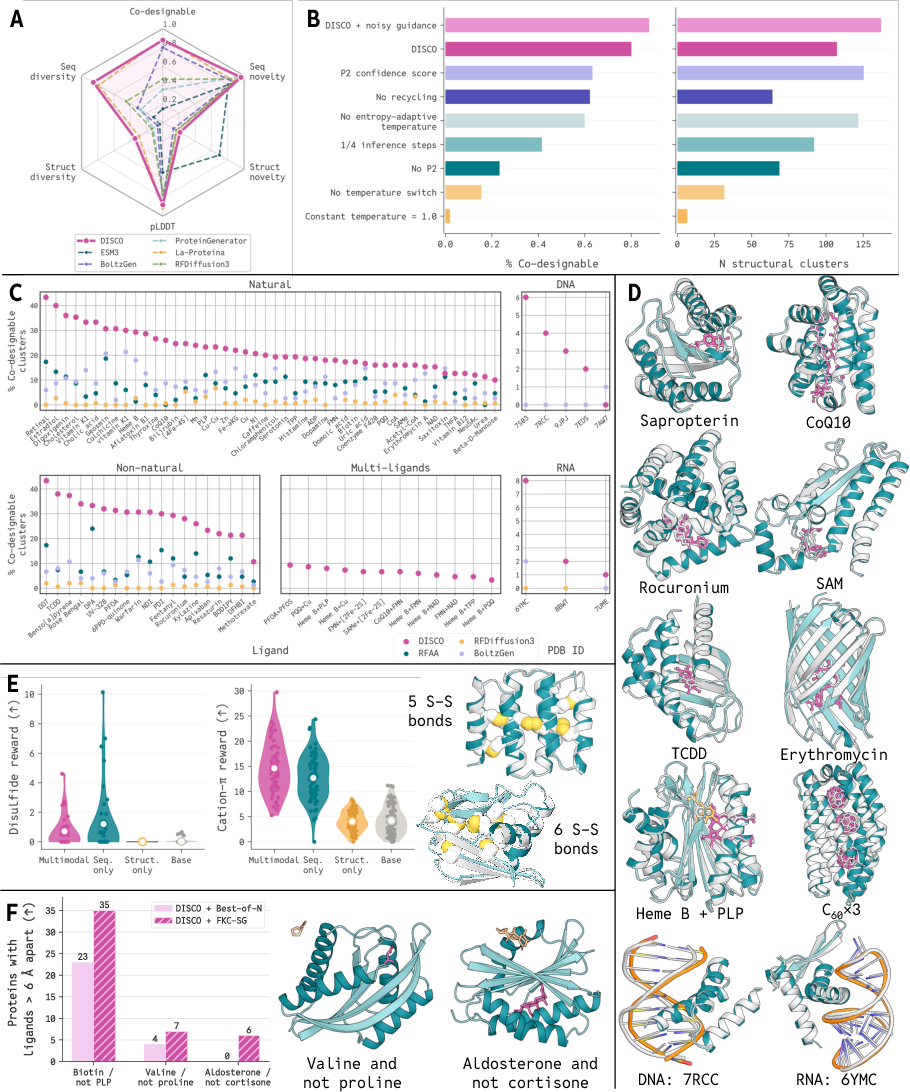
Figure 2: Disco achieves state-of-the-art sequence-structure co-design, conditional generation across biomolecules, enhanced motif/control via FKC, and binding specificity compared to existing methods.
Across unconditional monomer design and conditional generation, Disco outperforms all baselines in co-designability, novelty, and diversity. For 178/179 ligands, Disco yields the highest proportion of diverse, foldable sequence-structure pairs. This is robust across ligand flexibility/rigidity, multi-ligand contexts, and nucleic acid binding. In unconditional generation, ∼90% of sequences refold to ≤2Å RMSD (ESMFold), with disco achieving superior diversity without sacrificing foldability or biasing amino acid composition.
Inference-Time Steering: Feynman-Kac Correctors
A highlight is the use of Feynman-Kac Correctors (FKC) for multimodal reward-driven sampling and specificity guidance, extending beyond standard classifier-free guidance. Disco can be preferentially biased towards sequences/structures with desired reward properties (e.g., maximizing the frequency of disulfide bonds, cation-pi interactions) and selectivity (binding to one ligand but not a close analog), with resampling and drift correction formalized via rigorous SMC and PDE analysis.
FKC-MM allows for reward specification on sequence-structure pairs, enabling, for example, dense disulfide-bridged proteins—only the most exceptional such proteins arise in natural datasets—while FKC-SG steers designs to discriminate closely related ligand pairs. This supports hit discovery for selectivity, allosteric regulation, and robust de novo function acquisition.
Statistical and Physicochemical Realism
Analysis of Disco-generated proteins (both unconditional and conditional) demonstrates that key protein biophysical statistics are well recapitulated: amino acid frequencies, secondary structure content, Ramachandran distribution, surface hydrophobicity, net charge, long-range contact order, and compactness (radius of gyration) are all within natural or design-compliant regimes.
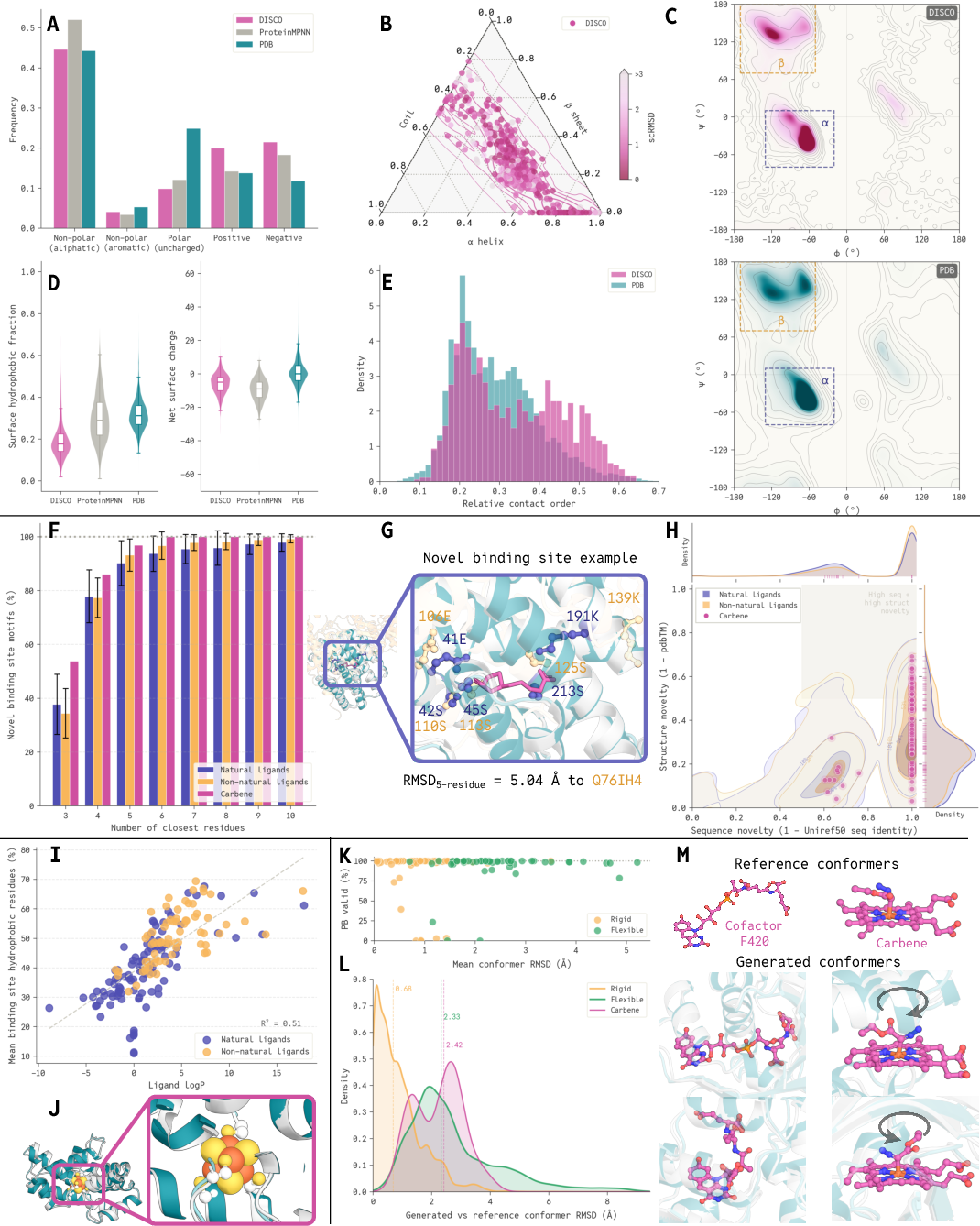
Figure 3: Disco designs recapitulate protein statistical properties, yield novel binding site motifs and flexible conformers, and generate pockets that physiochemically complement the conditioning ligand.
Crucially, binding site motif diversity and novelty are extremely high. For clusters of up to ten residues involved in ligand coordination, the majority of generated motifs lack even remote analogs in AlphaFoldDB (RMSD > 3Å). Motif clustering reveals >90% unique clusters per dataset, and no tendency for convergence onto trivial or known folds.
Binding sites and pockets are generated with chemical complementarity to the target ligand: hydrophobicity, pocket size, and residue selection are quantitatively influenced by ligand features, with high fidelity and low steric clash rates. Notably, flexible ligand conformers are valid and physically plausible, as assessed by PoseBusters, with rare or unseen conformers accessible to the model. This joint flexibility is inaccessible to pipelines that decouple ligand and protein.
Experimental Validation: De Novo Catalysts for New-to-Nature Reactions
Disco was applied to the design of heme-based carbene transferases for multiple classes of carbene transfer (alkene cyclopropanation, B–H insertion, C(sp³)–H alkylation, and spirocyclopropanation), conditioned only on DFT-optimized geometries of transient catalytic intermediates and without explicit catalytic residue motifs or mechanistic theozymes. Out of ∼10⁴ generated designs, 90 were screened experimentally for catalytic activity in E. coli.
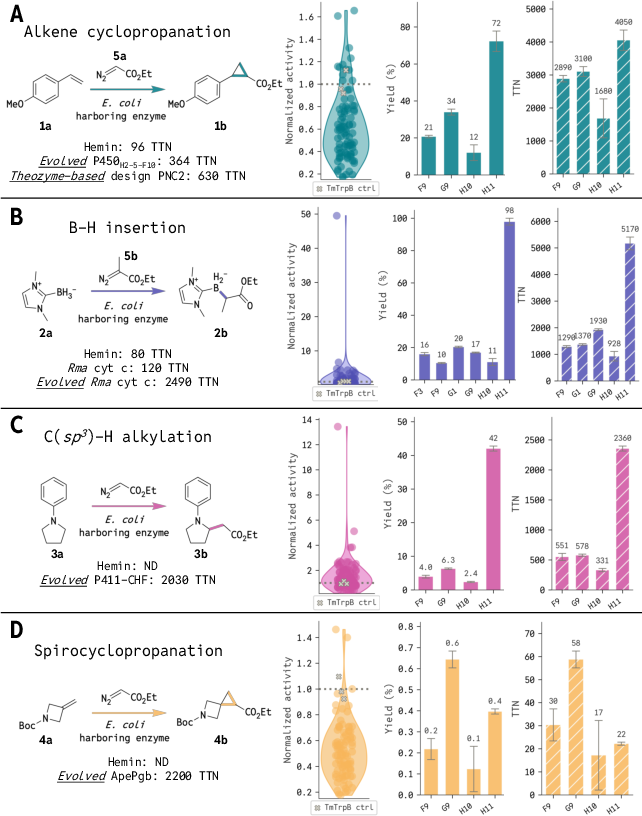
Figure 4: Disco-designed enzymes (dCTs) catalyze multiple room-temperature carbene transfer reactions with high activity, surpassing previous designed or evolved enzymes.
Multiple designs showed high room-temperature activity, with the best achieving yields of 72% (TTN 4050) for cyclopropanation, 98% (TTN 5170) for B–H insertion, and 42% (TTN 2360) for C(sp³)–H alkylation. Notably, for C(sp³)–H alkylation, no explicit transition state or motif was used, and the best design approached or outperformed state-of-the-art directed-evolved catalysts. Enantioselectivity (up to 35% ee) and diastereoselectivity (99:1 d.r. for cyclopropanation) demonstrate that the designs can access specific and tunable stereochemical regimes even when not explicitly optimized for this property.
Evolvability and Structural Novelty
To assess evolvability, selected designs underwent a single round of error-prone PCR; approximately 35 variants displayed improved activity, including both increased enantioselectivity and inversion of selectivity. Substitutions are broadly distributed, consistent with robust, traversable fitness landscapes akin to natural enzymes. Disco-designed active sites and folds are structurally dissimilar to both natural heme proteins and design templates (closest sequence identities <21%, TM-scores 0.51–0.81, active-site RMSD >7Å), signifying de novo topology and geometry discovery outside the boundaries of current PDB and AlphaFoldDB.
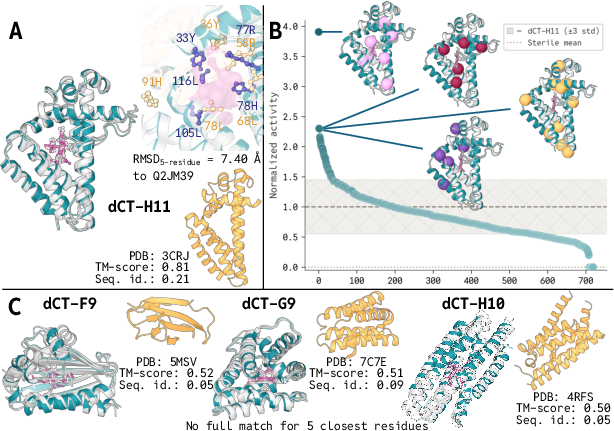
Figure 5: Top Disco designs exhibit novel folds, unique active-site configurations, and accessible fitness landscapes supporting directed evolution.
Implications and Future Outlook
Disco is a significant advance in end-to-end differentiable, multimodal generative modeling for biocatalyst discovery, enabling:
- Unconstrained exploration of sequence–structure–function space far beyond current motif-based pipelines.
- Direct encoding of complex and unnatural chemistries into DNA—expanding the genetically addressable chemical landscape.
- Control of both sequence and structure during generative inference, allowing reward/constraint integration unavailable to sequential or autoregressive pipelines.
- High-throughput, scalable design amenable to future cycles of active/reinforcement learning, directed evolution, or in silico directed search, with rapid convergence to high-functioning, evolvable catalysts.
Theoretically, the framework paves the route to programmable molecular interfaces and metabolic engineering, and lays the groundwork for closed-loop systems fusing generative models with directed evolution or automated selection strategies. Extension to further functional classes, multi-enzyme assemblies, or complex allosteric systems is immediate. Disco's architecture, guided inference, and demonstrated experimental prowess are likely to serve as reference in next-generation protein design.
Conclusion
Disco establishes a general, scalable, and reward-steerable framework for DNA-encoded de novo protein design, enabling function acquisition across broad chemical and structural regimes. By fully leveraging joint generative modeling and principled inference steering, Disco bridges gaps in current protein engineering, rendering new-to-nature reactivity genetically accessible and evolvable. The demonstrated results in enzyme catalysis, motif discovery, and ligand interface engineering presage rapid expansion of the protein design landscape, with profound theoretical and practical consequences for synthetic biology, biocatalysis, and cellular engineering.
Reference:
"General Multimodal Protein Design Enables DNA-Encoding of Chemistry" (2604.05181)