- The paper derives a generalized Smarr formula via the Komar charge in Einstein–nonlinear electrodynamics theories.
- It employs Wald’s formalism with a dynamical treatment of the coupling constant to rigorously extend black hole thermodynamics.
- Results show that nonlinear electromagnetic fields smooth out singularities, impacting energy conditions and thermodynamic behavior.
Introduction and Motivation
The paper "Derivation of the Smarr formula from the Komar charge in Einstein-nonlinear electrodynamics theories and applications to regular black holes" (2605.02813) develops a systematic approach for deriving the Smarr formula and the first law of black hole thermodynamics in four-dimensional Einstein gravity coupled to generic nonlinear electrodynamics (NLED) theories. The presence of dimensionful coupling constants in NLED models modifies thermodynamic relations, necessitating a generalized treatment to account for contributions from these couplings. Previous approaches often relied on homogeneity arguments; this work employs a principled derivation via the generalized Komar charge, providing both geometric clarity and rigorous consistency across arbitrary NLED models, including those with regular (singularity-free) black holes.
The methodology rests on first recasting the NLED coupling α as a dynamical field, constrained to constancy on-shell through a Lagrange multiplier, permitting application of Wald's formalism and consistent derivation of Noether currents and charges. For a generic Lorentz-invariant NLED theory—where the Lagrangian depends on the electromagnetic scalar X=−41FμνFμν and pseudoscalar Y=41Fμν(⋆F)μν, as well as a coupling α—the total action extends Einstein-Hilbert with L(X,Y,α) and a constraint term ensuring α(x) is constant on-shell.
A key result is the explicit form of the generalized Komar charge 2-form,
K[k]=−16πGN(4)1⋆(ea∧eb)Pkab+32πGN(4)1Pk⋆Π−32πGN(4)1P~kF+32πGN(4)γαPkH,
where Pkab arises from the Killing bivector, ⋆Π and P~k encode electrical and magnetic contributions, and X=−41FμνFμν0 comes from the variation of the coupling constant. This charge is proven to be on-shell closed, forming the foundation for deriving both the Smarr relation and the first law without relying on homogeneity assumptions.
By integrating the closed Komar charge over hypersurfaces bounded by spatial infinity and the event horizon, the paper establishes the generalized Smarr formula for asymptotically flat, stationary black holes (with mass X=−41FμνFμν1, temperature X=−41FμνFμν2, entropy X=−41FμνFμν3, angular momentum X=−41FμνFμν4, electric/magnetic charges and potentials X=−41FμνFμν5, and coupling constant X=−41FμνFμν6 with conjugate X=−41FμνFμν7):
X=−41FμνFμν8
The first law is similarly extended:
X=−41FμνFμν9
These relations hold generically for any Einstein-NLED theory, with explicit calculations provided for Born–Infeld, ModMax, Hayward, and Bardeen regular black holes as test cases.
Regular Black Holes, Komar Charge, and the Role of Nonlinearity
One substantial focus is the detailed analysis of regular (non-singular) black holes in NLED, especially the Bardeen solution. In classical GR and Maxwell theory, conservation of the Komar charge implies singularity or non-trivial topology as the source of mass or charge; in the context of NLED, the nonlinearity enables smooth mass/charge sourcing via the electromagnetic field itself, even as the integration surface shrinks to a point. The paper rigorously analyzes each term in the Komar integral, showing that for the Bardeen black hole the mass is sourced non-singularly—contrasting with the divergence seen for the magnetically charged Reissner–Nordström solution.

Figure 1: Plot of ADM mass Y=41Fμν(⋆F)μν0 and extremal mass Y=41Fμν(⋆F)μν1 as functions of the nonlinearity parameter Y=41Fμν(⋆F)μν2, with shaded regions indicating the physical regime for regular horizons; further panels illustrate the nature of Y=41Fμν(⋆F)μν3 for various Y=41Fμν(⋆F)μν4.
Black Hole Thermodynamics and Nonlinear Effects
Explicit computation of temperature, entropy, and specific heat reveals distinctive thermodynamic behavior for regular black holes, including a temperature peak, nonzero extremal entropy, and a phase transition marked by divergent specific heat. The derived relations between energy conditions and the causality properties of the theory confirm that regularity requires violation of the strong energy condition in the core, in agreement with the Penrose–Hawking theorems.
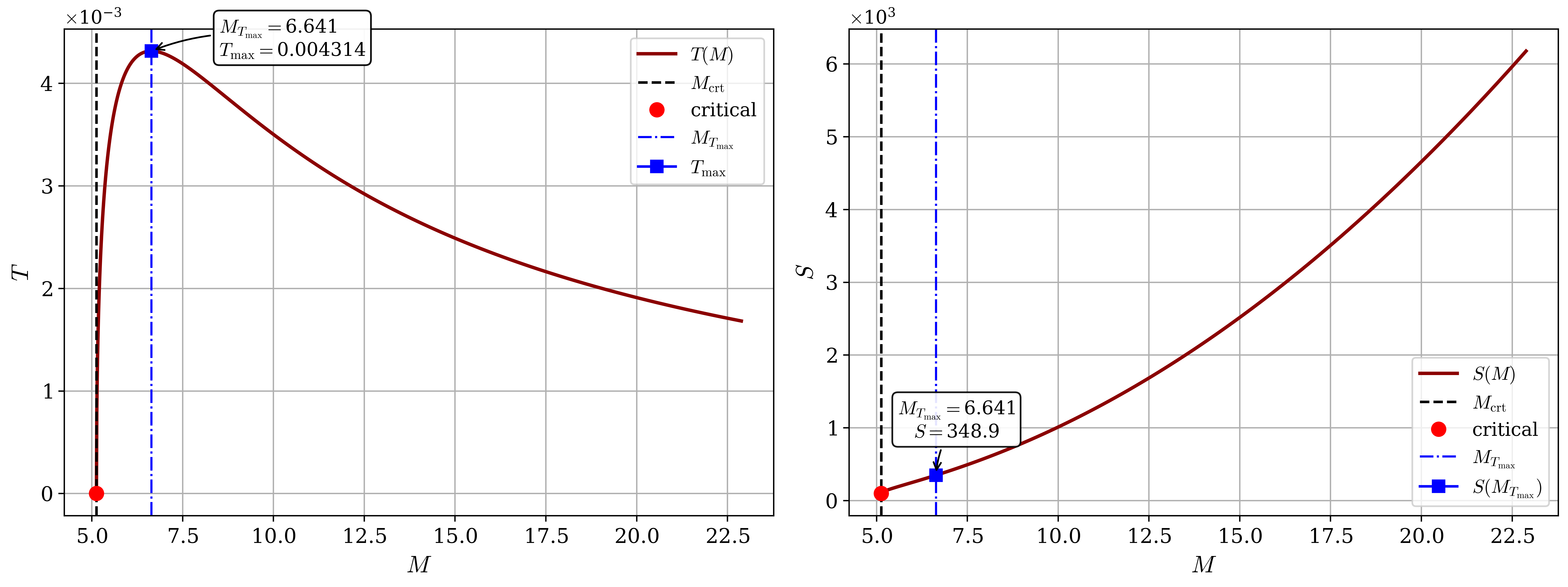
Figure 2: Temperature and entropy as functions of mass Y=41Fμν(⋆F)μν5 for fixed Y=41Fμν(⋆F)μν6; the nonlinearity introduces a temperature maximum and smooth extremal limit.
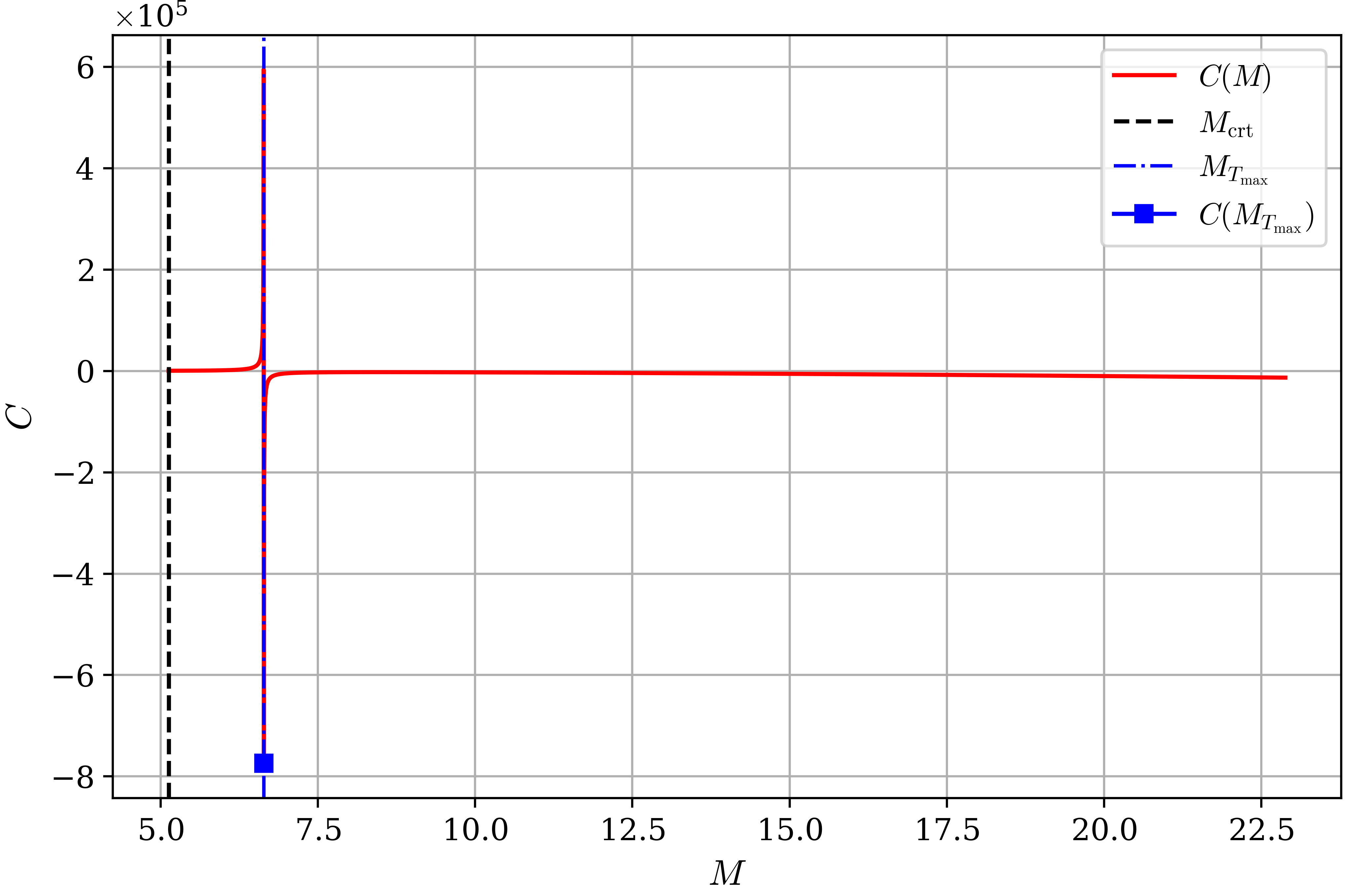
Figure 3: Specific heat as a function of mass Y=41Fμν(⋆F)μν7, displaying divergence at the transition, with nonlinear effects shifting thermodynamic behavior relative to Schwarzschild.
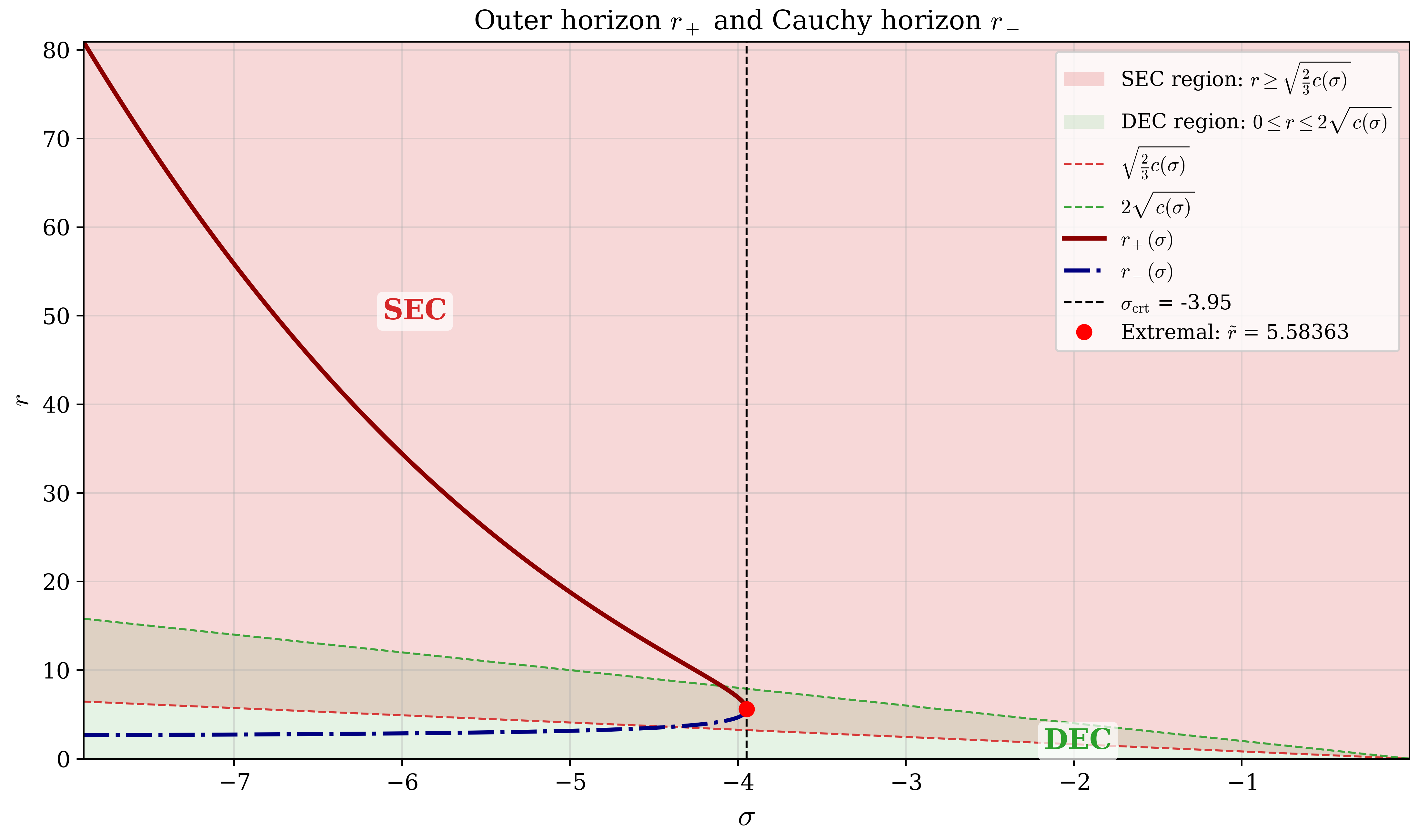
Figure 4: Outer horizon radius as a function of Y=41Fμν(⋆F)μν8, identifying regions with/sans horizons and mapping the boundary between soliton and black hole phases.
Energy Conditions, Causality, and the Komar Integral
Analyzing the energy-momentum tensor and its implications for NEC, WEC, SEC, and DEC, the work confirms that regular black holes in NLED violate the SEC in their core, triggering acausality. Functions such as the electromagnetic energy Y=41Fμν(⋆F)μν9 and the effective charge α0 are shown to provide physical insight into the transition between soliton and black hole, with the Komar integral terms directly related to these energy scales.
Implications and Future Directions
This generalized approach to black hole thermodynamics in Einstein–NLED theories clarifies the geometric and physical origin of mass and charge in regular black holes and provides a unified framework for constructing and analyzing their thermodynamic behavior. The ability of NLED to regularize classical singularities through its nonlinear structure opens theoretical avenues for exploring new phases (soliton vs. black hole), the transition mechanism between these configurations, and the impact of energy condition violations and acausality in gravitational collapse scenarios.
The methodology offers direct applicability to diverse NLED models—including those motivated by string theory, quantum corrections, and strong-field phenomena—and is extensible to higher-derivative and higher-dimensional contexts. Future investigation may focus on gravitational collapse dynamics, phase transitions, and the stability of horizonless solitons versus regular black holes, especially in settings where cosmic censorship is not tied to classical singularity formation.
Conclusion
The paper rigorously derives the Smarr formula and first law for Einstein–NLED black holes via the generalized Komar charge, confirming these relations for a broad class of theories and demonstrating their utility in the analysis of regular black holes. The physical mechanism for mass sourcing in regular black holes is uniquely clarified: nonlinear electromagnetic fields, rather than classical singularities or exotic topology, account for the entirety of mass and charge in such solutions. Theoretical implications for energy conditions, causality, and the nature of horizons are elucidated, providing a robust platform for future exploration within gravitational and quantum field theory.