- The paper presents Manifold k-NN, a novel algorithm extending DP-NNS to support exact k-NN queries on manifold point clouds with dynamic point operations.
- It leverages recursive geometric partitioning and local Delaunay retriangulation to reduce query times up to 10× compared to traditional volumetric indices.
- The method enables efficient prefix-subset queries and dynamic updates, benefitting real-time 3D graphics, scan merging, and neural surface reconstruction.
Manifold k-NN: Accelerated k-NN Queries for Manifold Point Clouds
Motivation and Background
k-nearest neighbor (k-NN) search is a core algorithmic primitive in geometry processing, surface reconstruction, and 3D graphics, underpinning procedures from local shape analysis to neural point cloud pipelines. Standard spatial indexing structures such as KD-trees, Octrees, and R∗-trees exhibit critical limitations when applied to point clouds sampled from low-dimensional manifolds: their partitioning schemes are manifold-agnostic, resulting in poor pruning efficiency and excessive node traversals, particularly in volume-to-surface query scenarios. These deficiencies become prominent in tasks where query points are distributed throughout the ambient 3D volume but target points are constrained to a manifold surface.
Dynamic programming-based nearest neighbor search (DP-NNS), leveraging incrementally constructed Voronoi diagrams and successor lists, overcomes some of these pitfalls for k=1 queries, offering superior runtime when manifold structure is present. However, DP-NNS does not natively support arbitrary k-NN queries or robust dynamic point operations. The paper introduces Manifold k-NN, a recursive extension of DP-NNS, generalizing exact k-NN search and fully dynamic point set maintenance for manifold point clouds (2605.02224).
Algorithmic Framework and Theoretical Foundations
The foundation of Manifold k-NN relies on recursive geometric partitioning of point set insertion history. Let P={p1,…,pn} be points ordered by birth-time (insertion) and q a query point. The nearest neighbor Φ1:n(q) is determined via recursive traversal of successor lists in the incremental Voronoi diagram. The paper's key geometric insight: once the nearest neighbor pi is found, the second nearest must reside either within the prefix P1:i−1 or the successor list of k0. This principle generalizes; the k1-th nearest neighbor is guaranteed to reside in one of k2 disjoint intervals determined by the birth-time indices of the k3 confirmed nearest neighbors.
This recursive approach formalizes exact k4-NN queries as sequences of restricted 1-NN subqueries coordinated across dynamically partitioned index intervals. The search exploits transition sites encountered during the initial 1-NN traversal, and successor lists encode local topological changes in the Voronoi diagram, enforcing spatial locality. Algorithmic complexity is dominated by Delaunay triangulation (k5 avg.), and the expected per-query cost is k6 for small k7 due to logarithmic average successor list length.
The method natively supports prefix-subset queries, enabling instantaneous k8-NN retrieval in any subset k9 without re-construction—a crucial property for level-of-detail analysis and temporal streaming.
Manifold-Aware Dynamic Operations
Efficiently supporting point insertion and deletion is nontrivial due to the entanglement of successor lists and construction history. The paper introduces a robust deletion operator via local Delaunay retriangulation, exploiting the topological locality of Voronoi adjacency changes:
- Deleting R∗0 only affects its immediate (Delaunay) neighbors; new adjacencies that emerge are confined to this neighborhood.
- Lemmas formally prove invariance of unaffected successor list entries and characterize adjacency redistribution strictly within the vacated region defined by R∗1.
- Local Delaunay reconstruction, typically on small neighborhoods (~33 points), updates successor tables efficiently without global rebuilding.
This enables fully dynamic maintenance of point sets in manifold settings, crucial for scan merging, defect localization, and streaming analysis.
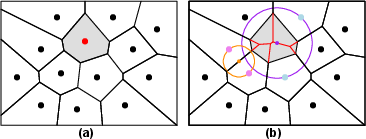
Figure 1: Voronoi diagram evolution under site deletion; local adjacency changes confined to the target cell's neighborhood.
Empirical Evaluation and Numerical Results
Manifold k-NN demonstrates substantial speedup in practical settings. On large-scale datasets (e.g., 1M points sampled on the Earth's surface, 1M query points in a R∗2 AABB), query times per R∗3 neighbor search are reduced by an order of magnitude relative to KD-tree, Octree, and R∗4-tree baselines: average query time of 1.87 μs compared to 11–25 μs for standard volumetric indices.
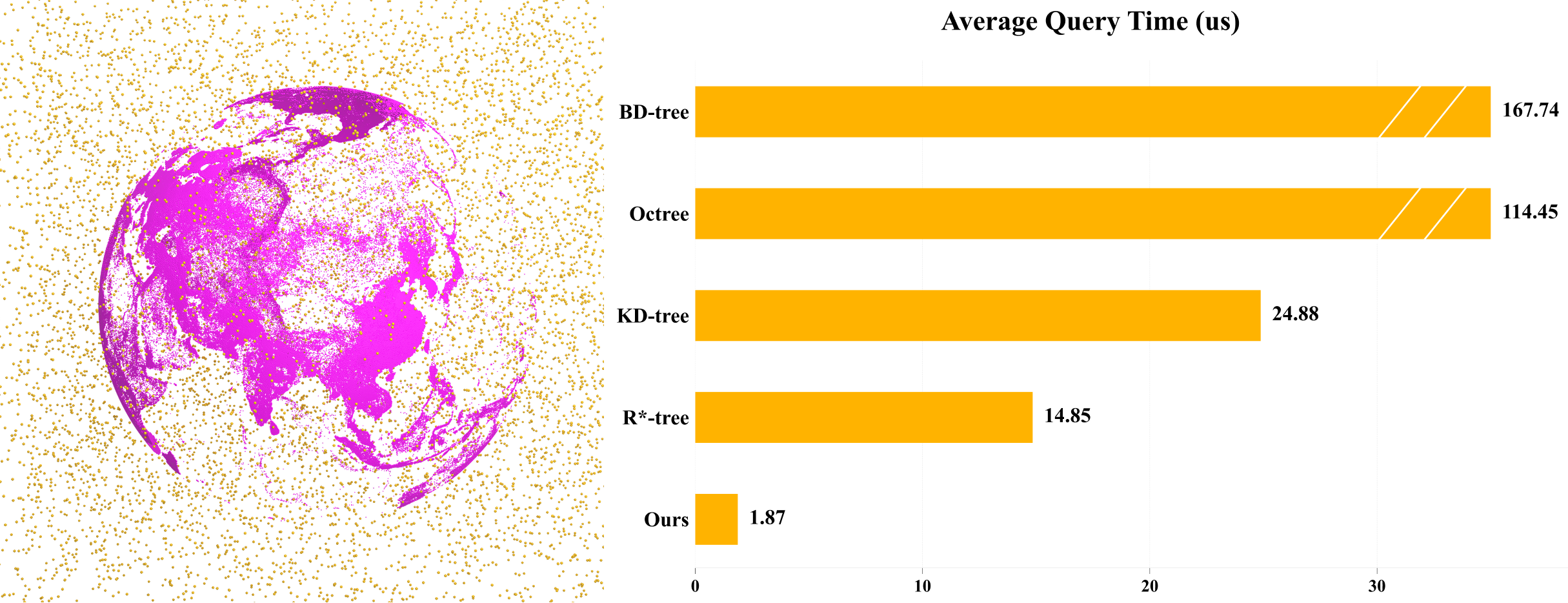
Figure 2: Manifold k-NN outperforms volumetric indices in volume-to-surface R∗5-NN query workloads, exploiting intrinsic surface structure.
Prefix query performance—crucial for progressive scan analysis—enables zero-overhead switching between temporal states, affording >250R∗6 speedup in defect exploration and scan convergence tasks versus KD-tree and R∗7-tree, which require full structure rebuilds.
Dynamic maintenance outperforms static KD-tree and incremental KD-tree alternatives in query-dominated workloads, with locality in deletion operations verified across diverse point cloud sizes. Scalability with R∗8 remains competitive; for R∗9–k=10 on 1M points, manifold k-NN consistently outpaces domain-blind baselines.
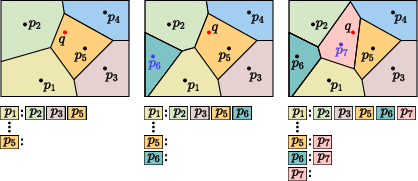
Figure 3: Successor list structure; newly inserted points only affect local Voronoi cells, efficiently encoding manifold-aware neighbor transitions.
Sensitivity analysis—perturbing manifold points towards uniform volumetric distributions—shows graceful performance degradation: while the manifold advantage diminishes under severe violation, the method remains competitive, even matching optimized spatial indices on fully random point clouds.
Performance across dimensions (2D–5D) confirms highest efficiency on low-dimensional manifolds (e.g., samples on hyperspheres), but query times scale exponentially with ambient dimension, conforming to theoretical expectations regarding Delaunay triangulation complexity.
Insertion order, explored via spatial sort versus farthest point ordering, is shown to influence successor locality and k=11-NN query times; spatial sort is optimal for k=12-NN traversal due to better locality in successor lists.
Implications and Future Directions
Manifold k-NN advances the state-of-the-art in manifold point cloud querying, providing substantial speedups and dynamic flexibility unavailable with established spatial indices. The recursive DP-NNS extension and robust local deletion mechanisms enable both static and progressive workloads, fundamentally improving efficiency for algorithms demanding millions of queries.
Practically, this enables real-time and interactive geometrical processing in applications such as neural surface reconstruction, point-based neural rendering, and scan merging—all of which are bottlenecked by k=13-NN queries in large-scale geometries.
Theoretically, the approach exposes new avenues in dynamic geometric data structures, exploiting construction histories and local topological evolution. Parallelization strategies—inspired by recent advances in multi-zone Delaunay triangulation [LO201288, nguyen2020delaunay]—and memory coalescing for GPU acceleration represent promising research directions. Batch reordering and lazy update mechanisms could address current limitations in deletion efficiency. Extending the algorithm to non-Euclidean metrics and heterogeneous sampling regimes (including adaptive resolution and multimodal point data) would broaden applicability.
Conclusion
Manifold k-NN generalizes exact k=14-NN search for manifold-constrained point clouds, leveraging geometric insights from incremental Voronoi diagrams and recursive construction history partitioning. Experimental results show k=15–k=16 speedup compared to volumetric spatial indices in volume-to-surface query scenarios, efficient prefix-subset query support, and robust dynamic point maintenance via localized Delaunay updates. The algorithm enables scalable, efficient, and dynamic k=17-NN querying in modern geometry processing pipelines, with future work poised to enhance preprocessing efficiency, deletion locality, and parallelization (2605.02224).

