- The paper introduces adaptive proxy site augmentation to partition dense Voronoi clusters, mitigating quadratic preprocessing in symmetric meshes.
- The paper reformulates interference testing using sphere-triangle intersections and BVH pruning, significantly reducing candidate complexity.
- The paper demonstrates up to 50× preprocessing and 30× query speedups over traditional methods, enhancing efficiency in simulation and collision detection.
P2M++: Enhanced Framework for Efficient Point-to-Mesh Distance Queries
Introduction
Point-to-mesh (P2M) distance queries are central to geometric modeling, graphics, simulation, robotic motion planning, and computational geometry. Recent work has established Voronoi-based proxy-site acceleration as state-of-the-art for high-throughput P2M queries, notably through the P2M method. However, that approach has inherent inefficiencies, particularly in the precomputation of “interference” relationships—a process that becomes especially pathological on geometries with high local or global rotational symmetry, where proxy-site Voronoi vertices densely cluster, yielding superlinear, often quadratic, computational and memory complexity.
The P2M++ framework, as presented in "P2M++: Enhanced Solver for Point-to-Mesh Distance Queries" (2605.00429), introduces critical architectural and algorithmic advances to address these known deficits, attaining higher preprocessing scalability and further accelerating runtime queries on standard, organic, and highly symmetric meshes.
Limitations of P2M and Symmetry-Induced Interference Inflation
P2M leverages mesh vertices as proxy sites in a Voronoi diagram partition of space, associating each cell with an interception table mapping to candidate triangles that may contain the closest point for queries located within the cell. Interference relationships are discovered via an iterative “sweep” of adjacent Voronoi cells, which leads to excess predicate evaluation—a process with O(n2) candidate complexity in the presence of high symmetry.
For example, consider a regular n-gon (approximating a circle) and its mesh; any interior point near geometric center may have every vertex as a plausible nearest site and every edge as a valid closest feature, inducing a fully-connected vertex-edge interference graph. As mesh resolution increases, this results in quadratic blowup in both time and memory for preprocessing.
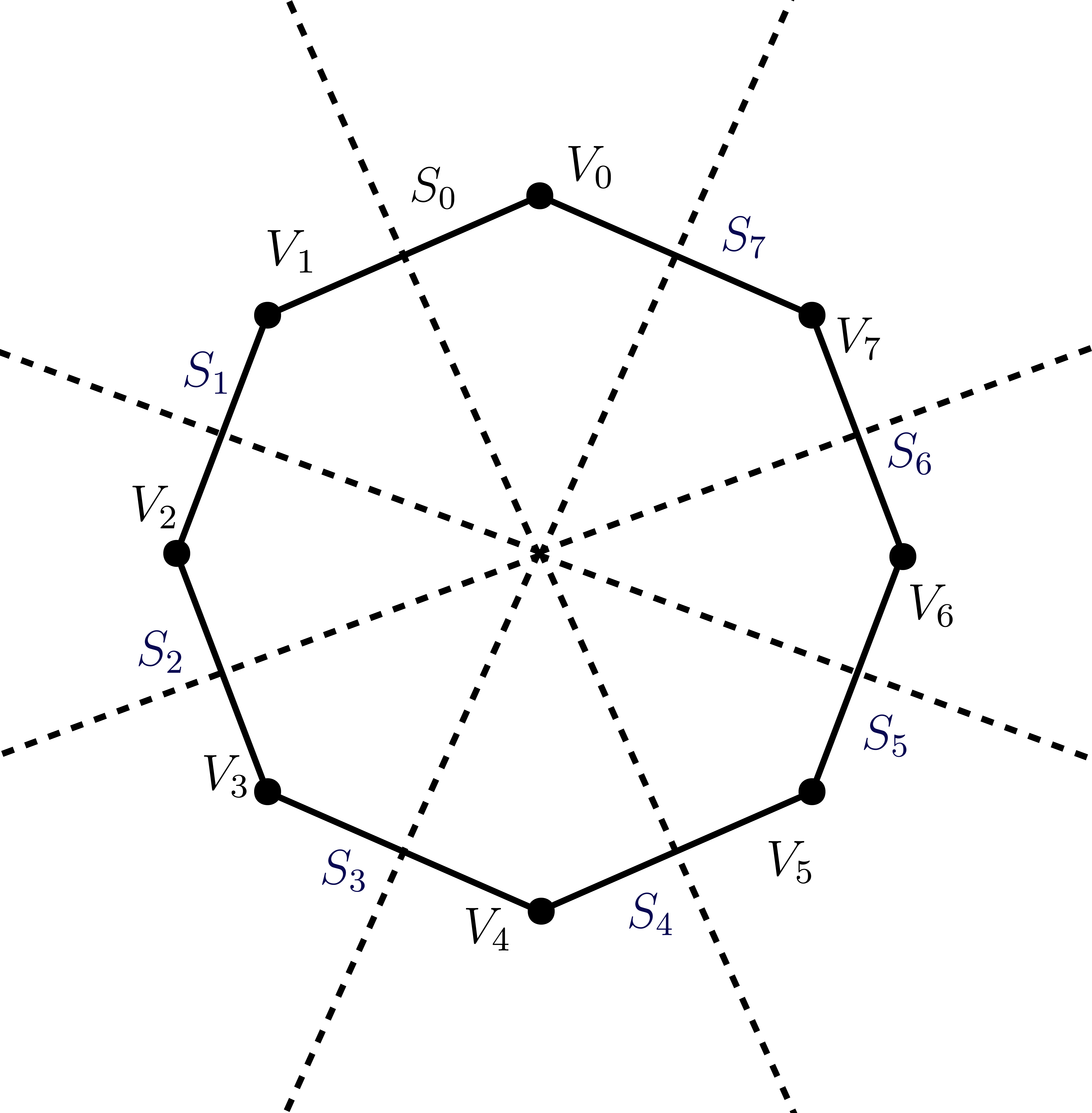
Figure 1: Site augmentation motivation—In highly symmetric configurations (e.g., regular n-gon approximating a circle), Voronoi vertices cluster near the center, leading to quadratic complexity in interference relationships.
Methodological Advances in P2M++
Adaptive Augmentation of Proxy Sites
To neutralize pathological clustering in the Voronoi structure, P2M++ adaptively inserts auxiliary proxy sites in regions where Voronoi vertices exhibit high density. Occupancy in a regular grid is used to detect clusters: within dense regions, new proxy sites—off-surface, if necessary—are introduced at the centroid or distributed as a surrounding ring. This refined site placement effectively partitions problematic regions, bounding interception table growth and spatially localizing complex interference.
Importantly, this method is parameterized by site-density thresholds and local mesh sampling rates, tuned empirically for robust performance across a diverse set of meshes, without introducing overhead on well-behaved, irregular geometries.
Interference test logic is recast as a set of sphere-triangle intersection evaluations. For a convex Voronoi cell associated with proxy site v, triangles are candidates if they intersect at least one “vertex-centered” sphere B(u,∥u−v∥), where u samples the cell’s vertex set. The critical Vertex Sphere Union theorem proves that the union of these finite vertex-centered spheres is sufficient to cover all possible query-centric balls needed for interference discovery, reducing the originally infinite sampling to a manageable, bounded set.
When proxy sites lie off-surface (from adaptive augmentation), a conservative bounding sphere is constructed to cover all possible cell-vertex-to-site spheres by the triangle inequality, and BVH-based broad-phase pruning is used for efficient interference discovery.
Runtime Query Acceleration
At query time, P2M++ replaces kd-tree-based site location with a recursive dynamic programming (DP) accelerated Nearest Neighbor Search (NNS), as DP-NNS is known to yield superior performance for manifold-distributed points [11165079]. Additional bounding sphere pruning reduces the number of triangle queries by early elimination for triangles with lower-bounded distances above the current minimum.
Empirical Evaluation and Analysis
Comprehensive experiments on the ABC dataset and canonical benchmarks (Bunny, Armadillo, Dragon, Lucy, Camel, synthetic spheres and symmetric shapes) demonstrate that P2M++ achieves:
- Preprocessing speedup of 3×–10× relative to P2M on irregular/organic models, and up to 50× on spheres—bringing previously intractable cases into practical scope.
- Query speedup of 1.5× relative to P2M, and up to n0 on symmetric models, consistently outpacing both P2M and FCPW.
- Containment of regionally localized high-complexity interference lists, so that even for problematic cells, the global query-weighted average interrogation cost remains low.
Performance scales sublinearly with increasing triangle count, contrasting with P2M’s quadratic behavior under symmetry, and site insertion is inert (zero overhead) for irregular meshes.
Implications and Future Directions
For practitioners in collision detection, path planning, mesh processing, and large-scale simulation, P2M++ delivers a practically robust acceleration for P2M queries, especially crucial for scenarios featuring locally or globally symmetric meshes (spheres, cylinders, torque applications, rotationally invariant designs).
Conceptually, the framework’s adaptive spatial decomposition method can be generalized toward other high-dimensional non-convex partition tasks (e.g., mesh–mesh proximity, swept volume computations, or convex-partitioned spaces as per [10.1145/997817.997823]).
Remaining bottlenecks pertain to preprocessing, which, while greatly reduced, is still higher than lightweight BVH-only (FCPW-style) techniques; for small batches or highly dynamic models, such initialization may remain prohibitive. The pursuit of lower-complexity geometric predicates and extension to mesh–mesh proximity queries is a logically promising direction.
Conclusion
P2M++ achieves a decisive advance over previous Voronoi-based acceleration frameworks for point-to-mesh queries, via adaptive site augmentation and BVH-accelerated, finite, discrete sphere-union interference localization. The framework brings sublinear preprocessing and query cost scaling even in the presence of high symmetry, without introducing overheads on generic models. For simulation, modeling, and geometric inference pipelines requiring exact, high-throughput signed distance computation, P2M++ represents an advance in both algorithmic design and practical runtime/system integration (2605.00429).