- The paper presents a novel framework integrating CKAN nonlinear patch projections into SRGAN to boost local expressivity.
- It employs spline-based functional operators and a two-phase training scheme to balance perceptual quality with structural accuracy.
- Experimental analysis demonstrates reduced GAN artifacts and improved metrics (PSNR, LPIPS) compared to conventional methods.
SRGAN-CKAN: Nonlinear Functional Operators for Efficient Super-Resolution
Motivation and Background
Single-Image Super-Resolution (SISR) is a classical ill-posed inverse problem, aiming to reconstruct high-resolution images from degraded low-resolution inputs. Conventional approaches based on interpolation or deep CNNs often trade off reconstruction fidelity for perceptual quality, and recent advances using transformers and diffusion models deliver enhanced global context modeling but at significant computational cost. Generative Adversarial Networks (GANs) such as SRGAN and ESRGAN have established perceptual super-resolution as a practical paradigm, but their reliance on linear convolutional operators constrains local expressivity, especially in texture-rich domains.
This paper, "SRGAN-CKAN: Expressive Super-Resolution with Nonlinear Functional Operators under Minimal Resources" (2605.01459), introduces a resource-efficient, locally expressive framework by integrating Convolutional Kolmogorov--Arnold Networks (CKAN) within an SRGAN setting. The central innovation is reformulating convolutional processing as nonlinear, spline-driven patch projections, yielding high-frequency texture modeling and improved perceptual quality under severe resource constraints.
CKAN Operator: Kolmogorov--Arnold Representation in Patch Space
The CKAN operator replaces the classical linear convolution kernel with a nonlinear mapping over local patches, inspired by the Kolmogorov--Arnold representation theorem. Each patch is unfolded into a vector, transformed via a network of learnable spline functions (approximating univariate nonlinearities), aggregated, and spatially reassembled. This move explicitly implements multivariate nonlinear functional approximation efficiently, leveraging the LTBs-KAN framework for linear-time B-spline parameterization.
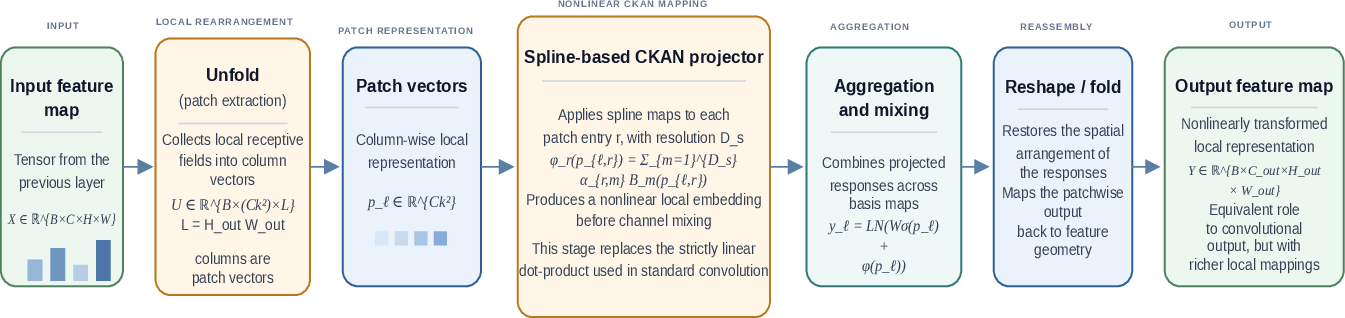
Figure 1: Internal CKAN operator architecture, showing patch unfolding, spline-based KAN transformation, aggregation, and spatial reassembly.
Architecturally, CKAN replaces convolution layers inside SRGAN generator residual blocks, maintaining global connectivity but fundamentally increasing the expressivity of local operations. Chunked processing is used to manage memory, ensuring scalability to high-resolution images on resource-limited hardware.
SRGAN-CKAN Architecture and Adversarial Dynamics
SRGAN-CKAN integrates CKAN operators into the SRGAN generator, preserving the adversarial pipeline while enhancing local feature modeling capacity. The generator undergoes supervised pretraining (reconstruction-oriented) followed by adversarial fine-tuning (perceptual-oriented), with losses combining pixel fidelity, perceptual similarity in deep feature space (e.g., VGG), and adversarial realism.
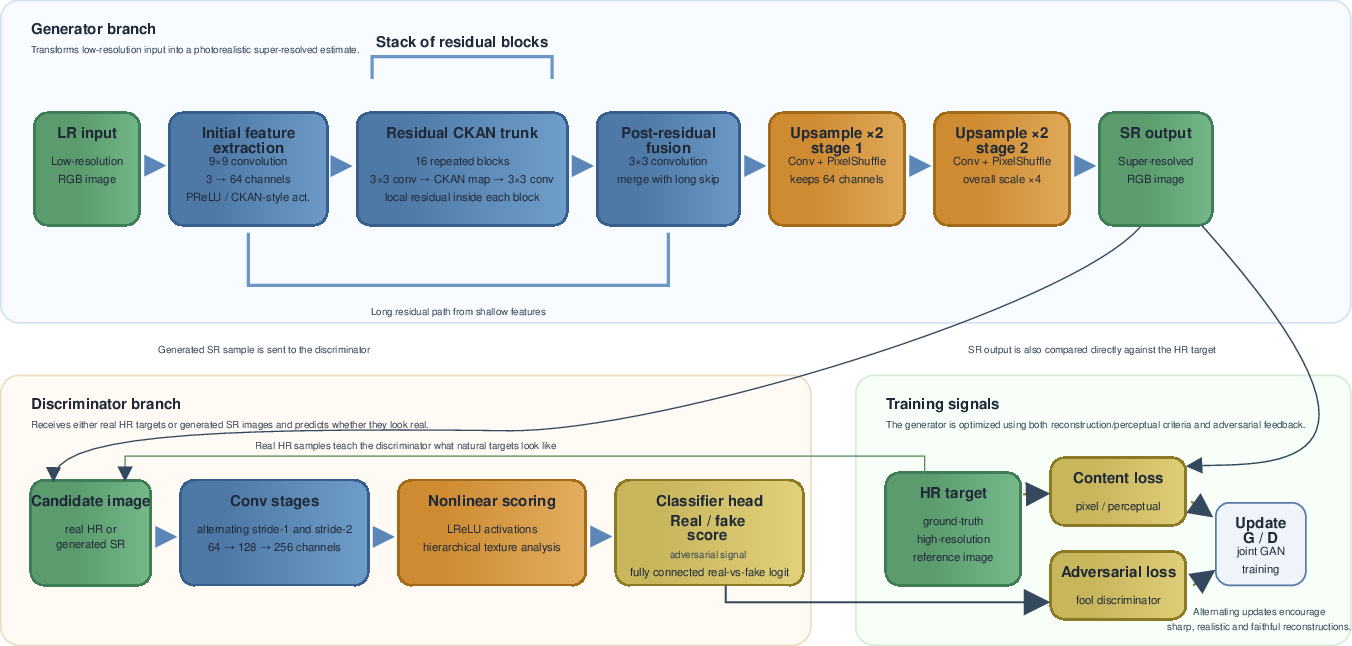
Figure 2: SRGAN-CKAN adversarial pipeline; generator uses CKAN operators, discriminator evaluates perceptual realism.
CKAN's nonlinear patch projection enables richer local dependencies, counteracting the tendency for GANs to introduce artifacts or lose structural fidelity during adversarial optimization. The balance between perceptual quality and distortion metrics is directly modulated by the expressivity of CKAN.
Experimental Analysis
The paper employs DIV2K, processing ×4 bicubic downsampled LR images and evaluates PSNR, MS-SSIM, and LPIPS as fidelity and perceptual measures. Training is performed on an RTX 4060 GPU with batch size 1 and HR patch size 384×384, demonstrating practical feasibility under minimal hardware.
Training dynamics illustrate stable adversarial optimization, with gradual shift from reconstruction fidelity to perceptual enhancement. SRGAN-CKAN achieves minimal loss in PSNR and MS-SSIM during adversarial fine-tuning relative to its SRResNet-CKAN baseline, while substantially improving LPIPS scores and suppressing GAN-induced artifacts. In direct comparison with conventional SRGAN (conv), SRGAN-CKAN shows superior metrics across all categories, especially in perceptual similarity.
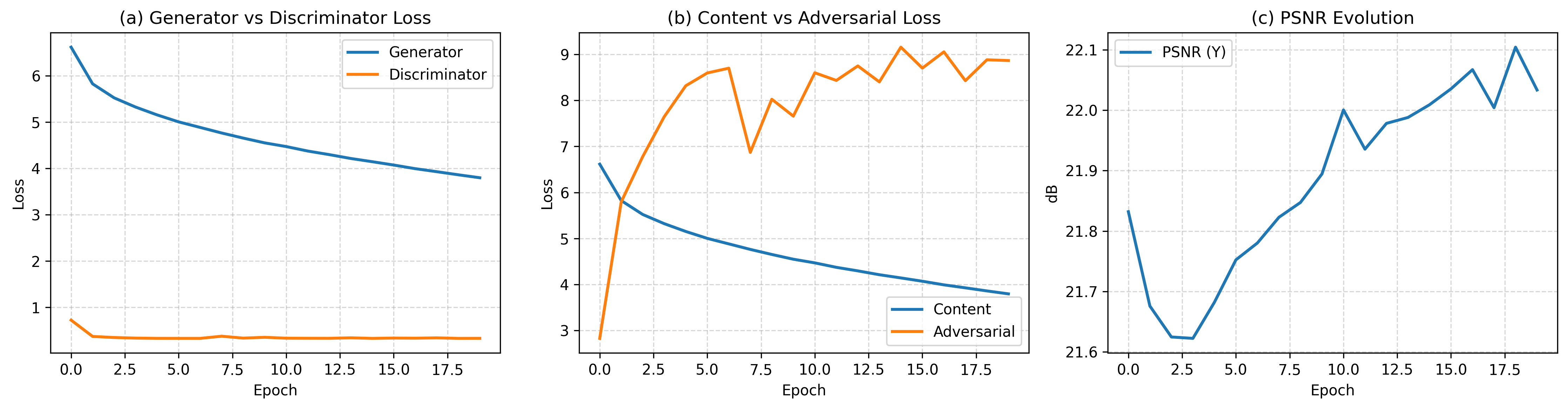
Figure 3: SRGAN-CKAN training dynamics, showing generator and discriminator losses, content and adversarial loss balance, and PSNR evolution.
Qualitative analyses reinforce these findings: CKAN-based generative outputs exhibit sharper, artifact-free textures and improved structural integrity in zoomed regions compared to convolutional SRGAN.
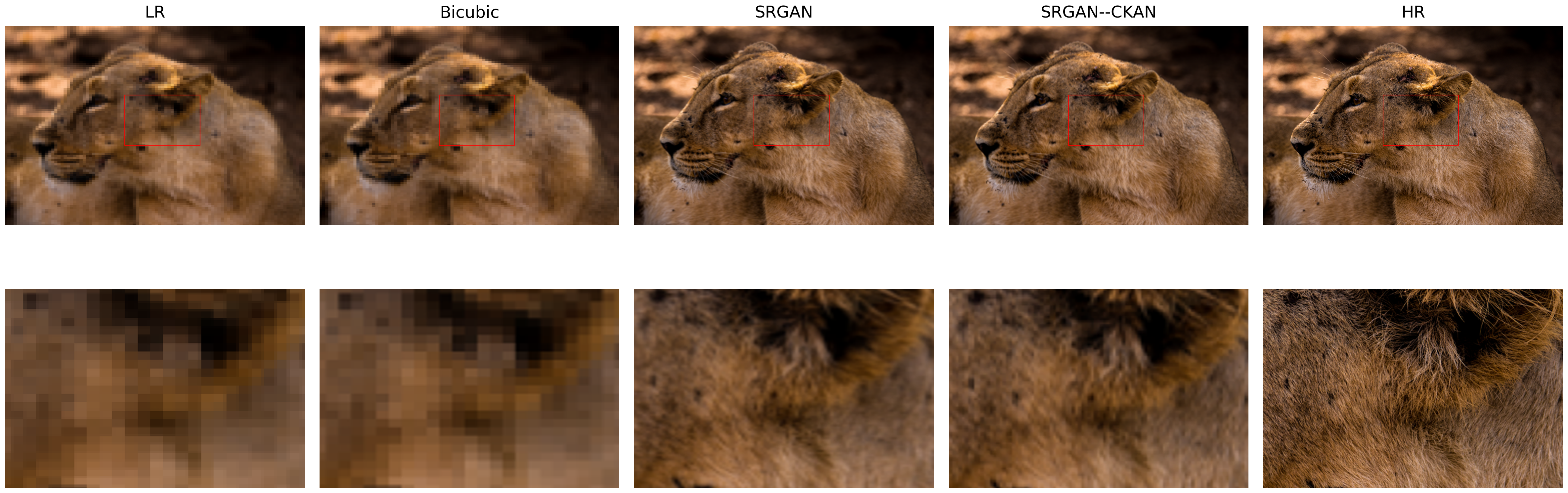
Figure 4: Visual comparison of LR input, bicubic interpolation, SRGAN (conv), SRGAN-CKAN, and HR reference in representative regions.
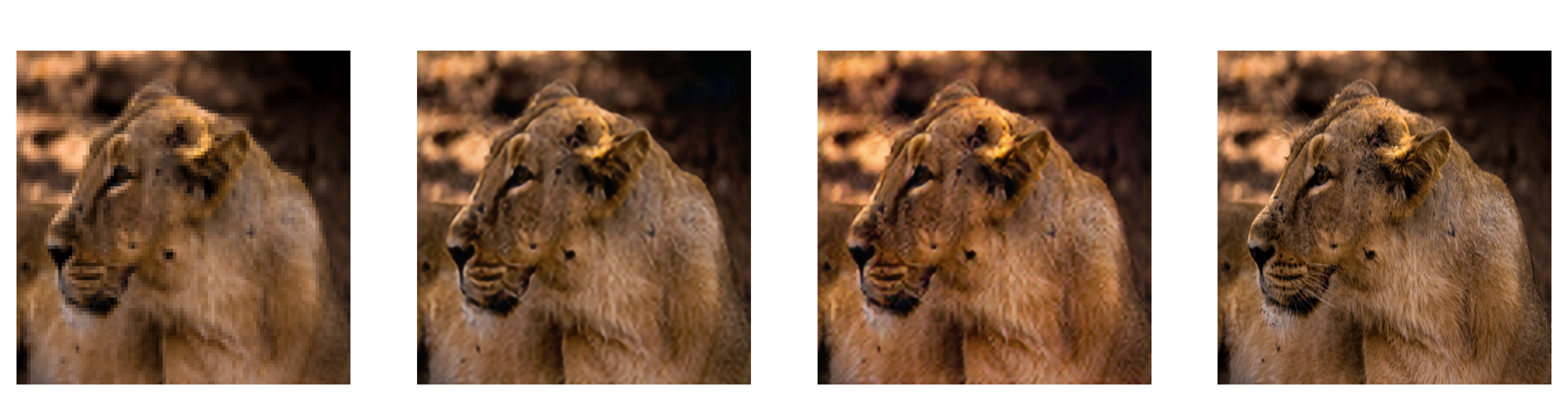
Figure 5: Comparison between SRResNet-CKAN (reconstruction-based), SRGAN-CKAN (adversarial-based), and HR targets; CKAN yields sharper perceptual detail without sacrificing structural fidelity.
Computational Efficiency and Scalability
CKAN maintains the asymptotic computational complexity of standard convolution with linear patch projection, but via chunking and efficient spline evaluation, enables scalable processing of high-resolution images on GPUs with limited VRAM. The chunked unfold-KAN-reshape pipeline is theoretically equivalent to full patch mapping, greatly reducing peak memory footprint without altering time complexity.
Implications and Future Directions
The introduction of nonlinear functional operators inspired by Kolmogorov--Arnold theory represents a shift toward locally expressive mapping in deep vision architectures. SRGAN-CKAN achieves a favorable perception--distortion trade-off typically unattainable with linear convolution in GAN settings, yielding robust and perceptually sharp results with stable training, all under resource-limited regimes.
This paradigm has practical implications for deployment in edge devices and real-time imaging scenarios (e.g., medical, remote sensing, surveillance). Theoretically, it opens avenues for generalized functional operator design, adaptive attention in patch-space, and integration with diffusion or transformer architectures for hybrid context modeling.
Future research should investigate further reduction of computational cost, systematic benchmarking against large-scale transformer/diffusion solutions, and the extension of CKAN to multi-modal restoration tasks. The fusion of Kolmogorov--Arnold representations with deep learning may enable richer model classes for structured data beyond vision.
Conclusion
SRGAN-CKAN demonstrates that resource-efficient nonlinear functional operators via Kolmogorov--Arnold-inspired patch projections can substantially enhance perceptual image super-resolution while retaining structural fidelity. The CKAN operator modifies local transformation dynamics, yielding stable adversarial optimization and improved perceptual realism under minimal resources. This work lays a foundation for developing expressive, scalable super-resolution models and encourages further exploration of functional representation principles in deep image restoration.