- The paper establishes the strongest single-system constraint on the æther coupling α1 using a Bayesian analysis of the pulsar–white dwarf binary PSR J1738+0333.
- A comprehensive Bayesian framework incorporates both conservative and dissipative post-Newtonian effects to robustly map timing observables to Einstein-Æther theory parameters.
- The analysis emphasizes the importance of accounting for Galactic acceleration and system kinematics to tighten bounds on Lorentz-violating gravity.
Constraints on Lorentz-Violating Gravity from Pulsar Timing: PSR J1738+0333
Introduction and Motivation
The paper addresses strong-field constraints on Einstein-æther gravity using precision timing of the pulsar–white dwarf binary PSR J1738+0333 (2605.01436). Einstein-æther gravity is a Lorentz-violating, generally covariant extension of GR, characterized by a dynamical unit timelike vector field (the æther) that selects a preferred frame. Lorentz violations in matter are tightly bounded by laboratory and solar system tests; constraints on the gravitational sector are comparatively weaker, motivating high-precision experiments with strongly gravitating systems.
Pulsar binaries, especially those with asymmetric component self-energies (such as neutron star–white dwarf binaries), are highly sensitive to violations of the Strong Equivalence Principle (SEP). The theory predicts preferred-frame effects, strong-field corrections to orbital motion, and dissipative (beyond-quadrupole) radiation, all accessible via pulsar timing. The work implements a comprehensive Bayesian framework including both conservative and dissipative post-Newtonian effects to extract robust bounds on Einstein-æther couplings.
Einstein-æther Theory and Strong-Field Phenomenology
The Einstein-æther action introduces coupling constants (ca, cθ, cσ, cω) that modulate the scalar, vector, and tensor modes of gravitational and æther propagation. The leading observable quantities for compact-object physics are the PPN parameters α1 and α2, and the vector coupling cω, which encode preferred-frame and Lorentz-violating effects. Solar system experiments strictly limit ∣α1∣≲10−4, ∣α2∣≲10−7.
Strong-field deviations arise from the effective coupling of self-gravitating bodies to the æther, parameterized by the “sensitivity” s of each object (see Figure 1). Sensitivity quantifies the fraction of gravitational binding energy responsive to the æther, with neutron stars possessing nonzero cθ0 and white dwarfs negligible cθ1. These sensitivities enter both the orbital dynamics and the gravitational wave flux, governing preferred-frame effects and dipole radiation.
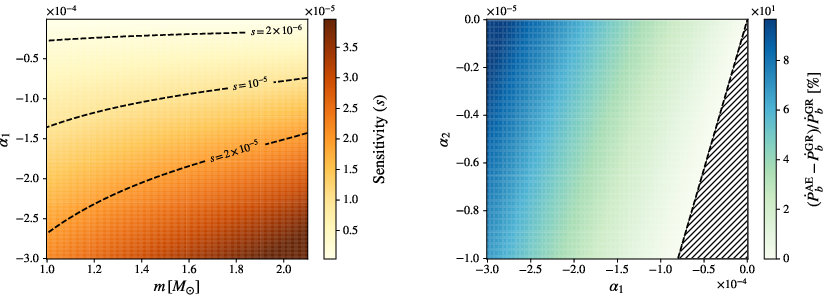
Figure 1: Sensitivity parameter cθ2 of a neutron star as a function of mass for fixed cθ3 and cθ4.
Post-Newtonian Dynamics and Pulsar Timing Observables
The analysis develops the full 1PN equations of motion for a binary in Einstein-æther theory, including:
- SEP violations encoded via object-dependent gravitational constant,
- Preferred-frame corrections driven by system velocity cθ5 relative to the æther,
- Dissipative effects (dipole and modified quadrupole radiation) linked to sensitivities.
Key post-Keplerian timing parameters are derived: Einstein delay (cθ6), Shapiro delay (cθ7, cθ8), periastron precession (cθ9), and orbital period derivative (cσ0). Explicit expressions are provided for all timing effects in the Einstein-æther framework, with inclusion of kinematic corrections (Shklovskii effect, Galactic acceleration). The orbital period decay is sensitive to the difference in sensitivities; for PSR J1738+0333, this is dominated by the neutron star.
Dataset and Bayesian Timing Framework
The timing dataset spans over two decades and comprises more than 25,000 narrowband ToAs from eight telescopes (Figure 2), including EPTA and NANOGrav releases, complemented by intensive campaigns with Arecibo and Effelsberg. The Bayesian pipeline (Vela) incorporates timing and noise modeling (white and red noise, dispersion measure variations), and computes posterior distributions for orbital and post-Keplerian parameters, marginalizing appropriately to propagate uncertainties and correlations.
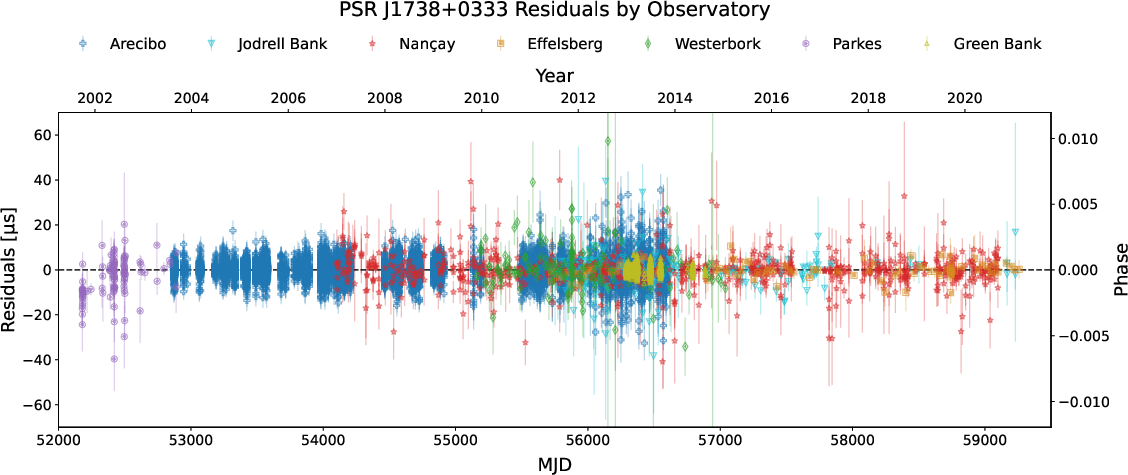
Figure 2: Timing residuals for PSR J1738+0333 from eight telescopes, with noise realization subtracted, demonstrating consistency across instruments.
Theory Parameter Inference and Resampling Procedure
A novel Bayesian resampling approach is employed to translate posteriors on timing parameters to constraints on theory parameters. The mapping from orbital/timing to theory parameters is constructed via explicit analytical expressions; Monte Carlo samples from the posteriors are reweighted using normalizing flows for efficient density estimation in high-dimensional space.
Resampling includes the full set of orbital and theory parameters, specifically: component masses, orbital elements, system peculiar velocity, Einstein-æther couplings (cσ1, cσ2, cσ3), and sensitivities. The companion sensitivity and its derivative are fixed to zero for the white dwarf; neutron star sensitivity is modeled with the APR equation of state.
Results: Bounds on Einstein-æther Parameters
The joint posterior for all post-Keplerian parameters is visualized in Figure 3. Most parameters retain broad prior-driven posteriors, except for cσ4, which is sharply constrained by the data (Figure 4, Figure 5). The limits on cσ5 are quoted as one-sided credible intervals:
- cσ6 (68%),
- cσ7 (90%).
These bounds represent the strongest single-system constraints on Lorentz-violating gravity in the strong-field regime to date. The methodology critically incorporates the system’s peculiar velocity (rather than assuming zero), yielding statistically robust and tighter bounds.
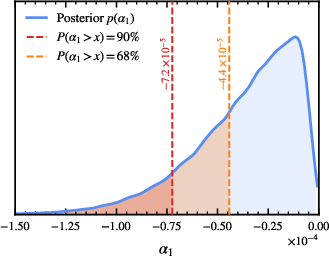
Figure 4: Posterior probability density for cσ8 with one-sided lower bounds at 68% and 90% credible levels.
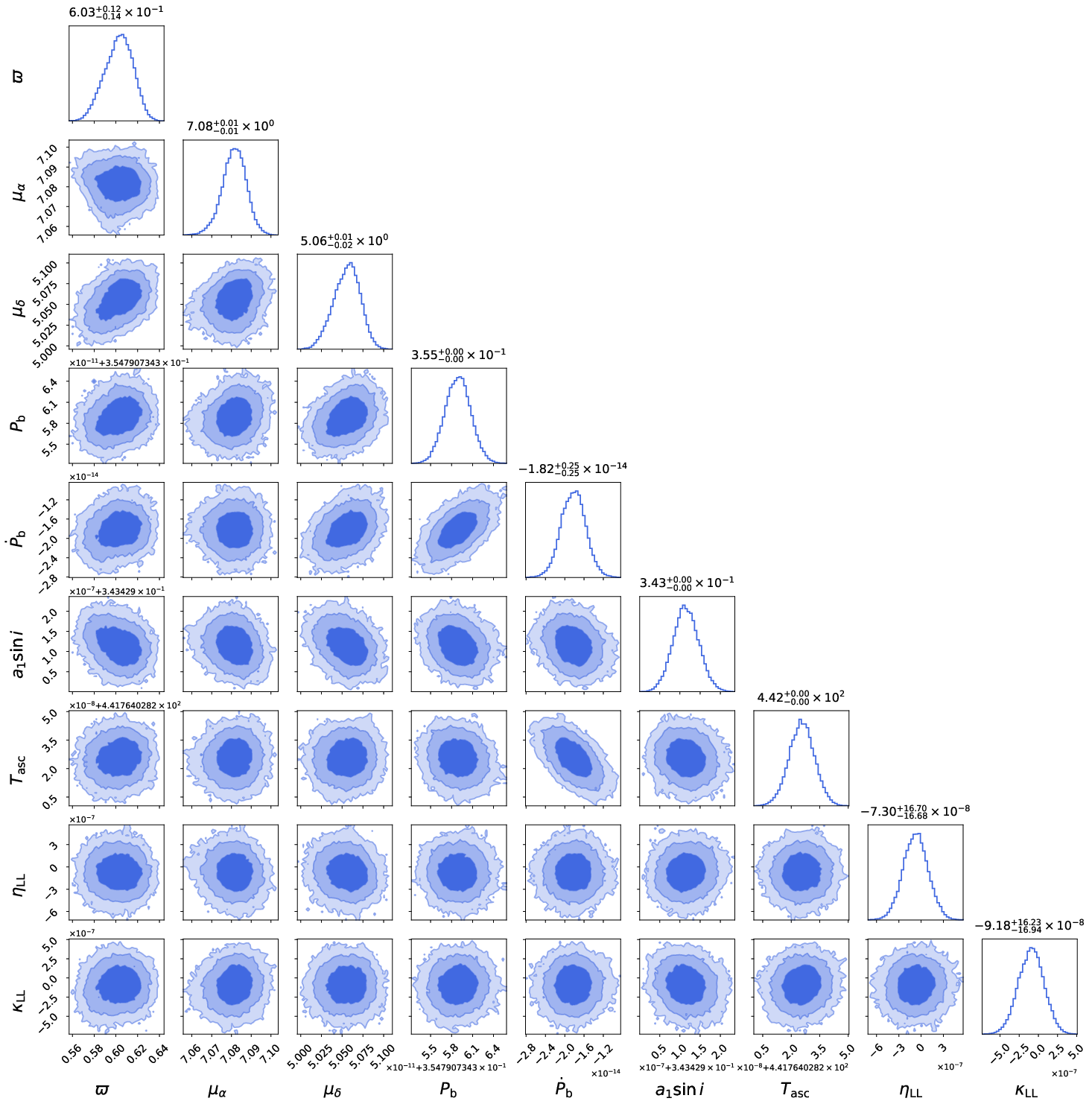
Figure 3: Joint posterior distributions for all post-Keplerian parameters in the timing model, showing covariances and credible intervals.
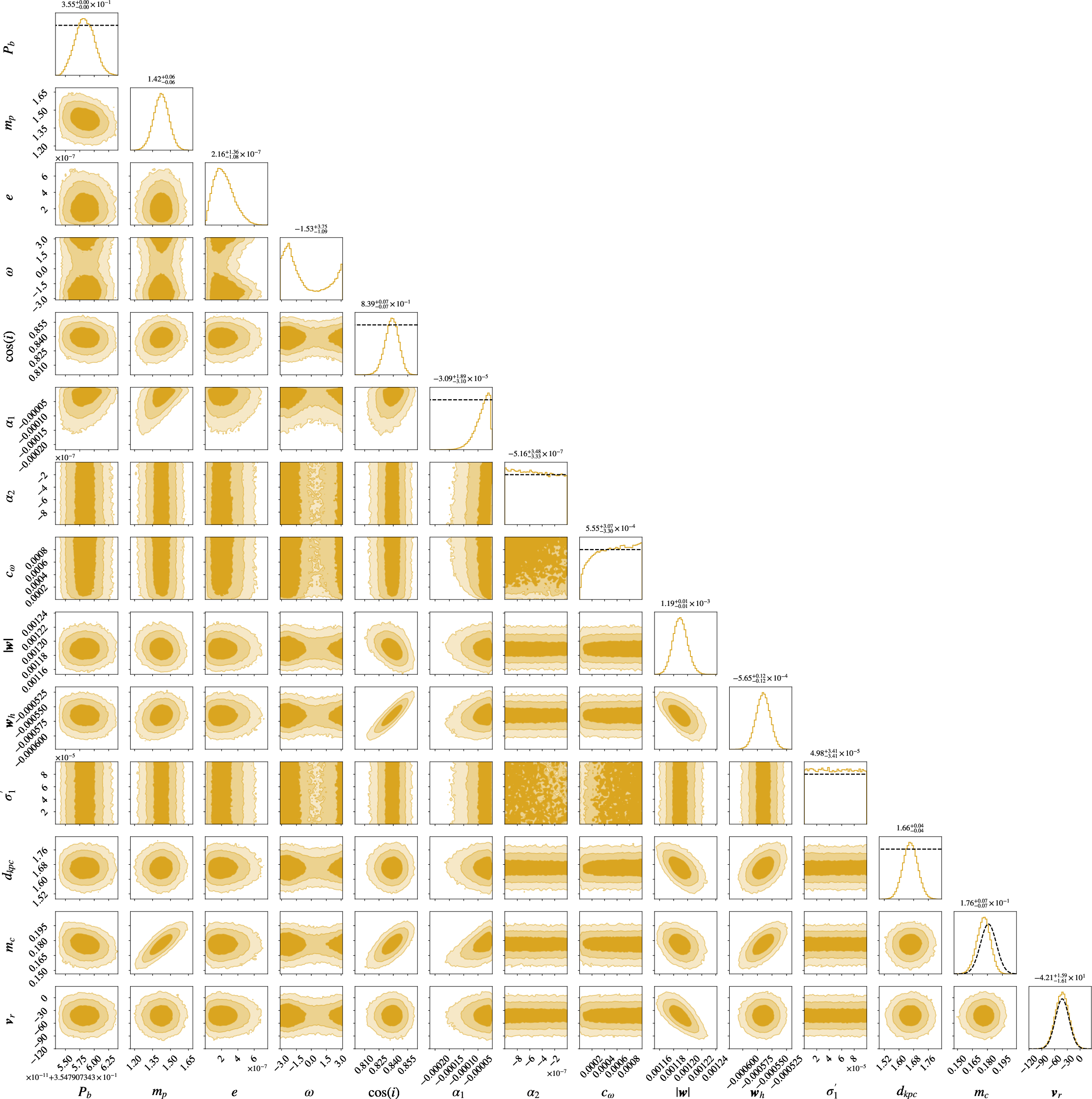
Figure 5: Joint posterior distributions for theory parameters, with prior ranges indicated; cσ9 is sharply pulled toward the GR value.
The Galactic acceleration correction computed via MWPotential2014 (galpy) is shown in Figure 6. This correction exceeds the analytic cω0 model and reverses the sign of the kinematic effect in cω1 compared to earlier work.
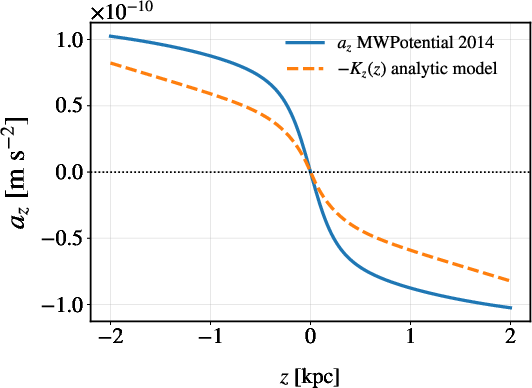
Figure 6: Comparison of line-of-sight Galactic acceleration between MWPotential2014 and analytic cω2 models as a function of distance.
Implications and Outlook
The analysis demonstrates that binary pulsar systems, especially those with asymmetric sensitivities, are powerful probes of Lorentz violation in gravity. Full Bayesian pipelines and robust parameter resampling techniques are essential for eliminating systematic uncertainties and propagating correlations. For cω3 and cω4, Solar System tests remain dominant, whereas the strong-field limit from PSR J1738+0333 is decisive for cω5.
The methodological advances are generalizable to other relativistic binaries, particularly those with extreme mass asymmetry (e.g., PSR J0348+0432, PSR J1141-6545), and double neutron star systems with exceptional timing precision (e.g., the Double Pulsar). Coordinated multi-system analyses will further tighten constraints. The framework is also adaptable for tests of alternative gravity theories beyond Einstein-æther.
Conclusion
Precision timing of PSR J1738+0333 sets robust strong-field bounds on the coupling constants of Einstein-æther gravity, with a statistically sound Bayesian methodology factoring in all relevant post-Keplerian effects, system kinematics, and parameter correlations. The result establishes the system as a key laboratory for gravity in the strong-field Lorentz-violating regime and provides a template for future gravity tests with pulsar binaries.